
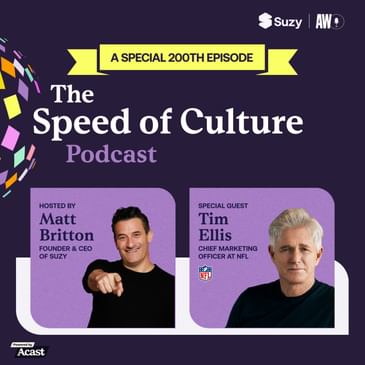
To celebrate our 200th episode of The Speed of Culture, Tim Ellis, Chief Marketing Officer of the NFL, joins Matt Britton to share how the league continues to lead with purpose, power, and cultural relevance. From creator-led content to global fandom and deeper player storytelling, this episode dives into how the NFL stays iconic—and ahead.
Follow Suzy on Twitter: @AskSuzyBiz
Follow Tim Ellis on LinkedIn
Subscribe to The Speed of Culture on your favorite podcast platform.
And if you have a question or suggestions for the show, send us an email at suzy@suzy.com
Hosted on Acast. See acast.com/privacy for more information.
[00:00:03] We know brand growth equals business growth, but do your stakeholders? Tracksuit is an affordable, always-on brand tracking dashboard that helps marketers and agencies prove the impact of their work on brand metrics over time, benchmarked against competitors. Built from best-in-class methodology, the Tracksuit dashboard is accessible and easy to understand for everyone from CSOs and CMOs to CFOs and founders.
[00:00:27] Research shows that brand investment in good economic times and bad is essential to driving sustainable growth. The bottom line? Turning off the brand tap will cost you in the long run. Tracksuit gives marketers and agencies a common language to measure and communicate brands' impact without the $100,000 price tag. Their in-house research experts will have your survey live and your full marketing funnel and brand perceptions visible in just 30 days. Check Tracksuit out at GoTracksuit.com.
[00:01:06] I would say one of the things that I've learned since I've come to the NFL and I think a big part of our success is that we just need to keep opening our arms wider, bringing more people into the NFL. We have the theme that football is for everyone. And I think that sort of clear and passionate message of inclusivity is really important. To thrive in a rapidly evolving landscape, brands must move at an ever-increasing pace. I'm Matt Britton, founder and CEO of Suzy.
[00:01:42] We're here live at the Possible Conference in Miami, and I'm thrilled to introduce Tim Ellis, EVP and Chief Marketing Officer of the National Football League. Under Tim's leadership, the NFL has expanded its fan base, embraced diversity, and used innovative campaigns to spark social change. Tim, thanks so much for joining us today. Great to see you. Yeah, thanks for inviting me. Absolutely. So I'm a huge NFL fan.
[00:02:07] In fact, I just had Jen Kavanaugh, the head of marketing for the Philadelphia Eagles, and where I'm from, I'm from Philadelphia, so I'm a huge Eagles fan. Went to games since I was like eight years old with my father. And I also had Lara Krug, who's the CMO of the Chiefs. And the two Super Bowl teams have been the last NFL-related guests I've had. Now, of course, I have you. So equally as excited to have you aboard today. Yeah. What's your favorite NFL team? Are you even allowed to say? I'm not allowed to say. Okay. You can guess. I'm from Northern California. Okay, there you go. I grew up there.
[00:02:35] But by the way, Lara and Jen are like amazing CMOs. They're two of our top CMOs. Because brand building in the NFL is something that really fascinates me because people have such passion towards their teams, obviously. And it goes so much deeper than a game. It's about families, about tradition. It's deep-rooted. So what does it mean to steward a brand, whether it's a team in the NFL or the NFL itself? Because the nuances of the brand are so much different than, say, a detergent or deodorant brand. It essentially drives culture.
[00:03:03] It's a reflection of culture, but it also drives culture, right? Yeah. And most of us became affiliated in some way with football or with sports in your earliest stages of life. Yeah, for sure. And so I would say it's a great honor. And it's just so much fun to be a part of the NFL, but it's a big responsibility as well, right? Yeah. You realize that when you have over two-thirds of the country who call themselves fans, while that is certainly a strength, it's also a big responsibility. And we take that quite seriously.
[00:03:31] So when I think about my strategy for the NFL, it's really a dual-pronged strategy. On the one hand, we focus on football as an escape, so the joy of the game, and then we transcend the game. And there are lots of things that we're doing right now in order to be a better uniter in this country. We know right now it's divisive times, right? I mean, we know that. And we take that role as a force for good very seriously. So the NFL contributes, for example, like over half a billion dollars a year, right, for causes.
[00:04:01] We have a lot of really important partners who we work with in order to really give back and to be a uniting force. In fact, today I'm speaking with the CEO of Big Brothers Big Sisters on stage here at Possible. And we're talking about a lot of things that we've done that are literally changing kids' lives across the country. And in fact, one of the folks who's going to be on stage with us is Ray Davis, who's a half running back for the Buffalo Bills. And he was a little. Oh, wow. In San Francisco and the Tenderloin at the age of five. Where's Dory?
[00:04:31] Yeah. He's got an incredible story. Yeah. And look where he is today. Anyway, I just think that it's an incredible time to be a part of the NFL. Well, I'm responsible for obviously getting people to engage and watch the games and engage with all of our social content. That's how we earn our revenue. But then I'm also responsible for building an image around the NFL and the players and the clubs, which in essence help us bring in more these casual audiences. Yeah, for sure. So much to unpack there.
[00:04:58] I mean, I think one point you made that really stuck with me is you're right. Like being in a stadium of 50, 60,000 people where everybody is holding hands and cheering for the same thing for the most part. I've been plenty of Eagles games right through snowballs and Giants fans. But you get my point. It's unifying. And it's not only unifying in person, but the NFL is 90 to 95 percent of the top 100 live watch shows on television every single year.
[00:05:23] So it unifies people in person, unifies people over television, a world where we're increasingly fragmented. So it is one of those rare forces that we still have in America, for better or worse, that is bringing people together. That being said, like, how do you know what the right decision is? How do you know what center is? How do you know you're not going to piss people off and what goes into those decisions? Yeah, that's a really good question, because there are some parts of our program that do make people uncomfortable. Yeah, I'm sure. Right.
[00:05:50] And if you really want to move forward, if you want to be progressive, you have to be willing to make some people uncomfortable in order to sort of connect on a human level with others and bring them in. When I first came to the NFL, I had a very simple but I think important shift in strategy. It was I just call it the helmet soft strategy. Like the helmet literally is between us, our game, our players and our fans. And so from a very practical perspective, the NFL, most people don't know who these guys are.
[00:06:20] They don't know what they look like. Yeah. Right. But more importantly, they don't know who they are as human beings. And so to put forth a more human, more compassionate face of the NFL towards our fans, I employed this helmet soft strategy. I love that. And then just to begin to sort of like get behind the things that the players really cared about. And that could be anything from video games or music or fashion, or it could be an important foundation, important cause that they care about and they want to get behind.
[00:06:46] And we can help them with their platform, be their platform in essence. And then these guys, they care about building their own brands. Increasingly so. So we also work with them to understand them and to sort of help them build their own brand so they can be successful both on the field and off the field. Yeah, for sure. I mean, the accessibility of players is so much more dramatically intense now than it was when I was growing up where sure you would be able to watch the players highlights on ESPN. Right. But you wouldn't be able to see them walk into the locker room.
[00:07:16] You wouldn't get to see what they tweeted and what they cared about. And now you have these huge kind of crossover stories like Travis Kelsey and Taylor Swift. And several years ago, as you know, it was Tim Tebow and he brought kind of devout Christian community into the NFL. So imagine when you see those kind of crossover stories, it gives you an opportunity to give the NFL broader cultural relevance. When that happens, do you lean into that or do you kind of let those stories take shape on their own? No, we definitely lean into it. I mean, in fact, now we even have a fashion editor.
[00:07:45] We have a guy who works with us who does nothing but like work with players and work with Vogue and work with GQ and like work the NFL putting forth like is the fashion. Right. Right. And like if you look at, for example, we just got finished with the draft this year. Yeah. In Green Bay. What a turnout. I mean, what are the red carpet there in the draft? The turnout was insane though. It was insane. Yeah. Yeah. And then tune in was also, I mean, we had, I think, 13.6 million people who tuned in and watched that, which is bigger than any of the NBA finals games last year. Wow. Right.
[00:08:15] Like it's amazing. It's become like the third most talked about event of the year, only behind the Super Bowl and the Grammys. And we're doing a lot of things right there to sort of drive that. So again, obviously we reflect that culture, but we're also driving that culture. I feel like the more access we can give our fans, the more they just enjoy their experience with the NFL. Like that inside access, particularly for Gen Z and Gen Alpha is everything. Yeah. Right. And so, in fact, we have like a whole army of what we call these LCCs.
[00:08:43] So it's live content creators. And we started them out in the beginning about six years ago when I first joined, seven years ago, I first joined the NFL. And they were on the sidelines just getting stuff that like NFL films and that the broadcast partners were not getting. Essentially, again, helmets off, right? These guys having intimate, fun, interesting, warm moments on the sidelines. And then we realized that we should be having our LCCs also off the field. So we began to put them with players throughout the NFL.
[00:09:12] And so now each of the teams has at least four of these LCCs on their team. And they're constantly getting capturing content, which is intimate. It's interesting. Again, it's sort of showing these guys in a more human light. And storytelling. And it's storytelling. Yeah. Right. And so now we're finding even ways through our partnerships with Adobe to sort of allow our fans to also be creators. So we got creators with some of our programs like with Google, for example, YouTube TV.
[00:09:39] We have a creator program together where we bring creators to the games. We give them access to our content so they can produce. And it's exponentially increased our distribution of NFL content throughout the world, not just in the U.S., but all over the world. And now we're also through another program with Adobe right now. We're allowing our fans to actually create things and distribute it on their social channels as well.
[00:10:03] So we're finding ways in which to sort of like get out that sort of interesting, intimate, inside access content. And it's like bringing people closer to our brand, to our players, to our clubs. I mean, I think that's awesome because I would imagine 10 years ago, the NFL never would have ventured down a direction where the fans can basically take content and make it on their own. Right. There's IP issues. Lawyers are scared, et cetera. But the reality is that's where the world is headed. And when you look at Gen Z, they're spending all their time on phones.
[00:10:33] And when they're looking at content from phones, they're only looking at content from other people. So in order for you to gain mindshare and continue to be relevant, you need to get into that news feed. And the way you do it is through creators. That's right. Through creators and through smart use of technology and really understanding what each individual fan wants. I mean, you're an Eagles fan. And you have your special players and you have the things that you want, the types of content that you want. And so our role really is to understand that and do it proactively before you even go to look for it. That's right. Right.
[00:11:02] Another way I think fandom has changed for the younger generation is they consume more songs versus the album because there's fantasy sports now. There's online gambling. There's all sorts of ways to interact where you're rooting for an individual player and you can follow the player to your point. How has that changed the way that people consume the NFL since they really now can watch any player through YouTube TV? You have a great partnership there. So you obviously can watch any team you want. You're no longer limited to your hometown. How does it change the way that you market the league?
[00:11:31] Well, this is an incredibly important question because most people don't realize 60 to 65 percent of our fans are what we call displaced fans. So they don't live in the same town. You're one of them, right? There you go. So it's important for us to really understand who their teams are. That's obviously we have like 300 attributes we know of each of our fans in our database, at least that we're trying to get. And certainly which team, which players they love the most are the top of the most important attributes.
[00:12:00] So we're essentially finding ways to allow fans on various platforms to consume the way they want to. So you mentioned Sunday Ticket from YouTube TV. They've done a great job with it. Fantastic. And they're doing things we never even imagined we could do before in terms of serving things up as you're watching on your fantasy team and like giving all kinds of information and insight. Side note, by the way, I had the DirecTV satellite when I lived in New York City, but they didn't have it in my building.
[00:12:25] I literally took a piece of wood and I drilled it into the window ledge so I can actually watch Eagles games. Like that's what fans do to get. That's what fans do, right. And it worked half the time. The other half time it didn't, but it was just. Right. Yeah. But us finding ways to sort of partner with those folks who can help us deliver that content, again, the way that fans want to consume it on the go. Like we have NFL Plus as well, where anywhere you are on the go for your own home team there in your area, you can watch or you can watch Red Zone.
[00:12:55] So anyway, so it's just finding the right partnerships and having the courage to sort of go away from some of the traditional forms of distribution has really helped the NFL grow. I mean, if you think about YouTube and Sunday Ticket and then Amazon and Thursday Night Football, Netflix with two games at Christmas, like we're continuing to sort of find the right relationships that we can distribute our content where we know where our fans are. And in doing so, we're lowering the average age of our fans significantly. Right.
[00:13:23] And that's one of the biggest challenges for the NFL and obviously for me in marketing is that if you're not careful, you age out, literally age out. You know, that happened with other sports. That's right. So the focus on the youth segment is absolutely critical. And that helps you kind of in two ways. On the one hand, you're future proofing your business, the NFL. But on the other hand, you're driving energy and excitement and youthfulness, vitality into the brand, into the product itself as well.
[00:13:51] And sort of, again, finding those right partners, whether they be distribution partners or that they be creators and influencers is really important. And we always aim to find the partners who we know are authentic fans like yourself. In that regard, we saw Major League Baseball recently change the rules of the game. They put a timer on the pitcher and they obviously had problems with the games being too long. They weren't risk disenfranchising the younger fan. I wouldn't put the NFL in that category.
[00:14:20] But as we move forward, do you see the NFL changing the rules of the game or how it's presented to make sure that this TikTok generation continues to be attracted to the NFL? Well, listen, the NFL is constantly looking at its rules and making adjustments as we move along. Yeah, the kickoff rules last year. Yeah, that's what's made, I think, the NFL great. I mean, that's why it's still so relevant and exciting for fans of all ages, not just our younger fans, but fans of all ages.
[00:14:48] And I think that, I say those guys, my colleagues, right, and Commissioner Goodell have done an incredible job of continuing to sort of just find ways to make the game more exciting. The offense is now, like with the quarterbacks, it's incredible what they're doing right now. Like how close the games are right now, the powerful nature of the offenses today. It's just, it's because they continue to find ways to sort of make the game better by making these little adjustments.
[00:15:16] So I think I applaud what the MLB did. I think it was terrific. We'll be right back with the Speed of Culture after a few words from our sponsors. We know brand growth equals business growth, but do your stakeholders? TrackSuit is an affordable, always-on brand tracking dashboard that helps marketers and agencies prove the impact of their work on brand metrics over time, benchmarked against competitors.
[00:15:42] Built from best-in-class methodology, the TrackSuit dashboard is accessible and easy to understand for everyone from CSOs and CMOs to CFOs and founders. Research shows that brand investment in good economic times and bad is essential to driving sustainable growth. The bottom line, turning off the brand tap will cost you in the long run. TrackSuit gives marketers and agencies a common language to measure and communicate brands' impact without the $100,000 price tag.
[00:16:09] Their in-house research experts will have your survey live and your full marketing funnel and brand perceptions visible in just 30 days. Check TrackSuit out at gotracksuit.com. Do you think we're going to see robots referee games at some point in our lifetime? Do you think AI will take the place of referees over time?
[00:16:38] I'm not going to speculate on that, but what I will tell you is that we are very close- That question just popped in my head. Yeah, yeah, yeah. Now, listen, we're very carefully working with our partners in employing the right technologies in order to have the game as great as it can be. So, like, robots, who knows? Yeah, exactly. I would never say no to anything like that, but I think that what is important is that you continue to have the right traditions and the right level of authenticity that fans expect and want. Yeah.
[00:17:05] And then you find the right ways through technology to make the game better and to make the experiences better for fans. Yeah. The other thought I had is how great would it be to have cameras in each player's helmet just so you've got that view of the ball coming out of the gas. Oh, that we've definitely been looking at. Yeah, I'm sure. Absolutely. I mean, not surprisingly, some of the best content we have out there is the audio. Yeah. When you have the live mics. Oh, totally. I mean, fans love that stuff. Yeah. So do I, by the way. But you want to get closer to the game, right? That's right. Yeah. Yeah.
[00:17:34] So they've looked at ways about how you could actually do that with cameras and so forth. But listen, again, all of our partners, our broadcast partners and those are my colleagues there at the NFL. They're finding ways to provide surprising experiences through technology. And it just makes the whole thing more fun. Absolutely. And I'm sure you're aware of Cosm, the sports bar chain that's going on, which is like a sphere-like experience. And then with the Apple Vision Pro, you're getting ways to more deeply emerge.
[00:18:01] Do you see mixed reality and virtual reality entering the fan experience over time even more? I think so. I think it will. Absolutely. I mean, I come from the gaming world, right? Yeah. So I was at Activision for seven years. So I think that any time you can do an immersive experience like that and give it sort of a different, sort of unexpected, unpredictable experience, I think fans are going to love it, right? I'm still waiting for an NFL game at this sphere in Vegas. That would be amazing. Yeah, it would be. I'm just throwing ideas at you. Obviously, I've been thinking about it a lot.
[00:18:30] So you mentioned global and the NFL going global. Yeah. And my Eagles opened up last season in Brazil on a Friday night, which is a really unique way to kick off the season. I know the NFL is really focused on globalizing the game. I think one disadvantage the NFL has versus, say, the NBA is a lot of NBA players are from international markets where most NFL players aren't yet. But that being said, there's really a huge thirst for NFL content globally. What is the global strategy? What are some of the markets that you're currently seeing subtraction in?
[00:18:59] So the markets we're really working on right now, you mentioned one, Brazil, right? Mexico is obviously another. Canada, Germany, England. We're increasingly looking at opportunities in Africa. But we have a great development program, for example, across the continent of Africa and several countries there. And there are other countries, Middle East and Asia, that we're looking at as well. But the current right now, we're going to be in Spain for the first time this year, Madrid for a game and in Dublin as well. So it's a pretty aggressive strategy globally. You're right.
[00:19:28] While we are very dominant in the U.S., we have a long way to go in countries around the world. And so we're very carefully in our strategic plan, sort of taking it from a participation perspective. So not only are we developing players throughout the world and helping them realize their dreams of coming back to the U.S. and playing in college and ultimately in the pros, but we're also really helping to drive flag football participation. So flag is going to be in the Olympics for the first time in LA 28.
[00:19:55] We're hoping to get them in the Brisbane Olympics in 32 in Australia, where right now it's one of the fastest growing sports in the world right now, and certainly in the U.S., but also around the world. That's key for us, because just like in the U.S., when you play the game, you're much more likely to become a fan. In fact, four times as likely to become a fan if you play the game. So that's critical. And you really need to sort of also bring in the family unit. So bring in the parents and friends and family, if you will, into that experience.
[00:20:25] So there's a lot of things that we're doing to drive flag. So it's really a combination of getting people to play the game, getting people to engage in the game. So we have games over in these different countries. And then we're also developing players, because if you have players who are playing the game from your home country, like the Eagles who won the Super Bowl, they happen to have a player from Australia. Yeah, Jordan Maulata. Yeah, Jordan Maulata. And he started and he actually got a ring. So that's really important.
[00:20:54] So Australians didn't see that, of course, and they get excited. Yeah. So having these players actually from these different countries, we also have a program where even if you're not from that country, but you have a heritage connection, then there's a program where you can put the flag on the back of your helmet, which sort of way to show the pride of where you come from or your family comes from. And that's, again, it's like making the game more open, making it more international.
[00:21:18] Listen, I would say one of the things that I've learned since I've come to the NFL, and I think a big part of our success, has been we just need to keep opening our arms wider, bringing more people into the NFL. We have the theme that football's for everyone. And I think that sort of clear and passionate message of inclusivity is really important. We are now, we have the biggest fan base ever for the NFL, over 200 million people.
[00:21:41] And that growth over the last seven years has come from our youth segment, our girls and women, and Latinos. So we have been really incredibly focused on those three acquisition targets. And that's what's driven our success. And it's also, I think, key to our future. Yeah, totally makes sense. So one last question before we wrap up and talk a little bit about you, but sponsorship is obviously a big part of your business.
[00:22:06] And for brands that are sponsored by the NFL, it's a critical channel because as mentioned earlier, the NFL is one of the last bastions of live viewing that exists here in America. When you look at sponsorship activation, what's true in sponsors that have activated the right way and gaining the most out of their investment in the NFL? Yeah, those who really get involved with the NFL, both on the operational side as well as on the marketing side, those are the partners.
[00:22:32] And I always tell our partners that as well, like, just work with me to help you. Yeah. Right? Like, let's get our teams together and really work on this together, as opposed to you guys giving us ideas and we say yes or no. You know what I mean? If you really want a great partnership, it really is based on a strong level of cooperation and collaboration and co-creation. Yeah. Right? It's not just slapping your logo on a billboard. That's right. That's exactly right. And most of our partners do that, by the way.
[00:22:59] But, like, I think those partners who do that are the ones who get the most value out of their partnerships. And I always encourage that. I think that finding clever, interesting ways to integrate their product or service within the world of the NFL and within something that's going to be relevant to our fan base is what it's all about. Obviously, we also work on the technological side of things to ensure that we're employing all the tools that we use when we target and when we do fan journeys with our fans.
[00:23:27] So, there are lots of things that we do in order to sort of just unlock opportunities for them, whether they be through technical innovation, whether they just be through fan experiences or through our obviously the right players. Right. Right? Again, our Helmosoft strategy, getting the right players with the right partners really makes a big difference. Yeah, I'm sure. So, shifting gears, we wrap up here, Tim. We're at the possible conference. There's thousands of people.
[00:23:50] And of all the jobs everyone has here at Possible, yours might be the one that I would probably most call a dream job, at least for me. So, you're sitting here as chief marketing officer of National Football League. When you look back on your career, what are some of the right decisions you think you made along the way to put yourself in a position that you're in today? Well, you kind of already said it when you said like dream jobs because I've always gone after jobs where, first of all, I love the product or service. Right. Right? Like, it was special to me.
[00:24:19] I come from cars, gaming, and now football, right? Sports. And I happen to love all of those things. And I think that's been part of my success. Also, I never go anywhere unless I realize, I really think that I know what I have to give them. I know that I have to sort of offer them that will help them. So, my first interview with the NFL, I laid out the strategy that we're still employing today. When I talked to the NFL, I knew exactly what they needed to do.
[00:24:47] And it's probably not surprising that that is a strategy that we continue to sort of expand upon deep and broaden today. And then I tend to sort of, I like to go big. Like, the NFL is an incredible platform. I mean, the scale and the influence of the NFL is amazing. When I worked at Activision, we would come out with a game. I mean, the gaming world was waiting for the next Call of Duty game.
[00:25:10] Like, some of the strategies that we had around teasing out the next game and, like, getting fans excited before the game would launch. And then getting them into our live games throughout the year. Where, again, the stage was massive. And that, to me, was exciting. So, I think those are things I like. That, to me, that kind of gets me going. I love that. And then I love just good brand challenges. I mean, people don't realize that the NFL also has had a real brand transformation in the last seven or eight years. And plenty of challenges along the way.
[00:25:40] Yes. A lot of challenges along the way. And everyone, including the commissioner, would say, no, we made some mistakes along the way. And we need to be open about that. And we know no one is perfect. But showing a level of self-reflection, even of contrition, is important. And then sort of very clearly and passionately laying your strategy and your journey forward so people can see it and understand it and come with you.
[00:26:02] I think it's taken quite some time to sort of form some of the relationships that we've had, I think, with our players, with our partners, with some of the music industry, for example. Some of our partners in the music industry. And it takes time. You don't do that overnight. So I think that that journey has been an important part of our success and something I'm personally very proud of.
[00:26:23] So I think having that opportunity to actually make a difference when you go someplace, having the sort of the courage to do the things that you know are right, taking some chances, being willing to take a risk and living with that, and then being open about your successes or your failures. Yeah. Right. So I think those are all things, I think, that have helped me be successful and that certainly have helped me build the brands and build the businesses that I've been involved with. Absolutely. Of course, greatness, just like on the field, off the field as an agency of others.
[00:26:52] And I know that you've built a great team around you. When you look back at your career as to what is the hallmark of a great teammate, especially maybe younger people who are just coming in to the fold, what are some of the attributes that are normally the case of someone's a rising star that you work with? That's a really, really good question. And I think when we talk about success, certainly my success has been based on building great teams. Yeah. And then letting them do their jobs, letting them loose and letting them do great stuff.
[00:27:18] And I always tell the people who come into our teams, like, I want you to do your best work here. I want you to have a great time doing it. I want you to do your best work here. And I hope you're here forever, but most of us won't be. So while you're here, let's have a great time. Let's actually enjoy it. We're in marketing, for goodness sake. Let's actually have a good time and enjoy it. And let's do some great stuff that hasn't been done before.
[00:27:38] I think that those who have great ambitions, who actually want to do stuff that hasn't been done before, that understand the power of creativity and technology coming together, those things are very important. But I think maybe most important is how they work with others. And I don't mean just in the marketing team, like how they work with others across the different parts of the organization, as well as our core partners, is absolutely critical.
[00:28:03] I mean, we can't do anything at the NFL in particular if we don't work closely with our colleagues. That's the key to our success. And so understanding why it's so important to have somebody else be successful, not just yourself, but have somebody else be successful and help them be successful is so important. And I want our teams to be the most well-liked and most valued teammates in the entire NFL, as well as our partners.
[00:28:28] You talked about the importance for our partners, whether they be our corporate partners or our broadcast partners. I want all of them to say like, hey, those guys in the NFL marketing team, they're awesome. They're really incredible partners and they want to help us. They work hard to help us be successful. And to me, that ultimately makes you stronger. And of course, it builds a level of trust and esteem that is invaluable. Yeah, absolutely.
[00:28:54] So to wrap up here today, Tim, we always ask our guests here at the podcast if there's a saying or mantra that they feel defines their professional journey to date. And it's one of them might come to mind for you. Oh, man. I don't know that I have a mantra. I mean, the reality is I've just always just gone for it. Yeah. Like, actually, I didn't even start in marketing as a young person. I was an actor. Really? Yeah. You kind of look like an actor. Well, thank you. You think you'll ever get back to your old acting days? You never know. You never know. Maybe someday.
[00:29:20] But, you know, then I went off and I spent many years traveling around the world working as an actor in Tokyo and drove tractors in the Middle East. And I worked on oil rigs in Scandinavia and I did all kinds of stuff. And so I just decided to just explore and be curious and just go for it. I was working at Goodby Silverstein and Partners when they were just winning every award there was to win. And they were at the top of their game. They're still a great agency, but they're at the top of their game in the 90s. And I decided just to go off to Europe and just see what I could do.
[00:29:47] And I stayed there for 12 years and then came back to the U.S. and worked for Volkswagen. So I just made these big leaps that just, to me, seem like exciting and fun. Were you ever scared? Scared in a good way. You know, a healthy level of fear. Yeah. And I think that that's fueled me. It's allowed me to, enabled me maybe, to do things that I couldn't have done otherwise and maybe that haven't been done before. I'm proud of there's a lot of firsts I've done in marketing. And that, to me, is part of the fun about being in marketing.
[00:30:17] And the whole art and science of marketing and bringing that together has also been a part of my success. And again, it takes courage. I think art takes courage. And obviously, you need to have everything kind of come together with the businesses and the commercial side of things. But anyway, I think, yeah, just going for it has really fueled my success and hopefully will continue to do so. Well, I'm glad that we went for it to ask you to join the podcast. It was a fantastic episode, and I can't wait for our audience to hear it. So thank you so much for taking time. Thank you. Absolutely.
[00:30:45] On behalf of Suzy and Iwit Keen, thanks again to Tim Ellis, EVP and CMO of the National Football League, for joining us today here live at the Possible Conference in Miami. Be sure to subscribe, rate, and view the Speed of Culture podcast on your favorite podcast platform. Until next time, see you soon. Take care. The Speed of Culture is brought to you by Suzy as part of the Adweek Podcast Network and A-Guest Creator Network. You can listen and subscribe to all Adweek's podcasts by visiting adweek.com slash podcasts.
[00:31:15] To find out more about Suzy, head to suzy.com. And make sure to search for the Speed of Culture in Apple Podcasts, Spotify, or anywhere else podcasts are found. Click follow so you don't miss out on any future episodes. On behalf of the team here at Suzy, thanks for listening.
[00:31:48] We know brand growth equals business growth, but do your stakeholders? Tracksuit is an affordable, always-on brand tracking dashboard that helps marketers and agencies prove the impact of their work on brand metrics over time, benchmarked against competitors. Built from best-in-class methodology, the Tracksuit dashboard is accessible and easy to understand for everyone from CSOs and CMOs to CFOs and founders.
[00:32:12] Research shows that brand investment in good economic times and bad is essential to driving sustainable growth. The bottom line? Turning off the brand tap will cost you in the long run. Tracksuit gives marketers and agencies a common language to measure and communicate brands' impact without the $100,000 price tag. Their in-house research experts will have your survey live and your full marketing funnel and brand perceptions visible in just 30 days. Check Tracksuit out at gotracksuit.com.
[00:32:46] Audible präsentiert. Sie sind nach dem Einschlag und dem Feuersturm gekommen. Eine Vampirjägerin führt einen unerbittlichen Kampf. Wenn du meiner Schwester was antust, stirbst du einen grausamen Tod. Sie sterben nur, wenn man ihnen den Kopf abschlägt. Höre das Audible Original Hörspiel Impact Winter. Jetzt nur bei Audible. Hella