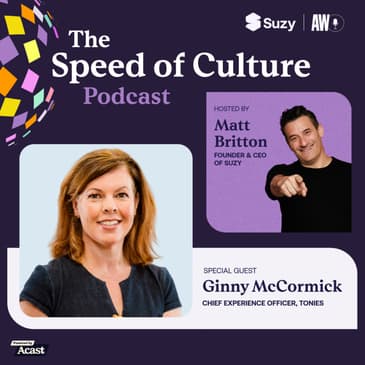
In this episode of The Speed of Culture podcast, Ginny McCormick, Chief Experience Officer at tonies, joins Matt Britton to explore the delicate balance of technology in the modern household and how tonies is pioneering a new category of screen-free entertainment. The conversation examines evolving parenting habits of Gen Z, while highlighting how audio-first experiences foster child independence. Ginny also shares insights from her career at brands like Hasbro and Amazon, offering a unique perspective on the intersection of AI, storytelling, and childhood development.
Follow Suzy on Twitter: @AskSuzyBiz
Follow Ginny McCormick on LinkedIn
Subscribe to The Speed of Culture on your favorite podcast platform.
And if you have a question or suggestions for the show, send us an email at suzy@suzy.com
Hosted on Acast. See acast.com/privacy for more information.
[00:00:00] We pioneered audio content for children at the heart of the product. It's about balancing and giving children that independence, that agency, which is so important to their development intellectually, emotionally, but at the same time, making parents feel comfortable that this is a trust-safety environment for their children. To thrive in a rapidly evolving landscape, brands must move at an ever increasing pace.
[00:00:28] I'm Matt Britton, founder and CEO of Suzy. Join me and key industry leaders as we dive deep into the shifting consumer trends within their industry, why it matters now, and how you can keep up. Welcome to The Speed of Culture. Up today on The Speed of Culture Podcast, we're thrilled to welcome Jenny McCormick, the Chief Experience Officer at Tony's. Ginny has spent her career building beloved consumer brands across companies like Zappos, Hasbro, Amazon, and Reebok.
[00:00:56] And today, she's helping lead one of the fastest screen-free entertainment platforms for kids at a time when families are rethinking the role technology plays in the household. Ginny, so great to see you today. Thanks so much for joining. Matt, great to be with you. Absolutely. I'm a big fan of your brand. I actually have a Tony's in my house. I have it for several years. My kids love it. We'll get into that, but I just wanted to say I'm a huge fan of the brand. Amazing. I can't tell you how much that means to us.
[00:01:21] So, before we dive into Tony's, which is a brand I think a lot of people still have a lot to learn about, just given how early the brand is in its evolution, we'd love to talk about you for a little bit and your career journey and the road that took you to where you are today. Yeah, well, I've been incredibly fortunate in my 20-plus years now to work on a handful of true brands. I know, Matt, you share this view that there's amazing products in the world, but a brand is something different.
[00:01:49] And to me, that really is about solving a real customer need in a way that connects emotionally and responds to what's happening in people's lives. And that kind of has been the through line for me for my time at Amazon and Zappos, where obviously customer obsession is something they take a tremendous amount of pride in operationalizing at all different scales.
[00:02:13] At Hasbro, I spent a lot of time really understanding the power of stories and characters and fandoms and how much people really connect to these worlds and what that means to their identity and connection to community. And at Tony's, those are all coming together in a really unique way. Yeah, I mean, it's such an interesting time to obviously be in the children's space because technology is obviously becoming so much more pervasive.
[00:02:41] We've all read the stories of Gen Z and their struggles with depression and addiction and all these things as a result of obviously not only COVID, which isolated them, but just the pervasiveness of social media in their lives and all the mental health issues that kind of come about as a result of that. Obviously, Tony's targets a much younger audience. And I just want to start off a question for you that if you walked into the average American household at say 6 p.m., what would concern you most about how young children are spending their time?
[00:03:09] What an amazing question. I think I have a tremendous amount of empathy for that household, right? 6 p.m. is mass chaos in this world because you have juggling kids and trying to have dinners and competing priorities and divided attention. So I think there's a lot of challenges for modern families and to the conversation. At times, technology can really help and be a hero in those moments.
[00:03:36] But more and more, as you were seeing in the research, we know there's tradeoffs and there's consequences, especially on younger minds that are developing. And to your point, Matt, I think for parenting, we're now at this tipping point, right? Because now first-time parents are the ones who grew up with social media. They grew up with constant connectivity. Yeah. In fact, this year, the average age of a first-time mother in the U.S. is not even millennial, it's Gen Z.
[00:04:03] So she grew up with the iPhone social media, the average first-time mother in the U.S. So we are past the point of the Gen X parent who doesn't really understand it. And I think one of the downsides, I think you'll agree, is that Gen Z parent is on their phone themselves too much around their kids. A hundred percent. They are struggling with it, understanding how it changed and shaped who they were. And there was positive, but there was also a lot of negative consequences to that.
[00:04:31] And to your point, they're struggling with attention, focus, sleep dysregulation, emotional dysregulation, that really now we know, based on the science, can be tied back to that screen usage. So they're thinking a lot about their own behaviors and struggles, what that's modeling now to their kids, and thinking also about how do I in any way navigate this because my children have more connectivity, more choices, more content.
[00:04:59] They can speak versus type. That used to be a big hurdle, right? And so they are having to figure it out with a lot more pressure and optionality in their household. Yeah, and there's also like the reality is there's more to income households now. And families are staying in cities for longer because that's where the income opportunities are. So they have less space. There's less third spaces for kids, so to speak. There's homes, school, but the third places aren't like they used to be. Kids aren't playing outside as much as we know.
[00:05:29] And I think a lot of parents would probably tell you that the reason that they give their kids an iPad when they get home is that they just need a break. They need some time to themselves. And I guess how would you respond to that and relative to just all the trends that we've been talking about? A hundred percent. We obviously listen a lot to parents and families around the world. This isn't just the U.S., by the way, that are struggling with this. And to your point, the technology has become a tool, but it's one they're not really comfortable with, depending on how much.
[00:05:59] They're thinking a lot more with intention about how frequently they give over that tablet, how long in the duration. And that's part of the reason we know families really love this product.
[00:06:40] You can't. You hit your limit. Chaos breaks out and everyone sours for the next hours. There goes dinner. Right. So for those in the audience who aren't familiar with Tony's like I am, it'd be great to maybe hear about the company, how long it's been around and what the core product is and does. Yeah. At the heart of it, we are a listening platform that grows with your child.
[00:07:03] So it's a safe, screen free, ad free experience that was created over 10 years ago by two fathers who met at their preschool in Germany and had a lot of thoughts about technology and its impact on their children, but also a love of audio. And I think especially in some of the European cultures, there is a real reverence for how much audio can impact and different ways, especially at your youngest age, it can engage.
[00:07:32] So basically, at the simplest level, Tony has a magical box where children can put figurines that represent characters like Disney princesses, all kinds of entertainment that you may remember from your childhood, books and stories. And then the audio instantly entertains and educates them. The same way a podcast with an adult almost, right? Absolutely. Except this is one where instead of handing over your phone, which we also know parents do,
[00:08:01] and have challenges with, this is something they can independently operate. There's no instructions. It's very intuitive. Our Tony box, it takes bumps, beatings, drops down the steps. It is incredibly durable because it really was designed by thinking about the child first and then incorporating the technology. There's lots of products that have technology that are adult-focused and then they shrink them down for children. At Tony's, we do the exact opposite.
[00:08:30] And I think that really comes through and why this experience is so intuitive for children and something they stay with for years and years. Yeah, I mean, it's this tiny little box that's padded around the outside. So even if it falls off a table in the playroom, it's not going to hurt the kid. And the way they operate it is you just take the figurine, you drop it on top of the box, it starts playing the programming. And there's different tracks, right? So there's music tracks and story tracks.
[00:08:58] And if the kids want to change it, they literally just slap the side of it and it changes. So there's no little buttons or knobs or dials or anything. And I just think that's so intuitive because you're not trying to replicate the behavior of a tablet and you don't want kids to start looking at screens. But you do want to give them some type of autonomy where you can pick what you want to listen to and even within that, what you want to listen to. And I think that really makes kids so much more engaged. A hundred percent.
[00:09:26] And this is really child development at its core. That idea of agency, even at the earliest ages, if I do something and there's a reaction and I can have that sense of empowerment, discovery, curiosity is absolutely built into the product. And to your point, kids love it. It's not something that parents are saying, okay, take this and this is a better, healthier choice for you.
[00:09:50] It's something they are gravitating to multiple times a day is what we see in these households. And at the same time, it gives parents that moment of stepping back and having that pride in that child independence and discovery while not having to choreograph the play to be at every step and point with them. So it's a really amazing balance.
[00:10:12] And what's interesting is like adults, we have this thing where if like we're at the gym or cleaning the house, we want to have something on in the background, even though we're really focused on that. And what I found with my young children is when it starts playing, it's not like they're sitting here on the couch just listening to it. They'll take out the Legos or take out something else and do something. But they're also listening at the same time.
[00:10:34] It kind of gets their brain moving and it kind of scratches that itch that they have some type of media-based entertainment, which almost then unlocks the ability for them to just do other stuff. Where if nothing was on, I feel like that they wouldn't necessarily get that initial spark to start playing the way that you want kids to play. Again, I think you did some time, Matt, as like a childhood development expert. But it's very true, right?
[00:10:59] We talk a lot about Tony sparking this imagination, creativity, like hearing the music and the stories, which we take a lot of pride in and crafting for specific ages and how they can hear and hold and remember, then causes them to engage. It's not passive. And I think often as adults, we think about listening as this passive. But really for us, we believe it's a superpower.
[00:11:24] Every great thing that you want your child to have, whether it's a skill or an emotional capability, starts with listening. It is their first skill. And by really tapping in and allowing them to see the power of listening, to your point, we see how it spurs all this imaginative play and really growth as they're developing. It's interesting because you were saying earlier about how the iPhone or the smartphone in general and social media had negatives and positives.
[00:11:54] And now we have a new generation coming in, which all your users are part of, which is Gen Alpha, right? Age zero to 15. And they're going to be defined as the AI generation, right? So they're going to be the first generation with AI in the household. And one thing when I talk about AI on stage, I talk about how instead of just reading always like the same books to my five-year-old daughter, I'll ask her to tell me a story of something that she experienced. And then I'll turn that experience into an audio story that I'll play for her.
[00:12:22] And kind of the idea there is that reading and comprehending is important. But I believe in this new world, what's even more important is the ability to understand what to say, what to write, how to storytell, how to communicate. And if you start with that, I think then your kids will be future-proofed in some way in this world moving forward. And just curious what your thoughts are on how AI is going to impact storytelling.
[00:12:48] Because really in the first time ever, kids and everyone have the ability to make whatever's in their head come to life, whether if it's a video. And that really, I think, is going to change humanity and certainly the way that we look in entertainment. I mean, there's no way to underestimate the impact, I think, that AI is going to have on our communities and our families. And to your point, I think of it as this paradox of storytelling has always been core.
[00:13:14] Like you go back to the cave and the campfire and this is what bonded us. So to your point, this will continue to, I think, be the absolute connective fabric tissue that communities rally around. And therefore, it's so critical. And I think enabling people to tell different stories, personalized stories, to have your child and other children hear stories that represent them and their unique perspective in the world is critically important.
[00:13:43] But we have Creative Tonys, which is a product that allows you to create personalized voice messages and have that on a figurine. Are you seeing a lot of adoption of that? We've been blown away in not only the adoption, but the variety map. So how does that work? Talk me through how that works. Yeah. And part of this gets into your question about AI. So we have an experience where parents can record a message and then that gets uploaded on a figurine.
[00:14:10] And then their child can use that figurine to receive that message or updates as stories continue. For some parents, the idea of record a story sounds like a lot of work, right? I have so many things going on. Can you help me here? So we've created AI tools and templates to say, here's a great story starter. How do we incorporate your child's preferences and really customize that?
[00:14:35] So there's families using them to, again, have dad's voice so he can do bedtime, even though he may be traveling. There's families, like to your point, were more distributed than ever before. This is a tool for people to share language and culture with families that may live in all different parts of the world. Families are using them as almost audio pen pals and exchanging messages. And this is just the tip of the iceberg. Again, we have a really passionate, creative community.
[00:15:04] And I'm always amazed at how personal these messages can get and the role they can play in kind of helping families. Again, going back to that utility, here's a tool that helps with dinner transitions. And here's the piece that engages you, especially at bedtimes, which we know are the most painful moments for rituals and houses today. Yeah, and I'm sure you guys put a lot of thought into the fact that just using the product doesn't require a phone because some might ask,
[00:15:33] well, why don't you just play a podcast for your kids or look something up on Spotify? I think the second you pick up your phone, all bets are off. The second a parent picks up their phone to look something up, they're going to get a text from their boss or something pops up on Slack. And then they're gone for 10 minutes, mentally gone. And I think just the notion that it starts with your kids' figurines and toys, it almost makes it like throwback, even though you are, to your point just now, are using some really new innovative technologies and approaches. You're right.
[00:16:03] I think for us, it's twofold. We want to, one, allow children to drive this experience. We know it's super important that they don't have to navigate and work through them with that tension of whose phone, privacy concerns, text popping up. What did they just buy, add to cart? All of those kind of pieces that happen when you really enable a young child with a phone. So we wanted to make sure it was appropriate for them.
[00:16:28] And then also the figurines are absolutely designed because for you, to your point, this has been a play pattern for children for decades. Collecting figurines, storytelling with them, having different characters to represent and identify with. So it really is a two for one as we think about the value that we give to families and that ability, again, for the child to have that independence and agency. We think a lot about that in our design choices at Tony's.
[00:16:56] We'll be right back with The Speed of Culture after a few words from our sponsors. So let's talk a little bit about the Tony's business. So you obviously sell the speaker, the core product, and then you sell these figurines. Where are they sold and how does the licensing business, which I'm sure is very critical of the success because a lot of people will look at a Peppa Pig figurine and say, oh, I want that. They'll know that brand more than the Tony's brand. So I'd imagine licensing plays a huge role also in sustained growth.
[00:17:24] Yes. So to your question, we have our Tony box and we have a whole range of figurines, now plush products and extensions for it and a line of audio gaming called Tony Play as well. So we create those products in the U.S. You can find them at Target, Walmart, Amazon. We're widely distributed. We've been in the U.S. now for just over five years and have a deeper history in Germany, France and the U.K.
[00:17:53] And the shelf space that Tony's has at Target is, I mean, it's a dream for a CPG company. You literally have like half a full shelf in the toy section. So obviously they're selling. Obviously it's taking off. Just seeing that I was there a couple of weeks ago, I was blown away. We have an amazing partnership with Target. And to your point, they see really strong demand from their guests who are really looking at family life and balancing.
[00:18:18] So we've been growing the toy section across retailers, both in the U.S. and beyond, because again, there's such a need for this product in differentiation. So we're super proud of those partnerships. Similar, we work with over 200 licensed partners.
[00:18:33] So we have big partnerships with all the IPs that are new and developing for children, like Miss Rachel or some Danny Go, people like that in the U.S., as well as the whole Disney portfolio, Paramount. Hasbro is a key partner for us. We've just announced Pokémon.
[00:18:53] So we also have these nostalgia brands that are super important as well, because as you know, there's nothing probably more passionate for parents than sharing something they loved in childhood and felt great about and passing that along with creating new memories for your child. So those titles continue to be a core part of our portfolio.
[00:19:15] The way we work with the licensed partners is a bit unique because really we bring this expertise in audio that many of our partners would say this is a forum outside of what we do day in, day out. So we have original studio full of storytellers, producer, musicians, et cetera, that take care to bring these stories to life.
[00:19:37] So, for example, with Pokemon, we're creating originals, new stories exclusively for Tony's that really bring the brand to life in a way that we're excited about for our listeners. And moving forward, what does this all mean for the future of the Tony's brand? Where do you see it going and what are some of the growth opportunities you see moving forward? Yes. Well, we've had some very successful years of continuous growth. And we, again, Matt, are at such early stages because this is a trend and a need from families.
[00:20:07] That's not a fad. It's now being entered into public policy in the U.S. There's a lot of change going around in the medical communities as we get more and more research. So we really think about how can we serve more families. We're incredibly ambitious about the households we have and how much we've been able to help them and be part of the daily routines.
[00:20:30] Like, unlike many products, some I've been experienced with before, Tony's is something that children and families play with every single day. It's amazing the engagement we see, whether that's to your point. We actually have a podcast called Tony's Today that many older children, six plus, start their breakfast with all the way through to bedtime. So that's something we're looking at.
[00:20:54] How do we serve more of their needs as children also grow and expand and then expand beyond our current markets, which currently are in the U.S. and in Europe primarily? Got it. So switching gears, we wrap up here, Jenny, and it's been such a great talk. And again, such a big fan of the brand and all the great work you're doing. Would love to hear, when you look back on your career and all the prestigious brands that you've helped lead marketing for,
[00:21:19] what are some of the takeaways in terms of some of the things that you've done right personally along the way that put yourself in the position to continue to get and lead these great opportunities? I had a boss very aggressively yell at me one time. You don't ask, you don't get. And it really stuck with me, Matt. So I am a big believer in ask. Ask the question if you don't know, you don't understand. Ask for the opportunity that you want to participate on.
[00:21:49] Ask to challenge. And I think I love a good question. And that idea of really asking and advocating is something I am passionate about doing and mentor different team members to do as well. Yeah, I think the whole notion you don't ask, you don't get what you don't ask for, is so true. Like your boss is not waking up every day saying, how can I give Jennifer a raise? How can I give her more things to do? Your boss is worried about their own job and their own family and own opportunities.
[00:22:18] And it's up to you to figure out what you want from your life in your career and to go get it. And I think that's such a great piece of advice for people in terms of business. And it sounds like, I think, especially for a younger woman in business, I think sometimes it's just not intuitive to them. As a dad of like two daughters, like I think it can be hard sometimes to speak up for yourself. And just like, what advice do you ask specifically for a woman in the workplace? Could you think maybe presents a particular challenge in that regard to be more aggressive?
[00:22:46] Yes, I think like to your point, there's so much that has conditioned women's voices to not be aggressive, to really kind of lean back. I'm a mother of three very empowered daughters. So my message to them, to your point, is to really, one, be clear about what you want. And really, I think that self-awareness of why am I asking for this? Why is this important to me?
[00:23:14] What do I perceive this unlocks, especially in my career path? And to really do some hard work there. And then to share that and say, come forward, whether it's to your boss or a specific opportunity. Because I think when I've had those conversations or have been on the receiving end of them, if someone's really clear about their intention, why they think this is good for the company, why they think this is good for the team and for themselves, those are things that are undeniable to me.
[00:23:41] Absolutely. So we always ask our guests when we wrap the podcast, if there's a saying or mantra that's helped guide the professional journey and just wondering what might come to mind for you. It ties very much to what we were just talking about. I am a big believer in that saying that your life is a reflection of the quality of questions you ask. So interesting. And is that about curiosity? Is that about just making sure that people understand what you're thinking? Why does that came to mind for you?
[00:24:09] I think especially in the work environment, I think maybe this resonates for some of your listeners. Every project I've been part of that didn't go to plan, that we would say is a mistake or was a miss, someone in the room already knew that. They knew it was going to go off. They could kind of tell this wasn't good work, but they felt like it wasn't their place to stand up. Or didn't trust their instincts, maybe. Yeah. Or like question each other.
[00:24:37] So that idea of really thinking about questions and being open to challenging yourself, to have others challenge that this is maybe not the right path. Those are the kind of things that I think unlock big moments for teams. And so really, I think a lot. Time is very precious. We're all super aware of how limited it is. So how can I ask the best questions for this team, for this environment, for this organization to unlock opportunity?
[00:25:07] Absolutely. So to wrap up here, I think that there's some new developments in the Tony's business that you wanted to tell us about, specifically on the new Hasbro and Tony Play launch. We'd love to hear about what we can expect from the upcoming collection. Absolutely. So as we talked about, Tony's really grows with listeners. And as children develop and they're asking more questions, they're more interactive, we've created audio gaming as a way for them to play.
[00:25:34] And at the heart of all good games, this gives children the ability to make moves, to have control, to respond to different pieces. And we paired up with Hasbro, who has the ultimate portfolio of games. And we're launching three games on Tony Play, which will be Monopoly, Guess Who? and The Game of Life. So this for me is super exciting. Obviously, I spent 10 years at Hasbro.
[00:26:02] I am passionate about their portfolio, but also know how much the world loves these games and shared experiences. And as we talked a bit about that nostalgia of having these games that were, for parents, real memories and core family moments, now being able to play them with their children in a different way is a huge unlock. And a personal favorite for me is you can also have children play these games independently.
[00:26:31] So they can learn the game of life and then play independently and then also have a family moment as well. Such a cool collaboration. I love the kind of gameplay overlay to a business that's already driving such high engagement from your consumer. So we'll look out for that and can't wait to see how successful that is and wishing you nothing but success in this new initiative and everything else we have going here in 2026. So thanks so much for joining today, Jenny. Great to be with you. Absolutely.
[00:26:57] On behalf of Suzy and Adweek team, thanks again to Jenny McCormick, the Chief Experience Officer at Tony's, for joining us today. Be sure to subscribe, rate, and review the Speed of Culture podcast on your favorite podcast platform. Until next time, see you soon, everyone. Bye-bye. The Speed of Culture is brought to you by Suzy as part of the Adweek Podcast Network and A-Guest Creator Network. You can listen and subscribe to all Adweek's podcasts by visiting adweek.com slash podcasts. To find out more about Suzy, head to suzy.com.
[00:27:27] And make sure to search for the Speed of Culture in Apple Podcasts, Spotify, or anywhere else podcasts are found. Click follow so you don't miss out on any future episodes. On behalf of the team here at Suzy, thanks for listening. Hey!