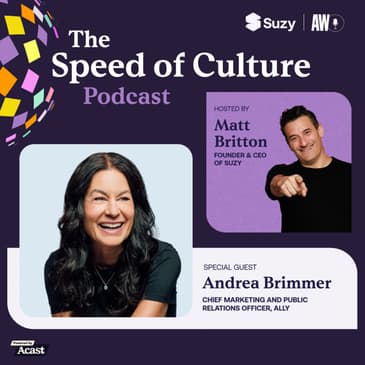
In this episode of The Speed of Culture podcast, Matt Britton sits down with Andrea Brimmer, Chief Marketing and Public Relations Officer at Ally Financial, live from the POSSIBLE conference in Miami. Andrea discusses how Ally established itself as the original digital disruptor during the great financial crisis and continues to lead by prioritizing cultural relevance and consumer trust. They speak about the shifting financial behaviors of Gen Z, the psychological relationship people have with their money, and Ally’s groundbreaking 50/50 Pledge to level the playing field in sports media. The conversation also covers the integration of AI in marketing and why authentic brand acts matter more than traditional advertising in a digital world.
Follow Suzy on Twitter: @AskSuzyBiz
Follow Andrea Brimmer on LinkedIn
Subscribe to The Speed of Culture on your favorite podcast platform.
And if you have a question or suggestions for the show, send us an email at suzy@suzy.com
Hosted on Acast. See acast.com/privacy for more information.
[00:00:00] Just a lot of the traditional pain points that have always existed in banking, we've solved for. We've always had this rule of complete transparency, no complex terms. So we speak in human language. There's a lot of friction in having to go into a branch and a lot of the traditional structures that exist in kind of the big banking today that just don't exist with Ally.
[00:00:25] To thrive in a rapidly evolving landscape, brands must move at an ever increasing pace. I'm Matt Britton, founder and CEO of Suzy. Join me and key industry leaders as we dive deep into the shifting consumer trends within their industry, why it matters now, and how you can keep up. Welcome to The Speed of Culture.
[00:00:47] We are live in Miami at the Possible Conference and today we are thrilled to welcome Andrea Brimmer, our returning guest and Chief Marketing and Public Relations Officer at Ally Financial. Andrea is one of the most recognized and innovative marketers in America, known for building Ally into a different kind of financial services brand, one rooted in trust, cultural relevance, and doing right by customers. You're doing right by us by joining us once again. Thanks so much for joining. Thank you. I had such a good time last time, so I was excited when you reached out.
[00:01:13] You should feel honors not many times that we bring a guest back, but I think you have such a unique take on brand building and being purposeful in what you're doing that we thought that our audience would continue to get great value from hearing Thank you. I appreciate that. So for those who don't know what Ally is, would love to maybe start with that because it's an emerging brand, but it's not like a big bank that's been around for hundreds of years. Right, right. So for those that don't know, what is Ally?
[00:01:37] Yeah, so Ally is an all-digital bank, all online, the largest auto lender in the country, one of the largest digital banks in the country, and the original digital bank. We launched about 16 years ago during the great financial crisis at a time when the world said that we don't need another bank, but we had this thesis that we needed a better bank, that something different could exist. So that really is the platform, and it's really a fun time to be in digital banking. I know.
[00:02:04] And it's funny, when you say digital bank, there are some really outrageous stats about the amount of real estate that is used by physical banks. Yeah. There used to be a world where you would be walking down Main Street and say, oh, I need a loan, I need a mortgage, I'm going to walk in. Right. And that's just, even ATMs, that's just not how consumers act with money anymore. How much longer do you think we're going to be seeing physical banks that people walk into? Because this year, a big stat that you might know of is for the first time ever in the US, the average age of a first-time mom is now Gen Z.
[00:02:33] So when people think about Gen Z, they think about kids. This is the CFO of the household. She grew up in the TikTok era. Right. And she is not going to be walking into a bank. So then the question is, 10 years from now, who is? Yeah, you know, it's really interesting. There's this misperception where when we go out and we look at data and we do research, still, regardless of age, almost half of people say that they think they need a physical branch. It's crazy. But then you ask them, have you ever been in one? And the answer is no.
[00:03:03] And so I don't know why there's this misperception. And that is really one of the things that from a marketing perspective we have to tackle. I know why. I'm going to tell you why. I'm going to teach the CMO up. Because that's where they think their money is. They do. Well, not only do they think their money is, but I think a lot of it is they think that in order to open a checking account, which we don't call checking. We call spend because we think checking is an archaic term. Yeah, that too. I think that they believe in order to deposit cash, in order to send a wire, because there
[00:03:32] are a lot of structures where that still exists, where you can't do those things unless you walk into a physical location. But that's one of the things with a digital bank that we've enabled. You can deposit cash. You don't have to go into a physical location. Right. You can send a wire just by going into your app and doing those things. So there's still this sea change that needs to occur in order to do that. And I think it's a learned behavior because if you think about it, most people, where do you get your financial advice?
[00:03:59] Especially if you are in college or your kid, you're growing up. Your parents, right? You get it from your parents. Right. And so your parents are still giving you this advice. They're still writing checks. Right. They're still writing checks. Right. They're still saying, oh, I bank at XYZ Bank. They may even have a relationship with their banker. Right. And why don't you just open your account here? And so that creates a lot of inertia that we have to overcome. So how much of your job in building your brand is about category awareness and educating consumers on just what we spoke about? Yeah.
[00:04:28] You know, it's really funny when we look at our, just our pure awareness, our awareness is a little bit over 60%. When we look at our logo awareness, our logo awareness is almost 80%. So people are like, yep, I recognize that logo. That's Ally. And then when you ask people, what does Ally do? It drops to almost 40% of what we do. Wow. In terms of our familiarity and what category we're in. Funniest social media post I ever saw was around our NASCAR sponsorship. And somebody said, Ally's best sponsor in NASCAR. Love them.
[00:04:58] By the way, does anyone know what Ally does? Do they make corn dogs or what? And the guy was being facetious, but he had no idea. Right. And so a lot of our job is still building that category awareness. Because as you mentioned at the onset, we're still a relatively young brand. Yeah. 16, 17 years old, which in this category where some of the, you know, the Chases and the Wells Fargo's and the Bank of America's of the world have been around for almost 100 years. So before we get into the Ally brand and its business specifically, what are some of the
[00:05:28] core benefits to consumers from banking with a digital bank? Yeah. I think there's a myriad, particularly with Ally. First and foremost, we don't have branches. So we don't have the legacy cost of carrying the branch. Which gets passed down to the customer. Which gets passed down in terms of interest. Yeah. Right. Second is we really have no fees to speak of. We weren't born out of making revenue from fees. And as a result, that was one of the things that we said we never really wanted to have.
[00:05:58] And so you have very high interest rates. You have no fees. I think the third thing is just ease of use. You can really do everything in the app. And whatever you feel like you can't do in the app, we have 24 by 7 customer service. So you can always chat or get on the phone and reach somebody at any time. Right. Night or day. And have that conversation and enable what you need to have happen. So it really is a better banking experience overall.
[00:06:23] And then just a lot of the traditional pain points that have always existed in banking, we've solved for. We've always had this rule of complete transparency. No complex terms. So we speak in human language. Yeah. And those things that just don't exist. And there's really no friction in our experience. There's a lot of friction in having to go into a branch. And a lot of the traditional structures that exist in kind of the big banking today that just don't exist with Ally. Right.
[00:06:53] And it's interesting you brought up the app first because to a lot of younger consumers who maybe never visit the bank, the app is the bank. It is. Right. And so in that regard, what is the new banker, if you will? It doesn't mean they have to be necessarily young. They could just be people who are more progressive in terms of thinking about what their needs are. What are they looking for? What's most important to them? Maybe some things that are important to them now that wasn't really the case 10 years ago. Yeah. I would say, first of all, we live in a completely digital world. Yeah.
[00:07:20] And one of the things I talk about a lot with my team and my business partners is during the course of the day, nobody's comparing Ally's digital convenience to another bank's. They're comparing our digital convenience to how easy their experience was on Amazon. Or Starbucks. How easily they ordered their coffee in the morning on Starbucks. Who's competing for attention and mind share. Totally. Yeah. And so think about your typical day.
[00:07:43] You're going to get up, maybe you're going to go on Instagram first thing in the morning, then you're going to order your coffee and then you're going to order something on Amazon in the afternoon or you're going to get on Netflix and you get all these recommendations. That's what people are looking for in terms of their digital banking experience. That's right. I want it to be that easy. I want the content that I need when I need it. I want to be able to move money freely. We talk a lot about the fact that people are moneying differently. If you think about it, money terms have become verbs. I'm going to Venmo you. I'm going to PayPal you. I'm going to sell you.
[00:08:13] Right. Nobody says, can you write me a check? Yeah. Can you give me some money? That's just not the world that we live in. Yeah. And so the enablement of those frictionless, very easy transitions and transactions are what people are looking for in a digital bank. Sure. I know another area that you've leaned into and we talked about it last time you were in the podcast was about just the notion of financial literacy. And, you know, you talked about a lot of kids are learning from their parents, but parents grew up in a different era.
[00:08:40] I mean, I talk about often when I'm on stage that when my father passed away, I was left in charge of his estate. And I was shocked by how much he had saved up because it was so incongruent with how he lived. Yeah. Like he would drive around for half an hour. He didn't want to pay five hours for a parking spot. You could argue the merits of that, but he grew up in the shadows of World War II and the Great Depression. So his relationship with money was one of scarcity. Right.
[00:09:03] And with younger people, we saw what happened during the fiscal stimulus where you saw GameStop and NFTs and all the speculative assets, collectibles, explode because they had a different mentality. I'm just curious, like, do you see that with your younger customers and what does financial literacy mean if that is the case? What's really interesting about this younger consumer is there is almost this duality in them. On one hand, they are the most financially savvy generation of our time. Yeah.
[00:09:31] They spend a ton of time consuming content. Think about just on TikTok alone, all the Finfluencers that are on TikTok that they're consuming information from. And they spend a lot of time on Reddit and they study and they have a much better grasp of financial literacy than any generation before. Of course. But on the other hand, they also have the highest levels of financial anxiety of any generation. And for good reason, I would. And for good reason. I mean, look, we're living in a macro that is extremely volatile.
[00:10:01] Inflation is extremely high. Most of them, regardless of kind of what they're making, they're living paycheck to paycheck. They've seen in some cases their parents lose everything during the financial crisis. They don't want to go through that. What happened in New York City with the mayor that got elected? I mean, in the most capital of the world, if you will. Right. In the shadows of Wall Street, you have someone that's decidedly anti-capitalist. That's his platform. Exactly. And he gets elected because people feel disenfranchised. I can't afford to live here anymore. So that's what you start to see.
[00:10:30] There's definitely a big reclamation from this generation against capitalism. Yeah. Which is so interesting. It's almost a dirty word. And so I think that that presents both an opportunity and a challenge for us. And I think the huge opportunity is the way that we can validate the kind of content that they're searching for, be helpful in terms of providing the right kind of content at the right moment, being authentic, being real, speaking their language.
[00:10:57] One of the things that we've done that I'm the most proud of is three women on my team, we sent them to Texas Tech and they got certified in financial therapy. And we've created this entire curriculum called Money Roots. And what Money Roots is, is actually classes that we put on that study your psychological relationship with money and helps you develop your money story so that you can kind of break the chains that bind you.
[00:11:23] So for instance, your childhood, if you think about it, you watched your dad drive around for an hour to get a parking spot. Right. And so how did that affect you? How did that affect you? Yeah. Some people might like revolt and go the other way and just spend everything because they felt like they were, you know, bottled up. And it's extremely emotional. Yeah. We hold these sessions all the time. Well, financial difficulty is what the number one reason that, you know, marriages break up. The number, the second biggest reason for divorce is financial infidelity. Right.
[00:11:53] Because people don't have those money conversations. It's an uncomfortable conversation to have. We find in our research so many people that get married and they're like, wow, I didn't know my partner has $80,000 in student loans. I didn't know my partner has a 580 credit score. I didn't know my partner had this much debt. We never talked about it. Yeah. Or even how much more one another is making. It's just uncomfortable conversations. So a lot of what we try and do is force those financial conversations through money routes.
[00:12:22] And it's really differentiating and fascinating. Yeah. I mean, I think if you look at also how younger people are growing up today, looking at everyone else's highlight reels, you know, and obviously only 0.1% of the people are creating 99.9% of the content on social media. Right. But it's what people see. Right. So if you see people with fancy houses and cars and going on fancy vacations, you feel bad about yourself. Right. And maybe it forces you instead of being patient and to save up money, try to say, you know what? As soon as I get a little bit of money, I'm going to spend it and I'm going to post too and show up.
[00:12:52] And I think that's something that I didn't have to deal with growing up. Right. I didn't see what anyone else had. Right. And I think that's a whole nother layer of difficulty that young people have to face in building a financial future. Yeah. The inauthenticity that exists in social and what the mirror that they have to hold up to themselves is really, really difficult. Yeah. But interestingly, in some ways they're regaling against that as well. And we see really just different structures that this younger generation cares about.
[00:13:19] Some not as focused on these materialistic things, you know, really rejecting those constructs. Right. And delaying a lot of the things that were the constructs that we grew up with, like graduate from college, get married, get the house, have the, you know, two kids. White picket kids, two car garage. Right. Where now... What was known as the American dream. Right. They're delaying those things. Yeah. Really to lean into more of experiences. I want to travel. I want to delay marriage. I don't even know if I want to get married. Right. I don't even know if I want to have kids.
[00:13:48] I even hear my own kids talk a lot about the fact that I want to have X amount of savings before I even consider having kids because I don't want to bring kids into this world and be living paycheck to paycheck. So it's just really interesting to see the seed shift that is occurring. And again, in a very complex and dynamic generation that Gen Z is. We'll be right back with the Speed of Culture after a few words from our sponsors.
[00:14:13] So given this dynamic consumer landscape, how do all these insights impact the way that you're building your branded ally? And what are some of the areas and initiatives you're leaning into as a result? Yeah. You know, with a name like Ally, we've always wanted it to be something literally as well as figuratively. Right. And we really believe we have this unique opportunity and always have to show up as a financial ally for our customers. Yes. And so we're actually getting ready to launch a whole new campaign in May.
[00:14:40] And it's all built around this idea of where life and money collide today, how they come together. And these insights that really, I think will appeal to this younger generation around, you don't have to have the constructs that your parents did. It's okay to delay some of those financial decisions. It's okay to lean into those experiences. And I think what we see, especially in a lot of bank advertising, is there's a lot of preaching that happens. Don't get that latte.
[00:15:10] Don't go on that vacation. Don't do this. Don't do that. Save, save, save. And for us, it's really, we're never going to preach at somebody, but we're always going to help people find the joy in money. Yeah. We're always going to help you have money on your terms, help you grow it, help you save it, help you spend it. That's a little bit of the reason why we chose the word spend account versus checking account. Because checking almost feels like somebody's watching a review. Yeah, that's interesting. Where spend is, you know what, you work really hard for your money. If you want to go spend it on a vacation, go spend it on a vacation.
[00:15:40] You know what, when people like think about marketing, they think about, oh, content and Facebook, or I shouldn't say Facebook anymore, Instagram or Snapchat, I'm dating myself, right? But um... MySpace. Yeah, exactly. There you go. But ultimately, marketing is also getting rid of the word checking. That's marketing in a way that people don't really see, but when they look at it like, oh, that's different. Right. And that alone could be just as impactful, that one word change as a major campaign. Totally. That's been so much of what we've tried to do at Ally. I always call us the original disruptor.
[00:16:09] We disrupted the category. We launched something in the middle of a worse financial crisis since the Great Depression. We solved for customer pain points. And candidly, we made the entire financial services category move towards us. And it's... Are they leaning towards you? They're trying. I mean, if you look at the prevalence of what's happening in terms of digital banking and even how much, I would say, the big banks have leaned in to trying to get to better customer service, different kinds of experiences, you know, there definitely has been this move towards... Not easy for them though, right? Not easy.
[00:16:38] Legacy institutions that can't pivot fast. Right. They're fee-based. Yeah. They've got all these branch systems. So it's very difficult. Like we've got this incredible advantage that almost can't be disinterested, which is a good thing. Speed is a moat. Speed, totally. And just perception and authenticity of that perception and all the things that come along with it. But the reality is, I think we also have this amazing amount of authenticity and relevance with this younger generation because this is how we were born.
[00:17:08] Right. This is how we came up. This is what we've always been. Yeah. And... It's native to the brand and its story. And in an AI world where if you think about the way that the purchase funnel has collapsed, right? Maybe a long duration product like banking was a six month purchase funnel. It's now collapsed into one question. Yeah. I know. What's the best online bank? Isn't it crazy? Right? And... Are you seeing a lot of volume coming from the large language models like... I would say a lot, but we're starting to see certainly a pickup of it. Yeah.
[00:17:38] And we've really built an entire process within my organization to make sure that we stay in the top three in any search across all of the different LLMs. Right. Answer engine optimization. Totally. And the team has a scrum literally every Monday, every Friday, they go through 300 priority prompts to make sure. But to the point that we were just talking about with a spend account, that's not a common terminology. Right. And so people are going in and they're practicing what's best checking account. You also want to be in the aisle where people are shopping. Right. And not shopping for a spend account.
[00:18:08] And so we had to do a lot of work to make that something that shows up in the LLMs. Yeah. Which is interesting. But using interesting terminology, speaking the language of the consumer like spend is one of those ways that we have differentiated ourselves. Because marketing is a brand act. I always say behave like the brand you want to be. Right? When we waived overdraft fees several years ago, we were the first and still I think only bank to not have any overdraft fees. They disproportionately affect those people. Right.
[00:18:38] We don't need them. Right? They could seem like it just has to happen. Because they make millions and millions of dollars on overdraft fees. Right. Nobody wants to overdraft. Nobody's purposely trying to overdraft. Right. You're overdrafting because either you're busy and you forgot to move money or you don't have the money. Your cash crunch. Right. Your cash crunch. And it disproportionately impacts those that can afford them least. Right. And so we made a conscious decision as a brand act to waive overdraft fees. Those are the kinds of things that to me are deeds, not words. Yeah.
[00:19:07] And that is marketing. That's behaving like a brand you want to be. I agree more. We're talking about all this change, but I think one of the things that's remained the same is people's passion for sports. Yes. And I know that you were, I remember correctly, a college athlete. I was. So why are, is sports important? I know you do a lot around women's sports as well. Yeah. I would love to hear why that remains a big pillar to the brand and some of the initiatives you have in that area. I think one of the, probably the thing I'm most proud of in my professional career was the 50-50 pledge that I made four years ago. Yeah.
[00:19:37] And we saw it was the 50th anniversary of Title IX. I'm a product of Title IX and Title IX has been under siege and there are a lot of things that I think are kind of chipping away at the foundation of what Title IX was meant to stand for. And so we wanted to do something meaningful to commemorate Title IX and to really stand up for the protections of Title IX. And we saw two pieces of information at the time.
[00:20:03] Number one was that 94% of C-suite women in the Fortune 500 played sports at some point in their life and 54% played at the collegiate level, myself included playing soccer at Michigan State. Right. The second statistic that we saw at the time was that women's sports was receiving less than 5% of the media coverage. And so I said to the team, how much are we spending on women's sports versus men's sports? And we did the calculation and found that 90% of our investment was going into men's sports media
[00:20:31] and 10% was going into women's sports media. So we were part of the problem. It was just something that we had never thought about or even looked at. Right. And so we came up with this idea of what if we pledge that for every dollar we spend in men's sports media, we'll match that dollar for dollar in women's sports. And we gave ourself a five-year time horizon, not because we didn't think that we could get there more quickly, but we wanted the time horizon to signal the inequity that existed in terms of the availability of women's sports media.
[00:21:01] And so it was a really hard challenge because every year it reset at zero. Every year we had to start clawing, buying media, finding media, making media deals, working with big companies to make things happen. And a couple of weeks ago we hit our 50-50 pledge a year early. And announced it at the Business of Women Sports Summit. And just something I'm extremely proud of the team for and extremely proud of Ally, the entire organization from our CEO on down.
[00:21:30] Right. Because those values have to be shared throughout. Otherwise you hit roadblocks along the way. A thousand percent. And it's such a pride point with an Ally. And I know that you have a new campaign coming out. Yeah. I would love to hear a little bit about that as well. Yes. Yeah. So we're working with Anomaly LA and really excited about the campaign. The whole concept of the campaign is about life today. The idea of how do you find the joy in money? Where do life and money collide? And recognizing what that's all about.
[00:21:59] So we'll launch with a bunch of video assets. We've got some really interesting outdoor going up all over the country. I'm a big believer in the out of home. Yeah. Of course. And we've got some really. A lot of research behind how it's impactful. And we've got some really fun things planned as just little disruptors that we're going to do as well. I always love to launch with just kind of disruptive ideas that pique people's interest and speak to people differently. So it's really going to appeal to this Gen Z.
[00:22:27] We're really moving our business more towards everyday banking and away from just being primarily a savings institution and really moving towards the spend account and this notion of everyday banking. We've got a lot of new product features, cash deposits now where you can walk into a Walmart and make cash deposits. Very cool. A whole big. That's sort of like your way to compete with, you know, physical presence, but everyone. There's a Walmart everywhere. Yeah. And it's a super simple experience. Another thing that we've done is a refer a friend program.
[00:22:55] We believe that customers referring friends are our greatest advocates. And we've built a whole QR code right in the Ally app where I could just open up the QR code, hold it up to you. You scan the QR code, take you right into an app opening experience. You can open an account in less than 10 minutes. An entire new loyalty platform that we're launching. First time we've ever had loyalty rewards, which I'm really excited about. The team just absolutely killed it and built this amazing loyalty platform with some really great partners.
[00:23:26] Calm, where you can get discounts on the Calm app, Trust and Will for life insurance and will. Instacart for discounts and Instacart. All of our sports properties giving you early access, seat upgrades, unique experiences, and more to come. So just really a very holistic campaign. Lots of exciting stuff. And you must be the pie chart of your day. What is the pie chart of your day? The pie chart of my day is how do I find five hours a day to sleep? There you go. Well, sleep's important as you know, so make sure you get that. Well, you know, it's really interesting.
[00:23:56] And I think the thing that I love about my job is, especially being at a digital bank, I don't have responsibility for just marketing. I've got marketing. I've got PR. And I've got product innovation. And so we have an off property innovation lab where we do rapid kind of empathetic learning to find those pain points that exist in financial services and then do rapid prototyping to bring new products and features to life. So one of the things that we created through the lab was our savings buckets.
[00:24:24] And if you think about it, when you're saving for something, oftentimes what people do is they have to open multiple savings account because you want to make sure if I'm saving for this big vacation, I don't want that money mixed with my everyday money. Right. Right. And so people will open multiple accounts with Ally now with our savings buckets. You can open one account and then you can create buckets. So you can name my wedding bucket, my vacation bucket. It humanizes it. Yeah. My savings bucket. No one knows what account 13715 means. Exactly. Right. And you can name them.
[00:24:53] And we look at the data around how people name them. We help track their progress. I love that. We surprise and delight them. So we've got a budget for surprise and delight. And if you're $500 away from hitting, let's say, your new home down payment bucket, we'll drop 500 bucks in your bucket and congratulate you for being smart about the way that you save. So that all comes out of the product innovation studio.
[00:25:15] So it's a really nice way to bring all of that together under, you know, really the person that should be maniacally focused, the consumer, which is really what we should be doing in marketing. A hundred. I'm glad you said that because I think there's a lot of discussion at conferences like this in terms of what is the changing role of the CMO and of the market today. And if you look back over the last 20 years, the most successful products didn't necessarily grow because they had the best ads. Right. Because they had the best product and a lot of the best products grow because the marketing is built into the product. A thousand. Right.
[00:25:44] And that you understand who your customer is and every touch point shows them that and then they love it and more people talk about it. And then advertising becomes a lot easier. Yeah. Right. And then you don't have to be as demand driven, bottom funnel driven in your advertising. You can do cool and interesting things like you're doing with your new campaign because you have momentum because you have a great product. Absolutely. Marketing has got to create demand and it's got to capture demand. And the demand creation comes through not just marketing, but it comes through the product experience. It comes through product innovation. And I'm fortunate.
[00:26:14] I have a great business partner on the consumer bank side as well as on the auto side of our business that really believe in the fact that this is a team sport. We've got to play together to make these things happen and work. We're really good about prioritization around investment capacity together, highest and best use of what's really going to move the needle. And then that's the way that it should be. Yeah, for sure.
[00:26:38] So as we kind of wrap up here, I would love to hear you mentioned AI earlier and obviously it's forcing every marketer, really every business person to rethink what their role is and what they're capable of. How are you using it in your everyday role and how are you deploying it throughout your organization in ways that you find that are already moving the needle or not? Yeah, I mean, we really look at it across kind of three different dimensions. And we've got a very specific marketing AI strategy that integrates into the larger enterprise AI strategy.
[00:27:06] And ours is really around number one, efficiency and kind of effectiveness. Right. And so it's like, what are all the tools that our teammates can use to make them more efficient at their job every single day? Microsoft co-pilot, creative tools, analyzation tools, those kinds of things. Yes. The second component of it is really around content generation. So how do we get to market, especially where we need to pump out just an absolute ton? Right. Multivariate testing.
[00:27:35] You're having many different versions. Exactly. Right. And just the level of content, especially around financial that we need to put out. And then in the LLMs, the amount of content that we need to put out in order to ensure that we stay kind of top of search, if you will. And then the third pillar is really around the changing consumer interaction with brands as a result. I mean, look, the reality is a brand can very easily be disintermediated in this AI world. I know. Right?
[00:28:03] If somebody goes into the LLMs and says, what's the best online bank, and we don't show up in those top three positions, how are they ever going to even hear about LL? Yeah. And if- For years it was just about Google, right? Right. Exactly. Yeah. And so what do we need to do? And this is what's really interesting, is brand has never been more important than it is now. And the other component is PR. Earned media has never been more important. Those are the two things that fuel the LLMs more than anything else. Yeah.
[00:28:31] Because they're validating and in sites that are completely objective, and their citing sources are really fascinating. When you go into the tools, we happen to use Scrunch. When you go into the Scrunch tool and look at the referring sites, there are things that oftentimes we never would have paid attention to in the past. And they're pulling from earned media. They're pulling from the brand acts that you've done. They're pulling from consumer word of mouth and rankings. They're pulling from awards.
[00:28:57] And so one of the things that I think we've recognized early at Ally, and this is one of the things I talk about with my product partners, is I need you guys. I need to make sure that all the customer reviews, I need to make sure NPS is really strong. Right. Because if not, we're going to fall out in those LLMs. So it's hand-to-hand combat right now. Yeah. I wouldn't say anybody's got the answers, but I feel really good about where we're at. Changing way too fast.
[00:29:23] And what's interesting is, yeah, the LLMs are looking for content sources with authority because since the barrier to create content is near nothing, they have to separate the signal from the noise. Right. And the way they do that is leaning into known trusted sources to fuel their ranking. Right. And a lot of those are what's always been known in trusted sources. So as much as things change, they also remain the same in that regard. The difficult part about it right now is there's so much temptation to use AI for creativity. There's so much backlash about anything created by AI.
[00:29:53] Are you finding out? Oh, big time. Like big time. Even if you disclose it. Just people for whatever reason, especially younger generation, I know even with my own kids, when I send them something that's AI, they're like, Mom, you know, like I'll do funny little, my dog dancing from AI. And they're like, not funny, don't want to see it, don't send it to me ever again. I think it's because it touches a nerve of fear and anxiety about the future. It does. Absolutely. And so I think that balance is something that all of us as marketers are really trying to navigate and figure out.
[00:30:22] Because when you look at the statistics, right, Gen Z is using AI at least three hours a day for different things that they need to do, right? Their searches, their answers. Writing their term papers. Exactly. Right. But when it comes to creativity, they don't have anything to do with it. Really interesting. So to wrap up here, we always ask our guests, and first of all, it's been an incredible discussion as I knew it would. So maybe we'll have you back a third time. Never been dumb, but it's possible. Wow. I love that. Okay. That gives me something to shoot for. I would love to hear from you.
[00:30:50] We always ask our guests if there's a saying or mantra that helps kind of encapsulate the professional dirty to date. I don't know what you said last time, but maybe it's changed. Maybe it's the same. But what comes to mind for you? Yeah. I mean, look, I have a couple of mantras that I kind of live my life by. And one is never drink your own Kool-Aid. I think it's really easy in the marketing world to become very full of yourself.
[00:31:13] And I think it's dangerous to get too far away from where the work is done to almost believe your own PR, to just relinquish the care and feeding and the nurturing of the brand and the human capital to others. And so that notion of really never drinking your own Kool-Aid is really important to me.
[00:31:33] And then the second one, and this may have been what I said last time, but it is how I live my life, which is this idea of the meaning of life is to find your gift and the purpose of life is to give it away. And I just believe in that really definitively. I feel like we have a platform and if we don't use it, that's on us. Right.
[00:31:51] And we have to take risks, things like the 50-50 pledge, things like taking time to mentor young people, things like taking time to be a human and answer every email that you get to the best of your ability, even if you get 12,000 a month like I do. Yeah. Just being real, being involved in educational boards, being in industry boards, trying to leave the world better than we found it. And so I've got that in my office. I've got it at home. Look at it every day and do my best to try and live my life that way. Great.
[00:32:21] We're going to leave it at that. It's been a great discussion again. Thank you so much for joining. Wishing you a lot of luck here in Miami and the rest of 2026. Thank you. So good to see you. Likewise. On behalf of Suzy and AdWeek team, thank you again to Andrea Brimmer, Chief Marketing and Public Relations Officer at Ally Financial for joining us today here in sunny South Beach. Be sure to subscribe, rate, and review the Speed of Culture podcast on your next podcast platform. Until next time, see you soon, everyone. Bye-bye.
[00:32:52] And a guest creator network. You can listen and subscribe to all AdWeek's podcasts by visiting adweek.com slash podcasts. To find out more about Suzy, head to suzy.com. And make sure to search for the Speed of Culture in Apple Podcasts, Spotify, or anywhere else podcasts are found. Click follow so you don't miss out on any future episodes. On behalf of the team here at Suzy, thanks for listening.