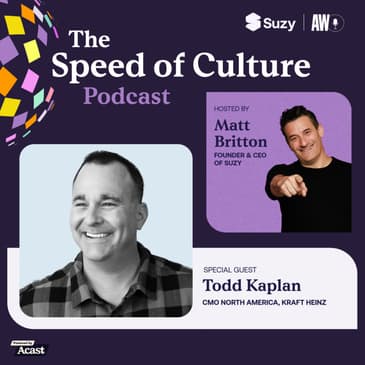
In this episode of The Speed of Culture podcast, Todd Kaplan, Chief Marketing Officer at Kraft Heinz North America, joins Matt Britton live from the POSSIBLE conference in South Beach. Todd shares how one of the world's largest food and beverage companies manages 70 iconic brands with 96 percent household penetration across a rapidly shifting cultural landscape. The conversation covers the generational divide in media consumption, Kraft Heinz’s new five-year partnership with the NFL, what it takes to build an entrepreneurial mindset inside a Fortune 500 company, and how AI is playing a supporting — not starring — role in the brand’s future.
Follow Suzy on Twitter: @AskSuzyBiz
Follow Todd Kaplan on LinkedIn
Subscribe to The Speed of Culture on your favorite podcast platform.
And if you have a question or suggestions for the show, send us an email at suzy@suzy.com
Hosted on Acast. See acast.com/privacy for more information.
[00:00:00] When you think of how endemic a lot of our brands are to the game day experience, whether it's at tailgate outside the stadium in your home as you're doing viewing parties, it just seemed like such a natural fit. To thrive in a rapidly evolving landscape, brands must move at an ever increasing pace. I'm Matt Britton, founder and CEO of Suzy. Join me and key industry leaders as we dive deep into the shifting consumer trends within their industry, why it matters now, and how you can keep up. Welcome to The Speed of Culture.
[00:00:33] We're here live at the Possible Conference in South Beach, and I'm thrilled to be joined by Todd Kaplan, the Chief Marketing Officer at Kraft Heinz North America. Todd's one of the most recognized marketers in the industry, known for building powerful brands and products and leading iconic businesses like PepsiCo, and now helping to shape the next era of growth for Kraft's powerhouse portfolio. Todd, so great to see you today. It's great to be here. I'm a big fan, always have been ever since the PepsiCo days, and now I know you're here at Kraft Heinz. You've been at Kraft Heinz for a couple years.
[00:01:01] What is your take on the culture and the overall brand portfolio to oversee? And what's one thing that maybe surprised you about working at Kraft that you didn't think? Yeah, I think just the breadth of the portfolio is unlike anything else, right? We have 70 brands in North America. Between these brands, it's 96% household penetration, which if I were to open up your pantry or fridge in your kitchen, I'm sure you have five, six, seven of our brands without even thinking, right? And some of these things, which is amazing.
[00:01:27] And a number of these brands are over 7,500, 150 years old, right? These are also a lot of legacy brands that have been around for a while. So it's a really interesting dynamic portfolio because of that, where you have these high awareness brands that need to be kind of reimagined or reintroduced to today's consumer. We need to accelerate growth between so many different business dynamics in each of these subcategories we plan as well. So we plan over 50 categories.
[00:01:52] So it's the competitive set's different, the consumer needs are different and evolving, which makes it really fun and dynamic to come in as a marketer and think about how are we going to build these brands? How are we going to grow from start to finish? So it's been a lot of fun. And when you kind of onboard for a role such as this, we have about 70 brands, all the people under you, all the partners, where do you start in terms of onboarding, getting your arms around this opportunity? Yeah.
[00:02:18] I mean, obviously there's been a lot of onboarding over the last year and a half since I've been there and it's been great. It's a lot of starting with consumer insights. I always start with the consumer, everything of like, what's the consumer doing? How are our brands doing? You know, you look at everything from the business performance all the way to the brand health to how it's innovation. You look at all the kind of core levers of any business. And as you get under the hood, you realize that each brand needs kind of different things to give it where they are in their life cycle.
[00:02:44] Some around as we've changed some of the brand strategies, we've looked at brand positioning, visual identities, the packaging, clarity, even down to the product quality of working with R&D and stuff. There's everything in between and each brand is getting a little bit of something different based on what it needs. But what's great is we're doing a lot of the foundational things that have been needed on a lot of these brands and businesses and really setting ourselves up for some really great growth in the future.
[00:03:07] And when you look at the portfolio of brands across all of them, what are some of the biggest, I guess, common consumer drivers or insights that you think you can tap into to unlock growth based upon the change in consumer? Yeah, I think we need to continue to evolve our products and offerings to meet today's consumer needs. So you think of obviously health and wellness, a lot of the trends that are happening here and there, making sure that we have the right proteins popping. And with that, we just came out with something called Power Mac, which has protein and fiber in Kraft Mac and Cheese.
[00:03:36] So like there's a lot of things that you can figure out very quickly where we need to kind of plan certain other things. Others are more just making sure our brands are kind of modernized in a way that they're still relevant for today's consumer with the right offerings, not just in the product offerings, but how we show up. What's our social strategy? What does our brand stand for? Even our growth strategies. There's brands like Philadelphia Cream Cheese, for example, where it is the cream cheese if you have a bagel or anything like that.
[00:04:03] But at the end of the day, a lot of the growth in that category is going to getting beyond the bagel. And so using cream cheese as an ingredient brand, seeing how you can put it in your eggs, make it in your pasta sauce, put it in your mashed potatoes to make anything creamier, which is actually a lot of top chefs use cream cheese as a recipe ingredient. And so there's a lot of different growth strategies for each business that's unique and different to each of them. But that's what also makes it fun and dynamic. So I'm going to double click on that.
[00:04:27] I mean, some of the obviously wider aperture trends, if you will, that probably impact the entire portfolio is GLP-1 adoption, for example. So you mentioned protein and I just spoke at the American Meat Association conference. Do you believe there is such a thing? And they are doing very well based upon people really gravitating towards proteins. And it doesn't surprise me to hear that that's. But are there other also things you look at with the GLP-1 trends, like new packaging and form factors? I mean, there's a ton of stuff.
[00:04:57] And as you look at consumer trends, it's always interesting when everyone says health and wellness. Right. Because there's the removal of negatives. There's the addition of positives. There's perception of health. So if I said all natural ingredients, that's healthy, but it could be tons of calories or tons of other. Right. If I said fat-free or I said removal of now with this percent less, whatever, that's a different thing. You know, and addition of protein. So it depends on the perception of health and wellness.
[00:05:24] And relative to each of the specific categories we plan in the different brands and consumer needs, it's going to vary on what's needed most in each of those things. We're looking at it across the board and really excited, you know, of taking this iconic portfolio of amazing brands that we have and figuring out how do we set them up for the next 10, 20, 30 years, you know, of growth platforms. Another trend that we've seen coming out of COVID that it seems to just have staying power is just online ordering of groceries. Oh, yeah. Platforms like Instacart. Oh, yeah.
[00:05:52] And I would imagine that also changes the way that you think about merchandising your product. Totally. We do a ton in that space. Instacart's been a huge partner of ours. You know, we did something with them last couple Super Bowls and all the way just through the line. They've been a great partner of ours. But even just across the board, you know, as you look at the emergence of DoorDash and Uber Eats and all of that stuff, even just down to the e-commerce offerings as people are buying more of their groceries online through Walmart.com, through Kroger, through a lot of our partners.
[00:06:19] And so we're doing a lot partnering with their retail media networks and some of the lower funnel marketing tactics that can also help drive basket and conversion on that all the way up to the upper funnel and how we partner deeply to build physical displays in store all the way to our advertising and everything else. So you really got to look full funnel in this. But I think that lower part of the funnel and e-commerce in particular has been growing like crazy. For sure. And you mentioned retail media networks. Is that something you're bullish on moving forward across your partner? Yeah, I think it's a big thing that we're going to be playing in. And we obviously like it. It's an and, right?
[00:06:49] At the end of the day, you need both parts of the funnel working and talking together and pulling through. And so it's an area we've done quite well with, but also just making sure we maintain our above-the-line relevance and saliency and all these things we need. Yeah. So as a CPG marketer, one area, obviously, that I'm sure you're clamoring for is first-party data and the ability to really truly understand your consumer. You sell through channel partners. So to have that, I'm sure, is incredibly important for a lot of reasons. I would love to hear what your strategy is on that overall across your portfolio.
[00:07:19] Yeah, I think we look at a lot of different things in terms of how we want to target, who's buying our product, what we want to look at. And we have a lot of tools internally that we use to analyze all of that stuff and make sure we're targeting the right consumer with the right message at the right time is critically important. And how, from a first-party standpoint, how we collect some of that stuff as well is something that we're continuing to work on as well. Right, because obviously in the AI age, your ability to mine that data, extract insights on the consumer. So let's talk about AI for a minute.
[00:07:48] I mean, I think we set a record in 10 minutes. It's a thing, yeah. In the podcast without talking about it. Yeah, AI. I'd love to hear, first and foremost, how you're using AI personally on an everyday basis. Personally, I mean, much like everybody else, I'm dabbling, I'm learning, use it to help plan itineraries on a trip that I'm going to take or try to figure out, you know, do research on certain things and just kind of explore the limits. I've dabbled with the image creation thing, you know, just having fun and stuff with it, just to kind of learn and explore a little bit.
[00:08:15] But I think from a work standpoint, obviously there's a million applications that we can figure out. And what's great is at Kraft Heinz, we've built a lot of proprietary in-house tools. Oh, really? Obviously, from a secure standpoint, there's certain things that you don't want to share documents externally and things like that. And so they've built some really good tools that we've been working with our digital team and our IT team on. We're building some tools around creative development internally that can help kind of rapid iteration as you think about innovation concepts for a brand, all the way to image
[00:08:45] generation for personalization at scale. So if I want to have someone eating a hand, eating, holding a hot dog, putting mustard on it, I can change what the hand is, the mustard, the background, like all those things very quickly. You could have the Sears Tower. Correct. And as we try to then target then and pair that with our targeted media is where you can really start to scale. And so we're at the early stages of a lot of that stuff still. And we definitely use it and are dabbling in it, but it'll be an interesting accelerator of a lot of the things that we're doing. Yeah.
[00:09:13] There's a weird pushback about AI-generated creative. Yep. And they see it. Totally. How much you think this is going to penetrate the creative? Yeah. I don't think we're looking to build like just AI-only generated creative and that, and you've seen some ads that get a little weird and look a little AI. Like that's not the goal. It's not about replacing humans. It's not about changing creativity.
[00:09:38] And if it's about driving efficiency and if it's versioning, if it's resizing, if it's cutting that, like go nuts. Like that's easy stuff when we already have a lot of the things we're doing. So I think that's an area where we're looking to utilize it. Yeah, it's interesting. I mean, some people say nobody would ever look at AI creative, but then if you look at like the electronic daisy carnival, 500,000 people go to Vegas and watch DJs play music that isn't made by instruments. Right. Because it's really about how it makes them feel.
[00:10:06] So my take is over time, as the technology gets better. As it gets better, it's going to be a different game. It could be indistinguishable. Right. So essentially right now we're very much focused on our creative partners, our in-house agency, like all the people who kind of connect the dots and are brand marketers. As we build these things out, but it's an exciting time. I think everyone gets all nervous and worried about the future of AI. What's it going to mean? Oh my God, Mark. It's like, it's no different than when the internet came around and everyone was just like, it's like, it's going to change.
[00:10:34] Like at the end of the day, if you even go back to like the 1960s, right? People would go to work every day and they would sit at a desk. They didn't have a computer. They didn't have an internet, but they would sit at a desk. They'd have papers. They'd have meetings. They'd, you know, they'd also have cigarettes and other stuff. Right. But like, yeah, Don Draper. But it was a very different time. And like, then the internet came about and people now still come. They now do emails and virtual kind of meetings and whatever. Then now it's at home with like Zoom and calls and teams and all. And so it's like, it's going to keep evolving. There's going to be stuff for people to do.
[00:11:04] It's just the type of things we focus on, given. That's right. Machines will help on other things. That'll be more efficient. Other things will focus on different parts as the journey continues. But I'm very bullish on the role that AI can play in just kind of accelerating a lot of things that we're doing, not replacing anything. But I think there's a lot of good to be had. Yeah. The parallel I think about is like before the telephone was invented, if you need to know the guy who could do Morse code, if you want to actually communicate across board or across state lines. Right.
[00:11:32] And then once the telephone was invented, the economy really were to people who were communicators and the orders because they actually knew what to say, not actually how to build the communication tools. Correct. I think it's a good analogy of where we're going now, where people have the ideas, the critical thinking, creativity are going to be able to use the tools. But aside from the tools, everyone's focused on the efficiency and the industry. And what does it mean? But like, I think what's fascinating is how people understand what brands matter and they
[00:12:01] discover brands is going to dramatically change. So I think of when Google and search first came about, when everyone was like jockeying for keywords, making sure like, what does it mean? And like, if someone goes to AI tomorrow and says, I want a Friday night dinner for my family, that's high in protein for $10. What should I make them? Yeah. Give me a recipe. Give me a recipe. Right. What products come in? What brands do they recommend? If I say, hey, what are the best brands for this? If you're not in that short list, you're invisible. Right.
[00:12:30] So how do you understand how the algorithms scrape the internet to actually grab the different pieces of data? What are you doing for your brand to show up and make sure you're not invisible? There's a whole other side of the coin too, because it's how people discover what to do, what not to do is really going to change dramatically. And where it all connects is, yes, today people are asking for recipes. Tomorrow it's, I'm having 20 people come over, order everything for me. Correct. Agent to agent. And it just shows up and it knows, and once it knows your preferences, if you're in on
[00:13:00] the, it's like, it's the automatic carts and stuff like that. It's like, once you're in on the preferences, then like, oh, I know you like this brand. I'm going to reorder that kind of toilet paper, that brand of milk or whatever it is. And so it's all going there very quickly. We'll be right back with the speed of culture after a few words from our sponsors. You know what's interesting? I do a lot of AI coding. Oh, wow. I'm building a variety of different things. I learned how to be a full stack A engineers. And as I'm building, if I need a tool, Claude will say, you need this tool.
[00:13:28] Like, for example, if I need a form, it'll say, use Formsprey. Here's the link and paste me back the API code. And I'll just listen. I'll go there. Oh, add my credit card. Yeah. And I'll give it back to Claude. And basically that company has zero customer acquisition costs. Claude told me to do it and I did. And you did it. Correct. And that's going to go to CPG. That's going to go to retail. That's the future of where I believe we're headed. That's what I'm saying. Right. Oh, you hurt your back. Use this kind of cream on it. You, whatever. Like, go click here. Right. It's like, okay, I guess that's it. Right.
[00:13:57] Like it's going there. And I think people are going to trust it more and more as they put more and more data in there. As it gets better at personalizing, knowing your preferences, knowing other things. And so it's a really interesting dynamic for marketers because if that's discoverability, if that's how it works, what you have in the real world, like is where is it pulling its data from? And it's also going to get more sophisticated how it pulls from different real world and other elements as well. But it's fascinating. Companies like Kraft Heinz, they have world-class brand managers, as you know. Of course.
[00:14:23] But how do you see everything we just talked about changing what you look for in the next brand manager? Like how are the skills are going to have to evolve? Yeah. I think marketing is one of those things where it's not rocket science at the end of the day. Yeah. People who have the right, obviously, strategic rigor, analytical ability, creativity, you know, sense of initiative, all the kind of core things. But I think the number one skill that's needed today and will still be needed tomorrow is really this idea of agility.
[00:14:49] And people who can kind of like, it's not a formula when you do these kinds of things. It's you're thrown into something and it's going to change as you go and you got to zig and zag with it. And making sure that as you can learn and be agile on how you learn on the job and how you can shift what you do. And so you might have started your career doing this sort of things. And as it continues to evolve, you'll need to evolve along with it. And that involves with the creative agencies and media partners. And that needs to evolve alongside as well, which we're seeing right now being disrupted.
[00:15:18] Speaking of partners, and I've always wondered this. Yeah. I can't imagine what it must be like to be somebody like you who sits on top of these big brands. First PepsiCo and now you're a craft where everybody wants your time. Everybody wants you to partner with them. Everyone wants your budget. And ultimately you have a job to do, right? And you have a lot of things. I mean, first of all, I want to know what that's like. And B, what does it take for an outside partner to capture your attention, add value? So you're going to want to spend time with them and they'll have an opportunity to work with you. Yeah.
[00:15:46] I think it's one of those things where, listen, the great thing is we have kind of everything at our disposal. We call whatever media partner. We can talk to whatever agents like. There's no shortage of that. Obviously the inbound and, you know, even coming to places like there's always sales people calling, cold calls, emails, pitches. And it's like, I mean, I've seen them all. Yeah, sure. There's probably people waiting outside. Right, exactly. Exactly. And it's like one of those things.
[00:16:10] And it's like, listen, at a company this size and with the brands we're doing, like, we can find you just as easily. Like it's a lot of these things. There's very few things that have been like, I've never heard of this. And let's talk about like, we know the ecosystem of things. And so a lot of it is kind of the- Things you put your bought, not sold is what you're saying. Correct. It's one of those things. And so it's one of those, you know, I think the idea of having patience and coming along, you know, sometimes it's an interesting thing, but it's not the right time. Or we don't have the budget. Or our company is not there yet.
[00:16:39] Or it's not a big focus window for us. So it doesn't mean that a lot of these other areas and opportunities that we get pitched all the time aren't important, but we also have to be choiceful on where we spend our media, who we partner with. We only have certain people that we bring in. So it's trying to figure out all that, that I get that people want to be a part of a big company, brands and these turnarounds, which is awesome. They have jobs to do and all that, right? Jobs to do, right? Right. So a lot of times our media agency will help sift through some of that. A lot of times it's relationship-based where you've worked with someone, you know, 10 years ago.
[00:17:09] Yeah. Oh, they'd be perfect for this kind of... So there's no formula to it, but we're always looking to make sure we're... What's the best way to get on your radar, though? And for the audience listening, it's not spamming Todd. It's not cold calling him. Definitely is not. But what is the best way to get on your radar? What's getting on my radar is just by making sure just, you know, it's about building authentic relationships, obviously, at the end of the day. But I'd say also just it's mainly need based on a lot of the things.
[00:17:35] You know, if you have some great service and you're the best at what you do, but we have no need for it, like, we're not going to call you. It doesn't matter. Right. At the end of the day, if we're really looking and it's a time where we're... And you've heard of it before. That's it. Right. It's not as deep as people... Yeah. Yeah, I know. And that's where I think a lot of people don't realize. I know. They have a quota to make, et cetera. And it's like, these guys aren't thinking about this or these ladies are not thinking about this right now. But do great work. Be known for it. Get out there. And over time, you build a reputation. You build a reputation.
[00:18:06] You can connect. Exactly. Yeah. I think in this day and age of Instagram, and I have two kids in college right now, right? Yeah. And like what I see with them is they're on Instagram. They see everybody else, quote unquote, killing it. Yeah. And they're comparing their lives against everyone else's highlight reels. And because of that, kids don't have patience because they want it right now. But you got to where you got to. I got to where for a lot of ups and downs. And we did things we didn't want to do for a long time. And you get there and you can't get there overnight. And you have to build a reputation.
[00:18:34] There's no exchanging for time and reputation. Totally. Well, it's not just about rationale also. Like there's a million things I get pitched daily that are, yeah, it's a good idea. Right. Or I get it. Yeah, we could use something like that. But we're already doing these other 10 things. Right. It's a good majority or it doesn't mean it's wrong. You know, some of it is just, yeah, we're not going to do that. But it just for the most part, it's just a lot of its timing as well. And I would also imagine, and this is kind of moving on to a new point, which is that
[00:19:01] given the evolution in the food and beverage industry specifically, you are dealing with rising costs and tariffs and all sorts of different externalities that are putting cost pressures on you. So are you more bottom funnel performance focused now? Never before do you look at? There's a lot. Yeah. I mean, right now it's a very crazy time in CPG. Yeah. You have the rise of private label as the economic pressures are coming more and more. You have snap benefits being changing with our consumers.
[00:19:30] You have tariffs coming and going on certain categories, creating a lot of back and forth. There's all sorts of consumer trends changing of like, you know, whether it's GLP ones, whether it's protein. So there's a lot going on at once. And then each subcategory has its own thing. And so it's a very dynamic time to be a CPG marketer. And so it's been tricky to kind of navigate. But I think the most important thing is staying connected to our consumer and then making sure to your point, the lower funnel stuff is going to be critical, but it's an and we need to
[00:19:57] make sure we do the long term too, because you can't just run a business quarter to quarter or eventually you're going to run out of steam if you just keep cutting, cutting, cutting and going that way too. That's right. So my favorite set of the week is this year for the first time ever, the average age of your first time mom is Gen Z, which means she grew up looking at her TikTok, et cetera. And that's obviously your core consumer, I would imagine, is the mom who's shopping for the households. So does that make you think differently about your media planning?
[00:20:24] Because I think so many brands look at things like creators as sort of like alternative spend at the very bottom. But if your core target didn't grow up with the television, does that flip things? It does. Well, it's interesting as you look at kind of these generational cohorts. And again, we're doing a lot more like psychographic targeting and all that stuff as well. But when you look at channels like discoverability on TikTok versus, you know, someone watching broadcast TV or something like that, you need a bit of mix of it all because most people use multiple channels.
[00:20:54] But it does really change, you know, as you think of your media mix, as you think of what creative you want to be nascent to that kind of media and how you build it. And it's just interesting as you look at different cohorts and how they consume data. This is a great story. I remember when, so I'm a big Lakers fan. And so is one of my sons. My oldest son is a big Lakers fan. And I remember once I was talking with my dad and my son and we were recapping about a game, a Lakers game. And what was very clear as we were going through the discussion is we had the same information,
[00:21:24] but a little bit of different context because we saw it from a different vantage point. My dad watched the whole game. I watched the highlights on SportsCenter and my son saw some TikTok, a couple dunks, a couple three-pointers. And we were having a conversation about this critical moment of the game that was like one of these like marquee things. But the context around it had changed because we'd all experienced it very differently. You know, seeing the dynamics of a whole game, you can see all the different back and forth, seeing kind of the highlights, you get, okay, I understand a little bit of the
[00:21:53] cliff notes of the storytelling. And then on TikTok, you just, yeah, that was a crazy dunk. Oh my God. I can't believe he made the buzzer beater. I'm going to pick him from my fantasy team. Yeah. But that's also how my sons get their information directly from social. But it's like, when you think of that lens, the same information is happening, but you have different snippets of how you digest and process it, which I think as a marketer, you need to understand that viewpoint is going to be very different depending on who you're talking to and understanding and empathizing with that. It's almost a music analogy.
[00:22:23] Like your dad listened to the whole album. You listened to the song. Your son saw a clip of the song on TikTok. That's it. Correct. He saw in the context of a TikTok dance or something, most of the action, he doesn't even know like who did the original song. Right. So it's all of that. But that's exactly right. I mean, where is it going to go next? That people's agents are going to listen or watch the game for that. Like who knows? Probably. It's right. You're right. And say, here's what you need to know. Here's your stats of the people you follow. Or like, it's crazy. So what does that mean for your content strategy? Yeah.
[00:22:50] We need to be talking to different ways, to different cohorts, depending on the medium. Right. So for certain brands that need more or linear TV and reach is really important. Again, of course, you can get scale and tonnage. And we just partnered with the NFL as a big strategic partner of ours across over 20 brands. So that's going to be a critical way, both from on broadcast to online to in store to all those different things. But again, we need to tailor the message. It's marketing 101. You need to know your audience, know how to reach them, but also know what's going to resonate with them. Yeah.
[00:23:19] We just had a couple months ago, Tim L. Oh, Tim L. Yeah. He was fantastic. Former actor, which like he walks in the room. He's got that. Yeah, totally. So yeah, the NFL obviously is incredibly powerful. Arguably, it's the last bastion of live viewing. So tell me about the partnership. You know, why you thought that was a great place to invest in for your brands. Yeah. I mean, listen, the NFL is a powerhouse, right? To have that many fans, you know, you look at live sports is where all the kind of consumers really high engagement scale. Yeah.
[00:23:47] One of the last places you can actually reach them. NFL is the top of the mountain of that here in North America. And I obviously know a ton of folks in NFL having spent years at PepsiCo running the Super Bowl halftime show and the partnership there with them and all of that stuff. And so coming into Kraft Heinz, when you think of how endemic a lot of our brands are to the game day experience, whether it's at tailgate outside the stadium in your home as you're doing viewing parties, all that stuff, it just seemed like such a natural fit. And so I'd been working on this partnership with the league.
[00:24:15] So we're very excited that we're partnering with the NFL across more than 20 of our brands. It's a five-year partnership global in nature. Wow. And there's a lot of really exciting things. So we just kicked it off at the NFL draft, which was in Pittsburgh. Over 100,000 people showed up. It was crazy. I think over the three days, over 800,000, they said. It was in day one was over 300,000. That just shows fandom and why you're investing it to begin with. It's insane. Right. At the draft, like nothing happens. The guy gets out and reads the picks. Like, it's amazing.
[00:24:42] But so in Pittsburgh, the birthplace of Heinz, we did a lot of really great stuff. We had this thing called Mr. 57, where the 57th pick on day two, I've got a lifetime supply of Heinz. Very cool. And I have an endorsement deal with Heinz and a nice red jacket. And so there's just a lot of fun things just taking over the city of Pittsburgh. But it shows to just the power of when you use a property like the NFL well, it's not just about fan engagement. It's really using it back to, I know what we were talking about earlier about full funnel, right?
[00:25:09] So everything from how it shows up in retail, when retailers are building their displays for Super Bowl or for fall football, our packaging, you know, do we do limited time offer products and custom packaging to speak to football fans, our advertising and our media buy, obviously, and how we'd use thematic kind of stuff all the way down to a lot of the lower funnel things where we can also online and whatnot. So it's a great property across the board that we're really excited to partner. Yeah.
[00:25:35] And what a lot of people don't realize is that NFL is, if you look at the top 100 most watched TV shows, NFL is like 95 of them, but not just amongst male viewers, but female viewers as well. All of the above. Right. It's an anomaly. And so it'll, it's great. We're really excited to partner with them and do some really fun stuff. The other reason why I think the NFL is so powerful is in a world that's increasingly polarized. Yeah. When you go to an NFL game, it's one of the only real unifying moments that you feel
[00:26:02] in America, unfortunately, right now, where everyone is cheering for the same thing. And to have your brand be a part of that, I think is really powerful. And our brand is an endemic part of it. They're already eating a hot dog with ketchup on it. They're having a lot of our things while they're at home watching the game on TV. And so it felt like such a natural fit. And we're really excited to take this partnership to the next level, obviously in the fall. And as we continue to move forward. Anything else that you're working on that you're excited about moving forward in terms of campaign type work? Yeah.
[00:26:29] I think across the board, listen, a number of our brands are always launching new campaigns and we have new big creative ideas coming out from each of them. I think one of the big broader themes I'd say across the board, as you look across our portfolio is really trying to drive deeper relevance and connection of these brands with culture in different ways. And so whether it's through sports like the NFL, whether it's through music, like we did with DJ Mustard a while back with all this stuff, there's always a lot of these fun areas
[00:26:56] where we can find these brands that again are just iconic brands that everyone has in their pantry and find a way to connect them on a deeper emotional level with consumers. Contemporize them, make them relevant for today's consumer. Totally. Yeah. Totally. Awesome. We've been having a lot of fun with that. Very cool. We'll have to check those out and look out for you at NFL stadiums across the country. I love it. I can't wait for football season to start. Let's go. Let's go. So shifting gears to wrap up here, would love to hear a little bit about your journey. We have a lot of younger listeners on the podcast, all of which I'm going to give your phone number to after. Of course. Yeah.
[00:27:27] Please do not. They want to end up in a CMO seat or leadership seat one day. What are some things you think they need to focus on to future-proof themselves in this world? I think it's really on, a lot of it is everyone's so focused on getting next and getting what and moving and all that stuff. I think not enough people focus on just do great work. Just focus on like the thing in front of you right now and become that indispensable, invaluable asset to your team. A lot of people are moving around very, and again, and I come from a different generation.
[00:27:56] I spent almost 18 years at PepsiCo, which sounds unheard of, but it's because they rotated me into so many different roles at the time and stuff. And a lot of people say, oh, I'm going to spend a year here and then a year. And then a lot of the places where they want to work also might not be the type of thing. It might be a cool company. It might be something, but it's the different kind of quality of work of what they're actually doing in the day-to-day might not be what's needed to get to that seat at the end as well. And so they're focusing on such a small niche or area of the thing.
[00:28:23] And so making sure to push and kind of grow and expand your remit of what you're trying to do and pushing yourself not to just go deep and narrow, but to kind of go a little bit wide and explore, especially at the early days when it's a lower cost to say, I'm going to try this, try this, try that. What was great about a place like PepsiCo where they would rotate you every so often into new things is you would know what you loved and you would also know what you didn't love. And you would also still learn a different side of the business,
[00:28:49] even though you'd say, okay, now that I'm at a higher level, I've gotten that broader breadth of experience to bring with me to my new job. Yeah, it's fantastic. And when you look back at your career, what are some of the things you think you did right along the way to put yourself in this position? I think a couple of things. I kind of went with the flow and trusted a little bit as the company would move me at PepsiCo into new roles and new opportunities and stretch me into new spaces and stuff. But I think I also have this mantra of this point of view of you make the role, the role
[00:29:19] doesn't make you. And so a lot of people take a job description and say, well, this is what I'm supposed to do. And here's my job. And this is the five things that are being asked of me, or this other person before me did it. And I need to fit into this box. Yeah. At the end of the day, you're in the role, take an enterprising view of here's how the role sits in the organization. Obviously you got to do your job description. Right. But how you would approach that role is going to be very different from how somebody else would approach that role and who the next person would approach that role.
[00:29:44] And so the most consistent thing about that job is that you are in that role. Like you're the only person who are bringing yourself to each of the jobs that you're in. You're the most consistent thread to each of them. So what is that approach? And so I've always brought a very entrepreneurial spirit, kind of this enterprising view of being consumer led and kind of being a pain in the ass at times as well of like wanting to kind of say, Hey, I know you want me to do this, but have we looked about this and how you pitch your leadership and say, let's figure out what you want today. Right. That's what you're looking for.
[00:30:13] I want people with initiative, people who will drive and who will push, obviously who will do the job asked of them at the end of the day, but we're not looking for people just to be executors and running the play and put the X's and the O's out there. Like you want people who can think, who can push, who understand the bigger chessboard going on and can figure out those right pushes and things to do. And I think that's one of the things, if I look back at my career, that I was very successful
[00:30:39] of figuring out how to be an entrepreneur at a big public fortune 50 company, almost treating the company as the PE or the VC funding all the things that I wanted to do as I've built new brands, I've launched new products, I've tried new campaign, done things that have kind of pushed a little bit more that I would encourage people to kind of bring that mindset, that challenger mindset and that entrepreneurial point of view to their company. I love that. It's really inspiring. We're going to leave it at that. This has been great discussion. It's been great.
[00:31:05] I, you know, I think that we have so much to learn for people like you who've been through so many different brands, so many different opportunities and situations that have come out on the other side, the way you have huge fan. Can't wait to see what's next for you and the great brand you oversee in 2026. So thank you for joining us. Thanks so much. Happy to be here. Absolutely. On behalf of Suzy, I would team thanks again to Todd Kaplan, chief marketing officer of Kraft Heinz, North America for joining us today. Be sure to subscribe, rate, review the Speed of Culture podcast on your favorite podcast platform. We're here live in South Beach. See you soon. Bye-bye.
[00:31:36] The Speed of Culture is brought to you by Susie as part of the Adweek podcast network and Agast Creator network. You can listen, subscribe to all Adweek's podcasts by visiting adweek.com slash podcasts. To find out more about Susie, head to susie.com and make sure to search for the Speed of Culture in Apple Podcasts, Spotify, or anywhere else podcasts are found. Click follow so you don't miss out on any future episodes. On behalf of the team here at Susie, thanks for listening. Hey! Bye! Bye!