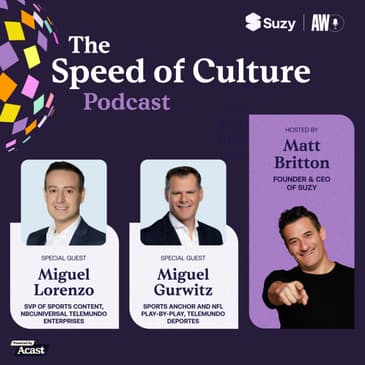
Live from South Beach, Matt Britton sits down with Miguel Lorenzo and Miguel Gurwitz from NBCUniversal Telemundo Enterprises to explore the future of soccer in North America. They discuss the logistical complexity of the 104 game FIFA World Cup and how Telemundo is leveraging Peacock and FAST channels to engage fans. The conversation dives into the art of sports storytelling and the role of technology in bringing viewers closer to the athletes.
Follow Suzy on Twitter: @AskSuzyBiz
Follow Miguel Lorenzo on LinkedIn
Follow Miguel Gurwitz on LinkedIn
Subscribe to The Speed of Culture on your favorite podcast platform.
And if you have a question or suggestions for the show, send us an email at suzy@suzy.com
Hosted on Acast. See acast.com/privacy for more information.
[00:00:00] Well, you have to go where the audience is. If you try to do it the other way around, good luck. And we're in a great spot that on the streaming side, we're able to tap into Peacock that has over 46 million paid subscribers. And you mentioned social. And then there's also Fast, which is an emerging and growing proposition being free. So we recently launched Telemundo de Porta Saora, our 24-7 sports fast channel in August. And that's a big priority for us so that we can reach new audiences and grow the overall brand.
[00:00:27] To thrive in a rapidly evolving landscape, brands must move at an ever increasing pace. I'm Matt Britton, founder and CEO of Suzy. Join me and key industry leaders as we dive deep into the shifting consumer trends within their industry, why it matters now, and how you can keep up. Welcome to the Speed of Culture.
[00:00:49] We're here live in South Beach at the Possible Conference. And today we are thrilled to welcome Miguel Lorenzo and Miguel Gerwitz from NBCUniversal Telemundo Enterprise. Miguel Lorenzo oversees sports content strategy, live production, streaming, fast channels, and rights acquisitions for Telemundo Deportes, helping shape the future of Spanish language sports media. Miguel Gerwitz is one of the network's leading on-air voices, covering everything from the FIFA World Cup and Olympic Games to NFL Sunday Night Football. Gentlemen, so great to see you. Thank you.
[00:01:18] Normally we don't have two guests, so it's a lot for me to get through the introduction, but I'm incredibly excited. And I would just love to hear from both of you why you're here at the Possible Conference and why you're so excited about the core topic we're going to discuss today, which is the World Cup coming here to America. Yeah, I mean, you hit it. We're here because of the World Cup. It's the biggest sporting event in the world. I would argue it's the most logistically complex sporting event that's ever been organized this iteration because the expanded format, now there's 104 games.
[00:01:45] It's taking place in the United States, Canada, and Mexico. Last time the World Cup was in the United States in 94, it really took soccer to the next level. It kick-started MLS. So we anticipate that this World Cup is going to have similar type of effects for soccer fandom in this country. Yeah, and of course, soccer, or as most people call it football, has really had an explosion of popularity here in North America.
[00:02:06] And every four years when the World Cup comes back, I think there's exponential growth. More players are well-known to even casual average fans. Of course, here in Miami, you know, we've had Lionel Messi come and enter Miami, which has obviously created massive fanaticism around not only him, but the sport in general. So we'd love to hear from you, Miguel, like what you're seeing with fans. And how do you think they're going to be opening their arms to this incredible new event coming here?
[00:02:36] This is a multicultural country. Yeah. And we have a lot of Hispanics, a lot of Latinos. They love football. They love football. That's our sport. Yeah. And this is a huge opportunity, you know, to engage, to connect, not only with the sport, with their country. And we are so excited to be in that middle position between the players and the fans. Yeah. So it's really exciting for us. There's no bigger sporting event in the world that FIFA will go.
[00:03:04] Yeah. I mean, sports right now is just bigger than ever before. I think in a time where people might feel divided, sports is the ultimate unifier. You know, there's few experiences that you can have, unfortunately, in today's day and age where you'll have a stadium full of people. Yeah.
[00:03:50] Yeah.
[00:04:20] Well, you have to go where the audience is. If you try to do it the other way around, good luck. Exactly. And we're in a great spot that on the streaming side, we're able to tap into Peacock. It has over 46 million paid subscribers. It's a huge fan base of content and sports is one of the big drivers of Peacock. And you mentioned social. I mean, Telemundo across its different verticals, whether it's news, entertainment, sports, we have some of the biggest social followings in Spanish language in the world.
[00:04:46] And then there's also Fast, which is an emerging and growing proposition. Being free, that's one of the great benefits of it. And so we recently launched Telemundo de Porta Saora, our 24-7 sports fast channel in August. And that's a big priority for us so that we can reach new audiences and grow the overall brand.
[00:05:01] Yeah. I mean, the fast networks, the viewing data is just mind-blowing because it's easy. It pops up on people's devices. And I think increasingly we're seeing that these device manufacturers are looking at it as a revenue opportunity as well. And it's really changing the way that a lot of people do consume television.
[00:05:20] And for us, it's an opportunity to expand our sports portfolio. When you look at different platforms, if you're only maybe focused on linear, you're going to have limited programming windows, especially at Telemundo where you aren't just a sports network, you have news, entertainment. So by having streaming, by having fast, now we can derive more value out of our sports rights. And we can also go after other properties that maybe wouldn't work for linear, but we can experiment even if there's not a lot of data behind it.
[00:05:46] We can take some more shots on different properties that ultimately can grow audiences. One thing I've noticed in the past when you have a major franchise or major event coming in is to get more people interested and aware, it's about the stories behind the athletes. And so many of these athletes have such incredible stories and the path they took to get there on the pitch during the World Cup.
[00:06:08] And we'd just love to hear from you when you speak to athletes, when you speak to fans, what are some of the stories that you think really hit home that will get people more interested and tuning in? At the end, people, maybe they forget that they are like simple human beings. Right. They had the same struggles maybe that you had in your career, but they're not always able to open those doors to the people. And for us, that's a great opportunity to know more of the athletes.
[00:06:35] Who's behind the Leo Messi that you see in the pitch and you cheer for him? Who's behind Lionel Messi? Who's behind Cristiano Ronaldo? And for me, it's not about the player. It's about the story of the player. And I love the underdog stories. I've been finding more interesting stories in those athletes that they're not so popular. Yeah. But they have a great backstory. Yeah. Because ultimately, it's about relatability, right?
[00:07:03] You want people to see a bit of themselves in the athlete. And then the next time they tune in, they're going to be following that person. They're going to care more and want to be more engaged. That's part of our job, to engage people. I think it's not easy. Believe me. The easy part of sports is the game itself. That's the easy part. It's not easy because you have a lot of components that you have to bring together. But our challenge is what happens after the final whistle? What's going to happen?
[00:07:32] Because back in the day, maybe in 1990s, I started in 1990s. I'm not that old. And it was all about the match and the TV show. Right. So you, as the broadcaster, you had the power over the people. I'm going to tell you, you're going to need to watch the game from three to five. And then my TV show from eight or nine. Right. That's over. That is so over. When the final whistle comes, that's when the difficult or the creative or the challenging part comes in.
[00:08:01] You need to keep the people involved. And a lot of platforms we talked about, YouTube, Fast, Peacock, all these platforms, you need to create content for them 24-7. It's not only about the match. Also, I think one big thing that's changed is the athletes have their own brand and their own voice. So I think you can see what athletes are wearing when they're walking in and out of the arena. You can see the things that they say, how they react, and those become stories in their own right. So it is a 24-7 cycle.
[00:08:30] And you're right, it's not just about when the whistle starts and the whistle ends. It's about everything in between. And that's all part of the story of sport. Yeah. And I think that the way that people are consuming content has changed a lot. Of course. You just named it. It's what is he dressing? What shoes does he have? I mean, in 1995, who cared? Right. Nobody cared about it. It's all about knowing more about the sport and the players. And in today's environment, a lot of them are weighing in on political issues and social
[00:08:59] issues and all sorts of things, especially when you're talking about a global event like the World Cup. How do you balance something like that? Because on one hand, people go to a sporting event or tune into a sporting event to escape from the everyday world. But on the other hand, these people, they come from different backgrounds and different experiences. And you almost want them to have a platform. So do you find that that's a balancing act? I think so. You just mentioned it before. I think sports is the only platform that has a power to unite people.
[00:09:29] That's right. Unify everything. 1994, we had that beautiful picture with United States and Iran together. That only sports is able to do that. You have a lot of examples in Olympics. It's this guy from Qatar and this guy from Italy sharing the gold medal at the same time. Hey, what do we do? Do you want to share the gold medal? Oh, yeah, let's do it. That only sports has that power. And for us, that's a great opportunity to, you know, develop those kind of stories. Yeah.
[00:09:58] So for Telmo and for NBC more broadly, what are some of the more interesting ways that you're looking to broadcast these matches and just give them a deeper experience in the World Cup overall? So there's a lot of priorities with the World Cup. I'd say one of the most important is our on-air talent. And just today, this morning, we announced the first wave of FIFA legends and experts. We'll be joining Telemundo. Some big names like Andres Guardado, who used to be the captain of the Mexican national team. Jose Peckerman, who coached Colombia.
[00:10:28] Guti, who was a Real Madrid legend. They'll be joining Miguel and the rest of the Telemundo Deportes team. And we think not only big names, but big names that come from a diverse background are so critical to what we want to do. Because we know that Hispanics aren't just from one country. They're many. And they're all going to be represented not only in the World Cup, but in our talent. And we think that if you watch a World Cup game and you hear commentary and you hear points of views from voices that you recognize, that voices are relatable to you, we think that's
[00:10:57] the most authentic viewing experience that we can create. And we think that's a differentiator for us. There's 104 games. It's a lot of ground to cover in 16 cities, three major countries. But we're going to be live at every single game. That for us is also a priority because this World Cup, more than any other, is a local World Cup. It's taking place in our country, in our cities, in our communities. And going back to the storytelling opportunities, it's storytelling opportunities around players, coaches, but of the fans. We're traveling from all over the world. Exactly. You have the millions here and the millions coming in.
[00:11:26] Think about the storytelling opportunities. Soccer fandom is so different in Mexico compared to the United States. But even within the United States, soccer fandom here in Miami is pretty different than Seattle. Yeah. And then you, on top of that, add all the different communities around the world that are going to be coming. It's going to be an amazing storytelling opportunity. Yeah. I mean, if you love telling stories, what better time than this summer to do so? Yeah. And you're seeing a demand in terms of just record prices for tickets and hotels and everything.
[00:11:54] And it's going to obviously have a massive economic impact on every city that hosts it. Absolutely. So one thing, this is just a curious question I have, is one thing that's obviously changed in the world of sports now than four years ago is the legalization of gambling, sports gambling, which obviously has had a massive impact. There are people that say it's great because it drives more fandom. There's people that say it's not so great. Just curious. And the obviously of fantasy sports and all sorts of extensions of that.
[00:12:24] Do you think it's a good thing for the game? Do you see it bring more people into the fold? Just curious your thoughts on that and how it's impacting sports, the business of sports. I mean, we've seen, for example, if you take fantasy sports, whether it's football or soccer, it's something that's really engaging and that it generates consumption for games itself that maybe you otherwise wouldn't care about. You may not care about a Browns versus Raiders game, but you might want to watch it because you have players writing. That's right. So in that sense, it's definitely had a huge impact in viewership.
[00:12:53] And then you see on the content side how it's a priority and how we incorporate that into broadcast, whether it's leading up to the games or the analysis afterwards. I think it's had a huge impact. And I think technology is helping for these experience to evolve. I mean, if you take AI, for example, the way AI is allowing more in-depth data and analysis of maybe your draft strategies or maybe your lineup changes. I mean, it hasn't helped you much. I know. I know. I know. I was no need. No need to rub it in. AI has a way to go.
[00:13:22] But no, I mean, I think there's a lot of benefits to it, both in the amount of engagement that it has with audiences and how it is basically another tool in the storytelling kit opportunity for us with broadcast. We'll be right back with the Speed of Culture after a few words from our sponsors. At CES, we spoke to the marketing leadership team at Lenovo, who's a big sponsor of the FIFA World Cup. And they were talking about new technology they're deploying on the field to have special
[00:13:49] cameras that are attached to the referees and all sorts. So the new advancements in technology allows fans to be brought closer to the game than ever before. Are those elements that you're also leaning to, I would imagine, for the broadcasting strategy? Yeah. So the RefCam, for example, is something we're really excited about. Yeah. They tested it in the Club World Cup. They're going to have it in this World Cup. So that'll be part of our broadcast. And really, when you look at new technology, there's a couple of ways to look at it. One is, how do you improve the overall viewing experience?
[00:14:17] And then how do you use that to try to engage new audiences and younger audiences? So leagues and media companies are trying to attract younger audiences, and they, in their content consumption, focus on personalization. They focus on gamification. Yeah. It's no surprise you see some broadcasters create all casts of games, and they do it with different camera angles. They do it with data overlays that basically resemble if you're playing Madden or NBA 2K. So that's done very intentionally to try to attract audiences. Right.
[00:14:46] Maybe it's to watch, for them, sports that way moving forward. Maybe it's just a gateway to, oh, now I'm interested in this, and maybe I'll also- Like how the Manning brothers do. Exactly. Right. Yeah. Or I think Nickelodeon with the NFL. Right. Yes. So there's a lot of different opportunities, and you have to be constantly looking to evolve your broadcast, because if you're only focused in one particular way of doing it, you're going to limit your opportunities to speak to other audiences. Right. At the same time, I would imagine it's a balancing act, because the sport has been around for so
[00:15:13] long, and there's purists and people that just love the game, and sometimes maybe the technology, like I forget what the instance was where they had a drone camera. I don't think it was your network, but it was dizzying to the person that was watching it, and actually distracted them and took away from consuming the game. So technology, I think when additive can be really powerful, but if you push it just for the sake of pushing it, and people can't focus on what they're trying to watch, I would imagine that has deterring.
[00:15:42] There's got to be a value to it. If it's just, hey, let's have this shiny object. Right. Just to show we have it. Exactly. But if you do it in a way that's really going to enhance the viewing experience, and if you do it also tactically, maybe roll it out a little bit, and then as it gets more adoption, more buy-in, then you can have more of it. But to your point, it's important to have a viewing experience for everybody, and having it on different platforms, and having different platforms available gives you the flexibility to do that. And what are some of the new ways advertisers are looking to activate this event?
[00:16:11] Because I know you work with a lot of advertisers trying to bring the incredible exposure that World Cup will bring to their brands. What are some of the ways that you're leaning in there? I think having multiple platforms gives brands the opportunity to engage audiences in ways that they never have before. I think if you're a brand right now, this is the best moment to be able to do that, especially in sports. As you mentioned, it's the unifier. It's also the type of content that can still draw audiences. Live. Live. Live. Not right. Yeah.
[00:16:40] And then when you have different platforms, it gives you flexibility to speak to audiences. And you also mentioned this 24-7. It's not just right before the game, during, and after. It's really, truly 24 hours a day. And brands leaning into that, I think, well-positioned themselves to attract those audiences. Yeah. I mean, and I think what's really great about the World Cup is you don't have to deal with the time zone issues from the Olympics where if it's a seven-hour delay, what do you show live? What's delayed? You don't really have those issues here if everything's in North America.
[00:17:08] So at least for the audience here, I mean, it creates an ideal situation to really garner eyeballs, I would imagine. And that's one of the reasons, one of the many reasons why this World Cup is going to be so special. Not just that it's in our communities, but it's in our time zones, right? Right. So primetime audiences, it's viewing throughout 39 days. We're really excited. Amazing. So, Miguel, just curious from your perspective, what does preparation look like for an event like this? It's happening this summer. What are you doing over the next couple months to make sure that you're game ready, so to speak?
[00:17:37] Because this is a big deal, right? It's three things. Read, read, and read. Okay. Keep reading. Yeah, you need to prepare yourself. Right. I mean, maybe 20 years ago, you can get away with a couple of mistakes on air. Nobody knows. Right. Nobody had the opportunity to connect. Yeah. Hey, you're wrong about this. Now? Oh, forget about it. Oh, forget about it. Right. Like this. So you need to be prepared.
[00:18:08] Super Bowl preview. And now it's not about the pregame. It's about preparing yourself and be ready to react because it's life. You never know what's going to happen. And that is so, so exciting. That's powerful. You have your research. Okay. You can read maybe three books. How are you going to adapt those three books in 45 minutes? What are you taking more consideration? The game or maybe the story? Is that the time to tell the story about the player?
[00:18:36] So you need to have everything ready to adapt. Because as I said, it's sport. It's life. It's unpredictable. It's unpredictable. And in Mexican Spanish, we have a phrase. I hope I don't get missed in translation. It's called, tell your plans to God and then he will laugh. Right. So you don't have a script. You need to be ready. Well, Mike Tyson once famously says, everybody has a plan until you get punched in the face. Yeah. Yeah. That's another one. That's the more American way of putting it. I mean, it's not maybe, I don't want to get philosophic,
[00:19:06] but it's like life itself. You don't know what's going to happen tomorrow. Right. You don't know what's going to happen after the minute, 35 minutes. So you need to be prepared. You have to know your research and then adapt to life. So we have a lot of younger listeners on the podcast and some of which probably want to be on air one day. And obviously you have an amazing job and I know it's hard, but I also think it comes with a lot of benefits and you have a great experiences. What were some of the things that you've done along the path of your career to set yourself
[00:19:35] up for the position that you're in today? I mean, it's fun. I love what I do. Yeah. It's demanding. It has like all other jobs, not the fun part because you spend a lot of, you know, weekends without your family. Yeah. I'm going to tell you a story. My wife, we've been together maybe 30 years. I spent top five years in her birthday because it's March 26th. It's always a FIFA match. Right. Always a FIFA match. You do a lot of sacrifices, but it's a beautiful, I mean.
[00:20:05] Sounds like she's very understanding. Oh yeah, she, I have a hashtag that in Spanish is, le dicen trabajo. They call it a job and it's not because it's fun and I love what I do. I love what I do in the company that I'm at. What I really appreciate about Telemundo is that, and it's challenging, but they took this challenge the best way possible. When Miguel spoke about the multicultural people in this country, you're not only talking to
[00:20:31] the Mexicans or to the Venezuelans or to Colombians, you need to attend every single audience and going back to the point, you need to prepare for those. That's right. Because I don't know if a Colombian has a Mexican calling a game, maybe he's like, this doesn't resonate. I want to hear a Colombian guy. And this is what we've been doing. In this preparation, we need to talk to the specific audience. Absolutely. So we're here at the Possible Conference in Miami and it's a huge temple every year for
[00:21:00] the marketing and advertising community. Just curious what you hope to get out of this conference. Obviously, it's local here in South Beach. It doesn't hurt, but how are you spending your time here? And what are some of the more interesting things that you're looking to learn from other brands and other entertainment companies that are participating? Yeah, I think it's always interesting to see what brands' priorities are when it comes to reaching audiences and how they want to do that, what their timing is, what their priorities are. And in this particular moment, it's seeing how we can mirror that with the opportunity that we have this summer, which is the World Cup.
[00:21:30] I mean, Telemundo is on the biggest sporting events along with NBC Sports. We've had the Super Bowl, the Olympics. For us, nothing is bigger than the World Cup this summer. So it's always interesting. Okay, that's our priority. How does that align with brands and their priority? And then what are opportunities that we can collaborate? Right. Because you know that you're going to be able to get them eyeballs and awareness and impressions. But how? And how is it going to meet their business needs, right? Are you going to need to drive more engagement, help them collect first-party data, whatever
[00:21:58] those things are that they're prioritizing? And to your point, how do you connect the two to see if there's a marriage? And at this point, I would imagine it's probably too late for the World Cup, but probably for the future, right? It's never too late for me. Really? Okay. We are 45 days away. We heard it, everyone. These guys are ready to do business. Bring out your checkbook and yeah. And open. But yes, certainly in the future, whether it's future World Cups, future Olympics, future temples, there's always an opportunity to learn from an existing opportunity and apply it forward. Very cool.
[00:22:25] So we always wrap our podcast up asking our guests if there's a saying or mantra that helps kind of encapsulate the professional journey. And we're talking about sports. Sports is all about mantras, right? And since there's two of you here, I'm going to have you each tell me a mantra and then tell me why that's what you peck. So let's start with you. So probably cliche, but it really does apply to me. And that's don't be afraid to step out of your comfort zone. There's been so many pivots in my career that have been either doors that I didn't even know
[00:22:54] existed or doors that I wasn't interested in, but they opened and I dove into it either because I felt this is an interesting opportunity. I can learn something new or I can pick up experiences along the way, even if it's not necessarily something I envision myself doing long-term. And in every step of the way, it has helped me both professionally and personally. And I think more on the personal side, the other thing is I always try to look at the positive and everything. Again, pretty cliche, but you know, the way I was raised, my had generations of my family that left Cuba to the United States literally with nothing.
[00:23:23] So I find myself always thinking, what do I have to complain about when I think of what the sacrifices that they had to make? And that has always helped give me good perspective, good balance, never take myself seriously, work hard and always try to help others where I can. Yeah, I think perspective is so important. And on your first point, I think many people just either are afraid to make that leap or just are looking for a sense of conviction before they do so. And sometimes you do just have to act on intuition, right?
[00:23:51] Like what has caused you throughout your career to have the conviction to make a leap? What comes to mind for you? Well, I started my career at the local TV station here in Miami, WTVJ. I was on the linear side, actually started as a sports broadcaster. Really? The camera. Eventually. I buy that. I could see it. Thank you. And the opportunity to come to Telemundo was twofold in things that I had no experience in. One, it was in Spanish. I speak Spanish, but I had never worked in Spanish. And the other was in digital, whereas my experience up until that time was only linear.
[00:24:21] But I saw it as two opportunities to grow, two opportunities to be exposed to things that I saw, okay, Hispanics are growing in this country, Spanish isn't going anywhere. And digital and streaming is obviously going to be increasing as time goes on. This is a great opportunity to learn. And I dove into it. It has developed into so many other opportunities, even within Telemundo that I never studied for it. But I learned on the go. There was a need. I did it. And it's really helped serve me to this point. Fantastic. What comes to mind for you? You've had a lot of time in prep now listening.
[00:24:51] Yeah. No, it's for me. I always, when I have this Saturday, we have the Kentucky Derby. Next night, it's going to be Mexican soccer. So for me, it's always the same thing. I think about the same thing. Consider this broadcast as it's going to be your first and your last one. Why? Because you need to prepare. You need to have that butterfly. Yeah. You need to feel that. And I'm being serious. There's not one. And I've been working in this industry maybe now 30 years.
[00:25:21] I never went to the air like feeling I'm so chilled and cold and relaxed. Never. Right. It's think about the next broadcast if it's the first one and the last one. So you need to be prepared. You need to be ready. You need to be exciting because you never know what's going to happen. And the audience feels it. And if it feels like it's just another routine, then there's the emotion. So I always go with that mindset. And can I just add, he is so versatile in everything that he does.
[00:25:50] And you mentioned all the different sports that you've heard. And he's always got this disposition of preparation, but of also, again, needs of, hey, we have the Kentucky Derby. All right, let's do it. How can I help? And that is such a great quality and something that obviously we and I keep on. Yeah. Freshers are privileged, as they say, right? You know, being able to be in those environments is obviously such a privilege. And being able to travel these incredible experiences is an amazing way to spend your career.
[00:26:16] And then you think about the millions of people that will die for one opportunity that you have every single day or every single week. Yeah. Well, it's clear you've earned it. Yeah. And I really appreciate the both of you taking time out of your busy schedule as we lead up to the World Cup to share your stories and what you're experiencing with this incredible activation. So wishing you just a lot of luck this summer. And everyone, be sure to tune in to the World Cup wherever you are. Thanks so much. On behalf of Suzy, I would team.
[00:26:45] Thanks again to Miguel Lorenzo and Miguel Gerwitz from NBCUniversal Telemodo Enterprises for joining us today. Be sure to subscribe, rate, and view the Speed of Culture podcast on your favorite podcast platform. We're here at the possible conference in Miami. Talk soon. Bye-bye. The Speed of Culture is brought to you by Suzy as part of the Adweek Podcast Network and Agast Creator Network. You can listen and subscribe to all Adweek's podcasts by visiting adweek.com slash podcasts.
[00:27:13] To find out more about Suzy, head to suzy.com. And make sure to search for the Speed of Culture in Apple Podcasts, Spotify, or anywhere else podcasts are found. Click follow so you don't miss out on any future episodes. On behalf of the team here at Suzy, thanks for listening.