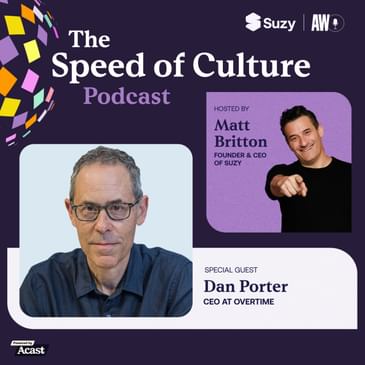
On The Speed of Culture Podcast, Dan Porter, CEO of Overtime, breaks down how the next generation of sports fans consume content, why Gen Z is rewriting the rules of engagement, and how Overtime is building leagues, media, and commerce for the digital-first era.
Follow Suzy on Twitter: @AskSuzyBiz
Follow Dan Porter on LinkedIn
Subscribe to The Speed of Culture on your favorite podcast platform.
And if you have a question or suggestions for the show, send us an email at suzy@suzy.com
Hosted on Acast. See acast.com/privacy for more information.
[00:00:02] Als mein Mitarbeiter plötzlich kündigte, musste mir schnell etwas einfallen, um die Aufträge weiterhin reibungslos ausführen zu können. Ich musste sofort eine Lösung finden. Da kam mir Indeed in den Sinn. Wenn es ums Einstellen geht, ist Indeed alles, was du brauchst. Mit gesponserten Stellen wird dein Angebot für relevante Kandidatinnen ganz oben auf der Seite platziert, damit du die gewünschten Personen schneller erreichst. Bevor ich von Indeed wusste, waren die Kandidatinnen oft nicht optimal, mal zu langsam oder unterqualifiziert.
[00:00:30] Dann fing ich wieder von vorne an mit einer neuen Stellenausschreibung. Das kostet Zeit und Geld. Wie schnell ist Indeed? In der Minute, in der ich mit dir gesprochen habe, wurden weltweit 23 Einstellungen über Indeed vorgenommen, laut Indeed-Daten. Es gibt keinen Grund zu warten. Beschleunige dein Recruiting jetzt mit Indeed. Und Hörerinnen dieser Sendung erhalten ein Guthaben von 75 Euro für eine gesponserte Stelle, damit dein Stellenangebot mehr Sichtbarkeit erhält auf indeed.de-podcast.de.
[00:00:58] Es gelten die allgemeinen Geschäftsbedingungen. Wir kamen in und wir kreaten etwas, das sehr nisch war, das nur hardcore oder Mäste und Eltern überrascht. Und komplett kreaten etwas, das 10 Millionen Menschen überrascht. Um in einem rápidig evolvenden Landschaft zu leben, müssen die Branden in einem ever-increasingen Pace gehen. Ich bin Matt Britton, Founder und CEO von SUSI.
[00:01:22] Join me and key industry leaders as we dive deep into the shifting consumer trends within their industry, why it matters now, and how you can keep up. Welcome to The Speed of Culture. Up today on The Speed of Culture, we're thrilled to welcome here in New York Dan Porter, the CEO of Overtime. From watching disruptive leagues to empowering athletes and redefining fan engagement, Dan's journey is nothing short of extraordinary. I'm a huge sports fan. I can't wait to dive in today. Dan, so great to see you.
[00:01:52] Thanks for having me. Absolutely. So for those in the audience that don't know what Overtime is, would you mind just giving us kind of a quick primer of the business? Yeah. Overtime is a next-generation sports brand, kind of specifically started to target Gen Z sports fans. When I started, the easiest thing for me to say was that someone's going to create the next ESPN, and I think it's going to be us. I had run the digital talent division at Endeavor and represented a lot of the biggest YouTubers.
[00:02:20] And the average age of a sports fan in this country is 40, 50, 60 years old. Yeah. And young people consume in a really different way. And we went out to capture them ultimately in their attention. And so today, if you look at the business, it's 110 million followers across all of our different accounts. It's got kind of 90% brand recognition among young people.
[00:02:42] Our visual language, our captions, the way that we talk and publish on social is really just geared to that specific audience. And then in general, we cover some professional sports, but we really focus on kind of 17, 18, 19-year-old athletes who we think are going to be the next-generation stars and talk about and cover them almost as if they're creators and influencers.
[00:03:05] So there was a whole generation of people who found us because we were the first people to talk about Zion Williamson and LaMelo Ball and Trevor Lawrence and a number of athletes like that. And if you look at the business today, after building a really big community and media platform, we decided to be kind of vertically integrated. We also own and operate several sports leagues. So we own and operate Overtime Elite, which is a basketball league of eight teams with some of the best 17 to 20-year-old players in the world.
[00:03:36] Live games, everything you could think, almost like a young person's NBA. Four of our players have been top 10 draft picks in the NBA. Thompson Brothers, I know. Yeah, Thompson Brothers. Last year, we had the number two and eight pick in the NBA draft. Who didn't go to college, correct? Correct. One of them went to Kentucky. One of them did. So when we started before NIL, we were like, come to us and you'll go to the NBA. Everyone got upset about that because they felt we were taking the best players out of college sports.
[00:04:04] And somehow all of a sudden NIL came and you were able to pay players. And I think we were a big influencer on that. And so now our players might go to the NBA, but they might also this year we have two guys going to Kansas, going elsewhere. And part of that is because even if they could go to the NBA, because they can get paid a significant money via NIL, they're taking that opportunity to play and train for another year and earn money, which they should. And that was a huge part empowerment of what we did.
[00:04:30] I think a lot of people are surprised that I would say we're the second biggest basketball league in the world. We have more followers than any other league, including college and more engagements on digital. And part of that is because there's a massive generation of young people who want to see young people. And like that's who they care about and that's who motivate them. Part of that is because our top of the funnel is 100 million follower of account.
[00:04:56] I could say in a similar way, if the audience is having trouble digesting that, could you imagine if Mr. Beast tomorrow started his own basketball league? How many people? Look what he's done when he was launched at Burger Place. Yeah, right. So I think it's the same type of thing there. And I think it's also sometimes the storytelling and access you get with younger athletes is really different. We can make videos, do podcasts, do a lot of other things.
[00:05:22] And their agent from a big agency isn't in the way or in the middle the same way somebody who's in their third year in the NBA who's talking about kind of doing all that. So for us, we've ended up being in a very vertically integrated position where you have this media company. We're also a rights holder through our own rights. And then we also partner. So we're an NFL partner and we work closely with NBC around the Olympics. But at the end of the day, the very simple thing is we just wanted to reach everybody we could in Gen Z.
[00:05:50] And sports as a form of culture was the way we decided to do that. Right. You stayed true to what the calling of the business was. Yeah. I was like, it kind of just took it. I'm sure when you started over time, you didn't foresee yourself running a sports league one. No, no idea. Actually, I didn't even know what the product was. I would just feel like, let's figure out how to get 17-year-old sports fans to love us because they're not engaged anywhere else. And so we tried a ton of different stuff. We failed. David Stern, the former NBA commissioner, was one of our first investors.
[00:06:19] And ultimately, not only did we not see that, I think one of the biggest things I learned is how much you can reach the next generation through the intersection of sports and culture. A lot of people don't know, but we're actually the overtime kicks. Our sneakers account is the biggest sneakers account on TikTok. And I think ultimately, it's this mindset that is driven by a couple of maxims. I think number one is that sports is culture. So is music. So is fashion.
[00:06:48] And if you think about sports just as a dunks and touchdowns, you miss that aspect. But if you think about sports broadly as an aspect of culture, you understand that. I'd say number two is like, I think our mantra was sports media is about talking to the audience. Overtime is about listening to the audience. So our kind of street team probably has been to over a thousand gyms. We were at like 10 different gyms in the last three days where somebody in an overtime hoodie pulled up, made content, and millions of people saw it.
[00:07:17] And we have a full-time team that responds to millions of comments and messages. There's no scale. There's no AI. There's nothing that is like secret sauce about it other than nobody else is scalable. It's a definition of being consumer-centric, right? I think if we think about those things, and I think the third thing, as we said, it's kind of like if you know exactly who your audience is, you have permission to talk to them in a certain way.
[00:07:42] If you are an ESPN, for example, which is a great company, they just reach a lot of different people. They can't go in with whatever the most recent slang or lingo or meme is and talk to the audience because a bunch of people in their 40s and 50s will be like, I completely don't understand what this is about. For us, we have that permission. And the example I like to say is when we were at the Olympics, Noah Lyles won, and our guy was right there, and he asked him what anime are you on right now?
[00:08:10] And he had an answer, Hunter x Hunter was his answer. And I think like 90% of sports fans would be like, what is that? And what is anime? And why are you guys talking about that? And I think our audience is like, oh, this is what we expect from overtime. We have the permission both from him as an athlete, like Bob Costas isn't going to ask him that question and also for the viewers. So it's like, that's the kind of what sits on top of everything. Yeah, because athletes in general used to just be this linear kind of engagement. Like when I was growing up, you would see that on TV.
[00:08:40] You wouldn't see them even be able to walk into the stadium and what they were wearing, like, let alone social media and sharing everything. It's the religion idea that you had their baseball card. And that was about it. That's exactly right. And it's completely changed. So incredible story. And like, you basically have given me so much to unpack for this podcast that like all the questions I had in advance aren't even as relevant now because there are just some key themes I've identified. I'd love to unpack with you.
[00:09:04] The first and foremost, the one thing you said was that the way that sports is consumed is different now. And recently there was a lot of news about the NBA's ratings being down. But at the same time, the NBA stars as individuals are making more money at every beat or are more globally famous than every beat or are more globally famous than every beat or are more globally famous than every beat or are more globally famous than every beat or more. So that's like a dichotomy. And I would have to imagine at the root of that is the ways in which young people like to consume sports content, like they're into the song and not the album sort of thing or into the highlights.
[00:09:33] Like, so tell me about why you think it's changed. And ultimately, how does Gen Z and now Gen Alpha want to interact with sports content? Yeah, for sure. I think that you're right. Like, did you get that album? Well, I have every album that ever existed. I have Spotify. Right. Like, I actually I'm old. I like albums. I'm like, oh, there's a new release. I'm like, it's a single. I don't listen to singles. I listen to albums. You think about the generational changes. I will say my dad wore a suit to her. Yeah, I didn't wear a suit and my kids don't dress like me. We don't listen to the same music.
[00:10:03] For those listening, he's wearing a cool green hood. Yeah, we don't do any of those things that are similar. And you look at the way generational change impacts fast, casual eating, like all of these things. And yet sports, because probably sports is closer to religion than a lot of those. I could watch Monday Night Football. And it kind of looks like when I was a kid watching Howard Cosell on Monday Night Football. And I don't say that as a criticism.
[00:10:28] It's really hard to adapt your product as generations change. I think our advantage is our product is built from the ground up for that. But I think one of the things, there's a couple, like if I were to point to trends in terms of how to reach that audience, I think 100% of young people get all their sports knowledge from social media. They don't read articles. They don't read the newspaper. They don't even see the sports center used to be the way. It's not really anymore. And there's a couple of things about that.
[00:10:56] One is they prefer visual media that's integrated with their other media as opposed to going and pulling out the sports section and reading a long article. I think number two, they want to be able to comment and share and engage, do all that and engage. And I think number three, sometimes they don't care as much who the winner or the loser is. They care about all the other kind of attributes or style points, if you will.
[00:11:21] And I think as you go deeper, like, for example, I play the fantasy football and I'm in two leagues, one with old people and one with a bunch of 22 year olds. And I look at who they share in our group chat to make picks. And there are actually these like TikTok creators who don't work for any outlet or anything else like that. But those guys know how to go. They know how to use live. They know how to get in there. And they speak to them, I think, in that type of voice.
[00:11:50] And I think more than ever, young people look to kind of either brands that they feel like they helped create as opposed to legacy brands or creators as a way to parse through information. I might look to GQ for a fashion tip. Somebody else might follow somebody on TikTok who says this is what's popping and this is what you should wear. And those are just really different behavior sets. Yeah. And to your point on leagues, like looking the same, I mean, at the NBA is the NBA Cup.
[00:12:20] They're trying to shake it up. The NFL changes their kickoff roles. Major League Baseball now has a timer. Like they're trying to basically make it more palatable for younger people. Yeah. Listen, I think Adam Silver is really, really smart. And the NBA is really good at a lot of those things. NFL also really talented. Their ability to work with creators at scale and so forth. I just think it's hard because you have to please a lot of people at the same time.
[00:12:47] And I think it's interesting because everybody's like in sports media obsessed with inside the NBA. What's going to happen? The NBA is not going to be on Turner. What about that show? If you look at kind of the Amazons and the NBC who now have NBA rights, all of the chatter is like who's going to host their show for them. I got to tell you, nobody watches those shows. Like the amount of people who watch those shows is less than an average YouTuber gets every day.
[00:13:14] And yet there's an obsession over how much Tom Brady got paid to be. Right. There's an obsession over who's going to watch those shows. And I'm like, those shows are fine, but nobody watches them. They don't make people tune in. And I think it takes a while. Like I think a Mr. Beast will say everyone is excited when 100 million people watch the Super Bowl, but 250 million people watch one of my videos. It takes a long time for people to understand like that is actually as big, if not bigger.
[00:13:43] They're like, ah, he's a YouTuber. It's not the same. But I'm like, if an audience member is watching him for 25 minutes or watching the Super Bowl for 25 minutes, what really is the difference there? It's just 25 minutes of attention. 100%. One big driver of, I think, the changing nature of engagement with sports is gambling. Yeah. And it's everywhere. You can't miss it. Some people think it's an epidemic. The league, surprisingly, are now way more behind it than I once thought they ever would be. You know, I use FanDuel sometimes. I mean, it gets fun, but I do it in moderation. Some people aren't able to do that.
[00:14:13] What is your take on the impact of gambling on sports? I think that if you have skin in the game, clearly you are more likely. Just like fantasy. Yeah. Just like fantasy. So I think there's positives there. I think that, listen, it's a free country. If you're 21, you can smoke, drink, gamble on sports and do anything you want. I think for us, I haven't put a ton of time and energy into that because I'd rather celebrate other aspects about shorts.
[00:14:43] I think that in general, well, people like to bet on the election, too. Like there's a lot of that, like Europe has said about America for a long time. You guys are weirdly moralistic about this stuff. Right. But I think you're going to have both. You're going to have edge behavior where athletes make terrible mistakes and young people get into a terrible amount of debt. And that's true with alcohol. And it's true with fast food. And it's true with a lot of figs. Yeah, true.
[00:15:10] But I think in general, I think it's interactive participation. And I think it's great for sports overall. One thing I want to go back to is, please, we are an NFL partner and we have a really amazing partnership with them. And what we do is we kind of create content around 10 poll events with them that don't have to do with the highlights. Such as? So we'll go to the Super Bowl and we'll create 254 pieces of content where we find the athletes. We might ask them funny questions like at a party.
[00:15:40] You might go to like, yeah, we're on Radio Row or something. We could grab Tyreek Hill and say, are you actually faster than a cheetah or anything else like that? And the NFL has been really just incredibly positive and supportive about understanding that that's our lane. They get it. Yeah. And like you guys and they facilitate that. And I've been in meetings with the NFL executives where we've shown the content and they say, you know what? We love working with you.
[00:16:08] But what I love about that content is the athletes are all smiling. They're laughing. They think the question is funny. They love to express themselves. And there's a realm of sports, which I understand, which is fire the coach. This guy's overpaid. Bench him. As Eagles fans, I think we consume a lot of that media. That's for sure. But there's also a part where you really do sometimes need an intermediary to help people show the best of these athletes and why you care about them. And I think that's really our puzzle piece there.
[00:16:37] And in the case of NFL and also in the case of the Olympics, they've really understood that and been able to put that in position. Nobody's coming to overtime to ask what the over under is or to say, what should this trade be? But there's a whole other aspect of understanding athletes as people. And listen, that's what the Olympics is about. If you don't fall in love with the athlete, it makes it a lot harder. Yeah, those stories will draw people in. They care about their stories. They're bad. So I almost say like the other trend that you see in sports is the drive to survive trend, right?
[00:17:07] Where everybody wants a non-scripted series alongside so you can get. And Sprint was a good example of that and so forth. There are a lot of those now. I think for us, because we are so dominant on kind of YouTube and short form media, it's almost on us to create the drive to survive series, but as an everyday short form content rather than just create a long form scripted series. So you talk about understanding athletes in the way that like unpacks their lifestyle. But in order for you to launch a league, you guys have to understand how good athletes are.
[00:17:37] So I understand that you created the big media platform and then kind of unpack what you said. It seems like you want to create even more content. The best way to create exclusive athlete content is actually showing them play. Yeah. But in order to do that, you had to identify who was good. So what was that process like? Because that is like a completely tangential business line. Yeah. And I'm just fascinated with how you were able to get that going. I would say that if you had my job and you were like a lifelong sports fan, this would be the absolute dream job. Yeah. You're like, wait, I have to draft 80 athletes and create teams and like actually do this.
[00:18:07] I don't know if I'd be very good at it. Yeah. I mean, listen, first of all, I clearly I don't do it. Like we have very talented people. We have a grassroots network. We have guys who were scouts and recruiters at college level, at the NBA level and so forth. I think there's two main things. Number one is like our sports leagues play for the Internet. They are not city designated teams. They are not school designated. Where are the games?
[00:18:32] Like games are mostly in Atlanta at an arena that we built ourselves as almost like a sound stage. So it's a twelve hundred person arena. But I don't really make money selling tickets or parking or beer or any of those other ways. It's almost like a sound stage where the audience is there as if we were doing a show and the audience was there. And we broadcast every game from there. So in a way, I don't know. So you're getting somebody who's a future NBA player. Yeah.
[00:18:59] Instead of wanting to go play at Duke or Kansas or Kentucky and playing in these crazy Cameron and Indiana, they're going to a sound stage because for them, they know that their ability to basically produce content of them playing is really what are going to matter? Well, I think it's both. I think, first of all, a lot of them now do go to Duke and elsewhere. They'll come to us in 11th or 12th grade. Or as a small digression, a lot of college basketball players take an extra year now because almost no freshman play because of the transfer portal.
[00:19:29] Like the average age in the final four is 23 years old. So there are a lot of people who used to play as freshmen who now take an additional time. So they all participate and play in our league. To them, they're just playing in a high competitive basketball league. It looks like an arena to them. There's fans that cheer. They do the wave. There's cheerleaders. There's all that. But for us, our audience is everyone. So the teams are called the Cold Hearts and the City Reapers. They don't have a city before them.
[00:19:56] The arena is designed all around the cameras and everything else like that. And a lot of different teams play in the same arena so that we can broadcast everywhere in the world. We have people from over 100 countries watch the game. Some of the games are on Prime Video that we have a rights deal with. But some of them you can watch live on TikTok, Instagram, YouTube, and tens of thousands of people will watch there and consume.
[00:20:22] So in a business way, like if you go to Kentucky, you're a Kentucky fan. If you don't go to Kentucky, unless you're watching March Madness, it's highly unlikely you're going to be motivated to watch Kentucky. You're going to watch your own college. Same if you're from a certain city, you're mostly likely to like that team. I think for us, we just strip away in that. And so it's really about simplification. Here's eight teams. You could be from anywhere in the world and you can like them. There's only eight of them. They mostly play on Fridays and Saturdays.
[00:20:51] And that's it. Here's the five stars. It's all about... Is it strange how they play, though? Because if you're playing for Duke, you have somewhat pride. Or if you're playing for the Celtics. But if you're playing for a team that you're just throwing a name on, are they more trying to play for their own stats than the team because the team winning means less? That's actually a really insightful question. I'd say yes and no. First of all, they're still trying to play because they want to get a college offer. Right. And they want to go to the next level.
[00:21:16] And they also understand, like, when John Calipari was recruiting Rob Dillingham and played for us, I had a call with him and he said, Dan, I need team players. I want guys who are team players. So if Coach Cal comes and there's a guy playing for himself, that's actually going to hurt him. Yeah, that's true. To do that. 100%. I think we're the most successful when the guys are friends with each other. We have two players from Pittsburgh who recruited each other, who play on a team. But sometimes you choose guys who only care about themselves.
[00:21:45] And I think that that can be true in other sports. I think we're vastly out of the kind of Derek Jeter. I played for the same team my whole life era anyway. That's like, yeah, you have to create a fan base and an allegiance to something that didn't exist in the world three to four years ago. And that's like an endlessly fascinating business and psychological challenge. Yeah. So kind of the play, the story of the athlete through. So they create content. They become internet famous. They're in your league. They become a professional athlete.
[00:22:13] What we start to see through people like Kevin Durant, who's a mutual investor of ours, or LeBron with Matt Carter and so many other athletes, they're becoming their own media channel. Yeah. Right. As Jay-Z said, they're not a businessman. They're a businessman. Yeah. Right. And that's interesting because the question becomes ultimately like who's in control? Yeah. And is that a good thing? And do you see that continuing in terms of athletes creating their own business ventures? And how's that tie in with your business model? Yeah. Listen, in the abstract, athlete empowerment is great.
[00:22:43] Sure. Of course it is. Of course they get paid, but like to play and to compete. And I will say for ours too, like their goal is to get really good at basketball and make the NBA. And the other thing is it's very difficult to make a player popular if they're not also a good athlete. Right. You could be the most funny, best YouTuber and I could put you on the floor and it won't matter if somebody crosses you over. And vice versa, you need a personality. Like Tim Duncan is famous for being a great player, not great personality. Yeah. He did great as a basketball player, but he's not really an idiot.
[00:23:13] Right. Somebody like an Iverson or someone else like that, you just can't take your eyes off. Anthony Edwards. Yes. Exactly. He is a great example. Great player, also dynamic personality. But if he weren't dunking over KD and everything else like that, it would be hard to get people excited. Of course. But I would say ultimately, also, listen, it's very hard to have a long career. The average career in sports is three or four years. Through social media, you own your own distribution.
[00:23:41] And you've got guys like Pat McAfee, who was a kicker, who's created the media empire. You've got guys like Blake Griffin, who loves movies. He made White Lake on the Pocket. Yeah. Like you've got all those things. And I just think at the end of the day, an athlete used to be about winning a championship for your team in your city, which they still are. But they have attention. And we live in a world where whether you're a YouTuber or an athlete or a musician, your ability to. Oh, no, you're an entrepreneur. Or CEO. Yeah. Yeah.
[00:24:09] Your ability to make a living from that attention is really different than just a stay in your lane. It doesn't mean everyone's good at it. There's lots of athlete brands and companies that have no traction. But I think for the best, it's an opportunity. And all of those things, whether you sing a song, you play a sport, it's just the way that somebody finds you and falls in love with you and then wants to be part of your journey. We'll be right back with The Speed of Culture after a few words from our sponsors.
[00:24:35] So as we discussed before the pod, the Speed of Culture community is one of brand builders and advertisers and digital marketers. And the great thing about sports is it's kind of the last bastion of live televisions. And the Super Bowl is obviously the number one way to garner eyeballs moving forward. So there's no big brand that doesn't have sports on its docket of priorities for heading into 2025.
[00:24:55] In your experience, given that you kind of come at it from a different angle, what are some of the best strategies you see in terms of brands effectively integrating themselves into sports to drive their business? Yeah, it's a great question. I mean, listen, sport, like even a movie, if your friend already saw it, they're going to tell you what happens at the end. Of course, you just never exactly never know. And I think on the brand side, I think nobody gets fired for doing a sports deal like it seems to make sense.
[00:25:22] I think for us, for example, we have a partnership with Gatorade that is a great partnership. By the way, like our athletes consume a lot of that because they want to be hydrated. We played a football event in Florida where it was so hot. I think we went through 27 cases of Gatorade. But Gatorade also cares about having a relationship with who that next generation athlete is. So part of that is like we have a whole bar there. They're introducing and building relationships. Same for Adidas.
[00:25:51] Like Adidas is a massive partner for us. And they understand that when our audience sees the next generation athlete who they look up to and they also feel that they have something in common with wearing Adidas on the court, that's hugely valuable. But they also want to have a reason to have a relationship with those athletes now so that they're not lining up with every other sneaker brand when that athlete because it's big. So I think that those are huge.
[00:26:17] I think that understanding that sometimes so like we've had brands, especially in the auto category sponsor our kind of training courts. And so, you know, you're a big logo on the training court there. And maybe you're an auto brand that is trying to resonate with the younger generation that seems older. And then all of a sudden we're making content there every day. It's not about the live game. Anthony Edwards lives in Atlanta. He comes up, does a couple runs, does something that goes viral.
[00:26:47] And in every single one of those, there's the name of the brand like in the background being engaged. And I'd say also actually like Bevel. Bevel is a really good example. If you don't know what Bevel is, it's a predominantly black oriented kind of hair care, skin care. I think it's owned by the P&G, isn't it? Yeah, they bought it. They sponsor our barbershop. We have a lot of players come through. They want to get a haircut. But all of the content then gets created there.
[00:27:11] And so number one, you've got a clear, almost like stage in partnership with your brand partner to create a lot of content around your product. Yeah. As opposed to just like the play of the game or anything else like that. And number two, you're tapping into a lot of these athletes who are making decisions about what brands are going to align with for the rest of their life.
[00:27:35] And so when you look at the athlete and you look at our audience, some of the superpowers like young people like to buy young people type products. But some is I haven't decided who my bank is for the rest of my life, what car, what my credit card is, all of those. And so being able to inflect those. I think there's a lot of traditional brand advertising in sports. Yeah. I know the play of the game. Does it make a Clydesdale horses? Is it they want to make me buy that or not? But I think you start to see more innovative stuff.
[00:28:03] And I think the brands that also really understand how to work both with the libel men as well as the athlete and the creator are going to have an advantage going forward. I'll give you an example. Like I do love it. The AWS Next Generation stats. I love that. When it's on Amazon on Thursday night for football is really smart. Yeah. It's like, oh, you're not just a brand sponsor. You're telling me the value that your brand has. It's like when our players dunk wearing Adidas and drink Gatorade, they're actually living in his utility. Grand utilities. Exactly. 100%. I love that.
[00:28:33] And people who love data, love Amazon, that they love sports. They love the sports data. 100%. So you've built a fascinating business. And as a sports fan, frankly, like a dream business in terms of all the touch points. So congrats to you on that. Where do you see overtime heading in 2025 or some of the opportunities you have your eye on that continue to drive growth? Yeah. So we have men's basketball, women's basketball. We're in boxing and we have a helmetless football league of the spring that's played by. Fake football? It's not flag football.
[00:29:02] It's like they call it seven on seven. It's like, well, I think in next year's college football playoffs, I believe if the same teams that made it this year make it next year, eight of the 12 quarterbacks to play in that will play in our league. Well, and the Tennessee quarterback currently will have its play play in our league. No, the. Oh, University of Tennessee. Yeah, yeah. I gotcha. And so, again, it's like what you tap into is I want to see the next superstar and I want to see them now. And now I want to go on a journey with them.
[00:29:30] So I don't think there's a world in which we're going to launch 50 million different leagues because it's just you run out of viability in terms of audience. I think what you see from us in 2025 is number one is we continue to figure out how to grow audience for our leagues, you know, get hundreds of thousands of people to watch them. We have three different creators that are kind of owners of the basketball team. I put owners in quotes if you're listening, air quotes.
[00:29:57] So we're linking really popular YouTubers with a team that actually has potential NBA players on it. So I think that's cool. That's big for us. We are looking at potentially doing something in flag football with women because it's an Olympic sport. And we have like an insanely cool thing in chess of all places called the Prodigy Cup. We're working with it. I accepted it during the pandemic. Yes. Yeah.
[00:30:23] And if you look at why it's always related to kind of Queens Gambit prodigies, 50-year-olds. So we have a really cool product there that I think is going to shock the world. But in general, whether it's chess or a high school basketball or helmetless football, we've kind of gone into these spaces where it's a mainstream sport, but it's kind of undervalued. If you think about high school basketball, there's only two aspects. You either think about my high school. Yeah, I went to watch a Berkeley Carroll basketball game. Who cares? Right. Or outside of the parents.
[00:30:53] Or you think about this guy's a five-star recruit. He's committed to this. It's like it's really designed for grownups. We came in and we created something that was very niche that only kind of hardcore or moms and dads cared about and completely created something that 10 million people care about. And so I think when I look at those sports opportunities, I'm looking at things that people are like. It's like when I go to talk to people about chess, they're like, why would anyone watch that? And I was like, sweet.
[00:31:19] I'm glad you think that because that means you're overlooking it and that's where our value is able to come in. I think second, we want to continue to work with creators and find ways to create interesting opportunities at the intersection of like the creator economy in sports. And I will say the third is we, believe it or not, have a massive, massive apparel business. Tens of millions of dollars that we sell direct to consumer through Amazon? No, direct to consumer.
[00:31:47] That aspect where you're able to generate revenue because somebody loves your brand so much. Is it all overtime brand or is it the brand of your team? This is all overtime brand. And now it is the brand of our teams. We have three teams that have done over a million dollars in team apparel. And I think like in a way I could go into meeting and someone could say, oh, are you different from House of Highlights and Bleacher Report and Sports Center? And I will say when I walk my dog in Park Slope, I will see two or three kids wearing an overtime hoodie. I don't see anyone wearing a Bleacher Report hoodie.
[00:32:17] It doesn't mean that they're not a great company. It's just the brand is really different. Yeah. The integration and the way that they live it is really different. And I think that's by design. I work in sports. I spent five years running a gaming company. I worked for Richard Branson for three years. I worked in a talent division of Endeavor. I was a public school teacher in Brooklyn. To me, I just take all of those experiences which are completely from other worlds and apply them to sports. I'm not a sports guy. That's not a criticism of sports guys.
[00:32:47] They know way more than I do. It just means, like as we said in the very beginning, if you think about it as a form of culture, you just approach it from a very different lens. So you've worked at so many places. You've had so much experience. Yeah, they all fire me. Exactly. But what gave you the conviction later in your career to become an entrepreneur and start something? That's a good question. I would say I've been a professor at NYU for like eight years. And so I see a lot of young people. I think about my experience to answer kind of like why entrepreneurship.
[00:33:15] I think whatever you graduate from college, you don't really know what you're good at yet because you've been in school and you get out in the world. And I always kind of say to young people, like figure out what you're good at. Like you don't have to be good at everything. And I think for me, for whatever reason, who knows DNA or interest, the thing that I was pretty good at and I'm bad at a lot of things was almost like positioning, understanding where there were gaps in the market and understanding.
[00:33:44] It's not like I have an idea for a product. It's like I see where there is something missing and I reverse engineer that. And I think that that is sometimes not the best skill set that aligns with a company that already knows what it does and is just looking for more of that. And I guess the third is I'm just too stupid to be afraid. Yeah, you can tell because like you're going to the leagues and you're going to apparel. What's going through my mind is like, how do they know what apparel to create? What's good? And where do you source it?
[00:34:13] I mean, it's a completely different skill set that's needed. Yeah, you just like, I don't know, like my students always say to me, like, what does it take to be an entrepreneur and so forth? And I look at them and I just say, like, listen, you kind of have to be a fucking killer. Yeah. Like, and if that's not you, like, that's cool. Like, I'm not saying you have to be. Logan Royce, that's a succession. Yeah, but like you kind of have to want it and you have to really have an insane amount of either naivete or optimism. And you just have to believe you're going to figure it out.
[00:34:43] I was, I mean, I started the first live event ticketing company that I sold Ticketmaster. I don't know anything about ticketing. I ran a games company and I made a game that was downloaded a quarter of a billion times. And I, well, really play games. I'm just like, my parents were college professors. If they didn't teach me anything about business, but they definitely taught me how to learn. Yeah. And I just think also as a young person, could you imagine if we had YouTube when we were growing? Oh my God. Or social media in general. I was in a nightclub when I handed out physical flyer. That's not right.
[00:35:10] The stuff I could have learned, like I'm a piano player. I used to be a professional musician. I learn all my piano stuff from YouTube now. The amount of things that I sat in my bedroom as a kid playing the piano or guitar where I'm like, I wish I knew somebody who could teach me the song is so different. I think you can learn about business from podcasts like what you do from YouTube videos. So there's an endless opportunity. So in a way, I think it's never been easier.
[00:35:35] There's been more access to be an entrepreneur to figure out what you're good at and to execute on that. Yeah. I mean, and a lot, so many of the tools that you in the past would need to have raised so much capital for. Oh no. A lot of the ways the technology is no longer a gating factor. Everyone can access the incredible large language models, tools, et cetera. It's just about having an idea and to your point, perseverance, willpower, vision, all those things. Like, listen, when we started over time, I had started and sold two companies. I sold my last company for $200 million. I'm like, I'm damn hoarder.
[00:36:04] Everybody's going to give me money for this idea. They love me. Isn't that the whole point of doing this? And a hundred people said no to me. And it's like, I could have just given up after a hundred no's. And yet I didn't until I found a person who said yes, David Stern and a couple of other people. And now 6% of active NBA players have missed a note. Yeah. So it's just hard to have that perseverance. You have to be probably as dumb and thick-headed as I am. So last question I have for you in terms of building a business is,
[00:36:32] obviously you can't do all this on your own or any partner. And I imagine when you go into building a league or building, you're finding people that have done it before. What has been a successful practice for you in terms of identifying and growing great talent at your company? Yeah. That's a really good question because, listen, if you set out to build a sports company and you're just like, we're going to do things differently, and then you go hire a bunch of people who worked at sports. Oh, true.
[00:37:02] All you're going to get is a version of what they were done elsewhere. Yeah. Now, if you hire someone who's never worked at a sports company, you're going to make so many mistakes that they're going to basically score on their own hoop the whole time. Right. And so there's two things. There's a weird kind of small lane of people who kind of hit the edge or the corner where they were, who you just like, yes, you worked at Bleacher Report or wherever else,
[00:37:30] but I get that you're looking at the future and you want to do things differently. You have to try to find those people and you have to try to hire those people. You have to try to fire them when they don't work out. You have to try to give them the keys when they do work out. But I think as a CEO or as a department leader, your job is to really proselytize. So even if they come in and they're like, I know a lot about, I'm a basketball coach. I think about coaches. Like there are a lot of basketball coaches we could have hired. And they all come in and they're like, well, my job is to win the championship.
[00:37:59] I'm like, but we're also a media entity. And they just like, some of them don't understand that. But the others are like, sit down there like, listen, Dan, I understand like we make money through media and you're doing this. How does that work? And so you try to find those people and then you just basically try to have your mantras. Like I said early on, it's like sports media is about talking to you. We're about listening to you. And you just have to say those things a hundred times and you have to show them and you have to take the time to do that.
[00:38:27] And not to make this filled with Mr. Beast references, but I spent three days with him. He's one of the most disruptive thinkers I've ever met. And he has this idea where like, he's like, listen, I'm an out of the box thinker, Mr. Beast. How do you scale that? He's like, I take five people and I make them live with me for a year until they literally can finish my sentences. And then I send them out in the world and I make each of them take five people and live with them. And that's how we scale it. I can't really do that because I don't live in North Carolina.
[00:38:56] I'm not running a YouTube vampire. But I think as much with my words and meetings that you can find that and get those people to understand. So if I get one of those three basketball coaches to understand it, I have a way better chance of getting the other two. Yeah. I love that. I love the just analogy of you can't replicate the Mr. Beast model, but yeah, also proves the value of like remote workforce in person is 100%. If you're remote, they're just not going to be able to, we'll go over your shoulder. They're never going to be able to understand. I kind of say to the sports people, I was like, listen, you could win every game.
[00:39:26] And if nobody watches, who cares? Right. Absolutely. So to wrap up here, I mean, when you look back on your career and all the kind of experience you had leading up to where you are today, what are some of the decisions you think you made right along the way to put yourself in a position you are today where you're working on a great business, which you're passionate about? Like you couldn't have gotten there if you didn't make some good decisions. If you had to summarize a couple of the good ones you made. I would say, I think I opportunistically said yes to a lot of stuff that I probably should
[00:39:54] have thought through more, but it was just like, hey, this young guy started this game company. They're interested in maybe you being the CEO. I'm like, that sounds cool. Like I wasn't like, show me how you stack up in the market and rice and that. I'd say number two, weirdly, listen, I want to make money, but I never let comp or any of those other things be the thing like chase and make the decisions.
[00:40:21] And I think thirdly, I understood ultimately, like probably like you are a mass consumer of culture, right? I love music. I love sports. I want to see what every NBA player is wearing. I like sneakers. And to me, I understood that I wanted to work in kind of consumer facing businesses. And I said no to jobs on the B2B side where I said no to a job on ad tech where eight months later they sold the company for $680 million.
[00:40:49] And I still to this day, I'm like, what do I really know about ad tech? Like nothing like it wasn't for me. And so I think that I made decisions where I was aligned with my curiosity and where to me, the greatest superpower that you can have as an entrepreneur is to make something in the world and a walk down the street and see somebody playing your game or wearing your hoodie and they have no idea who the fuck you are. And you're like, I fucking made that. And you love that.
[00:41:17] And to me, that was so endlessly cool. Like that will never stop being amazing to me. I love that. It's very well said. So to wrap up here, Dan, it's been such a great chat. It's interesting because I talked to a lot of CMOs, big brands that are, but it's really refreshing to talk to an entrepreneur that's so passionate and it's just, it inspires me to do more. So thank you for that. But is there a quote or mantra that you love to kind of guide your professional journey by that comes to mind? I think there's a couple of things that I think about.
[00:41:45] One is like, you got to play your own game. Like if I get into boxing and all I do is chase the same famous heavyweights as everyone else and try to outbid for them, I'm playing someone else's game. Like when you play your own game and you find your lane, not only are you focused and successful, you put everyone else in a box because they can't play your game. They can only play their game.
[00:42:10] So like when we started, I would say we're never making a post that ESPN would make. No hate on ESPN. Like they're awesome. It's just like we need to have a lane and we're never competing with a $25 billion company. So you've really got to, I think, understand how to play your own game in that sense and what your advantages are. And I think on the personal side, I think it's like you more regret the things that you didn't do than the things that you did do.
[00:42:40] And so in that sense, it's like, yeah, like in a year I might tell you all this league or this thing we tried. You're like, what happened to that? I was like, yeah, that blew up. It really didn't work. But it's like, at least we tried it. We learned something from it. And I think that you can be stuck in kind of a paralysis over analysis. And I would say for your young listeners, it's like my students come up to me and they're like, oh, Professor Porter, like I'm not a business major. So dot, dot, dot.
[00:43:09] And I was like, I'm an American history major. Do you think that I know what the fuck anybody who works for me, what their GPA and their major was? It doesn't matter. Their fucking major was it. You care what you do in life. You care what your ideas are. So go to college and just fucking open your mind. Like, and in a way, being a business major could potentially be the worst things because they're just telling you how it should work. And every great thing in innovation is made by somebody who couldn't figure out how it should work. Not in the text bits. Exactly. Yeah.
[00:43:38] And so I think that there's a huge element to that. So those tend to be my mantras. I'm not sure I'm going to get a tattoo of any of them because I'm those tattoos. But roughly that's where it is. Well, I mean, I love play your game and I hope everyone listening plays their game in 2025 because like they say, be yourself. Everyone else is taken. Yeah. And that's kind of what it comes down to. Yeah. So thank you so much, Dan. It's been so great, especially in person here in New York having this conversation. On behalf of Susan Iwakim, thanks again to the great Dan Porter, the CEO of Overtime, for joining us today.
[00:44:08] Be sure to subscribe, rate, and view the Speed of Culture podcast on your favorite podcast platform. Until next time, Susan, everyone. Take care. The Speed of Culture is brought to you by Suzy as part of the Adweek Podcast Network and Agus Creator Network. You can listen and subscribe to all Adweek's podcasts by visiting adweek.com slash podcast. To find out more about Suzy, head to suzy.com. And make sure to search for the Speed of Culture in Apple Podcasts, Spotify, or anywhere else
[00:44:38] podcasts are found. Click follow so you don't miss out on any future episodes. On behalf of the team here at Suzy, thanks for listening.