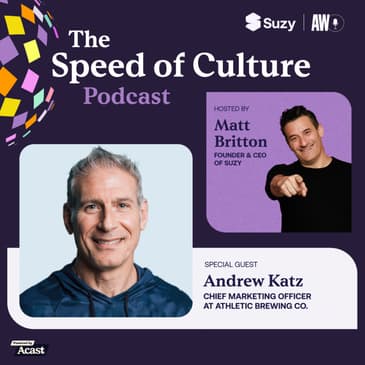
In this episode of The Speed of Culture, Andrew Katz, CMO of Athletic Brewing Company, explores how the brand is redefining the beer industry with nonalcoholic brews. They discuss consumer trends driving the shift away from alcohol, the importance of brand storytelling, and how Athletic Brewing is scaling through strategic marketing and distribution. Tune in to hear how Athletic Brewing is capturing market share and winning over drinkers—one can at a time.
Follow Suzy on Twitter: @AskSuzyBiz
Follow Andrew Katz on LinkedIn
Subscribe to The Speed of Culture on your favorite podcast platform.
And if you have a question or suggestions for the show, send us an email at suzy@suzy.com
Hosted on Acast. See acast.com/privacy for more information.
[00:00:01] The biggest number of touchpoints you have is your packaging. It seems pretty obvious, but you better make that packaging as recognizable, as standout, as attractive as you possibly can, because maybe that's the only touchpoint a consumer will ever have with your product.
[00:00:20] To thrive in a rapidly evolving landscape, brands must move at an ever-increasing pace. I'm Matt Britton, founder and CEO of Suzy. Join me and key industry leaders as we dive deep into the shifting consumer trends within their industry, why it matters now, and how you can keep up. Welcome to The Speed of Culture.
[00:00:42] We're here live in the year today. I'm really thrilled to welcome Andrew Katz, the Chief Marketing Officer of The Athletic Brewing Company, the brand revolutionizing non-alcoholic beer industry with innovative brews in a mission-driven approach. Andrew brings a wealth of experience from global giants like Heineken Pepsi Cup, coupled with an entrepreneurial spirit that's helped athletic brewing become a category leader. Andrew, so great to see you today. Great to be here, Matt. Absolutely. So athletic brewing has really exploded in recent years, and for those in the audience that don't know about athletic brewing, would love to hear just a little bit of a background.
[00:01:12] A hundred percent. So it was founded in 2017 by John Walker and Bill Shufelt, and they started just brewing in Gatorade jugs, five gallons at a time, until they got something that they were really proud of. Brewing what? Brewing non-alcoholic beer. Gotcha.
[00:01:27] So Bill had a thesis that he didn't really love the effects of alcohol, but he loved beer. And he just couldn't find anything on the market that was satisfying. And he's like, why has nobody solved this problem yet? And I think after a long conversation with his wife, she's like, you should solve it. And he's like, I don't know anything about brewing. So. You never had any experience in that one?
[00:01:50] No, he was, you know, a Wall Street guy and definitely living a very high performance lifestyle, but didn't have any brewing expertise. The classic entrepreneur story, he reached out to a hundred different brewers. He got 99 no's, but then John Walker answered his call and said, yeah, that sounds interesting. And so John Walker, very awarded brewer, award winning brewer. And they got together and started putting together what is now athletic brewing, which is the number one non-alcoholic beer brand in America.
[00:02:19] Now, some of the big incumbents in the beer space have tried to launch and have launched non-alcoholic brewery. Why do you believe that they were not as successful at coming out with a product that really kind of became a dominant brand? Because obviously if a need is filled for the consumer, it's much harder for a company like athletic brewing to come in there. It seems like what you're saying, there's an unmet need. Right. Yeah. Why not am I need to guess?
[00:02:43] A hundred percent. So there's not one simple answer to it. So I'll give you a longer winded one. The longer winded answer is we had no baseline. We had no expectations about what athletics should taste like. So if you are a Budweiser, if you are Heineken, you have a reference. You have the reference is your base brand. Right. So it has to taste like your base brand. We had no reference. Right. So we could create the best tasting version of what is scratch.
[00:03:12] From scratch. So we make 50 different styles of beer, some of which is right here on the table. And then we've got five different flagships from IPAs to Hazes to Lights. And so each and every version of that beer is the best possible tasting NA beer that we can make. So that's number one. Number two, if you think about these legacy brands, these legacy brands, 94 to 95 percent of what they sell has alcohol in it.
[00:03:41] So if you think about how small that volume is for them, they're really focused on their core. Right. It's almost like an afterthought. I mean, I think it's becoming less of an afterthought. Mic Ultra Zero just launched and the ABI CEO was just on stage this past weekend talking about how much they're going to lean into it. It's where the market's going. The challenge is we are never selling against ourselves. At some level, they have to sell against themselves. And it's a tough space. It's cannibalizing your core business.
[00:04:11] In a lot of ways, it's not accretive to your business. It's probably just a substitute. For us, we are accretive to the rest of the alcohol industry. Eighty percent of our drinkers drink. And therefore, a lot of what we refer to our drinkers as they're zebra striping, right? So they're going back and forth or maybe they're having a couple of IPAs and then they're switching to an athletic IPA. They don't want to stop drinking, but they don't want more alcohol.
[00:04:36] So you crafted these new brews from scratch that were endemic to the notion of non-alcoholic beer. Then you obviously had to do a lot of other things right as a company to bring it to market as successfully as you have. What were some of those other things after you actually came up with the formulas and the liquid to actually make it work? Yeah. So I joined the company about three and a half years ago.
[00:04:59] And when I joined, I was just so impressed with everything that had been created very thoughtfully. Bill, at the very beginning stages of the business, would load up his car with beer and drive up and down the eastern seaboard going to road races and sampling athletic at the end of a road race.
[00:05:20] So he went to one of the most authentic communities there are, people who are already inclined to be thinking about their health and well-being and gave them something that they really appreciated. They're very receptive. In that moment, you're trying something new and it was just a great fit. People who are living active lifestyles are generally thinking beyond just like physical health. They're thinking about other aspects of their health. This fits so well. So like that was how this brand was born.
[00:05:50] It was really born by getting cans in hands. It's a very experiential brand. I could tell you, hey, you want to try some N.A. beer? And you're like, nah, right? But then once you get it in someone's hand and they try it for themselves, they're actually pretty blown away. They're like, oh my God, this tastes like beer. And it's like, that's the point. And the packaging obviously is fantastic. And for those listening, and you brought a bunch of different versions of athletic brewing product. And when you see the packaging, it looks different. It doesn't look like overdone kind of micro brewery packaging.
[00:06:20] It looks very tasteful, but still kind of sticks out. Tell me about what the ethos is and kind of thinking is behind the packaging. And why do you think it's been part of the success? So that's a great question. And unfortunately, a lot of craft beer was anti-marketing. Yeah. Right. And not for nothing, marketing actually works.
[00:06:41] Like any marketing professional can attest to the fact that when you have a great product, great packaging and great content, chances are you're going to be successful. So a lot of craft beer was anti any of that. And you can see what's happened in the craft beer market, a lot of declines and it's too bad. So we had a very different opinion on why wouldn't we want to market this great product? And so this is some of the things I've learned in my career.
[00:07:09] The biggest number of touch points you have is your packaging. It seems pretty obvious, but you better make that packaging the best. People judge a book by its cover, right? People judge a book by its cover. Yeah. And you better make that packaging as recognizable, as standout, as attractive as you possibly can, because maybe that's the only touch point a consumer will ever have with your product. Right. So better be great.
[00:07:35] And so some of the things that we did was when I joined, it was really about making athletic the hero. And that was always intended to be our bar call was always intended to be our retail ask. Where's your athletic? Do you have athletic? So that this was first and foremost, the thing that people would subscribe to. Then it was about a fanciful name, what's peak. So something clever or something fun. And then what kind of style of beer are we talking about? In this particular case, it's the Belgian style.
[00:08:03] But then these landscapes that really were kind of, again, foundational to the company. We want to espouse a healthier, happier life for people. How do you do that? The best lives are not typically lived indoors. The best lives are typically out in the world. And so we just wanted to bring that to all of our packaging. Very cool. So distribution to me is fascinating for a non-alcoholic beer because on one hand, the consumer expects to buy non-alcoholic beer, I would assume, where beer is sold. Yeah. Right.
[00:08:32] Which could be in liquor stores or in the aisles where other alcoholic products like beer are. But the other hand, you are not bound by the constraints of having to sell where there's alcohol because you don't have alcohol in your product. So theoretically, you can sell anywhere. So from an off-premise distribution standpoint, what is working in terms of where your product is actually offered and sold? So it's an interesting paradox. The reality is we go to market just like beer. We're distributed by beer distributors.
[00:09:02] We're sold in the beer aisle. Right. So in many ways, we mimic what the industry does. But you're right. We can show up in many other places. So it's a much more durable type of a product. And also, without alcohol, it removes any friction. Right. Right. From like, man, I'd love a beer right now. Like right now, I'd love a beer. You know what? I'm going to have a beer. Would you sell to 18-year-old? We don't. Even though there's no alcohol in it? Even though, I mean, and it varies by state in terms of how it's regulated.
[00:09:28] But the reality is we tend to mimic, you know, we're LDA compliant. So we behave the same way. That's so interesting because ultimately, there's no alcohol in it. Correct. But it's still meant to be seen as an aspirational adult beverage. Got it. In spite of the fact that it doesn't have alcohol. Got it. So that being said, I mean, I imagine you also have an on-premise business where you're selling in nightclubs and bars, etc.
[00:09:52] What does that strategy look like and how has demand been on-premise where you're selling a product that doesn't have alcohol in it? Where basically people generally go to those venues to drink alcohol traditionally. So like I said, it's not a binary thing. People are zebra striping. People are going back and forth. Some, you know, they may have their 7.5% IPA and then they back off and they have an athletic state.
[00:10:17] So it's very much integrated into how people are kind of consuming alcohol these days. Also in Brooklyn, there's one of my favorite drink specials. It's called the hypocrite and it's a shot of tequila and an athletic. Oh, wow. And then the other thing too is we do see a high degree of correlation between states where marijuana is legal, THC is legal, and incidents of non-alcoholic beer. And it makes sense. People don't want to get cross-faded.
[00:10:44] So basically what you're saying is that in states where cannabis is legalized, consumers might adopt that, but they're still out. I wonder, out. Yeah. They might have taken an edible or something before they go out, but then they want to have a drink and they don't want to drink sparkling water or something, so they'll have something like that. Yeah, I mean, look, beer, any beer, regular beer is one of the most ultimate social and savory drinks out there. Right. It's embedded in our culture. It's embedded in our culture.
[00:11:10] I mean, we live in a drinking culture and we could have a whole other conversation about like people feel very okay, opining about why you're drinking or not drinking as opposed to like it's the one thing where people feel like there's no boundary. And like why I'm drinking or not drinking is really no one else's business. But everyone feels like, well, why aren't you drinking? And it's like, well, why are you drinking so much? Right. So I do think there's still this societal pressure that you should be drinking. Yeah. But it's changing.
[00:11:38] Well, when I asked you why it's changing, you know, you'd mentioned earlier the market is moving away from alcohol and beer. And I imagine we're saying it's moving away from alcohol in general. Why do you believe that? A. And B, if so, why do you think that's the case? What are the drivers behind that? I mentioned cannabis is one. Yeah.
[00:11:55] And so I was reading an article on the way in from the Atlantic and they were talking about how it's really about like temperance movement back, you know, in the early 1900s is really about just like getting people away from alcohol and like the incidents of alcoholism and everything where it's crazy how much people were consuming. Nowadays, it's really about like this neotemperance and the neotemperance is really about how am I self-actualizing? Like how am I living a better, healthier, happier life?
[00:12:24] And some people are like, if I cut out alcohol, I know I sleep better. How do I know that? Because I've got a ring or I've got a whoop. Right. Sonified self. That's right. It's like telling me your sleep was really good last night. That didn't used to exist. I didn't know that much about my body. I know if I felt sick, but I didn't really know was I having like a good recovery day, a bad recovery day. Now I know. So I think the information. And then speaking of information, Andrew Huberman put out what I would say a pretty seminal podcast, I think two years ago.
[00:12:54] It's still one of the most downloaded podcasts of all time about the science of alcohol. What does it actually do to your body? People are mourned for it. The Surgeon General of the United States coming out and saying very recently, we know that there are three types of cancers that are causally linked by alcohol. We should probably put warning labels. I don't know if there are warning labels ever going to be put on alcohol. I don't think it's really that important because the conversation is already happening. The quiet part was said out loud. Right.
[00:13:23] So your health reasons. Yeah. I mean, predominantly it's health, like, but not just physical health, mental health. Right. I think COVID taught us a lot of things about mental health and a lot of people discovered like, well, I'm more dependent on alcohol than I realized. And a lot of people backed off. So it's like total health, not just physical, right? Well-being. It's expensive. Like if you look at how much alcoholic products have increased over time, they're very expensive. Yeah.
[00:13:49] So a lot of people are like, well, if I cut that out, I can buy more coffee or whatever, save. And then the third is like the self-actualization. I know so much more about my body and I'm going to use that to help me like be healthier. Again, maybe it's in very small ways. Right. So moving forward, I mean, it seems like you have kind of like this paradox of strategic challenge moving forward.
[00:14:13] Because on one side, you have all the tailwinds of this, what's called anti-alcohol movement relative to where we've been in the past. On the other hand, since so much of beer has been alcoholic beer, basically almost all of it until now, if these headwinds against alcohol consumption continue, then the overall beer category will lower. And with that, the popularity of beer as a form factor could drive as well.
[00:14:42] So you're going to have to, I would imagine as part of your go forward strategy, really get consumers to embrace the love of beer for beer on its own. You are a thousand percent correct. I mean, that's a very astute observation. Like I live it and breathe it every day. You don't. But that's exactly like, so we have our annual meetings with our distributors. And that was sort of the thematic that I shared with our distributors was we want people to love beer. Right.
[00:15:09] Like if they don't love beer as a category, we're never going to be success. That's right. Right. Because you have to have a taste for beer. You have to appreciate the craftsmanship. You have to appreciate the process and the natural ingredients and all sort of the romance of the category. Yeah. We need to keep that alive. That's why we are never, we're not a soapbox company. We really just want to make great options available, but how people play it is always going to be up to them. Yeah.
[00:15:38] And then I'll just add one more thing because I brought it with me. So we just launched what we're calling cocktail inspired beer or NA beers. So this is a Paloma. Yeah. So, and one of the things I love about my job is I get to go and sample our product and having that one-on-one conversation with people to me is the best marketing there is. Giving a product in someone's hand, having them react, that's memorable. And a lot of times we're at different events and people are like, well, I'm not really a beer drinker.
[00:16:07] And that's a sizable audience of people. So we want to deliver things also that are beer based, but you wouldn't go, oh, that tastes like beer. So we make Rattlers, we make Sours, we make these cocktail inspired beverages because we do want to address this love of beer, whether you know it or not. We'll be right back with the Speed of Culture after a few words from our sponsors. So moving forward, what are some of the tactics and strategies that you're deploying to continue
[00:16:35] to drive awareness and ultimately sell through of your product? Like what's working in the marketplace to spread your story? So what's working is really kind of going back to the origin story, which is getting cans in hands. And it doesn't scale and it's probably not that efficient, but from an ROI standpoint, we know it works. And so we'll do north of a million samples. Well, where are you handing out samples? Everything from a local 5K race all the way up to an Ironman.
[00:17:05] And that's something you can do with it. You can't hand out alcoholic beer to anyone. Correct. But that's an example of, you know, a battery being removed. Exactly. You could do sampling. That's all companies can. It's frictionless. Right. And then we're over 300 venues. So we're really leaning heavy into live events. Like we talk about moments of participation. So that's, I go and run a 5K or maybe I do a half marathon or something. But then there are these moments of enjoyment where I just want to kind of sit back and enjoy
[00:17:35] music. I want to enjoy sports. And I want a beer. But again, I don't necessarily want the alcohol because it's a Tuesday night and tomorrow's Wednesday. Right. But I love the experience of holding a beer and all the rituals. And so we're pushing, I would say, significantly into new spaces. So obviously Gen Z is a huge target for you and Gen Z being the iPhone generation, getting all their content from their mobile device, mostly from creators.
[00:18:04] Yeah. What role do creators and influencers play in building your brand? And what type of work have you done in that realm? Increasingly more and more. Yeah. We've always been there. We've always had these incredible brand ambassadors that have really been authentically connected to the brand. So Walker Hayes is one of them. He's a country music artist. And he was just posting about Athletica, how much he loved it. And so the relationship was we reached out to Walker's team and said, hey, we'd love to do something.
[00:18:33] And he's like, let's do it. It evolved into, we launched a limited edition beer called Fancy Like, of course. But he's one of many, you know, Brian Mazza is another like fitness influencer and the list goes on. So there's fitness, health and well-being has always been core, but now we're adding some dimension to that. So again, more in the enjoyment route, cooking, music. So we're adding just different creators to our portfolio, but again, who really have an authentic link to the brand.
[00:19:02] And that makes a big difference for us. Yeah. Right. As opposed to it's like people can smell BS from a mile away. They know when it's like very inauthentic. And so I think that's why celebrity has still a place, but it's not quite what it used to be. And now it's more about like, does that creator really drink that? They really eat that? Do they really wear that? And how consistently can you show up in their world?
[00:19:28] Because then I actually feels like that's a real brand that they really have some connection to. Yeah. So we're sitting here in 2025, beginning of 2025. If we were to fast forward five years to 2030, which is so scary to think, and only five years is 2030, and we're just as close to 2030 as we are 2020, which kind of freaks me out. But if you will have executed your vision along with the founders of the company, where will athletic brewing be in 2030?
[00:19:55] Athletic brewing will certainly continue to thrive as a standalone non-alcoholic beer business. So I really hope that we're able to maintain our independence and continue to be successful. I mean, today we've got a north of a 19% share of the entire market. We're the number one and driving most of the growth. I hope that continues. Number one. Number two, I hope we get into some adjacent spaces so that we can attract people whose first response is, I'm not a beer drinker.
[00:20:24] We got you. We got you because we've got something that's incredibly savory and social that you're going to love. And then number three, just continue to expand our footprint outside of the US. We're in Canada. We're in the UK. This is a global phenomenon. This is not just unique to the United States. So how do we continue to scale the business outside and bring more and more users together? The thing that I love so much about working at Athletic and what attracted me in the first place is it's truly a mission-driven company. Yes.
[00:20:54] With two co-founders who are in the business. And it's different having worked at a lot of big companies. I was about to ask you what the difference is. It's just different, right? Because it's personal. All their blood, sweat, and tears have gone into this business to get it to this point. There's no reason why we stop here. We continue the journey. And the journey has been nothing but circuitous. But it's been great. And also, I imagine it's not for everyone. I mean, there are some people that work at large companies like you work at Amex, Heineken.
[00:21:22] When you go to a company that is founder-led, you know, it's different. It's inspiring. But it's also much more high stakes, high pressure, every dollar account sort of thing. So I would imagine it's also not for everyone. What about you makes it for you? So there, I think of a pyramid or a triangle, same thing. On the one hand, it checks the box for me personally around health, wellness, and what I'm being. Right? Like that's very core to who I am.
[00:21:50] And it attracted me to the space in the first place. Yeah. And for the record, I still drink alcohol. But I drink so much less of it than I ever have in my life. I drink more beer now though. Right. A lot more. So that's number one. Number two, entrepreneurship. I sort of did my own venture right before meeting Bill and John. And it's hard as hell. Yep. I mean, you can probably attest. Absolutely. So many days you feel like you're making no progress, but there's something about it that feels like it's mine.
[00:22:19] And if it doesn't work, it's because I didn't make it work. So I love that accountability component of it. And then the third part is it's beverages. And I think still there's something about with all the division in the world and et cetera, we can still sit down and have a beer together. And there's just something that's just universal about that and wonderful about it. And that's what I love getting up and doing every day, which is just knowing I'm making a very small dent in the universe by helping people a little bit healthier, a little bit happier.
[00:22:49] That's great. So what are some of the areas that you are trying to personally grow in in 2025 to evolve as a marketer, given all the changes we're seeing with technology and consumer expectation, et cetera? So you and Athletic Brewing could remain future-proof moving forward. So a lot of it is getting out into the world. Yes, I know that our phones are sort of our masters and so much of our lives are spent in front of a device. But the reality is there's nothing like getting people together and connecting.
[00:23:19] And so we're making a big push into music this year. So we're partnering with Live Nation for the next three years. We're going to be at over 117 different venues, including everything from comedy clubs to music halls to amphitheaters, plus at least probably four or five different festivals. There's nothing like getting people together in person. Yeah.
[00:23:44] Having that experience with Athletic, that's going to be a big push for us. And like maximizing that relationship is sort of paramount for me in 2025, making that work really well. So that's number one. Number two is continuing to push the envelope for ourselves with AI and kind of feel like it's a little bit trite and it's a little bit like, oh, AI, you know, but really trying to harness some of it. To make our jobs, our lives just better.
[00:24:13] Not that we're going to use it for our creative. Like I think there's been a lot of blowback on that. Yeah. Just more like how do we get smarter with the help of somebody that's a lot smarter than us. Yeah. And then the third piece is continuing to build my team and give them the skills that they want and the challenges that they deserve and recognition. And a coin operator did not really. Bye bye. Right. They're not passionate about what you're doing.
[00:24:39] Like to be a marketer, a good marketer, you really have to love the product, love the brand. And it comes off really seamlessly. Like if you do and if you don't, it's also obvious. So that's sort of like don't come in unprepared because if you're unprepared for this, you're not going to be prepared for the show up. And then the other is, you know, people who are willing to roll up their sleeves and do the work, even if it's not their work. It's like, hey, I need help on this.
[00:25:10] Right. We're a lean team. We're a lean company. That's how we operate. I think that's one of the benefits of being an entrepreneurial company is like you don't have infinite resources. You don't just say, well, I'll give it to my agency to do. No, you do it. So someone who has that mentality. And then the last thing is, I think someone who's innately curious. Like if you're not curious about learning new things, if you're not curious about staying up with trends, then you're probably not going to be very happy here. Totally makes sense.
[00:25:38] So Andrew, as you probably know, we wrap up our podcast always by asking if there's a quote or a mantra that helps sort of summarize our guest professional journey to date. Say anything come to mind for you. So, I mean, there's one that I like a lot that I had in my room as a kid. Okay. I don't think I really understood what it meant at the time, but it's a Nike quote, which is there is no finish line. And I think the idea you can challenge yourself with. So I definitely subscribe to that and I try and live it.
[00:26:07] I don't know if I always live up to it, but I love the idea that you can keep reinventing yourself. You can keep challenging yourself. So the finish line is really yours to decide. It's not somebody else. Yes. That's one of them. That's more personal. And then the one that professionally I really like is from the founder of Red Bull, who said the only competition is indifference. And I just love that sharing that with my team. It's like, yes, we have to pay attention to the competitors that are in our space.
[00:26:36] But ultimately, the consumer who's indifferent to our brand, that's really who we need to convince. We don't really need to compete with these. We need to be the best version of ourselves to attract their attention. And when we do that, we'll be successful. Yeah. There's a famous photo you've probably seen of Michael Phelps in the Olympics and he's looking straight towards the finish line. And then the two people who he's in front of are both looking at him. Right. And it's just like you have to have your eye on where you're going.
[00:27:03] And when you look, you know, to the left or the right, you're taking your eye off the finish line. Yeah. Usain Bolt, same thing. Yeah. Right. Like he never looks left or right in a race. He just looks at the finish line. Right. And for you, that's the consumer. That's who you're serving. A hundred percent. Yeah. And we just have to kind of remind ourselves of that sometimes. Love that. Well, that's so awesome today to get to learn about you and your strategy and the story of like brewing. Frankly, I hadn't known nearly as much about it until today. And I'm already a fan.
[00:27:30] So looking forward to trying some of the product you brought over and looking forward to continuing to see your success and success of the brand moving forward. Thank you, Matt. Absolutely. Thanks very happy to. Absolutely. On behalf of Susan and Iwitt team, thanks again to Andrew Katz, the CMO of the Athletic Brewing Company, for joining us today. Make sure to check out Athletic Brewing products anywhere they're sold. They're really tasty and very cool product. Be sure to subscribe, rate, and review this Vita Culture podcast on your favorite podcast platform. Until next time, see you soon, everyone. Take care.
[00:28:00] The Speed of Culture is brought to you by Suzy as part of the Adweek Podcast Network and Agass Creator Network. You can listen and subscribe to all Adweek's podcasts by visiting adweek.com slash podcasts. To find out more about Suzy, head to suzy.com. And make sure to search for The Speed of Culture in Apple Podcasts, Spotify, or anywhere else podcasts are found. Click follow so you don't miss out on any future episodes. On behalf of the team here at Suzy, thanks for listening. Hey!