
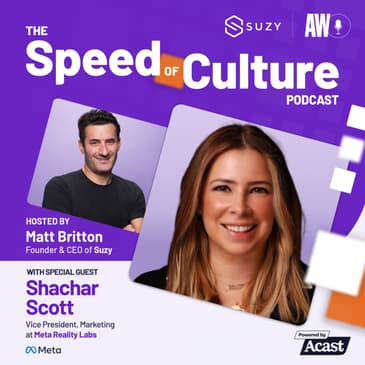
In this episode of The Speed of Culture Podcast, Matt Britton talks with Shachar Scott, VP of Global Marketing at Meta Reality Labs. She explores the rapid rise of Ray-Ban Meta sunglasses, the future of AR, VR, and AI wearables, and how personalization is transforming smart devices and consumer experiences.
Follow Suzy on Twitter: @AskSuzyBiz
Follow Shachar Scott on LinkedIn
Subscribe to The Speed of Culture on your favorite podcast platform.
And if you have a question or suggestions for the show, send us an email at suzy@suzy.com
Hosted on Acast. See acast.com/privacy for more information.
[00:00:00] What we've seen on MetaQuest is the breadth of reasons why somebody would love that experience. Yes, gaming, obviously, we've got the biggest catalog in the world of experiences that you can play for free. And with IP owners like Beat Saber and Batman, we launched this holiday. But we see fitness as another huge segment. To thrive in a rapidly evolving landscape, brands must move at an ever-increasing pace.
[00:00:28] I'm Matt Britton, founder and CEO of Suzy. Join me and key industry leaders as we dive deep into the shifting consumer trends within their industry, why it matters now, and how you can keep up. Welcome to The Speed of Culture. We are live in Las Vegas at CES. And today I'm thrilled to welcome back Shachar Scott. She's the VP of Global Marketing at MetaReality Labs. Shachar has been at the forefront of some of the most transformational innovations in AR, VR, and mixed reality.
[00:00:57] I'm super excited to dive in. Great to see you. Great to see you. Thank you so much for having me. Absolutely. So we talked, I guess, about a year, maybe a little over a year ago. And so much has happened in your space since then. And the adoption of the Ray-Ban Meta sunglasses, I think, at least from where I sit, has outsized expectations. And obviously you guys are just getting started on what you're building. We'd love to hear what you've been up to in the last year at really continuing to evolve in this space. And then what you have your eye on here in 2025.
[00:01:26] Yeah, it has been a very exciting year. The acceleration of which the glasses were adopted has definitely exceeded our own expectations. I think AI had a really big part of that. Yeah. And just how intuitive the glasses became. Game changer in the same way that our phones once did and our ear pods once did. And this has replaced a lot of the functionality that we use in some of those devices today such that it became a game changer. It also didn't require any change in human behavior.
[00:01:57] Yeah. People already wear sunglasses. You're not asking to wear goggles or something that's unnatural to them. And I think that just took that barrier away. And so much like ChatGPT, you're texting like you're texting a friend. You're wearing sunglasses like you're wearing sunglasses. And I think that is a key for getting mass adoption. Yeah, that's right. Foreign Factors is so comfortable that you can wear it all day, every day. And to your point, it had to be better than what you can already do. Googling using ChatGPT. Right.
[00:02:23] This is using voice on demand commands allows you to just continue to live in the moment. Yeah. And not have to look down at your phone in a way that I think has made that experience just exponentially better. So it's been really exciting. We also announced a long term partnership with Lanzotica, which means that you can expect a lot more. Amazing. In the category. With them, they're an amazing partner for us. And excited about what's to come this year. But you'll expect more display-less glasses.
[00:02:53] And then as you heard at Connect this last fall, we'll also start to introduce what does display glasses look like. We talked about Orion and the future of what that technology will allow us to do in this space. And so these things will have a crawl, walk, run, if you will. Yeah. Roadmap and just the success of the Ray-Bet Midhead glasses just allowed us to do 10 times more. So let's unpack a couple of things you said. So when you say display technology, basically, you'll be able to see an overlay into what you're looking at.
[00:03:23] Is that kind of where it's going? Yep. So what are some of the use cases of that? Yeah. I mean, messaging is a very clear one. Information that you need as your direction. Exactly. And that's all stuff that you can do today with the glasses using audio. So using live translation, I can look at a menu in Spanish, have it translate it for me into English audio. You can imagine a world in which very soon that would actually overlay in English a different version of the menu for you. I mean, it could be.
[00:03:50] Obviously, if the consumer opts in, you're walking around a conference like CES and it's superimposing who that person is and how you're connected to them. I mean, do you see that's where it's going? Yeah. I mean, I think that there's obviously privacy is really important. But people opt in. Yes. But it won't be able to facially recognize people in that same way. So it won't be able to tell me, that's Matt Britton. I know him from this, this or this.
[00:04:11] But what it will do is if I'm looking at ingredients, tell me what recipe I can make and show me a picture book of a recipe that I can follow along easily and cook that meal for my kids. Or you're looking at an apartment in a trendy neighborhood and you're going to wonder how much that costs. You can do that too. So you mentioned AI and how AI is kind of making this. Obviously, with voice, I think one thing with voice is you look at Siri and Alexa and it never really took off the way we thought because it really wasn't reliable.
[00:04:40] Now, those tools are getting better. And Amazon announced a partnership with Anthropic to make their better baked in with AI. So I think voice is getting better. And I think as an owner of the Ray-Ban Meta Glasses, the voice application is just so intuitive. Besides voice, what are some of the ways that AI can make this experience better moving forward? Yeah. I mean, I think for me and for Meta, it's about personalization. Yeah.
[00:05:02] So depending on what use case you're using it for, you'll be able to use voice and then over time neural interface to make sure that you're prompting the AI in a way that is allowing you to do what you're going to do anyway. What does neural interface mean? It allows you to do it using wrist control. Oh, wow. Yeah.
[00:05:19] And so that's a big part of the technology that Mark introduced with Orion is bringing that voice option, something that is more comfortable to do when you're in public because you might not be able to, when you're riding the subway, use a voice command. Sure. Right. You don't want other people to necessarily hear that. Right. And so it'll allow you to do that more seamlessly. So how far do you see us going in terms of like, do you see a world where kids are in a classroom and based upon where they are in a learning curriculum, seeing certain things in their glasses?
[00:05:49] Like, wow, I just can see so many applications, especially with personalization AI to really be a companion and a digital kind of view to your life. Yeah. I mean, I don't have a crystal ball, but I think that. Seems like you do. I mean, sometimes. No, but I do think that there is a productivity angle to what you just described. And certainly education has a lot of form factors that would benefit from that. I think we're a little ways away from that. What's a little ways? Two years or 10? I don't know.
[00:06:17] I think a lot of the research that we're seeing, a lot of the work that we're doing is to help accelerate that and to really understand how consumers are using it to improve it and make it more seamless. We're building a very open ecosystem so that we can have developers helping us. I was going to ask about that. Yeah. And we believe in that. And I think that's true from day one at Meta. And so, I mean, TBD, if it'll be two years or 10 years, I think it's not in the long distance. Right.
[00:06:44] So basically a world where you have partners, a developer ecosystem building applications for these wearables for all sorts of different things, whether it be for a police force or whether it be for students or gaming or being at an NFL game. Yeah. And we see that on Quest today. So we partnered with Lufanza where they use VR and MR to train pilots on how to navigate different flight patterns and storms.
[00:07:09] And Walmart uses it for training their employees at scale because they have so many employees. And so there are a lot of use cases that VR and MR is a better factor for. I think over time we'll see AR display glasses take shape. Yeah. So in terms of VR, which is a much more immersive experience, obviously Apple wrote out their Vision Pro. It was expensive. I think that I wasn't surprised to see it wasn't a smash hit because it was around one.
[00:07:36] But obviously with the Quest product, it has gained adoption since the acquisition occurred. Where is that space in its adoption curve with consumers? Because unlike the sunglasses, that does require a little bit of a consumer shift. And the cases you mentioned are more edge use cases. Yeah. But do you see that becoming more mainstream anytime soon? I do. And I think that Quest has proven that. So what we've seen on MetaQuest is the breadth of reasons why somebody would love that experience. Yes, gaming.
[00:08:04] Obviously, we've got the biggest catalog in the world of experiences that you can play for free. And with IP owners like Beat Saber and Batman, we launched this holiday. But we see fitness as another huge segment. So Supernatural, FedExR, you can work out with Jane Fonda and Paris Hilton and all your favorite trainers to entertainment, to sports. As you said, our partnership with NFL, Pro Era, NBA. You can watch every game courtside, but sit couchside in your own living room.
[00:08:33] You see a sphere here in Vegas and what it shows in the Cosm. It's like people want to be immersed more. Totally. And it's right. It's all part of the same thing. Yeah. And Cosm. Is a great partner of ours. We really, yes, we partnered with Wrexham and brought the stadium and also all their games into Quest. So cool. Yeah. So there is different use cases for that immersive experience. Entertainment being one that is another breadth use case that is really important to us.
[00:08:58] So I think that we see that adoption with Quest, people using it every day for different reasons. And of course, productivity. But I think that is what we're creating with AI glasses as well because the form factor is so comfortable. Yeah. And you can wear it all day. Yeah. Right now, Quest, you can wear it for two, three hours. Right. So I think that middle ground is what we're trying to figure out.
[00:09:48] Yeah. So they're fully integrated as well as, as I mentioned, open ecosystem. We've got Shazam. We've got Spotify, Apple Music, Amazon Music, Calm app. So lots of other apps as well. Again, things that you would be doing anyways with EarPods that now is just a way more enhanced experience. Yeah. With the glasses. And then with Quest, same thing into Horizon. You can text a friend using WhatsApp and Messenger while you're playing a game.
[00:10:18] Matt, let's play Beat Saber together. And so it's, again, how you would be using those features without having to take your phone out and do it. Yeah. We're trying to integrate that technology, just make it super seamless into the hardware. We'll be right back with the Speed of Culture after a few words from our sponsors. So you got me hooked on the product when we talked last time, as I told you, I got one for all my execs.
[00:10:40] And like this summer, like I was in the pool taking calls and no one knew, you know, and it's just like there's just so many little cool use cases where the music, the sound, it's all really great. And I'm the type of person where after I start using it, I always start to think ahead. And I start to think ahead as like, well, is this the future of the phone? And like, why do people need to carry around the phone in this pocket if this goes to it, especially with the advancements that we've talked about? Yeah.
[00:11:06] Like, how much time do you spend thinking about what your plan is this year versus where it's going to be in five and 10 years? Because something in here feels like the future to me. Unlike any other product, you just kind of tell that this is kind of where it's going. A lot of people have talked about contact lenses for a while. That has a lot more complications with that technology. But I'd love to know like where you spend your time thinking. Yeah. I mean, I think as a company, we have spent a lot of time seeing around corners. And to Mark's credit, he's brilliant at that.
[00:11:33] And I mean, a lot of the work that we do is longer term. And so taking that roadmap, backing out of it, what are the different milestones that we have to take in order to achieve that outcome? Backing out of that. And so there are going to be multiple generations of this before we get to a place where it could replace potentially your device. Right. But I think every time that we launch a new device, even in order for this to have been successful, Ray-Ban Stories had to happen. Yeah. Even though that wasn't adopted in the way that we would have hoped. Right.
[00:12:03] But we had to have first gen in order to have second gen be success and second will lead to third, et cetera. So a lot of what we do is plan ahead. But there's so much data that we're collecting and understanding about how consumers are enjoying and loving and using the product today. It'll help inform that. Yeah. And of course, like Facebook and Instagram, like those companies, those brands grew on the notion of like people sharing experiences. Yeah. And this ultimately is like, it's just built for that in such an easy way that keeps you in the moment, et cetera.
[00:12:32] Are you seeing adoption with this product with creators in terms of how they're going and capturing their own worldview? Yeah. And actually, that has been some of the most fun that I've had on this job is, and it's truly a privilege to work where I am sitting right now. But the inbound of creators, I'm already doing this. On their own. We've had Tyler. She shot her entire music video for Water on RBNs. That's awesome. We worked with Matthew Vaughn.
[00:12:59] And he wanted to create the first action film shot exclusively on the glasses. We shot an entire stunt film with him using only the glasses. We had a concert in Brooklyn with Busta Rhymes where he wanted to connect with his fans without seeing a sea of phones. We had a 600-person, hands-free, phone-free. No way. Concert. That's so cool. Coil-A-Rae was there. It was amazing. That matters. I was in that last night, and they made everyone cover up their phones, and it was such a cool party.
[00:13:28] It changes things. It takes you back. All you see are screens. And so that human connection that creators are able to have with their fans completely changes when you can see someone's face. Yeah. So that has been a transformative experience, and we've used that content, used those experiences to actually educate consumers about the device. Yeah.
[00:13:49] And they're not only trusted influencers, but there's an authenticity built into that that is very different than us creating marketing for the sake of the product, which we're doing both. But I think as much as we can do authentically with creators, the better. For sure. So we've got musicians, as I said, creators, chefs, you name it. They're all using it differently, and we're capturing that content and really working with them to tell that story. Wow.
[00:14:17] So obviously, in order for you to keep growing this, you need partners, you need use cases, and you also need the technology to involve, right? So how much time are you spending with the product team, with the engineers, to truly understand what's possible? Yeah. I mean, a lot. And I think that Ray-Ban was a perfect brand to start with because it is universal. Right. A lot of their designs and styles are actually worn by both genders. So it gave us a very wide net.
[00:14:44] It is a very well-known, iconic brand, almost 100 years of a heritage brand. Perfect partnership. Perfect partnership. Very lifestyle, fashion, iconic. Yeah. That is one use case, and it can be for every day. You can imagine there are other brands that would allow us to do other things in sport and performance and fashion and luxury that Ray-Ban might not be a fit for. So that's what you're going to see us do more of is proliferate with other brands.
[00:15:12] That's going to allow us to be something that can truly be for everyone. Yeah. And to my point of personalization, something that you'll want to wear every day, all day, it's got to fit into what you're doing. Of course. With it. So that's really exciting. I mean, a big trend I will often talk about is the trend of quantified self, where you're wearing the R-ring or the Whoop band or the Apple Watch or a connected pillow and collecting all the data on your body. Yeah. And in the past, you'd look at it, but you don't know what to do with it.
[00:15:41] But now with AI, it can synthesize all these data points and tell you what it means or how it's trending or how you benchmark, et cetera. So the ability to collect data is so important. So when you look at other wearables, obviously, there's nothing going to be better in terms of content capture than the glasses, unless you guys have something up your sleeve that I'm not thinking of. But like, is it going to be more in the realm of collect more data so you can synthesize a broader experience? Yeah. And to your question about how do we work with product and engineering, I mean, we are getting a lot of inbound.
[00:16:11] Like, oh, I wish I could do this. Right. Or I tried doing this, for example. From an OEM manufacturer. And also just with like use cases. So like, for example, wearing a ski. If you're wearing it outside in a very, very freezing temperature, battery's not going to last. Yeah. Right? So that's one use case feedback that we're getting from consumers using this product today for something that we could probably improve in the future. Yeah. Right now they're using GoPros, but it's so much easier. Exactly. Yeah.
[00:16:38] So we are getting a lot of that inbound data from the consumers that are using it today saying, oh, I wish you could do this. So that is informing a lot of our product strategy. And then, as you mentioned, I think with OEMs and just the proliferation of data and accessibility, we'll be able to do a lot more with our partners to get more people to have them bundles, et cetera. Are you seeing this as a product that's primarily like a Gen Z product or are you getting adoption from people of all ages? Yeah, it runs again for sure.
[00:17:08] And it's not just for Gen Z. We're seeing athletes use it. We're seeing... Cool CEOs like me. Exactly. Moms like me. So, yeah. I mean, it is definitely proliferated beyond Gen Z. I think that there's, again, with form factor, the price point, 10.9, like it is affordable, but we'll need to do even more to get it more affordable. Yeah. For everyone. And that is where we're heading. For sure.
[00:17:32] So, how much time are you thinking spending about consumer behavior and different ways that consumers are evolving the way they live in this crazy world we're in, especially here at CES, you're seeing the future. So, you understand really where were your vision and what's possible meet what consumers actually want to do. Because like when Google Glass, they said anyone's the first Google Glasses years ago, it was so cool, but way before it's time. Yeah. Right? So, part of it is you don't want to be too early. You want to make sure that you can be there just to the right time.
[00:18:00] Yeah, we have an amazing research team up in Redmond, and they are running the gamut across accessibility, health, I mean, all the different facets of what will help us to diversify, like the offering that the glasses provide, but also the use cases, the different segments that we'll want to reach. And so, they are constant funnel of information for us.
[00:18:26] And then again, we're getting that constant feedback from consumers that are using it today to better understand how can we improve it, what do they care about, make onboarding, like reduce any friction. Awesome. So, let's shift gears a little bit as we wrap up. I want to hear more about your role and what it's like more specifically the work at Meta Facebook. Because it's obviously one of the most impactful companies in our lifetime and so many twists and turns the company's gone through from a political standpoint and this and that.
[00:18:55] And yeah, it continues to innovate and perform really well, etc. What's it like to work there and what does a normal day look like for you? There is no normal day. No, I mean, it's a great question. I mean, honestly, it is truly a privilege and I mean that. I feel like I'm in the right time, right place, right role. My role with the RayBet Meta Glass is obviously the partnership with Luxottica is really important to us.
[00:19:14] So, a big part of my role in my day-to-day is aligning with our stakeholders, both externally as well as internally, working with XFNs, our product team, our engineers, product marketing, data science, analytics, the whole gamut. And then with Quest, it's also working with developers and really understanding what are they making for consumers. And so, a lot of partner and stakeholder management is a big part of my role.
[00:19:40] I have a global team, so I'm also understanding how our product's being used in different cultures, different people. How can we accelerate that in new markets? So, it's both like learning and doing. I feel like I'm the luckiest person in there. Yeah, you've earned it. But on the consumer front, the consumer marketing front, how are people finding out about your products? I know that obviously RayBan sells them. I know they're on Amazon. I mean, are you thinking of new ways to make sure that you have an omni-channel approach to make sure?
[00:20:09] Because I think a big part of this is just the more people see it, they want it. And I would imagine one of the issues is like it's not always clear to the other. Like everyone knows what AirPods look like. So, that became their best marketing channel. It's just everyone's wearing it. With these, you don't know that they're wearing one of your glasses as a regular. So, how do you think about consumer marketing and distribution? Yeah, we're building categories. We're building brands. And we're also educating consumers on the use cases and how this can fit into their life. Enhance what they're already doing. Make it better.
[00:20:38] To your point, I'll still wear my AirPods when I'm traveling because I want that noise canceling until these offer that. Right? But for making phone calls, listening to music, everything else, like this is the device that I use every single day. Yeah. So, educating consumers on that is a big part of what we do. But we're also building a category of products. As you said, before us, there was spectacles and glass. Yeah. This is better. This is different. And so... And the timing's right. The timing is right.
[00:21:05] And we're learning from past, but also creating a whole new category. Those devices did not include AI. Yeah. So, there's a different form factor now, but also a different user behavior that we're seeing among consumers. So, that is a big part of what our team is doing and also doing it at scale. Like, we've got half the world using our family of apps every single day. And how are we going to continue to build the tech that creates and fosters that human connection to the hardware and software?
[00:21:35] Yeah, for sure. So, here at CES, anything that you've run into or talked about in terms of innovation for 2025 that is piquing your interest right now? Yeah, I mean, I walked the floor yesterday and with the glasses, of course, so I could be hands-free. I mean, obviously, like, AI is everywhere. And I think this will be a very pivotal year for AI. Oh, my God, for sure.
[00:21:57] And how people not only adopt it, but to my point on personalization, to really figure out what does that mean for them? And use it in ways that they maybe didn't know that they were going to use it in that way. And then it just becomes such a natural behavior that they can't live without it. Yeah, it makes their life better. Totally. Yeah, I mean, I think for me that's been the biggest takeaway is wearable tech that is smart and intuitive and personalized. Awesome.
[00:22:26] So, to wrap up here, what are some of the ways that you're trying to improve personally? Because, obviously, you work at a very competitive company. You're probably working with some of the smartest people in the world. You have to be on your game, right? Yeah. And, obviously, you are. How are you able to stay in your game? What is your professional fitness regimen look like, so to speak? I love this question. I mean, I'm a voracious consumer. Like, I do try everything.
[00:22:48] I consume a lot of our peer and competitor products to understand what consumers might want from us and how can we complement what they're already doing. So, I think that, for me, has always been, I've been, you know, a student of technology for my whole life. Yeah, you're passionate about it. Yeah, and I love seeing how my kids use it and how they've known from a very young age to swipe and pinch and all the things, all the gestures.
[00:23:15] Watching them use the technology, too, is just very intuitive. Yeah. And focus group. Totally. And informed for how we should talk about things, right? And so, for me, it is being a consumer, but also watching consumers use our products and really understand how we can make them better. Yeah. Awesome. So, to wrap up here, you may remember we usually answer our guests if there's a quote or mantra that guides their professional journey. What comes to mind for you? I would like to say, like, if there's a word for this year, it's thriving. Like, our team to thrive.
[00:23:45] I want our products to thrive. I want the world to thrive. There's just a lot going on right now. So, I'll leave you with the word thrive. I love that. Well, I hope you thrive in 2025 and beyond. I have no doubt you will. So, thanks so much for joining us today. Thank you so much for having me. On behalf of Susie and the Adway team, thanks again to the great, innovative Shahar Scott, VP of Global Marketing for Meta Reality Labs, for joining us today live in Las Vegas. We'll see you soon. Be sure to subscribe, rate, and review the Speed of Culture podcast on your favorite podcast platform. Bye-bye.
[00:24:41] On behalf of the team here at Susie, thanks for listening.