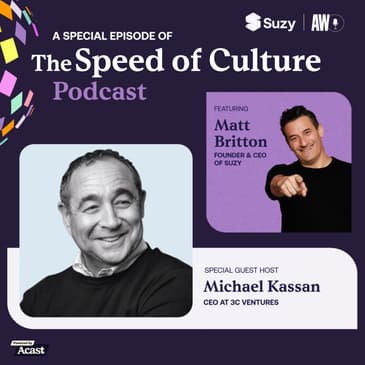
In this special episode of The Speed of Culture live from Possible 2025, Suzy Founder & CEO Matt Britton joins 3C Ventures’ Michael Kassan to discuss themes from his new book, Generation AI. Together, they explore the rise of Gen Alpha, the future of work, and how brands can adapt to an AI-powered consumer culture.
Follow Suzy on Twitter: @AskSuzyBiz
Follow Matt Britton on LinkedIn
Follow Michael Kassan on LinkedIn
Subscribe to The Speed of Culture on your favorite podcast platform.
And if you have a question or suggestions for the show, send us an email at suzy@suzy.com
Hosted on Acast. See acast.com/privacy for more information.
[00:00:02] This episode is brought to you by Philo Ads. Want to get your brand in front of the right audience? Philo Ads is the way to go. With 98% of viewing on connected TVs and over 900 million monthly ad impressions, Philo gives advertisers unmatched accessibility, flexibility, and results. Power your next campaign with Philo Ads today. Head to ads.philo.tv to get started.
[00:00:32] So Generation AI is Gen Alpha, and they are going to be known as the AI generation. If you think about it, there's a group of kids right now, age 0-15, that are never really going to know a world without AI. So the notion of interacting with technology like people is going to be as commonplace to them as us using our cell phones or getting in the internet. To thrive in a rapidly evolving landscape, brands must move at an ever-increasing pace. I'm Matt Britton, founder and CEO of Suzy.
[00:01:00] Join me and key industry leaders as we dive deep into the shifting consumer trends within their industry, why it matters now, and how you can keep up. Welcome to The Speed of Culture. Thank you all for coming amidst a very, very, very busy show. If there's one person in our industry that I'm convinced is powered by AI, it's Michael Kassan, because only he can be in this many places they want.
[00:01:26] Wait, Matt, I've been saying for years, artificial intelligence isn't new. I've been using it for my whole life. Exactly. The amount of information this guy captures in his head is AI-like. So thank you, Michael, for taking the time, and thanks for all of you for coming. I'm the author of this new book, Generation AI. It's my second book. Thank you. Thank you.
[00:01:44] Writing a book is not always that fun. The thing I hate about it the most is having to ask people for favors, because you have to do it along the way. It's also hard to balance it all. But this was a topic I felt very passionate about. My entire career has been about helping big companies navigate change. At first, change was the internet itself, which was happening right when I came out in my career.
[00:02:06] Then it was the social media era. Then it was mobile. And now it's AI. So I, like many of you, have been fortunate enough to have been front row seats witnessing all this. And this is going to be unlike anything we've seen. So, Michael. Well, Matt, one thing I probably can teach you, because I think I'm pretty good at this, is figuring out how to ask people for favors. So I've never been shy about asking for the order. Yeah, absolutely.
[00:02:30] So it's awesome. Matt, and I echo your remarks about thanks to everybody, because this is a very busy session. And I can't help to do my commercial for possible before we dive in. But three years in, in the good fortune of being chairman of this conference, I want to give everybody who's here, but everybody who made this happen, a real shout out.
[00:02:52] Because it's extraordinary to see this amount of people and this amount of energy, and especially this kind of a crowd when there's a lot of demands on everyone's time. Shout out, Passable. Thanks to the whole team. Thanks for, Michael, for having me put together. So, Matt, what I'd love to do is kind of dive right in. And lots of people in this room know you, but they don't know the story and they don't understand, perhaps, what in your background led you to this moment? Because putting pen to paper and doing this is not an easy job, obviously.
[00:03:22] Yeah. So my entire career has been helping big companies understand the new consumer. At first, the new consumer was the millennials, the first generation who grew up with the Internet and the household. Then it was Gen Z, which is the iPhone generation. And now it's Gen Alpha, which is going to be known as the AI generation, currently age zero to 15. And with each new shift in these generations, I've seen the same things play out. Companies get scared. Lawyers get in the way. They don't move fast enough. New startups come in, nipper their heels, and then all of a sudden, they end up swallowing them.
[00:03:50] And I'm really passionate at this stage of my career and helping not only companies, but more importantly, people, individuals, people like the people in this room, make sure they're not on the wrong side of this change. And it's interesting, Matt. I said this this morning. I was interviewing John Furner from Walmart, and I shared with him and the audience, and some folks might have been in the room, but what I had heard from Jensen Huang at the NBA All-Star Weekend Tech Summit, the CEO of NVIDIA.
[00:04:18] And what he talked about was he looked out at the audience and he said, you're all OK because AI isn't going to replace your job. But the person who understands AI is going to replace your job. Correct. That person's job will ultimately replace by AI, but we're kicking the can a bit. So you're OK as long as you're educated. So if that's part of the mission, that's the key. And a lot of people don't know what being educated looks like or where to start. With my company, I run a company called Suzy, venture-funded software company of 300 employees.
[00:04:48] Shout out, Suzy. And when a new technology comes to bear, as a CEO, my first inclination is to give it to my engineering team. But they had a really hard time ingesting it and understanding how to deploy it. And after it banged my head a little bit, I decided to take it back in my own right. And I basically committed to figure out how to build an AI myself. And before I dove in for business purposes, I decided to solve a personal challenge.
[00:05:11] I took 20 years of health information, x-rays, MRI, blood test information, and fed it into my own model, my own health bot. And I asked it questions like, if I'm going to die in five years, what's the most likely cause? And when it told me, I'm like, holy shit, what can I do about it, obviously? But it's been a resource that I use all the time. I did the same thing for my financial records. And that whole premise of starting with a problem you want to solve, getting your hands around the data that will help you solve the problem, and understanding what solution looks like is how we all need to approach AI.
[00:05:41] But it all starts with identifying the right problem. And I think too many people are getting just overwhelmed by the amount of tools out there. What I've learned is the prompt is the most important part of our conversation, number one. But I also heard this from Jensen Wang, so I'm going to share it. When he said the difference between knowledge and intelligence, and many of you may have heard this before, but I didn't. And so it was first time for me. So the difference between knowledge and intelligence is knowledge is knowledge. We know stuff. Intelligence is problem solving.
[00:06:11] That's 100% right. Artificially or not, it's about solving problems. And I think the knowledge economy is what's at risk. If you think about education, we're taught in our grade school years to memorize and regurgitate. Right? So I used to be a terrible student. I went to Boston University. I would cram information in my brain. I'd regurgitate it the next day, along with the Red Bull that I crammed in and regurgitate that as well. And I forgot it. But that's what it took to be a good student.
[00:06:38] But your retention of information and knowledge is now becoming commoditized. But you brought that up. I just anecdotally share this. As people would say to me over the years, Michael, do you do your best work under pressure? Right. I said, I don't know. I've never done it any other way. So maybe I do, because I never studied for a test more than the night before. And if I got an A, I guess maybe I could have done better. But the point is, I've done it that way my whole life. Yeah. Matt, we use these terms. What do you think defines Generation A? So Generation AI is Gen Alpha.
[00:07:08] And they are going to be known as the AI generation. If you think about it, there's a group of kids right now age zero to 15 that are never really going to know a world without AI. So the notion of interacting with technology like people is going to be as commonplace to them as us using our cell phones or getting in the Internet. It's funny you said zero to 15. My oldest grandson is turning 15 on Thursday. He just made the cut. And I said to him, Spencer, you and the iPad have something in common. He said, what's that? I said, you were both born 15 years ago. Oh, wow. Yeah, you're right.
[00:07:38] It's only 15 years? Yep. I said, yeah, we didn't used to be able to do this. Like it's been that round for so much longer. Yeah. As you've looked at your journey, and I always like to ask this question, Matt, what are the key lessons that you or the key moments that kind of prepared you for this? Well, I think you're one of the best at this, but relationships matter so much. I think when you say this, part of this is launching a book. Part of launching a book is getting people to care. Part of getting people to care is having relationships.
[00:08:05] So I think leaning into relationships is important. I think always trying to push myself to be curious around where things are headed, following and listening to the right people is important. And also being passionate about what I believe my mission is. And right now I think my mission is really helping people make sure that they really understand this. Because if they don't, to your point earlier, I'm really worried about the consequences of it. Yeah, absolutely. Matt, in Chapter 3, you discuss AI's influence on education. Yeah.
[00:08:33] And I'd like to look at that through the lens of the teacher and the student. I mean, what are the impacts that you see in this context around education? A company called Pearson Education hired me to speak late last year in front of 700 college professors. And what many of them said to me afterwards is, how am I supposed to adequately prepare college students to be tomorrow's leaders when my textbooks were written before AI existed? So they are ill-equipped. Teachers are ill-equipped. Parents are really ill-equipped for this change.
[00:09:03] And the problem this time is it's evolving so rapidly. Even writing the book, so many things I wrote about in the book because I had to submit to the publisher in November, I wouldn't say are no longer relevant, but it's just that much more intense now than even it was at that point. Absolutely. And as you look at this, you're talking about education and other things. What are the societal impacts on this moment through this generation's view?
[00:09:27] Well, I mean, unfortunately, and this is probably an unpopular opinion, but as I look out all these people outside and not just at this conference, but in general, there's going to be a lot of people who are going to face in the short term, I think, extreme job loss. Because companies are getting pressured from their board down to automate to offshore to be more efficient. I think over time, companies will become more profitable and will reinvest in innovation. And if people upskill themselves or reskill themselves, they will be able to be future-proofed at that point.
[00:09:54] I also think, generally speaking, I get this question all the time after I speak, what should I tell my kids? Where should they focus? Like, I'm worried about my kids. I always say the same thing. Go deep into an art or deep into a science. Going deep into an art is understanding critical thinking, problem-solving, creativity. Or deep into a science is learning how to own, code, operate the machines. But anything in the middle, a master of all trades, jack of none, right, or vice versa, is going to be the people who are the most- I knew that, but I was afraid where you're going, jack. Jack, so I got nervous.
[00:10:25] It's the wine talking. Well, since this was after five o'clock, there was no shot that I was not going to have a martini. Exactly. So we should talk to that. Fierce. And Matt, you just said it. You submit this to the publisher in November, and here we are in April. Yep. Almost May. It's still current, thankfully.
[00:10:41] But as you look at things that are changing and kind of applications of the technology are popping up literally every day, what's the best way that we, as individuals, students in this industry, if you will, stay up to date? So I think the best way to look at it is how to solve the problem is now far less important than knowing what problem to solve.
[00:11:06] Meaning, being a designer is still in demand, but less in demand today than it was even a month ago because of ChatGPT 4.0. You can design anything. I want to interrupt you because I liken this to a question that I asked several years ago of the then CEO of AT&T when they were launching 5G. And I said to him, how do you describe 5G according to this or that? And he said, well, we describe it as the technology of yes. And I said, why is that?
[00:11:34] He said, well, everybody asked me, will 5G impact this? The answer is yes. Will it impact that? The answer is yes. I said, well, that seems to apply to AI for sure. Everything will be impacted. The difference now, and you just said it, we don't yet know the right question to ask. And it goes back to the prompt. But I'm not talking about the prompt to ignite the AI. I'm talking about the prompt to even understand what we should be trying to figure out. Maybe this book can help us. Yeah, I mean, my prompt for my health bot was, I have young children.
[00:12:04] I just turned 50 years old. How do I stay alive? That's a pretty important prompt, right? So if you think about the prompts that are most important in your life, it's a great way of looking at it. Not the AI prompt. But what are your prompts for life? Well, I asked AI, how do I win money in Las Vegas? And you know what they told me? What's that? You bet a lot on the winning numbers and less on the losing numbers. And I thought, really smart. There you go. I think you may have given it to us already. But what is the best piece of advice that you can give to the folks that are listening to us?
[00:12:33] Again, at the stage and age that most of the people in this room are, we're in our careers. We're halfway or, in my case, way past halfway. We'll see about that. Well, maybe I'll make it to 150. I don't know. I think you have to pick a problem. You have to be focused. You have to persevere. And one thing I like to do with these AI tools is say, give me the steps on how to get from here to wherever I need to go to. Give me one step at a time. Don't give me the second step before I've answered the first.
[00:13:00] Because I think people get overwhelmed with the enormity of the end state. But if you pick a problem that you want to solve and you take it step by step through the process of going through those steps, you really realize what's possible. And then you can get to a point where instead of being an AI user, you can be an AI builder, which is where I've become, where I feel like there's very few things I couldn't build now, which is really fascinating since I have never learned how to code. We'll be right back with the Speed of Culture after a few words from our sponsors.
[00:13:30] If you're looking to connect with younger, highly engaged audiences on the biggest screen in the house, PhiloAds has you covered. From flexible buying options to powerful targeting and transparent results, PhiloAds makes premium CTV accessible to brands of every size. Visit ads.philo.tv and start building your next campaign today.
[00:13:58] So, I don't know about the rest of you, but I learn by example quite a bit. Are there examples, Matt, of a brand or two that have used AI in a way that you can kind of point as an example and say, look at that? I think brands are still trying to figure it out. We work with 400 large enterprises and the prevailing theme is the lawyers are getting in the way. Fear is getting in the way. They're worried about data privacy, security, and it's slowing them down.
[00:14:25] And as a result, you're seeing lots of little startups, which many people probably haven't heard of, that are leaning into it. I can't not use this moment. You know I'm a reformed hooker. I'm a lawyer. There you go. Started out as a lawyer. And you know my favorite lawyer joke. What's that? The guy walks up to the bar and he looks at the bartender and he says, you know, I hate lawyers. Lawyers are assholes. And the guy standing next to him says, I resent that. He says, why are you a lawyer? He says, no, I'm an asshole. That's amazing. But I'm bummed. Yeah, it's always the lawyer's fault.
[00:14:55] That being said, have you seen any brands that have done anything that you can talk about? Maybe you haven't. Well, I'm seeing the brands that are building the technology like Adobe, like Canva, that are really leaning in. And Shopify is another one. We just spoke with our head of partnerships today. They're doing amazing things to make what used to be complex tasks way more easy and reducing friction. And I think that's sort of like chapter one of it really starting to infiltrate our lives is reducing friction.
[00:15:21] But I think chapter two really is to empower us to do things that we really haven't done in the past. And as we're talking about the areas of impact, we're talking about a generation that is in the younger side. We're talking about changes in education. If you're advising parents now, and again, I'll look around. There's probably a lot of parents with children of the age we're talking about in this room. What's the advice you're giving the parents? And I think you may have said it, but I think. Yeah.
[00:15:46] Well, I mean, what's interesting is you have to think these kids are going to be born to a world where they're interacting with technology like humans. And in a lot of ways, it's going to be hard for them to distinguish. And tragically, like one kid committed suicide and there's a wrongful death lawsuit because allegedly the chatbot told him to cause self-harm. And there's going to be hopefully not more instances like that, but more instances where these young developing brains and emotions get attached to technology in a way that might have seen laughable to us five years ago.
[00:16:16] But it's going to happen more and more. I'm sure you saw the movie Her. However, that's going to be our reality. And parents need to understand it and understand how to deal with it because if they just blow it off, the kid's going to slam the door. And we saw during COVID, the mental health crisis, that social media cause. This is going to grip its hooks in kids far more than that. And I think parents really need to understand it, the parent in this new era. And I guess that's a good segue into the next question, which is from the standpoint of an ethical view.
[00:16:43] I know because we already see it, but are there particular ethical challenges that you should underscore for us? There's ethical challenges, but the problem is this is unregulatable. You can fit a large language model on a thumb drive. So it's not going to be something that the government, even if they wanted to control it, is going to be able to. It's very easy. We've seen this with the social media era for companies look the other way in the name of profits.
[00:17:09] So I don't really think we can count on anyone to come save us from the downsides of this. And it's funny, through chapter 12, I took a step back and I uploaded the whole book into AI. And I said, what am I missing? And it said, you're too much of an AI optimist. So I'm like, okay, chapter 13 is going to be AI gone bad, which is 13 ironically. But I wrote a whole chapter on it. And it's ironic that AI is the one who told me that I'm being too optimistic. You're being too nice to me. Yeah. Too much credit.
[00:17:36] I look at a generation and I wonder when Velcro came out, kids didn't learn how to tie their shoes. Yep. When digital clocks came out, kids couldn't learn how to tell time. We don't know how to read maps now. Yeah. By the way, I never did. I'm the guy when I asked for the instructions, I hope the other person's listening because I'm not good at that. But again, against the backdrop of the younger generation, how do we ensure that AI is an enhancement to people's knowledge and not an excuse for it? That's a great question.
[00:18:04] And not diminishing human potential as opposed to enhancing human potential. Right. Well, we don't need to milk cows anymore. We don't need to know how to get horses going to go use our horse in carriages. Like over time, things that we thought were central to society and society functioning became outdated. And I think a lot of the things that we hold true today, different types of art, different types of science, it's just no longer going to be in demand in society, especially in business.
[00:18:28] So whether it's good or bad, because I present it in front of a company, I won't mention a name, but they do a lot of design and artwork, et cetera. And I did a whole keynote on how AI is infiltrating and they were really pissed off at me. And my whole thing is I didn't invent AI, but it's coming whether you think it's good or bad. And it's up to you to figure out how you're going to shift gears to account for it. And I always like to get predictions, Matt. If you look ahead, you know, go 10 years. Yeah. The cultural impact of all of this. I mean, how do you look at that?
[00:18:58] And, you know, at least 10 year forward plans. I did one once with the Walt Disney Company with Kevin Mayer when he was a strategy leader. And we did a project in 2005 and presented it to the Disney board. And it was called Disney 2015. And it was funny to think back to that. And Kevin and I have looked back at that. Is it accurate? It was pretty good. I mean, we missed the full streaming context, but we saw it coming, but not anywhere near what it turned into be. And he certainly had launched Disney Plus.
[00:19:27] So it was interesting to have him as part of that because he was the client back then. But those 10 year forward plans are tough. But if you're looking at this 10 years out, talk to me about the cultural impact. I mean, I think from a business standpoint, you're going to see far more solopreneurs. People are going to start their own ventures without needing to create a big enterprise. So I think the enterprises are going to get smaller. I think relationships are going to change. I don't know what it's going to do in terms of we've been seeing a trend of people having kids later and later and later in life.
[00:19:54] There's a world in which that reverses and people start having kids earlier because they have more free time because you're not having to work 12 hours a day anymore. So one positive could be more of a work-life balance. I think that over time, this will make society more efficient and hopefully increase our GDP and have us all live better lives. That's the positive way of looking at it. There's a ton of negatives, but you got the martini out. So I don't want to douse people's ambitions right now. Yeah, we want everyone to be happy and happy-go-lucky.
[00:20:22] So before we wrap, I'm wondering, are there any questions from anyone in the audience? Because this is your chance, except for you, Vinny. Absolutely. Yeah. Mine. I agree. I mean, somebody who's a connector, somebody who has relationships is always going to be in need. He knows how to deploy the tools. Those jobs... Well, in that case, I'll take two out of three. There you go. Awesome. We'll take one last question. Sure.
[00:20:52] Hi. How long is it going to be before AI actually mimics events? Because whenever somebody writes business and using chat, I always tell when chat, I'm going to answer that question with an old commercial. For a company called Memorex. And the famous commercial, was it Ella or was it Memorex? Any of you have any idea what I'm talking about? Okay. Yes.
[00:21:17] By the way, in that commercial, they recorded her singing and it broke a glass. And the question was, is it Ella or is it Memorex? Okay. Because she carried her voice to a note that broke the glass. I think it's going to be as difficult as that to answer that question. And if you think about generating videos from text to video, a year ago, people had seven fingers. And now they have five fingers on their hand.
[00:21:41] And over time, the rate of change is accelerating so much that I think a lot of people make the mistake saying, Oh, I tried that three months ago. It was terrible. I'm not doing it again. Today's the worst it will ever be. And I think it's going to be here sooner than most of us think. Anything else? Babs, you're holding a drink. Oh, go ahead. I mean... Our personal brand. Personal brand. Branding is very much kind of going back to any art program. Yep. How is AI going to appear with this perspective?
[00:22:09] So the question about personal branding, my prediction about personal brands is we've seen this big evolution of whether it's Kim Kardashian and Skims or George Clooney with Casamigos or Dr. Dre with Beats. Celebrities have come in and now you're seeing creators do it like Mr. Beast and he's rolling out products. I think the next evolution is creators and celebrities actually white labeling technology products because there is no more gate limiting factor to creating technology.
[00:22:36] And if all technology is equally powerful, the differentiation is actually going to be the creators. And I think that's going to be a big thing we're going to start to see in the years ahead. We're going to wrap here. We're not wrapping that party. We got DJ Mick. Shout out to DJ Mick here. Your favorite DJ's favorite DJ. I have one favor for everybody. Before you leave, grab a copy of the book. Take a picture of your beautiful faces and help a brother out and share it on LinkedIn for me. That's all I ask. One little post. Can't hurt nobody.
[00:23:06] Really trying to create buzz. Enjoy the drinks. Enjoy the music. Michael, thank you so much. Matt, thank you. And take Matt's advice. Let's make this a bestseller. Yes. Thank you. The Speed of Culture is brought to you by Suzy as part of the Adweek Podcast Network and Agass Creator Network. You can listen and subscribe to all Adweek's podcasts by visiting adweek.com slash podcasts. To find out more about Suzy, head to suzy.com.
[00:23:36] And make sure to search for The Speed of Culture in Apple Podcasts, Spotify, or anywhere else podcasts are found. Click follow so you don't miss out on any future episodes. On behalf of the team here at Suzy, thanks for listening.
[00:24:05] Philo Ads is changing the way advertisers think about connected TV. With nearly a billion monthly impressions, 98% of viewership on CTV, and fan-favorite channels like Discovery, TV1, MTV, A&E, Own, Lifetime, and more, it's a smarter, more impactful way to advertise. So switch up your ad strategy and head to ads.philo.tv to get started today.