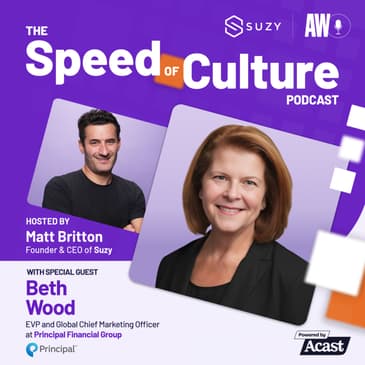
In this episode of The Speed of Culture Podcast, Matt Britton sits down with Beth Wood, EVP and Chief Marketing Officer at Principal Financial Group. Beth shares her insights on navigating financial services, the role of grit in leadership, and Principal's unique approach to brand-building through empathy and expertise.
Follow Suzy on Twitter: @AskSuzyBiz
Follow Beth Wood on LinkedIn
Subscribe to The Speed of Culture on your favorite podcast platform.
And if you have a question or suggestions for the show, send us an email at suzy@suzy.com
Hosted on Acast. See acast.com/privacy for more information.
[00:00:02] Deine Katze und du, ihr seid ein starkes Team. Und auch deine Allergie ändert daran nichts. Denn wir von Purina bringen euch wieder näher zusammen. Mit Purina ProPlan LiveClear, der ersten und einzigen Katzennahrung, die nachweislich Allergene reduziert. Hat alles, was deine Katze braucht und neutralisiert die Allergene auf ihren Haaren und Hautschuppen. Schon ab der dritten Fütterungswoche. Purina ProPlan LiveClear. Jetzt entdecken. Im Tierbedarf und auf shop.purina.de
[00:00:35] Peter Wieser, CEO of Suzy. Join me and key industry leaders as we dive deep into the shifting
[00:01:05] consumer trends within their industry, why it matters now, and how you can keep up. Welcome to the Speed of Culture.
[00:01:16] Today we're thrilled to welcome Beth Wood, the Executive Vice President and Chief Marketing Officer with Principal Financial Group, a global financial service company committed to helping people and businesses access the resources they need to feel more financially secure. We could all use a little bit of that right now. Beth, so great seeing you.
[00:01:31] Beth Wood, Great to see you, Matt. Thank you for having me.
[00:01:33] Peter Wieser, Absolutely. And where's this podcast find you?
[00:01:35] Beth Wood, We are in Des Moines, Iowa, United States.
[00:01:39] Peter Wieser, Oh, great. Right in the heartland.
[00:01:40] Beth Wood, Right in the heartland. Getting ready for fall.
[00:01:43] Peter Wieser, Yeah, that's excellent. As we all are in the heart of the back to school season. So in looking over your kind of career history, you spent now nearly two decades in the world of financial services. What drew you to the category that you currently play in? And what do you find to be some of the most unique aspects of it?
[00:02:00] Beth Wood, So my story is kind of interesting. What brought me to financial services? I was formerly a small business owner. And when I was a small business owner, that was not by choice. I call myself an accidental entrepreneur. My mother passed away and handed me a small business. And I didn't really know what to do with it.
[00:02:18] Peter Wieser, What type of business was it?
[00:02:19] Beth Wood, It was a chain of specialty coffee stores. So a very small family business in the Northeast. So I was an accidental entrepreneur. After doing that for 12 years, I retired and found myself at home with a little bit of time on my hands. And I was curious about small business owners and how they managed through things like succession and transition. Because my mother hadn't planned for succession. She was invincible and was going to live forever.
[00:02:47] And so there was no succession plan. And when she had cancer, when she became ill, it was a scramble to figure out what to do with the business. And I wanted to know more about that. I was curious about that. And so I was networking with former colleague of mine from my PepsiCo days. And he was the CMO at MassMutual. And we broke bread and decided that there was an opportunity for us to work more closely together. And that's how I landed in financial services.
[00:03:16] Peter Wieser, Wow. And I mean, what can you remember from your time at running a small business? And what are some of the learnings that you think help you today in your role as an executive at such a large corporation?
[00:03:28] Yeah, there's not much I've forgotten from my days as a small business owner. You learn so much. It's trial by fire. And it was not part of my career path. Again, accidental opportunity. But I decided I had been running brands for Pepsi and for Johnson & Johnson. And when this opportunity came my way, it was the early 90s. And specialty coffee was just a category that was starting to gain some traction.
[00:03:55] And my mother had been in business for 20 years at that time. So when she opened her business, Starbucks had one store. And so it's really fascinating.
[00:04:04] I've been in that store before in Pike Place in Seattle.
[00:04:07] Yeah, you're right. This is exactly right. And her exemplar company was Pete's Coffee. And they were actually quite formidable on the West Coast at the time. So I stepped into it immediately had more employees than I had ever had in my career that I was accountable for.
[00:04:23] And it wasn't just one employee from a family. It was the entire family because it was a small business. So mom, dad and the kids all worked in the business. So that was a new dynamic for me to learn and understand.
[00:04:35] And I'm a marketer by trade. And so now here I am faced with operational and financial and finance issues. How do you ensure that you have enough capital? How do you ensure that your unique value proposition is sustainable and ownable over time?
[00:04:53] And I was choosing landlords. I had never done that before. So certain elements of operations were quite daunting for me. But I think in the end, you learn a lot about yourself as a leader.
[00:05:05] I learned a ton about myself. And after 12 years, I decided that the business needed different leadership. And that's why I moved on.
[00:05:13] Yeah, I mean, there's a lot of takeaways there. And I'd also imagine that you growing up with a mother who is running a small business impacted you a lot as well in terms of a role model, work ethic, dealing with adversary.
[00:05:26] Do you feel like that your childhood was different because of that? Because I just know, and I've run various small businesses, that it's not easy and it takes a toll on you both personally and professionally.
[00:05:35] I agree with that 100%. And there's a word I often reflect on, which is grit. And you learn how to be gritty and you learn how to do more with less. And when I was in corporate America, the spoils were at my feet. You have budgets, you have people, you have resources. And when you run your own small business, you don't always have those things.
[00:05:57] And so coming in and out of corporate America, I look back now and you learn how to be very frugal with your resources. And I think in my role today, my team is incredibly efficient in what they do and how they think about the world, in part because we're in the Midwest and that's just part of our culture here.
[00:06:17] It's how they roll. Yeah, for sure.
[00:06:18] But it is still something that I learned in my days as an entrepreneur. You learn to just do more with less and the work ethic is certainly part of it.
[00:06:27] My mother was an English teacher by trade. That's part of how I ended up in marketing because I love words and I love storytelling.
[00:06:34] We used to have the old word of the day at the breakfast table every morning. So I've had to sit on my hands to not bring that forward to my team.
[00:06:42] They laugh at me, but you never know. Words are power and they really matter.
[00:06:46] One hundred percent. So after you spent a couple of years, three years at Mass Mutual, you joined Guardian Life where you would be for almost a decade.
[00:06:54] And life insurance is one of the most important decisions we can make, especially as we become parents.
[00:06:59] And there's still what I find is not a lot of knowledge out there with consumers about what the difference is of whole and term life and the value and importance of life insurance.
[00:07:09] What did you learn during your time? I'm also a Guardian Life customer.
[00:07:13] What did you learn during your time at Guardian Life just about the category itself and tell me about your journey there?
[00:07:18] Yeah, Guardian's an incredible company. So it's a mutual life insurance company owned by its policyholders, which is a little different than some of the public financial services companies out there.
[00:07:29] But when I went to whether it was Mass or Guardian, I wanted to understand what small businesses needed to be thinking about.
[00:07:37] And life insurance is a big part of the planning process, whether it's term life insurance for a period of time or whole life, which is just what it says, life insurance for your whole life while you're here.
[00:07:49] And I also learned about things like estate planning and valuations.
[00:07:55] How do you understand what your business is worth and how to build value in your business from where you are today to where you want to be?
[00:08:03] And those were really important lessons.
[00:08:05] And here at Principal, we have similar challenges and similar opportunities to help small businesses better understand what their future looks like.
[00:08:14] When I was running my own business, I used to say my succession plan is to die at my desk because I had no plan.
[00:08:21] So I had to learn very quickly.
[00:08:23] I was following in the same shoes as my mom, who had no plan.
[00:08:27] So I needed to very quickly construct a plan.
[00:08:29] And firms like Guardian, firms like Mass Mutual and even Principal were an incredible part of my learning.
[00:08:36] I was a Principal customer.
[00:08:39] My 401k for my employees was with Principal.
[00:08:42] My group benefits was with Principal.
[00:08:44] So I had experience with them from my small business days.
[00:08:49] Yeah.
[00:08:49] And after spending nearly a decade at Guardian Life, you made the choice to jump over to Principal where you're now Chief Marketing Officer.
[00:08:55] What goes behind a decision like that to leave such a prominent company like Guardian where you were for nearly a decade to move to Principal?
[00:09:04] Yeah, that's a great question.
[00:09:05] So much goes into those decisions.
[00:09:08] Guardian's a fantastic company.
[00:09:09] The people are incredible.
[00:09:11] I went there really as a cultural move.
[00:09:14] It was just a better cultural fit for me as an executive female.
[00:09:18] But I had a three and a half hour one-way commute every single day to my desk at Guardian.
[00:09:24] And that was a big commitment.
[00:09:25] Now, it was from Connecticut to New York.
[00:09:28] So we were in lower Manhattan at the time.
[00:09:30] And it was not something I regretted.
[00:09:33] It was something you just needed to learn to use your time wisely.
[00:09:36] Your time on the train is very precious.
[00:09:38] And when the job at Principal was brought to my attention, I thought, wow, what a great opportunity to move from a mutual company to a public company to learn about the challenges and the opportunities in the public space.
[00:09:53] So that was one of the biggest decisions.
[00:09:55] I had been at Guardian for 10 years.
[00:09:57] I didn't leave Guardian.
[00:09:59] I went to Principal.
[00:10:01] So that was a big part of my decision.
[00:10:03] Today, I have a six-minute commute.
[00:10:05] So I'm pretty happy about that.
[00:10:07] Six minutes is pretty good to get to my desk.
[00:10:09] But it really was about expanding my horizons from private mutual company to a public company.
[00:10:16] And then the opportunity to work with a larger team was also important to me.
[00:10:21] Brand was not as high a priority for Guardian as it is here at Principal.
[00:10:27] And brand is a part of my soul.
[00:10:30] It's really who I am.
[00:10:31] And what I love is to be able to build reputation and tell stories that are authentic to who you are.
[00:10:38] That's what comes through to your customers.
[00:10:41] And I think Principal's a really interesting spot because we're up against a sea of sameness in this category.
[00:10:47] People don't really understand the category, so all the brands get mashed together.
[00:10:51] And unless you have a really distinct master brand strategy that helps separate you from the pack
[00:10:58] and a storytelling mechanism that separates you from others, you're going to struggle.
[00:11:03] And people are going to look at the brands all the same.
[00:11:06] And so we worked really hard to try to distinguish Principal on a number of levels that we could talk about.
[00:11:11] Yeah, so let's dive into that.
[00:11:12] So for those who aren't as familiar with Principal or maybe just have seen your spots on TV
[00:11:17] but don't fully understand what the company does,
[00:11:19] what are some of the services that Principal offers?
[00:11:21] And how do you see the Principal brand being differentiated from other players in the space?
[00:11:26] Yeah, so we're primarily today a B2B company.
[00:11:29] We work with employers in the workspace.
[00:11:33] So we work with employers to help them with group benefits,
[00:11:36] with retirement plans, all flavors of retirement plans.
[00:11:40] Most people will know 401ks.
[00:11:42] But we also work on pension plans and trying to transfer risk away from the employer
[00:11:48] in a pension plan and help the employer manage the risk.
[00:11:52] So many employers today are concerned about their responsibilities when it comes to retirement plans.
[00:11:58] So we bring our expertise to the table to try to help them understand the landscape
[00:12:03] and what their options choices are.
[00:12:05] And then on the group benefits side,
[00:12:07] we work with employees with their dental and vision plans,
[00:12:11] their life insurance, disability insurance, etc.
[00:12:14] So that's really happening in the workplace.
[00:12:17] And then we also have an asset management group that manages assets globally.
[00:12:23] We do business in Latin America, in Asia, Australia, the UK,
[00:12:26] with very large global banks who work with high net worth and ultra high net worth consumers.
[00:12:34] We manage their assets.
[00:12:36] Real estate is a particular specialty of ours in the asset management side.
[00:12:41] And then we also manage assets inside a retirement plan.
[00:12:44] So you can see the intersection of the three businesses, benefits, retirement,
[00:12:50] and asset management all come together in the workplace and globally.
[00:12:54] Absolutely.
[00:12:55] Makes sense.
[00:12:55] And when you think about going to market,
[00:12:57] I guess there's two different broad paths you can take and go after the business decision makers,
[00:13:02] or you can go after the employees to kind of create that groundswell of interest to sway
[00:13:06] those decision makers towards you.
[00:13:08] What is the mix in terms of your target?
[00:13:11] Because even on your website, there's parts of it that are definitely seem more consumer
[00:13:15] focus and other parts of their business focus.
[00:13:17] And I imagine it's sort of a dual pronged approach.
[00:13:19] That's exactly right.
[00:13:21] We call it the double entendre approach.
[00:13:23] We try to make sure that the business decision maker feels really informed and feels as though
[00:13:31] they are able to make an informed and expert decision for their team because they know their team
[00:13:37] better than anybody.
[00:13:38] And typically in larger companies, those are committees.
[00:13:41] In smaller companies, that could be the business owner, potentially their advisor.
[00:13:45] Advisors still play a very important role in our industry.
[00:13:49] And then when we talk about the consumer or the person who's benefiting from those plans,
[00:13:54] that's where that B2C communication comes into play.
[00:13:58] And that's where our job is to help educate,
[00:14:01] nurture, and guide them to make good decisions.
[00:14:03] And decisions that some people might think are simple, but others may think are very complex.
[00:14:09] How much money should I put away in my 401k?
[00:14:12] Should I even participate?
[00:14:14] And a lot of people don't have the advice of a financial advisor,
[00:14:18] and they're trying to make those decisions on their own.
[00:14:21] So a partner like Principal can help educate them on how do you make that decision?
[00:14:26] How do you decide how much to put away?
[00:14:29] Is your employer matching or not matching?
[00:14:31] So those are some of the journeys we try to bring our customers through.
[00:14:35] And of course, the core worker right now are the parents and the people who are thinking
[00:14:40] about retirement and their future are millennials right now.
[00:14:43] People who are in their late 20s to mid 40s.
[00:14:46] And millennials are distinct for a couple of reasons.
[00:14:48] Of course, they're the first generation to grow up with the internet in the household,
[00:14:51] which makes them more digitally savvy.
[00:14:52] So when you have your interfaces where they're tracking their investments to their 401k,
[00:14:57] obviously it needs to be mobile first.
[00:14:58] It needs to be something that can speak to them.
[00:15:01] But I think even more importantly, there's been many reports about how millennials are
[00:15:05] the first generation to also grow up in a worse economic situation overall than their parents
[00:15:11] who are baby boomers, who are known for saving, and obviously not this YOLO type mentality that
[00:15:16] millennials have.
[00:15:17] So I guess given that millennials are your core, and it's a big shift from Gen Xers like myself
[00:15:23] who did not grow up with the internet in the household and maybe have a different value
[00:15:26] system, how does that impact, I guess, your brand and your communication strategy?
[00:15:31] What a fantastic question.
[00:15:33] So thank you for that.
[00:15:34] I really appreciate the lead in.
[00:15:36] Millennials are a fascinating group.
[00:15:39] We are enamored with some of the challenges that they're facing and some of the behavior
[00:15:45] that we're seeing, which is all good.
[00:15:48] I had to remind one of my colleagues that the oldest millennials have children going to college
[00:15:53] now.
[00:15:54] They're like, wait, wait, wait, wait, wait.
[00:15:55] That can't be true.
[00:15:56] But in fact, it is.
[00:15:58] It's not beer and pizza anymore for millennials, they say, right?
[00:16:00] Exactly.
[00:16:01] Adulting is actually a thing now for millennials and has been for quite some time.
[00:16:06] So the thing about millennials is their value system is really fascinating, and it's so much
[00:16:11] more empathetic than Gen Xers or baby boomers.
[00:16:15] They are thinking about the world in a very different way.
[00:16:18] And we have to remember that across the globe, employers play a really important part in how
[00:16:26] we as individuals plan for things like retirement.
[00:16:29] So governments and financial schemas are not always going to carry us forward.
[00:16:34] All of us wonder how long Social Security in the United States will last.
[00:16:39] How long will a 401k schema last?
[00:16:43] And does my employer offer that?
[00:16:45] And does my employer match?
[00:16:46] Those are all basic questions that people should be asking.
[00:16:49] But the responsibility for financing your retirement rests on us as individuals.
[00:16:55] I also am a Gen Xer and maybe a little older than you, but I feel an intense responsibility
[00:17:01] for my own retirement.
[00:17:03] The other thing that millennials are trying to figure out is how do I want to retire?
[00:17:08] It's not your father's Oldsmobile anymore.
[00:17:10] Not everybody retires at 65 and...
[00:17:12] People are living longer, of course.
[00:17:15] Exactly.
[00:17:15] And very few put work down 100%.
[00:17:18] There's so many different approaches to retirement now.
[00:17:22] And this is something that millennials are starting to think about.
[00:17:25] Do I want to retire in my 50s?
[00:17:27] Do I want to retire in my 40s?
[00:17:28] Do I want to just cut back on work and phase in full-time retirement?
[00:17:33] Or maybe it never becomes full-time.
[00:17:36] And how does that impact lifestyle choices in terms of your expenses and how you want to think
[00:17:40] about that long-term?
[00:17:41] That's exactly right.
[00:17:42] And the other thing we all have to think about is medical insurance in retirement.
[00:17:47] So that's a really interesting thing.
[00:17:48] Being able to do the things that you are passionate about in retirement, whether that's continuing
[00:17:54] to work but in a different capacity, travel, spending time with family, all of those things
[00:18:00] are in the mix.
[00:18:01] And what we found in our research is that people really think about financial freedom
[00:18:08] in three circles.
[00:18:09] It's really a Venn diagram.
[00:18:11] The first is physical and mental well-being.
[00:18:14] I want to make sure that physically, to your point, people are living longer.
[00:18:18] Physically, I'm able to extend my life.
[00:18:21] Health is wealth, right?
[00:18:22] Correct.
[00:18:23] Mentally, I'm able to extend my life and live my best life.
[00:18:27] Then the second circle is relationship security.
[00:18:31] So the relationship I have with my significant other, my kids, my grandkids, my family, my
[00:18:37] friends.
[00:18:38] So it's not just my immediate family, but the entire constellation of people that I interact
[00:18:43] with.
[00:18:43] And then the third piece is my financial security.
[00:18:46] When you put all three of those bubbles together, they make up financial freedom, mental and physical
[00:18:52] freedom, and relationship freedom.
[00:18:54] So that's what people are looking for, especially millennials.
[00:18:58] I think Gen Z will bring us a whole nother set of things to think about.
[00:19:03] And I think they will be much more altruistic in their approach to life and much more empathetic,
[00:19:10] maybe than millennials, who are a little bit inward focused.
[00:19:13] We'll be right back with the Speed of Culture after a few words.
[00:19:17] See you next time.
[00:20:00] From our sponsors.
[00:20:07] Gen Z.
[00:20:08] I mean, I think I have two children that are Gen Z and they grew up and had to go through
[00:20:12] COVID and the political instability and a lot of the things that are happening in our
[00:20:16] country now that people like you and I did not have to face during our upbringing.
[00:20:21] And I think that that definitely changes their mindset and the way they look at things.
[00:20:25] That also, in some ways, is sort of anti-long-term saving.
[00:20:30] Like, we've seen this whole concept of YOLO and the experience economy and just spend so
[00:20:35] much money now.
[00:20:36] I mean, the biggest difference between millennials and some of this is Gen Z and baby boomers is
[00:20:40] like millennials, they want to travel everywhere.
[00:20:43] They want to buy the things they want to buy now because they have access to Instagram and
[00:20:47] Amazon.
[00:20:47] And their access to everything in the world is so much different than it was when we were
[00:20:52] growing up.
[00:20:53] We didn't know these things.
[00:20:54] They know everything for better and for worse.
[00:20:57] They know everything.
[00:20:58] And Gen Z are savers.
[00:21:00] I think the interesting thing about Gen Z, they are savers much more so than millennials.
[00:21:05] And they want to know that they're going to be okay.
[00:21:08] And they understand that it falls on me.
[00:21:10] And they want to take advantage of everything their employer offers and everything, all the
[00:21:15] education that is at their fingertips.
[00:21:18] I have two Gen Zers as well.
[00:21:20] And my kids used to ask me, Mom, what's an encyclopedia?
[00:21:23] And I laugh at that.
[00:21:25] But you think about those days before the internet 30 years ago, and that's how we found information.
[00:21:31] And it was certainly not at our fingertips.
[00:21:33] So the ubiquitous access to information has helped all of us.
[00:21:38] And it's all about what each generation does with it, how they put it to work for their benefit
[00:21:43] and the benefit of the people around them.
[00:21:45] Absolutely.
[00:21:45] So given all that, you as CMO, principal in charge of driving the brand forward, making
[00:21:50] sure that you're communicating your USPs and the core pillars of the brand to get people
[00:21:55] to buy in both at the consumer level and the business level.
[00:21:58] What have been some of the tactics that you found to be most successful at building your
[00:22:02] brand at principal, especially given the fact that you clearly understand and value the
[00:22:07] importance of brand building?
[00:22:08] So first of all, there are so many, but we'll try to focus on three.
[00:22:12] The first is have a clear master brand strategy.
[00:22:17] Call it a universal parent brand strategy.
[00:22:19] But know the role that your brand plays in the life of your customers.
[00:22:24] And for us, there are two ideas that we are advancing both to our business decision makers
[00:22:30] and the end consumer who actually is the one that benefits and pays for our products and
[00:22:36] services.
[00:22:37] And that is empathy and expertise.
[00:22:41] And those two ideas are really authentic to who principal is.
[00:22:46] They are not ideas that some of our major competitors could credibly advance.
[00:22:51] So that sustainable value proposition is so important for brands to find.
[00:22:57] And if you look at your brand and you say, well, we're kind of stuck in a sea of sameness
[00:23:03] and we have to find a way to distinguish ourselves, look inside, figure out what's unique and authentic
[00:23:10] about you, who you are and what you bring to the world.
[00:23:14] And that will help guide you toward a unique and sustainable value proposition.
[00:23:20] For us, it's empathy and expertise.
[00:23:23] We are a Midwestern culture that tries very hard to understand people.
[00:23:29] We've been around for 145 years.
[00:23:31] And NCAA basketball is the place where we lean in because we are in the Midwest.
[00:23:37] We believe that basketball is a sport that appeals to a cross section of the generations.
[00:23:44] And we can talk a little bit more about equity in sports later.
[00:23:47] But our partnership with the NCAA and ESPN has been longstanding and really worked well for us.
[00:23:54] It's a platform that helps us not only get our messages out, but also engage our advisors,
[00:24:00] the important intermediaries in our business and our business decision makers.
[00:24:05] So partnerships really important.
[00:24:07] We also have a partnership with Bloomberg and another important partner,
[00:24:11] Wall Street Journal and Barron's, Inc.
[00:24:14] 5000 to help us reach small businesses.
[00:24:16] So those are two tactics that are super important.
[00:24:19] And then the third that I would spotlight is thought leadership.
[00:24:23] We have a lot of points of view here that are very unique and interesting based on 145 years of experience.
[00:24:31] I think about our asset management teams around the globe who are seeing opportunities,
[00:24:37] say, in Hong Kong or in Malaysia or in Chile that are very different than what we see in the United States.
[00:24:44] And global investors want to be able to benefit from those perspectives.
[00:24:49] So we try to use thought leadership as a wedge, a way in, if you will, with a different voice and a different point of view.
[00:24:56] And in terms of the form factor, in terms of how you're packaging up these strategies into content,
[00:25:02] into areas like financial literacy and education and content and thought leadership,
[00:25:06] obviously millennials are digital natives.
[00:25:09] And the way that you communicate is not necessarily just a linear 30-second spot.
[00:25:14] And you're talking about sponsorships.
[00:25:16] I'm sure sponsorships isn't just about 30-second spot either.
[00:25:18] What are some of those tactics that you've been able to leverage successfully to get these messages across
[00:25:23] to the millennial consumer, both from a B2B and B2C standpoint?
[00:25:26] There's so many.
[00:25:27] Media is so ubiquitous now, right?
[00:25:31] Fragmented, streaming, video on demand, programmatic, traditional TV.
[00:25:36] Our budgets in our industry and at principle have shifted for the first time in the last couple of years
[00:25:42] to a balance more toward digital than traditional media.
[00:25:46] So for the first time, digital has exceeded 50% of our budgets in the industry and at principle.
[00:25:53] That is a huge deal.
[00:25:54] Certainly social is a big part depending on who you're trying to reach.
[00:25:58] But social is a great engagement platform.
[00:26:00] Whether you're on Instagram or LinkedIn, you're still reaching people in a new and different way.
[00:26:06] And you're reaching them for the most part in their pocket,
[00:26:09] which is a different way than financial services have ever acted prior to the last call it 10 years.
[00:26:15] So social is another big place.
[00:26:17] Search is huge for us.
[00:26:19] And when you're thinking about the reliability that the consumer today puts on the search engines
[00:26:26] that they're using, whether it's Google or Bing or others, that is a really important idea.
[00:26:32] And nobody wants to be on the second page of Google.
[00:26:34] So that's where you hide dead bodies.
[00:26:37] But everybody wants to be on the first page of Google.
[00:26:39] So search is really important.
[00:26:41] And then I would also say events have had a resurgence.
[00:26:45] Interaction post-COVID.
[00:26:47] It's taken us a while.
[00:26:49] But post-COVID, being able to partner with companies like Milken and Inc. 5000 to be able to connect face-to-face
[00:26:57] with your target audience, those have been incredibly valuable for us as well.
[00:27:01] For sure.
[00:27:03] And when you look at the future in terms of both how the space and the consumer is evolving,
[00:27:08] obviously AI is a huge part of the conversation.
[00:27:10] Because as you were mentioning, like the second page of Google, I have a lot of thoughts personally.
[00:27:14] And I understand I'm an early adopter based on what I do.
[00:27:17] I use traditional search engines way less now than I used to.
[00:27:21] I mean, I'm using ChatGPT for so many things I used to use Google for.
[00:27:25] How do you look at AI as impacting not only your marketing strategies,
[00:27:28] but also the ways that you interact with the end user?
[00:27:32] Because questions that they may have had about how to allocate their 401k over time
[00:27:36] could be driven by a chatbot based upon your historical data that you can inform the consumer on.
[00:27:41] That's exactly right.
[00:27:42] So as you know, AI is a conversation in every boardroom across America and across the globe.
[00:27:49] There was an article actually this morning in the journal about how people are boosting their resumes
[00:27:55] with all this artificial intelligence who basically share that they're an expert in AI.
[00:28:00] I don't know how anybody's an expert right now in AI.
[00:28:02] It's so new, but I thought that was fascinating.
[00:28:05] But for me, AI has two roles.
[00:28:08] Number one, obviously, is cost containment and efficiency.
[00:28:10] And as our head of IT says, AI isn't here to eliminate jobs.
[00:28:16] It's here to make humans superhuman.
[00:28:18] And I love that because it does remind people that you can be so much more productive and efficient
[00:28:25] if you understand the value and the opportunity to use cases of AI.
[00:28:30] So on the one hand, there's cost containment.
[00:28:32] But I think any company that sees it as only a cost containment opportunity is missing the real opportunity,
[00:28:39] which is customer experience.
[00:28:40] And being able to connect what I call BX and CX,
[00:28:45] your brand experience with your customer experience.
[00:28:48] So if you say that you're an empathetic brand, how do you deliver that empathy through your experience?
[00:28:55] One of the things we say is there's no dumb questions at principle.
[00:28:59] Ask us anything.
[00:29:00] And I have to imagine that in the future, AI will help us answer every question that our customers bring us,
[00:29:08] whether it's what am I having for dinner or how much money should I put away in my 401k?
[00:29:12] You're 100% right.
[00:29:13] It also reduces friction because I think that friction to getting questions answered is a big reason why those questions are never asked.
[00:29:21] And I think in fields like the medical field or the financial services field,
[00:29:25] where there's sort of like this intimidation factor of a lot of acronyms and confidentiality and all these things that people just don't ask.
[00:29:33] And it's at their own long-term disadvantage.
[00:29:35] So I think lowering those barriers could be at the benefit of both the companies and the consumers that are involved.
[00:29:40] I agree with you, Matt.
[00:29:42] And one of the things I often say to my folks is it's like finger wagging at the dentist.
[00:29:46] You haven't been here in six months.
[00:29:48] You haven't been here in 12 months.
[00:29:50] Nobody wants that.
[00:29:51] Why would you go back if somebody's going to do that?
[00:29:53] So why would you approach your financial services provider if all they're doing is wagging their well-oiled finger in your face?
[00:30:01] No, you don't want to do that.
[00:30:02] You come to us for help.
[00:30:04] We need to be there to help you and not judge.
[00:30:07] And so it's the old Ted Lasso thing.
[00:30:08] Be curious, not judgmental, and help people find their path.
[00:30:13] Because every financial path is idiosyncratic.
[00:30:16] It's unique to every person.
[00:30:18] Everybody's dealing with something different.
[00:30:19] So I think the future is really bright.
[00:30:22] Absolutely.
[00:30:23] So shifting as we wrap up here, Beth, this has been such a great conversation for so many different reasons.
[00:30:28] Would love to hear a little bit about your leadership style as you run the marketing group.
[00:30:32] At principle, obviously, from going from your early days and your roots within a small business sphere to running marketing for a large organization.
[00:30:39] I'm sure there's a lot of things that have stayed the same over time.
[00:30:43] But definitely a lot has changed, especially as your employee base are digital natives as well.
[00:30:48] And you have to change the way you communicate and lead.
[00:30:50] So how would you describe your leadership style and how has it evolved?
[00:30:52] I think about that a lot.
[00:30:54] And it has evolved and continues to evolve.
[00:30:57] And I think it will evolve for a very long time.
[00:30:59] I consider myself a very direct, autonomous, and curious leader.
[00:31:05] I know what I do well.
[00:31:07] And I delegate everything else to people who are much smarter than me.
[00:31:12] And so when you can hire people who are smarter than you, do it every day, all day long, and then let them go.
[00:31:19] Because they will bring new ideas and new ways to solve problems that you wouldn't even consider.
[00:31:24] But you have to be comfortable letting your people have answers to questions that you don't have.
[00:31:31] You have to be comfortable with that.
[00:31:33] Command and control leadership is gone.
[00:31:35] Nobody's interested in that.
[00:31:37] I have a great phrase on my wall in my office which says,
[00:31:41] When leaders stop listening, their people will stop talking.
[00:31:44] And you want your people to talk to you all day long, every day, and bring new ideas forward.
[00:31:51] So that idea of autonomy and freedom and opportunity to share and express their thoughts and feelings, really important.
[00:32:00] Yeah, I mean, I practice this with my team.
[00:32:02] And it sounds like you do as well.
[00:32:03] If you're at a table and you're the most senior person, you don't want the HIPAA mentality,
[00:32:09] which is the highest paid person's opinion, where everybody just looks at you at the end.
[00:32:13] You want to just wait until everybody else speaks and then take all that as input and help guide the group.
[00:32:18] And I think you're right.
[00:32:19] The old way of things being done was everybody looking at the end of the table.
[00:32:23] And then what happens is people feel disenfranchised.
[00:32:26] They feel they're not growing.
[00:32:27] And then you lose the great talent that can actually get you to where you want to be in the future.
[00:32:30] That's right.
[00:32:32] Mastery is also really important.
[00:32:34] Helping your people develop the skills they're interested in developing.
[00:32:38] Megan, who's sitting with me here today, we're just having a conversation about why she stays.
[00:32:43] And I asked her the question, why do you stay?
[00:32:47] And she had a fantastic answer.
[00:32:49] But I think so many times leaders don't ask, why do you stay?
[00:32:53] Because I want to get smarter about what's important to my people.
[00:32:57] So I can make sure that we remove any barriers to the things that are important to them.
[00:33:02] A lot of times leaders don't ask those questions until the exit interview.
[00:33:06] Exactly.
[00:33:06] Until it's too late, for sure.
[00:33:08] Sure.
[00:33:08] So finally, Beth, you've already said some great phrases and you quote the great Ted Lasso.
[00:33:12] But I'd love to hear if anything else comes to mind in terms of just an overall mantra or phrase
[00:33:16] that comes to mind when you think about your professional journey.
[00:33:18] I love the phrase, know what you do well and delegate everything else.
[00:33:23] That was probably the best piece of advice I ever got.
[00:33:26] And you can only do that when you know how to hire great talent.
[00:33:31] And if you misstep and you don't hire existing talent, be sure you invest the time to develop that talent.
[00:33:38] We have an incredible team of people who are balanced from the outside and people who have
[00:33:43] grown up in the principal culture.
[00:33:46] We're about 50-50.
[00:33:47] 50% of the people here have been here more than 20 years, which is amazing.
[00:33:51] You don't often hear of that.
[00:33:52] But they have taken on new and different roles throughout their journey and picked up different
[00:33:57] experiences along the way.
[00:33:59] So all of that is really important.
[00:34:02] And then you blend that with the new outside-in perspective.
[00:34:05] And then you get this incredible fabric dynamic that happens among your team.
[00:34:10] And then they elevate each other.
[00:34:12] And co-elevation is what we're all about.
[00:34:15] Let's align on a common problem and then together we'll figure out how to solve it.
[00:34:19] I love that.
[00:34:20] We're going to lead at that, Beth.
[00:34:21] It's been an awesome chat.
[00:34:23] I feel like we can go on forever, but it's been a thrill for me to understand your background
[00:34:27] and where you came from and where you're focused on at Principal.
[00:34:30] And I'll continue to admire what you're doing from afar at the business.
[00:34:33] So can't wait for our audience to dive into this pod.
[00:34:35] So thanks again.
[00:34:36] You bet.
[00:34:37] Thank you for the time.
[00:34:38] Have a good weekend.
[00:34:38] Bye-bye, Matt.
[00:34:39] You too.
[00:34:39] On behalf of Suzy and Adweek team, thanks again to Beth Wood, EVP and Chief Marketing Officer
[00:34:44] with Principal Financial Group for joining us today.
[00:34:46] Be sure to subscribe, rate, and view the Speed of Culture podcast on your favorite podcast
[00:34:49] platform.
[00:34:49] Until next time, see you soon, everyone.
[00:34:51] Take care.
[00:35:02] You can listen and subscribe to all Adweek's podcasts by visiting adweek.com slash podcasts.
[00:35:08] To find out more about Suzy, head to suzy.com.
[00:35:10] And make sure to search for the Speed of Culture in Apple Podcasts, Spotify or anywhere else
[00:35:15] podcasts are found.
[00:35:17] Click Follow so you don't miss out on any future episodes.
[00:35:20] On behalf of the team here at Suzy, thanks for listening.
[00:35:40] Jetzt ist Herbst und bald stehen schon wieder die Feiertage vor der Tür.
[00:35:44] Das kann auch für Hunde ganz schön stressig sein.
[00:35:47] Viele Vierbeine reagieren unter anderem mit einer gestörten Verdauung und das ist wiederum
[00:35:52] Stress für ihre Besitzer.
[00:35:54] Aber es gibt schnelle und einfache Hilfe, das Probiotikum Purina Proplan Forti Flora.
[00:36:00] Streu einfach einen Beutel über das tägliche Futter.
[00:36:02] Die außergewöhnliche Zusammensetzung mit lebenden guten Darmbakterien stellt das Gleichgewicht
[00:36:07] im Darm wieder her.
[00:36:08] Natürlich kannst du Proplan Forti Flora auch präventiv oder bei alltäglichen Verdauungsbeschwerden
[00:36:14] einsetzen.
[00:36:14] Es unterstützt auch bei Ernährungsumstellungen oder Antibiotika-Einnahme.
[00:36:19] Purina Proplan Forti Flora.
[00:36:21] Jetzt auf shop.purina.de
[00:36:23] Musik
[00:36:24] Musik