
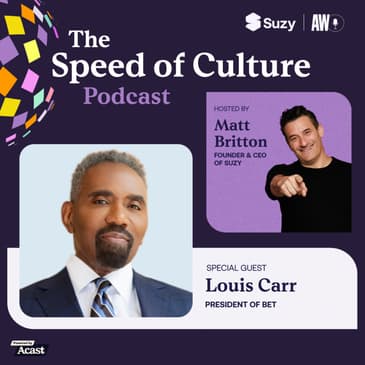
In this episode of The Speed of Culture podcast, Louis Carr, President of BET and founder of Waymaker Media, joins Matt Britton to discuss how one of the most influential media brands in the world is evolving for a new era. Drawing on nearly four decades at BET, Louis breaks down why the brands winning with multicultural consumers lead with growth targets, not purpose statements, and what that distinction means for marketers. The conversation covers BET's community, culture, and connection framework, the network's intentional approach to youth relevance, and what the BET Awards reveal about where black culture is heading next. Louis also gets candid about the $7 million mistake that nearly ended his career and the waymakers who shaped everything that followed.
Follow Suzy on Twitter: @AskSuzyBiz
Follow Louis Carr on LinkedIn
Subscribe to The Speed of Culture on your favorite podcast platform.
And if you have a question or suggestions for the show, send us an email at suzy@suzy.com
Hosted on Acast. See acast.com/privacy for more information.
[00:00:00] More and more people are realizing the influence and the impact of Black culture. And because of that, I think businesses are now starting to understand how they must embrace it, how they must engage with it, and how they must look at it for future growth. To thrive in a rapidly evolving landscape, brands must move in an ever increasing pace. I'm Matt Britton, founder and CEO of Suzy.
[00:00:28] Join me and key industry leaders as we dive deep into the shifting consumer trends within their industry, why it matters now, and how you can keep up. Welcome to the Speed of Culture. Up today on the Speed of Culture Podcast, we're thrilled to welcome Louis Carr, the president of BET and founder of Waymaker Media.
[00:00:49] Over nearly four decades at BET, Louis has helped shape one of the most influential media brands in the world for Black audiences, driving culture, community impact, and brand innovation, while helping redefine how major companies connect with multicultural consumers. Louis, so great to see you today. Thanks so much for joining. Louis Carr, Thank you for having me, Matt. It's a pleasure. David Carr, Absolutely. So I've been looking forward to this. You know, you spent nearly 40 years at BET and you recently stepped into the role of president.
[00:01:13] What would you say some of the biggest shifts are in how you've witnessed Black culture influences mainstream business? And where do you think maybe people are still underestimating its impact?
[00:01:23] David Carr, Well, I think more and more people are realizing the influence and the impact of Black culture. And because of that, I think businesses are now starting to understand how they must embrace it, how they must engage with it, and how they must look at it for future growth. So it is an exciting time in our business and how you navigate those waters, decide how you survive or how you thrive.
[00:01:52] David Carr, Yeah. And obviously BET is known as a television network. I know it's a multimedia platform. And just given how long you've been in the business, how has BET evolved over time? And what are some of the parallels to how the media industry at large has also evolved?
[00:02:08] David Carr, That's a great question, Matt. But I think most B2B people look at BET as this cable network, but our audience looks at us as a brand. And we know that by things that we do in digital or live events or just even our social media, people have this great expectation of this brand. And that is to serve them, to engage with them, to understand with them, to support them.
[00:02:37] David Carr, Sure. And you mentioned some of these pillars, but what are some of the, I guess, evolutions of BET over time that have been successful in connecting with audiences? Because you're right, like the cable network kind of run has kind of, I guess, flattened off to some extent because consumers have so much more choice now, right? They can get information through YouTube and everywhere else. There was a time where, when I was growing up, right, when you were growing up too, where cable TV kind of ruled the day, right?
[00:03:03] David Carr, And at first you had three channels on TV and then all of a sudden you had ESPN and the golf network and BET and you had all these other kind of more niche programming. But now you have this mess of long tail. So I guess how has BET reacted to that in terms of its overall media pillars where it really invested and focused on?
[00:03:21] David Carr, Well, in the first 30 days when I got into this job, I knew number one, we had to get deeper in serving our community. And we established this pillar of community.
[00:03:34] And I think any brand in this particular time has to get deeper into their audience through us is going to be through community. And that is something that I think we can easily do. I think it's an expectation that our community has of us and we're headed down that path.
[00:03:54] David Carr, I think the other thing is culture. We have been a brand that has been on the cutting edge of Black culture from the very, very beginning. I think now that we're going to get deeper into that, I think it's a little more complex than it was 20, 30 years ago, but I'm clearly know that we can figure that out.
[00:04:17] And then the final C is connection. We must be able to connect our consumers. We must be able to connect our affiliates. We must be able to connect our marketers all together so it serves the good of the business and good of our community and our culture.
[00:04:36] So those are the sort of pillars that we're operating in. Everything that we do has to touch at least one of those pillars. Every press release, every piece of content, all of that must make sure that we're at least serving one of those three Cs at all times. Yeah, and of course, the business itself is supported by advertisers and you've helped generate over, I saw $10 billion of advertising revenue throughout your career.
[00:05:03] How has the conversation with brands changed when it comes to kind of investing in multicultural audiences? Because America is so much more diverse than it used to be even 20 years ago. And investing in a platform like BET may have seen as a niche in the past, but now it's definitely core and the central pillar to the American consumer. So has that changed the way that you have conversations with brands and what are brands looking for from your platform?
[00:05:30] Well, I think what's common among all brands and all industries is one word called growth. Everybody wants growth. I don't care what you're selling, what you're offering, everybody wants growth. And when you look at our marketplace and our consumers, whether we are number one in that category or whether it's our impact or influence on those who are outside the Black community, it's still about growth every single day.
[00:05:59] And I think we see that based on the data. And it's in all categories, whether it is in beverages, technology, or even politics. People still want our consumers to show up, have an opinion, use that opinion for influence and impact. So those are the type of conversations we're having today. And we are just showing them the data that supports those things.
[00:06:26] Yeah. And speaking of brands, like many companies, I find they talk about purpose and inclusion, but I think consumers have really grown skeptical over time because I feel like brands increasingly just throw any label against themselves to try to appease the population at large, whether they mean it or not. But of course, there are some brands that do genuinely connect with Black consumers per se from just checking the box.
[00:06:51] I guess, what do those brands have in common, the brands that really are committed to supporting this community? The things that they have in common is that one thing, they've done the work and said, where am I going to get my growth from? Am I going to get my growth from international? Am I going to get my growth from the Hispanic audience? Am I going to get my growth from the Black audience?
[00:07:14] Am I going to get my growth from the Hispanic audience?
[00:07:44] Am I going to get my growth from the Hispanic audience?
[00:08:07] And obviously, you've had a front row seat to the rise of multiple generations of consumers through your ride at BET. And now the new consumer is Gen Z. Of course, that's the generation that grew up with the iPhone in the households. They are mobile first and they're consuming your content on platforms like Instagram and TikTok all day long. And now there's Gen Alpha, who is going to be known as the AI generation. They're the first generation that grew up with AI in the household.
[00:08:32] How does a platform like yours and the brands that you serve, I guess, effectively evolve to be able to connect with this new generation? Because MTV is no longer, right? Like, I was shocked when that happened. It was a big part of our upbringing, but it's gone. And probably one of the reasons why is they didn't evolve fast enough. They didn't embrace social media and digital fast enough. You guys obviously have, but how can you continue to do so moving forward?
[00:08:57] I think we have this advantage of when we embrace our community, we embrace young people. Young people are very, very, very vocal about what they want and what they don't want. And my leadership to my senior leadership team is all about being young, staying young, being relevant at the end of the day. That's why we have the host of the BET Awards that we have today, Drewski, because we understand his impact on culture.
[00:09:27] We understand that he is young. He's, matter of fact, the youngest host that the BET Awards has ever had. That didn't happen by accident. That was very intentional on how we approach and what we're going to deliver on. When we look at the people who perform in the BET Awards, you've got those who are iconic, and then we've got those who are on their way to be iconic.
[00:09:53] Young people, whether it's people like the International Superstar Tims, we understand the influence and the impact that they are having on our culture and our community. So we understand we've got to be young. I mean, that's no choice. That's something that has to be very intentional in everything we do.
[00:10:13] And we have another program called NextGen where we're working with college students and making sure that they can participate around some of our big events like the BET Awards, like the NAACP Image Awards. So we get them engaged. We try to teach them business acumen at the same time, but we're also learning from them. They are teaching us. So it's a two-way street. Yeah.
[00:10:38] And speaking of youth, you created Waymaker, which is a platform that intentionally focuses on mentorship and growth and leadership. What was the impetus behind you starting that? And what are some of the benefits that you hope to personally get out of it as well as the community that you serve? Well, I had started Intern Foundation 20-some years ago. And during COVID, I said, how can I take that to the next level?
[00:11:04] How can I have greater impact on young people? How can I have greater impact on my community? And we started this Waymaker brand to inspire, motivate, and educate people on what their best life can look like. Because if you are sort of in just one area of your life or one community of your life, you don't know how big the world is.
[00:11:29] So we wanted to sort of show people how opportunities and how hard work and how commitment can really lead to what your best life can possibly be. And we do that by highlighting people who came from the same backgrounds, who had the same struggles, and how they overcame those things in order to be leaders in our community and our industries today. We'll be right back with The Speed of Culture after a few words from our sponsors.
[00:11:58] So let's shift gears a little bit and talk about you, because you've obviously overcome that yourself. And we'd love to hear a little bit more about your story over the span of your career. And what are some of the challenges you face and maybe some of the key learnings that you are imparting on tomorrow's leaders? I would say, Matt, that the number one thing that always comes back to me is I was an All-American track athlete, and I didn't want to go to college.
[00:12:24] I had offers from every major university in the country. And I said, that's not for me. Why was it not for you? My family was poor, and we needed a check like right now. I didn't have four years to delay. I wanted to help my mother. I wanted to help my grandmother right now. And it took a community of people, coaches, neighbors, teachers to convince me to go to college for free.
[00:12:51] And I'm just like, when I look back on it, I'm like, how crazy could I have been? All right. And I went to college for free. I went to Drake University. And those things stayed with me as I knew other people who had college debt. So when I look at some of the things that I do now, the support of education, the support of, you know, I serve on the board of directors of Drake University. I used to be on the board of directors of Chicago State.
[00:13:20] It's because I never forgot the opportunity that I had to go to school for free. And I can tell you this is something very personal that my mother said to me. She said, son, we don't know what you would have been without a college education, but we know what you are with one.
[00:13:39] So I understand the importance of Waymakers, people who see something in you, Matt, before you see it in yourself, and they decide to do something about it. So that's what this Waymaker brand stands for. That's who I am as a person. When I got in this industry and I look at where I'm at today, it wasn't because I just worked hard and I had some success. It's because people saw something in me.
[00:14:08] People were intentional about trying to put me in the positions than the rooms that I am today. That was very intentional. And that's what Waymakers are. And we need more of those for everybody. And of course, once you're set on your way and you get over that initial friction, of course, it's not always roses, right? You do hit challenges personally and professionally along the way.
[00:14:32] When you look back at your career, what is one or two moments that you look at where it was very challenging for you and you had to overcome obstacles? And how were you able to get past that? What comes to mind? Well, I'll tell you one that was here at BET. It was in 2009. We had a horrible mishap in our self-service department.
[00:14:57] And that mishap, mistake, whatever you want to call it, cost the company about $7 million. And I was so devastated that I told, at that time, Viacom leadership that I was resigning. I was embarrassed. I thought it was the right thing to do as a leader. It happened on my watch. And I said, I understand. I'm out. Just tell me how quickly you want me out the door.
[00:15:26] If you want me to leave immediately. We're trying to take accountability for it. Yeah. And they chuckled at me. They said, Lewis, you're so crazy. They're just so crazy. They said, things happen. But it doesn't wipe away the tremendous career and commitment and success that you have had. It never has crossed our mind that you would not be here. Never.
[00:15:54] Through all of this, the investigations never crossed our mind. It happened. We all learned from it. We'll move forward. You'll be a better leader because of it. And get to work. So that sort of commitment that people have had to me and for me through thick and thin, through good and bad, is the reason that I do the work that I do today. Yeah.
[00:16:21] I mean, I think one of my takeaways from that story, and thanks for sharing it, Lewis, is that doing the right thing is always the right thing. And your first inclination was to take accountability for it. Like what you said, it happened under my watch. I feel like so many people would say, well, they messed up. They should get fired. But I didn't know anything about it. There's nothing I could have done. But I think you took the high road. And I do think that more often than not, and there's no guarantees they could have accepted your resignation. But you're putting yourself in the position where you're approaching it with accountability
[00:16:51] and integrity. And I think when you do that over time, the right things will happen to you. And it's hard to swallow that pill. But I think it's something that we need to do sometimes. That's what leadership is all about. Now, Matt, some people did get fired, but I was willing to put myself as part of that group because of the mishap. Yeah, absolutely. And when you think of Tamar's leaders and people who are just starting off in their career,
[00:17:17] which we have a lot of listeners that are younger here in the podcast, especially younger black professionals that are entering the workforce. What's some advice that you have for them to set themselves up for success so they can end up in the seat like you're in one day? Well, the things that I think are very important is, number one, understand the business and
[00:17:40] understand your partner's business, which requires tremendous commitment and study and continued learning. Have a big dream for yourself. As they say, think big and go after that. Oh, yeah, you're going to get pushback. You're going to get people who tell you no. You're going to get people to tell you that's not for you. Have a big dream and be committed to achieving that.
[00:18:08] That is one thing that I think has taken me a long way, is being able to say, it is for me. It's not just for people who may not look like me, who may not come from the same background with me, who may not have the same beliefs as me. I can contribute in a major way. I am very intentional about that. And the next thing, find somebody who believes in you. Find that way maker.
[00:18:37] Because sometimes people wait and try to say, how do you find your way maker? I think you find your way makers by being accessible, by showing up in different places, by making yourself uncomfortable. I can't stress that enough, that you've got to go into rooms where you're not comfortable. You've got to show up in places where people don't look like you.
[00:19:02] You've got to be able to push through that uncomfortableness in order to be successful. Because as you know, Matt, in order to have growth, you have to be uncomfortable. Because you've got to do some things differently. You've got to make some changes. You've got to do all those type of things that kind of make you kind of screamish. And it's like, you know, is this for me? How will they accept me? How will they view me? You've got to push through that uncomfortableness. And I love that, Lois.
[00:19:32] And here's what's interesting is if you look at the way culture has evolved, especially here in America, there's been all these technologies and conveniences that essentially allows you to avoid being uncomfortable. Like there's online dating apps. So you don't have to approach that girl or guy. You could just swipe, right? You don't have to reach out and introduce yourself. You could just basically copy and paste an email on LinkedIn, even though we both know it doesn't always work. But I think you don't even have to hail a taxi. You hit a button and an Uber shows up. Or order food.
[00:20:02] You hit a button and food shows up. So I think everything is kind of being conditioned to save people time and make life more convenient, which is sort of the opposite of being uncomfortable. And I think there's a risk there for younger people of conditioning their brains not to go into that discomfort area where I think all the benefit is, like you've said. But Matt, I do tell my interns, all of that technology, all of those process and procedures that make things easier, but then there becomes the moment of truth.
[00:20:31] And that moment of truth is when you have to show up, that real person you are, and you have to face that music. We do this exercise in internship program. Interns, before they leave at the end of the summer, they have to talk about themselves for five minutes straight. Not four and a half, not five and a half, five minutes straight. Because when they get out of school for a job interview, most of them, they'll have some internships,
[00:21:00] but they won't have a lot of experience. And they're going to have to sell themselves to that person on the other side of the desk. And what they say in their opening five minutes determines whether that person continues to listen or that person says this is a waste of time and this is not the one for this particular job or opportunity. So we practice that. And I can tell you, Matt,
[00:21:27] most of the interns don't get through that five minutes correctly on the first try. Most of them have to do it a second or a third time because most people, to your point of technology and the ease of how we navigate through our environment, have not become accustomed to telling their own story. And that's so important. You have to be able to tell your own story. You have to be your own best advocate. And really, you have to carve out your own path.
[00:21:55] Like they say, like everyone else is taken. You have to just be yourself. And I think that's a great exercise. Frankly, Louis, one I might steal from you for some leadership that we did. Please do. So to wrap up here, and as I knew it would be such a fantastic discussion, we always ask our guests when we wrap up if there's a saying or a mantra that has helped sort of encapsulate their professional journey to date. And just wondering what comes to mind for you. Well, the saying and the mantra is,
[00:22:22] think big, so big that it makes you uncomfortable at the end of the day. And that is something that whether you are 18 or whether you are 75, I think people have to really continue to drive and think about the future. I'm going to tell you a quick story, Matt. I was in Florida and I was at a furniture store and me and my wife, we make our purchase.
[00:22:52] And at the end, you know, they're getting all your information for deliveries and everything. And we give the guy our address and he goes, oh, you're my neighbor. This is the guy who's checking us out, right? We stare with him. We're your neighbor? He said, yes, you're my neighbor. And Matt, we saw Eric, he said, oh, I don't think so. And he said, oh, no, I know you're my neighbor for sure. I said, okay. He said, have you seen the big yacht?
[00:23:21] It's about 175 footer that sits right there on the inner coastal. It says, my lady. I said, I have. He said, yes, in front of the house that was just finished a couple of months ago. I said, yes. And he started to laugh at us, Matt. He said, so you're wondering why I'm working at a furniture store with a house that big and a yacht that big. He says, because I'm learning.
[00:23:49] I'm thinking about buying this chain of furniture stores and I'm learning the business from the ground up. Wow. Took everything out of me. He said, I come from a custom that learning is continuous. And if I'm going to invest a lot of money, I've got to make sure I know what I think I know. And that was many years ago, Matt, but it's a lesson that I learned
[00:24:18] that I'll never forget. Keep learning. Yeah. And that's probably why he's been so successful to begin with as he has this curiosity and thirst for learning. Absolutely. Great. Well, Lewis, thank you so much for taking time out of your busy schedule to share your story and your insights with us today. It's been fantastic. And I can't wait for our listeners to hear our conversation. Thank you, Matt. I appreciate it. And the best of luck to you. Likewise. On behalf of Susie and Adwi Keen, thanks again to the great Louis Carr, the president of the BET and founder of Waymaker Meteor, for joining us today. Be sure to subscribe, rate, review,
[00:24:48] the Speed of Culture podcast on your favorite podcast platform. Till next time. See you soon, everyone. Bye-bye. The Speed of Culture is brought to you by Susie as part of the Adweek Podcast Network and A-Gest Creator Network. You can listen and subscribe to all Adweek's podcasts by visiting adweek.com slash podcasts. To find out more about Susie, head to susie.com. And make sure to search for the Speed of Culture in Apple Podcasts, Spotify, or anywhere else podcasts are found.
[00:25:18] Click follow so you don't miss out on any future episodes. On behalf of the team here at Susie, thanks for listening.