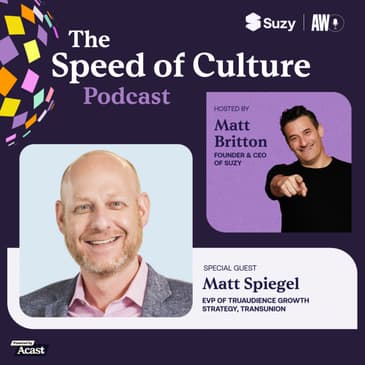
Marketers often find themselves caught between the promise of high-tech innovation and the reality of fragmented consumer data. Matt Spiegel, EVP of TruAudience Growth Strategy at TransUnion, joins Matt Britton on The Speed of Culture podcast to discuss how established analytical frameworks are finding new life in the era of artificial intelligence and privacy changes. The discussion highlights why the most significant hurdle in digital transformation often involves the human element rather than the software itself.
Follow Suzy on Twitter: @AskSuzyBiz
Follow Matt Spiegel on LinkedIn
Subscribe to The Speed of Culture on your favorite podcast platform.
And if you have a question or suggestions for the show, send us an email at suzy@suzy.com
Hosted on Acast. See acast.com/privacy for more information.
[00:00:00] What we've already seen through research we've done is, if you use AI without great data, you're not going to get great results. If you feed your systems incomplete, it doesn't have to be bad, it can just be incomplete data, but it can be bad data too, then you aren't going to build the competitive difference you think you're building. To thrive in a rapidly evolving landscape, brands must move at an ever increasing pace. I'm Matt Britton, founder and CEO of Suzy. Join me and key industry leaders as we dive deep into the shifting consumer trends within their industry.
[00:00:29] Why it matters now and how you can keep up. Welcome to The Speed of Culture. We are live in South Beach at the Possible Conference today. We're thrilled to be joined by Matt Britton, the EVP of True Audience Growth Strategy at TransUnion. Matt has spent over 15 years at the forefront of digital marketing, media and technology innovation, building companies launching industry-defining products and advising the world's largest brands. Matt, so great to see you today. Yeah, I appreciate that, Matt.
[00:00:57] Absolutely. So tell me a little bit about your background and the road that led you to ending up at TransUnion. Yeah, listen, I was very lucky to happen my way into the internet ad business in the late 90s out of school, really randomly. Got a marketing degree, got a sales call while at school to come recruit for this startup. Jumped in the industry, never left it. Worked for a lot of companies that didn't make it along the way. A couple that did some cool stuff. Happened to work for a direct response television agency really early in my career, so I learned a little bit about data and conversion. Uh-huh.
[00:01:25] I was part of the web 1.0 bubble era at L90, one of the great ad networks of the world. Had a great time there. Transitioned that into the search business. I got into search early, started an agency called Resolution Media. We sold at the Omnicom, spent six great years at Omnicom, learned a lot about this business from the inside out. Yeah, I think working at a place like Omnicom, it's a great place to cut your teeth. Learning principles of account management, branding, there's so much to learn at places like that. Loved it. And I got leadership training there too. I loved my time there, but I wasn't an agency guy for life.
[00:01:53] Went back to startups, to tech, made my way over to MediaLink for several years, which was another great- Yes. To see a lot about what was going on in the industry. Yeah. And I've always been passionate about the intersection of data and technology changing marketing. Like, I am a marketer at heart. I've just always been in kind of the data and technology side of the industry. Right. And so when it became time to join TransUnion eight years ago, what I saw was that the world was still colliding, and companies like TransUnion can provide a valuable service to marketers, and I've been doing that since.
[00:02:19] Yeah, I mean, coming out into the workforce, I did as well at the dawn of the internet era. Yeah. Right? I mean, you see so much change, and if you zoom out from a 30,000-foot perspective, there once was a world where there was no YouTube, there was no Google, and we think these things are gonna be the way they are forever. Yeah. But things change over time, right? And I think now what we're seeing is the pace of change accelerating to a point like we've never experienced ever.
[00:02:45] Yeah, things are certainly getting faster, but I think we are also overestimating some of the pace of the change again. Okay. Listen, people are always the slow part of this change, right? Right. The technology is first. Right. Then you've gotta deal with the process and the people side of it. Right, like I took my daughter to the dentist, and I was still filling out a clipboard for her. Yeah, there you go. There's still reality. And I'd like to say it actually has only been about really 15 plus years where mass media and data and technology really started to intersect. Yeah.
[00:03:10] Maybe you can go 20, but 2010-ish, programmatic buying was just becoming a thing. And so I think we've forgotten so much how much change we have actually pushed on this industry in the last couple of decades. So clearly, how can we not talk about AI in this journey? Of course. That will speed change. But I'm still a believer there's still some things that will take longer than we sometimes predict. Yeah, I mean, I remember there was a point when everyone said PNG was gonna be being programmatic in-house. Yeah. And that never happened, right? Right, totally.
[00:03:35] And it's interesting because even with those ebbs and flows, we went through the period where direct-to-consumer marketers had found this incredible formula with retargeting. And then we saw this whole privacy backlash and Apple changed the ability and then Meta came up with a new way where they used AI to target better. So it's always also ebbs and flows as well. Yeah, I agree. It's a push and pull. And one of the themes that I've watched is the notion of the easy button. Right.
[00:03:59] Which is how much do we want to actually learn for ourselves and do and get our kind of in the muck in the sausage making of it all? First, how much do we want to outsource? And I've watched as the industry and marketers and agency partners and technology companies, it keeps going back and forth. Right. In an ideal world, I think we as marketers broadly defined all get as close to the sausage making as we can, but that's really hard. It takes a lot of investment. It's not easy to do. Yeah. If you think the world that's coming makes it easier, I think that's really important. But I think what we've watched is a trend happens.
[00:04:30] We lean in a little bit. Turns out insourcing isn't actually quite as all that it's made up to. Right. And we go back to the outsourcing trend because new innovation has happened and new startups have been funded. Right. And then the cycle kind of repeats itself. I think generally speaking, at least forward moving. But yes, I think there's a cycle approach to this. I think the reason insourcing doesn't work as much, especially with large brands is everybody from the management down isn't really like, it's not life or death. Like a lot of them actually want things to stay the same, especially the top executives. They want the golden parachutes.
[00:04:58] They're not trying to reinvent a business that's doing fine and growing 2% a year. And that trickles all the way down. And it's really hard then for some pocket in your organization for them to become incredibly entrepreneurial and inventive. It usually just doesn't work that way. It is hard. And actually, we'll go farther. I think we sometimes forget that the marketers that we deal with at these companies like Procter & Gamble, they're not marketing companies. They're companies that build product that do marketing. Right. Now, P&G is a little bit of a class of it. Yeah. Arguably they are a marketing company. Right.
[00:05:25] If we go like broadly, more broadly defined, and I think where we see that marketing evolves more slowly, I think a lot of what still happens is, and this is a theme that I keep hearing constantly these days, is marketers at the C-suite are not getting the respect and the kind of the credibility that they deserve. And so I do think most practitioners of business don't know marketing particularly well. And when we live in a world of inexact science, even though we brought more data and more precision to the business, there still is a lot of proxy metrics.
[00:05:52] You still have to believe in the value that brand matters. Right. Understanding attributes and having an authentic voice matters. That stuff that you're not from the category, not from this industry, a lot of business executives don't appreciate. And so I think part of what this kind of change curve also is, is you actually now have to find people who want to lean into that innovation. They actually want to be the change agent. They are willing to be that kind of risk tolerant and actually push the envelope to executives that don't necessarily always like it. Yeah.
[00:06:20] And so I think that's another part of how this has gone and where our industry has and hasn't moved in ways we might think, is because this is a very people driven thing. It's not so much systematic. Yeah. It's interesting when you talk about brands and brands matter, because I kind of go both ways. It's like on one hand, like I understand the power of brands where if you're in the aisle and you see a brand you trust, you'll pay or pay more for that brand. Like, you know, store brand diet soda versus Diet Coke. You're like, oh, it's Diet Coke. Right. And I get that.
[00:06:46] But the reality is so many brands that exist today were built during the golden age of television. Sure. Right. Where if you actually had a checkbook and you could write checks, basically you could force your brand onto consumers through linear media. Sure. Right. And essentially, and the same way that Clear Channel had the ability to produce a top 10 songs by playing it on heavy rotation on the radio, Brand Markers had the ability to produce a top three brand by continuing to advertise.
[00:07:13] And that has a long, like you're talking about things don't change as fast as we think. I agree. Which is why despite some brands really doing nothing new and interesting, they still drive volume because they're playing on that moat they created during the industrial era of television. But then the question becomes in a world where then again, there's Kylie Cosmetics, right? Kylie Jenner's beauty brand takes off. What's the brand there? The brand is her. Mr. Beast has people around the corner to buy his chocolate bar or burgers. Yeah. The brand is him.
[00:07:42] So the question is, are people going to become the new brands ultimately? Because we're seeing Nike, who's like an iconic brand, really struggling. Sure. Right? Like they're having a very hard time recapturing growth. Sure. Will they ever recapture growth again? Yeah. Yeah. I don't consider myself an expert on Nike. Right. But I would say broadly, I actually think you are emphasizing that brands will still elevate. Sure. Right. A Mr. Beast, the Kim Kardashian. Right. But those are a new type of brand, aren't they? But new type of brand. Right. But I still think it's still a brand, right?
[00:08:10] Well, in some ways you're a brand, your name is a brand. We have personal brands. Exactly. I agree with that. I think what brands equal are newly defined. And I do think there's a category of product where brand matters a lot less. Right? So it is much easier now to build a business selling product through social channels and have a very successful business on a non-branded situation. I think that you want to get to scale. And I think that's where I get to actually that level of something that stands for something, some type of meaning. You know what Mr. Beast means right now. Right.
[00:08:39] You know what the Kardashian brand stands for at some level, even inherently. I think that will continue to, those examples in my mind will continue to stand out. Yeah. And I think the fact we're bringing the ability to understand customers more to that table, where consumer insights are actually more granular, they're more easily accessible, I think helps that journey. Right? I think you can have more micro moments to create those macro opportunities as well. So I'm still bullish, but I totally appreciate it. If you want to create the next DTC brand or DTC product line, you can probably make a
[00:09:09] lot of money and cycle through products lots of times and no one ever know what you are. I think that can happen too. But if you want to be scaled, I think it's a different story. Well, so I'll give you another thought, which is you were talking about these examples were all products, physical product. And once the ability to produce products became commoditized through outsourcing in China, and the barriers to entry were lower, that's when you saw the differentiator become people with distribution behind it.
[00:09:36] So you saw George Clooney with Casamigos, you saw Dr. Dre with Beats headphones, and going back to like Jennifer Aniston and 50 Cent with Vitamin Water, right? All these brands, all the way up to the Kardashian brands, et cetera, the list goes on and on, right? I think the next evolution of that is actually business influencers being connected to technology products. Here's why. The barriers to entry to creating software are now being eliminated through AI. Anybody can create software. So Ryan Sirhan has a big real estate influencer, has a software platform called SellIt, which is
[00:10:06] a real estate sales platform, which is at par with probably a thousand other tools. But he just raised $50 million in doing well. Why? He's a distribution. So I think conferences like this, the possible conference in the future, instead of it being the Trade Desk and Salesforce, et cetera, it could be like Daymond John and Ryan Sirhan, people like that. Their brand might be the business brand. Love it. I haven't thought that. But I'm with you. I think there's a there there. I think the brand building has definitely changed. And I think any of us can make it happen, I think is your key point. I totally agree.
[00:10:35] We'll be right back with the Speed of Culture after a few words from our sponsors. So let's shift gears a little bit to TransUnion. So a lot of people know TransUnion as an old school courier messaging company, right? Well, yes. Actually, you went even earlier to get credit scores. Yeah. Maybe I'm a little older than you. So basically, but its background was not what it does today. Correct. So tell me the state of TransUnion today, why you were excited about this business specifically, and then I want to get into the new products that you're working on. Yeah, sure. Yeah.
[00:11:02] Well, ultimately what TransUnion at its core is, is provides a credit score, which what is it? It's a calculation of risk. And so in order to do that, you have to source a lot of data and you have to have great analytics out of the hood to be able to connect. Right. And so we have to create a lot of disparate signals so that any financial service institution can understand who you are with enough precision in order to judge whether you deserve another credit card, you deserve a mortgage, et cetera. Okay. So really, if you kind of take that concept where the credit score obviously isn't relevant,
[00:11:29] except in very limited, very regular cases in marketing, the idea of aggregating consumer signals and using analytics to create profiles of individuals and households and likeliness of different actions is exactly what precision marketing at scale is all about. Yeah. And so we essentially took that same core capability and said, well, what if we did source marketing data? What if we did understand who people were from an identity resolution perspective? Interesting. What if we then hung attributes on that, 15,000 different attributes above?
[00:11:56] So this person's likely to lease a BMW based upon their income, this, this, that, and then basically you score them. That's right. Yeah, exactly. I mean, it's not always a score, but yes, it can absolutely be. Right. And so ultimately that was the kind of the core of our entry to this business. And as we spent more time on it, what we found is the industry for all that the digital industry has talked about acting on data, we've really used pretty bad proxies through most of this journey, but cookie was a pretty bad proxy for people, right? Devices are better proxy, but still not necessary people.
[00:12:25] So if you can provide a service that actually looks at both offline data, name, address, phone number with digital signals, hashed emails, different mobile IDs as well, and put that together, you actually can create a view of people and households that can be really, really effective and useful signal and TransUnion's capable of doing that at scale. And so that's the core of our business. And what we build from that is the ability to tell you here are who your customers actually are. You know this much about your customers. We can tell you this much about your customers.
[00:12:53] Based upon their existing first party data is like a seed data source. That's right. Send us data. Lookalike modeling. That's right. Well, even before we get into the modeling piece and the segmentation strategy piece, what we find is most customers, their data sets are disconnected. Your e-commerce set is different than your CRM set, right? They're in different databases. Often different databases. Right. Structurally or at least in a siloed partitioned way. Correct. And so I'm Matt in one database, Matthew in the other, and we're not linked, right? Right. Those consumer signals are broken. So we help solve for that.
[00:13:22] Help you really understand who is it you are engaging with today. Who's buying your product right now? Yeah. And then based on that, you can look at signals that say, well, what are people that look like this? Who should I target? So then we get in the who should you reach part of the game through various audience products, modeling products, access to attributes so that you can do different slice it and dicing. And then the third component of what we do, which I think is really critical for this industry is marketing performance analysis.
[00:13:45] And so ultimately what I think the challenge mostly as this business evolves is whether or not measurement is happening effectively and at scale and doing the type of measurement to actually prove and justify the new things you're trying are working. So we link all three parts. Who are your current customers? Who should you reach? And is the stuff you're doing working? And if you can put that on a common layer of identity, a common understanding of people, now you're not spending time going, why is my data not matching? Right.
[00:14:11] So a lot of what we're doing and a lot of what I think is important about where this industry is evolving is that kind of infrastructure. And so at the core, that's a way of saying if you take what TransUnion historically did, provide that type of analytics and identity resolution capability, we've provided a very similar layer in marketing and added these capabilities to hopefully stitch it together for companies in a way that stops having everyone go, well, it's apples and oranges. It doesn't have to be, so that's a lot of what we're working on. Interesting.
[00:14:37] And I think as you know, probably better than most in the age of AI, the ability for you to unlock insights and action items from your database, first party data is just massive, right? Yeah, the next area here makes it so that the time that we have historically had to wait for getting that different signals, putting it in, having an analyst run that process, maybe that takes a couple of weeks. And by the way, you only have so many analysts, you can only run so many tests and so many segments. We're going to live in a different world, right? And the world's obviously a rise.
[00:15:06] Is that world, do you think that world includes analysts at all? I do. Yes. We won't need as many per model, you know, or many per marketer or many per campaign initiative. But I am a believer that the next generation is AI plus humans. Again, I'm honest about the fact that I think we should prepare for the ability for us to do, you want to call it 10x, whatever the volume of work is with no more humans. Right. That's for sure happening. But I'm not the one that believes that what we're going to do is wake up and the machines are going to fully run autonomously.
[00:15:35] We're going to have them run parts of this journey autonomously and we can dig into that. Sure. But I do think what's going to happen is we're going to do better, more interesting marketing because we won't be limited either by access to data or by processing power to do that modeling. Yeah. And I think the personalization that comes out of it. So obviously you create these cohorts of audiences and you're giving likelihood to succeed, but that's only part of it, right? Because, you know, what's the message? And I think the other thing AI unlocks is you can have a database of a million people and actually send them a million different messages. Yeah.
[00:16:05] And I actually think the age of one to many email marketing should be over. It used to just be like the variable is name. Hey, Joe. Hey, Matt. Hey, Mark. That would be the only thing that changed in a name. Yeah. Now I think everything in an email, everything over time, maybe even in a television ad, should be completely customizable based upon you and those signals. Yeah. I think that's mostly true. I think the danger we've talked about over the last or the danger that the hype that was, I think, written over the last, that's called decade was the idea that it was all about one to one marketing. Right. At scale.
[00:16:35] I've kind of never fully believed that. Micro segments are great. The world of AI, I think, can get us closer. Yeah. We still need to be careful. Right. I think email is a great point where one to one is right. Mass media. I still think you want cohorts, but you want tighter cohorts and you want to be able to customize the creative. Now, again, in our job and where we sit in this ecosystem, we don't buy media. We don't build creative. We sit in the middle. We want to enable it. And what we've already seen, the research we've done is if you use AI without great data, you're not going to get great results. I agree. Right.
[00:17:02] We've partnered with some companies, a company called Actable did some work with us, used our data, ran models, 10% better performance. Wow. Right. And so you must pay for yourself. Yeah. And we've talked about the data is the fuel for the industry. And I think what Gen AI is going to do for us is prove just how much that's true. Yeah. Right. If you feed your systems incomplete, it doesn't have to be bad. It can just be incomplete data, but can be bad data too. Then you aren't going to build a competitive difference you think you're building. So how does your business model work?
[00:17:28] Do you have like a shared database where you overlay your models on top of a company's first party data? Yes. And that's certainly one way. We are trying to be as flexible as we can. So again, back to this theme of the easy button idea. If we can make this easier for marketers and agencies. And easy to understand, right? 100%. Yeah. Consume and understand. So for instance, one of the big things we've done is we've invested heavily in partnering with Snowflake. You can get our identity resolution capabilities natively inside Snowflake. Oh, very cool. So we've continued on that journey with a lot of the other.
[00:17:58] They're being a distribution partner of you, the channel partner. That's right. And what's important about that is many marketers are going, I don't want to send data everywhere. I need to keep it more secure. Yeah, of course. Great. By the way, I think the point is we will innovate and push out capabilities. What we want and what we believe everyone should have from us or others, but obviously we're biased, we'd prefer us, is have some infrastructure that helps you understand consumers. Great marketing comes from great consumer insights and tying that together. That's what we want to make happen and however we can make it possible. Yeah.
[00:18:27] And I think, you know, when you think about an agent to agent world, like I was just saying during the last interview, I do a lot of coding and building on AI and I've learned how to be a full stack engineer and building things. And during the process, tool like Claude will say, oh, you need to inject the form here. Why don't you go to Formspree, give them your credit card, pull back the API key and give it to us. Yes. And I'll do it. And Formspree has no customer acquisition cost in that, right? I'm just doing it. Sure. That's agent to agent selling, right? Because in that case, it's like agent to human selling. Yes.
[00:18:57] And I'm going to do it. But I think over time, you're going to be seeing more of that. And to the extent that you can enrich the models with this, you're going to allow them to more contextually be able to deliver. We see the same vision. Yeah. There will be different flavors of it. But no doubt that the way we think of our role in that ecosystem is how can we make sure who's ever making the decision or whatever is making the decision has the data necessary to make it. Yeah. Right? So that as we ask machines to make these decisions, let's make them as formed as we can.
[00:19:23] And of course, I don't think that all decisions will be made by agents only. Right. We'll cut some things. But you're right. Many will be agentified. Right. And yes, what we hope to power is the data that lives underneath that so that you can actually make smart decisions for your company. Yeah. So how are you spending your time? Obviously, you have your finger on the pulse of where things are going. How are you spending your time with the pie chart of your day to keep moving in the right direction? Yeah. I suppose it's different by day, which is part of what I enjoy. Yeah. We're spending a lot of time in market listening to customers and partners. What are they working on? What are they asking us for?
[00:19:53] What are they asking for? What's the most common theme you're seeing in 2026 first half that brands are asking for? Yeah. I mean, everyone's asking about AI because they know they're supposed to. Yeah. And again, we should all be asking about AI. But I don't think most people know exactly what about it yet. Yeah. But we are having that discussion constantly. Many people are trying to figure out how to do the types of precision marketing that's now pretty common in the US around the world. So we get a lot of conversations on how we do this globally. And then a lot of conversations about actually making it easier. Things like the Snowflake partnership we talked about.
[00:20:23] A lot of people are still struggling with the fact that they can't get their CIO to do that thing or they have too many partners to connect all the sources. And so can we make it easier? Yeah. Of course. Of course. We're making it easier or making it more accessible in a lot of what we spend time on. I love that. So shifting gears, we wrap up here. We'd love to know from you. We have a lot of younger listeners. Yeah. You are, I mean, everyone's reading the headlines like entry level jobs are going away. The world's changing. And I'm with you. I think there's some truth to that.
[00:20:52] But I think that there's a narrative that I'm not behind that like machines are going to do everything. I think that human loop matters. I just think the skill sets needed are going to change. Sure. But I think in that regard, what advice would you give to somebody entering the industry right now that you're in in terms of where they should focus on the skill sets that matter? Well, a couple of things. One of the things I'm telling my sophomore in high school these days is she's very anti the idea of using LLMs. I say, you shouldn't fear LLMs. You should fear the people that know LLMs better than you. Right. Now, again, you should probably fear them at some level too, but that's a more. Exactly. Right.
[00:21:22] So I'm a big believer in get to know these systems. That's one thing. Yeah, me too. But more broadly, listen, I'm a big believer in be curious. Right. We hear that all the time. Yeah, I think it is a nature of the beast, really. And I don't know that everyone is. So I really start there. And then I'm also always try to be a student of the situation I'm in. I've always worked hard to understand not just what I'm after in that moment, but what are you after in that moment? What are the people around me after? I think that gives you context. And then I would lean into being comfortable with change. Right.
[00:21:49] I mean, that certainly seems trite, but I think it's agile dynamic, et cetera. That's right. Own your own career, I think, is really what that comes from. I don't know if you know Rashad Tabakawala. Of course. Yeah. Yeah. Like forever. Chicago with him. Yeah. Chicago like I have a privilege to get time with him. He's OG. OG. Yeah. And his rethinking work stuff and some of what he talks about and really own your own career and understand what you stand for. I think are really, really great lessons. Yeah. I do think it's going to be harder to get jobs in this industry for the next couple of years. Yeah. I think that's true. And I think young people should prepare for that.
[00:22:17] But if you do lean into what is new, and by the way, I guess at the core, be comfortable with knowing what you know and be comfortable knowing what you don't know and being free to raise your hand and go, I don't get that. Exactly. I think that's critical. So many people when they hear acronyms or fancy words, they just shake their head because they think they're going to be ostracized for not knowing these things. I actually love when people ask me because it shows they care and they're listening. I'm totally with you. The number of meetings I've been in over the decades where I've been in a room going, I may be the only one that knows this thing.
[00:22:46] And I asked the question, it turns out nobody knew what anyone was talking about. Of course. So I always say, don't be fearful about these questions. Yeah, I love that. So we always wrap up our podcast, passing our guests, if there's a saying or mantra that helps encapsulate your journey. You actually just gave one as your lessons, but I'm hoping you have something else. I do. I have two that I've lived by in different ways. One, I try not to live by quite so much anymore, but my entrepreneurial self was all about Paranoid to Survive. Yeah, that's a great book about that. Yeah, exactly. I was never comfortable. Andy Grove, I think.
[00:23:13] I actually only read the synopsis, but I read enough to go, I love that. It was how I felt. Right. I couldn't stop. Sometimes the title is enough, right? Right. So I've tried to chill out a little bit on that, but there was a time in my life I believe that, like always what's around every corner and how do I prepare. And then the other one which will shock no one that works with me is I'm an ask for forgiveness, not permission kind of person. But I think there's a balance to that and I get that that can sound really aggressive. That's not the point, but I watched too many. Are you the one who took my dinner reservation last night? I did not.
[00:23:43] I don't know about that one. But hey. I've never done it in a restaurant, but I get your point, right? Yeah. But I do believe like too many people wait for the invitation to go do something. Yeah. I don't think that's where change happens. Yeah. So I tried to go the other way, which is can I explain to you why I'm doing something? Do I have a rational reason why? Can I justify it? Right. And is it relatively within the sphere of things I can control? Right. Which is if it does go wrong, it's a reasonable risk to have taken. I'd much rather do that 99 times out of 100 than wait for somebody to tell me it's okay to move. Yeah.
[00:24:12] I mean, so many people when they look back at their career journey, even their life in general, they'll say that they regret the things that they didn't do, not the things that they did that later regret it. It's those chances that you don't take that when you're looking back. And I think just diving in asking for forgiveness is kind of goes along those lines. I totally agree. Awesome. We're going to leave with that. It's a great conversation, Matt. Wishing you nothing but the best of luck as you continue to drive innovation, transformation, transunion and within the industry. Awesome buddy. Thank you. Thanks so much on behalf of Susie and the Iowa team.
[00:24:39] Thanks again to Matt Spiegel, the EVP of True Audience Growth Strategy at TransUnion for joining us today. Be sure to subscribe, rate, and review the Speed of Culture podcast on your favorite podcast platform. We're here live in South Beach. See you soon. Bye-bye. The Speed of Culture is brought to you by Susie as part of the AdWeek Podcast Network and Agus Creator Network. You can listen, subscribe to all AdWeek's podcasts by visiting adweek.com slash podcasts. To find out more about Susie, head to Susie.com.
[00:25:09] And make sure to search for the Speed of Culture in Apple Podcasts, Spotify, or anywhere else podcasts are found. Click follow so you don't miss out on any future episodes. On behalf of the team here at Susie, thanks for listening. Hey! Hey! Hey! Hey!