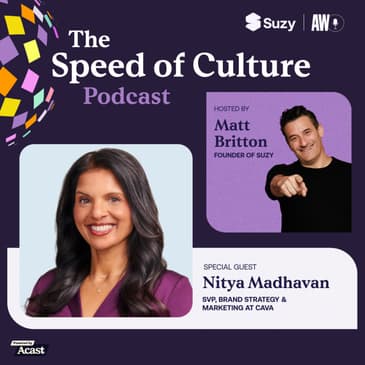
This episode of The Speed of Culture Podcast features Nitya Madhavan, Senior Vice President of Brand Strategy and Marketing at CAVA. Nitya explains how the fast-growing restaurant brand is scaling its national footprint while protecting the warmth, hospitality and human connection at its core. She breaks down the role of experiential marketing, social micro-communities, creator partnerships, loyalty data and AI, while sharing why the strongest brands use growth to deepen relationships rather than dilute them.
Follow Suzy on Twitter: @AskSuzyBiz
Follow Nitya Madhavan on LinkedIn
Subscribe to The Speed of Culture on your favorite podcast platform.
And if you have a question or suggestions for the show, send us an email at suzy@suzy.com
Hosted on Acast. See acast.com/privacy for more information.
[00:00:00] [SPEAKER_01] I think brands will have to figure out a way to find that balance that doesn't threaten who they are and what they're trying to deliver as a brand. But then when it comes to food, for me personally as a consumer, I don't want to see an AI-generated image of food quite yet because I want to know what I'm eating and I want to know that what I'm getting from a brand from a food perspective is real.
[00:00:21] [SPEAKER_00] To thrive in a rapidly evolving landscape, brands must move in an ever-increasing pace. I'm Matt Britton, founder of Suzy. Join me and key industry leaders as we dive deep into the shifting consumer trends within their industry, why it matters now, and how you can keep up. Welcome to The Speed of Culture. Up to the Speed of Culture Podcast, we're thrilled to welcome Nitya Madhavan, the Senior Vice President of Brand Strategy and Marketing at CAVA.
[00:00:50] [SPEAKER_00] Nitya leads brand strategy and marketing for one of the fastest growing restaurant brands in the country. With a career spanning global marketing, commercial strategy, and purpose-driven brand building, she's focused on growing CAVA's national footprint while creating authentic experiences that, of course, drive that human connection through food. So great to see you today, Nitya. Thanks for joining the podcast.
[00:01:09] [SPEAKER_01] Thanks for having me, Matt. I'm so thrilled to be here.
[00:01:11] [SPEAKER_00] Absolutely. So as I was digging in and researching for today's chat, I was really blown away by the size and scale of the company. Would you mind for maybe some of our listeners who aren't as familiar with CAVA talk about the business itself and kind of the growth trajectory of the brand?
[00:01:28] [SPEAKER_01] Yeah. So CAVA, we are actually celebrating our 15th year anniversary this year. So we're really excited for that milestone. We have about 470 locations all over the U.S. currently, but with aspirations to grow to 1,000 restaurants by 2032. So we are certainly on a growth trajectory that is fast and exciting for us. We are built on the roots of the Mediterranean.
[00:01:51] [SPEAKER_01] We're founded by four founders, three of which were friends growing up, first-generation Greek immigrants that really grew up around the table together and had aspirations of continuing their traditions that they were used to of sharing amazing Mediterranean food. They opened their first restaurant, CAVA Meze, in Rockville, Maryland. And then our fourth founder and CEO, Brett Schulman, joined them a couple of years later and really transformed the concept into what we all know today,
[00:02:19] [SPEAKER_01] which is the fast casual restaurant, a chain that is growing. And 15 years later, we're strong as ever and we're super excited to continue to expand our footprint across the U.S.
[00:02:29] [SPEAKER_00] Yeah, an overnight success, years in the making, as they say. What is the space that you think, you know, fast casual obviously is a space that's grown overall, but specifically regarding Kava, what is the space that the brand filled or the insight that unlocked about the consumer that created such success in the marketplace?
[00:02:48] [SPEAKER_01] I think for us, we're really rooted in that spirit of Mediterranean hospitality, which is really about generosity, abundance and being welcomed and seen. And I think that spirit of just savoring life, slowing down a little bit is kind of how we bring our food to life. On top of the fact that we have amazing food, Mediterranean food has long been known as a lifestyle and an approach to living where you don't have to compromise taste and flavor for feeling good. And that's very much the core of our food.
[00:03:18] [SPEAKER_01] And we're really proud of the food that we create and the fact that we bring flavors and ingredients that represent the Mediterranean region of over 20 regions across that space to the American consumer and help them really experience the Mediterranean in a way that feels very approachable, very easy to fit into their lifestyle and ultimately full of flavor and leaves you feeling good. So for us, it's really about expanding that way and bringing our spirit of the Mediterranean to the American consumer.
[00:03:47] [SPEAKER_00] And looking at your menu, I mean, it's very healthy, especially relative to what we in America consider fast food. You look at like the Shake Shacks and in and out to the world, great businesses, but obviously you have a completely different business that carries to a different audience. Obviously, we know of all sort of the post-COVID rush towards healthier living. And of course, now we see GLP-1s and that's a huge trend. Do you think that those shifts kind of unlock the potential?
[00:04:16] [SPEAKER_00] Like could Kava have worked in 2016 the same way it is in 2026?
[00:04:21] [SPEAKER_01] I mean, to be honest, I do. I believe that we are an enduring model and approach to eating and cuisine. And the beauty of the Kava way is that you can truly customize your experience however you want. So if you want a super healthy meal and you want to be really focused on macros that are important to you, we give you that option to do that. If you want to have a little bit more of an indulgent meal because you're feeling like you want some more pita chips that day or a little more extra dressings, we have that option for you too.
[00:04:49] [SPEAKER_01] So it's really, truly customizable and fits into every lifestyle. I think the other thing that has been really wonderful for our guests is that we truly have something for everyone. Whether you're on keto, whether you're a vegetarian, if you're a vegan, if you are a pescatarian now with our introduction of salmon. I mean, we truly have an option for so many different guests and whatever is important to them in terms of what they want to put in their body. So I do think that our format would have worked 2016 as it does today. And frankly, it did.
[00:05:19] [SPEAKER_01] You know, we've been around for 15 years and growing rapidly ever since we launched. And I think we're going to be around for decades to come. I think we're truly a brand that fits in.
[00:05:28] [SPEAKER_00] And in that regard, I know that business has really ambitious plans to reach over a thousand restaurants by the year 2032. As the brand continues to grow nationally, is it top of mind or imagine it is that you ensure that it just doesn't lose the warmth and hospitality that made people really fall in love with it in the first place? Because that's obviously one element that's hard to scale for a lot of businesses.
[00:05:50] [SPEAKER_01] Yeah. I mean, for us, it's absolutely going to be fundamental to our growth. We want to make sure that we're protecting how Kava makes people feel while continuing to allow the brand to grow and evolve. And it's how do we continue to deliver that same sense of welcome, warmth, hospitality, abundance. But that's so core to our business, the way that we serve food and also our ethos in terms of our hospitality. So I think that's something that we will always protect. And that will be the core to our continued success.
[00:06:18] [SPEAKER_01] And so it's something that we will continue to double down on. That's why we're investing in our restaurant experiences in our space. And you're seeing us open up these beautiful restaurant spaces that feel welcoming and inviting and invite people to join us to come in and take a break, whether that's with a group of friends or whether they just need a little bit of solace in their day and a good meal. We want to provide that for people.
[00:06:39] [SPEAKER_00] And of course, your role as head of the brand comes with a lot of responsibility, one of which is just stewarding the core pillars of what the brand means, you know, to create an identity in a world where everyone is sort of shouting for attention. What is the Kava brand about? And what are some of the elements that you're going to continue to lean into more in the years ahead as the company continues to expand?
[00:07:01] [SPEAKER_01] Our mission at Kava is to bring heart health and humanity to food. And it's something that we talk about every single day. It's part of who we are as a concept essence. It's something that's always core to every decision we make, certainly on my team. How does this align to our mission? How does this align to our concept essence? How do we want people to feel when they experience this with us at Kava? And so to us, that's something that's very, very important. And every decision that we make is really anchored back to those principles. And I think it's going to be something that will keep us.
[00:07:31] [SPEAKER_01] That's our core and that's our identity and our roots. And I think if you can stay really grounded to why you exist and how we want people to experience the Mediterranean way, that will really carry us forward. And for us, it's about meeting people where they are. It's giving people an easy entry point into experiencing that Mediterranean lifestyle without making them feel like they have to understand everything about it in order to experience our brand.
[00:07:54] [SPEAKER_01] And so giving them those natural entry points and really building connections with them along the way is how we stay true to our brand and how we're growing.
[00:08:01] [SPEAKER_00] So in that regard, what have been some of the more successful ways you've been able to bring up to life? What are some of the channels that you're leaning into and what types of content and messaging do you find really clicks with your target consumer?
[00:08:15] [SPEAKER_01] So one of the things that we did actually this summer is we launched a Mediterranean summer supper series. I'm not sure if you've heard of it, but it was kind of our chance and approach to have an in-person experience with our guests and our audiences and really bring the spirit of the Mediterranean to life while celebrating and sharing the new news and the new seasonal flavors that we have for the summer. And so it was a three-part summer supper series that traveled around the U.S.
[00:08:40] [SPEAKER_01] We started in Los Angeles, partnered with Outstanding in the Field and really brought to life with a great local chef who used our ingredients and our recipes to really inspire a dinner that brought together over 100 people in a farm in Los Angeles. I didn't know the farm existed in Hollywood until we did this event, which was really fun. And it really brought that spirit of sitting down around the table, having people that didn't all know each other connect, build relationships. And then from there, we moved that event to New York.
[00:09:08] [SPEAKER_01] We participated in the global events of the soccer summer that was happening. We set up right next to Fan Village and Rockefeller Center and really celebrated how sport and food bring people together. And it was a really fun.
[00:09:22] [SPEAKER_00] Yeah, it makes sense. I was thinking the World Cup is a great fit for the brand based upon everything you're saying.
[00:09:26] [SPEAKER_01] Totally. Fueling athletes. Like that's something that we do so naturally. So many athletes love our food. And so it was a great moment to do that. And then our final event was actually in San Francisco, and that was by FanVote. So we actually allowed our community and fans to tell us where they want us to pop up next, knowing that we have such a loud and proud and loyal fan base of guests who don't always have a kava in their market. And so we offered an opportunity for fans who didn't have a kava in their cities to vote which city we come to.
[00:09:54] [SPEAKER_01] And San Francisco won by a hair, by the way. I think by 1% of the vote, San Francisco won the location. And we popped up in San Francisco and were able to, again, curate a really lovely experience where we brought people together. And then at the end, I had the privilege of announcing that we're actually coming to the Bay Area next year, which was met with huge enthusiasm and excitement. And we're very excited to be entering the Bay Area next year.
[00:10:20] [SPEAKER_00] And from a digital standpoint, obviously, those events are super powerful, but obviously to really scale, you need to land digitally. And I know that you have a lot of experience in the digital realm. You spent nearly five years at Facebook working on Instagram and the Facebook brand. And I'm sure a lot of those experiences and frameworks that you helped develop there are quite handy in your job at Kava.
[00:10:43] [SPEAKER_00] What are some of the more successful tactics that you're deploying from a channel and content standpoint in the digital realm to build a brand?
[00:10:50] [SPEAKER_01] I think for us, what we like to do is try to build as authentic a relationship as possible with our guests. And knowing that our guests are digital natives and social platforms are absolutely the place that people are connecting with brands. We try to have a balance of both. We think that there's always a place for an in-person and in-real-life experience connection with our guests. But we know that meeting them where they are on social is really important, too.
[00:11:14] [SPEAKER_01] So we do that in a variety of ways, whether we are partnering with creators and partners and influencers that are very authentic to who we are. We don't just partner with people for the sake of partnering. We want to make sure that they really represent the same values that we represent. They genuinely love our brand and eat our brand and engage with our brand. So we use them and their platforms to really help expand and reach our guests. And then we also do some really fun things.
[00:11:39] [SPEAKER_01] I don't know if you saw the Bears activation that we did in New York this summer to launch Salmon, which was a really fun way, again, to take an in-person stunt, but create it and expand it digitally. And for us, what we're seeing is if we give people the opportunity to share on our behalf, that's really when we are building those connections directly. It lets people participate with our brand. It goes beyond a transaction and it becomes an active participation with our guests. And the Bears was a great example of that.
[00:12:06] [SPEAKER_01] We released nine bears in New York City who were in search of Kava's new salmon. And that created a viral moment where people were really... It's funny. Some New Yorkers are very unfazed because it's New York and anything can happen in New York. And they've seen it all. And they're like, it's a bear on a subway. Like just another day in New York. And others were really delighted by it and shared broadly. And that created a big movement for us and a moment for us. And it was really exciting. So I think it really just depends on what we're doing.
[00:12:32] [SPEAKER_01] But we're constantly engaging with our fans digitally and even through our community management. Just really speaking directly to our fans, responding to what we're hearing from them. We brought back white sweet potatoes to our menu this year in January because our fans have been demanding us to bring it back to our menu for a couple of years. And we actually announced that by having one of our founders, Ted, go on a Zoom call and surprise our fans by letting them know first that it's coming back to the menu. And they brought it back.
[00:13:00] [SPEAKER_01] So it's a surprise and delight moments, I think, that digital really helps you unlock and helps expand.
[00:13:05] [SPEAKER_00] We'll be right back with The Speed of Culture after a few words from our sponsors. Of course, social media itself has changed so much since you first joined Facebook in 2018. And you obviously had a front row seat to a lot of the evolution of social media. It continues to evolve. How do you think it's going to continue to evolve moving forward with consumers? I mean, so much has been made of going from FOMO to JOMO, joy of missing out. And obviously, we have this whole new issue of like AI slop in a lot of the social feeds.
[00:13:34] [SPEAKER_00] How do you see it changing and obviously the continued role of creators in the news feed?
[00:13:40] [SPEAKER_01] Yeah, it's interesting. I mean, I'm seeing that there is a movement right now in social where people are also really excited to find their people and find their kind of micro communities. And so the Internet and social platforms are it's overwhelming, right? There's so much information available. There's so much opinion that is sort of thrust on you whether or not you want to engage. And I think people are actively seeking out and using these platforms to actually find people that are really relatable to them,
[00:14:06] [SPEAKER_01] that finding their people online and really celebrating what it means to be an individual and have those individual interests and seeing that those communities exist. So I think that that's something that we'll continue to see more of as people are finding sort of what are these sort of easier ways to connect and smaller micro communities connect while still having access to sort of the broad information and appeal that's out there.
[00:14:29] [SPEAKER_01] I think you're going to see people really seeking some of those smaller moments of connection and doing that, whether it's digitally or in person and finding ways to make it really, really low pressure. It doesn't have to be these big, meaningful moments or experiences, but finding sort of those like micro moments of joy and connection. And I think people are finding that online more and more.
[00:14:49] [SPEAKER_00] Yeah, it's interesting. I mean, social media is kind of like have this slingshot where when people first started using it, the feed was just your friends. And over time, it became creators and publishers. I didn't really see people who actually knew as much. And now to your point, I feel like people want to revert back to it where they want to connect with people. They know things are the real things they really care about.
[00:15:12] [SPEAKER_00] And it will be interesting to see how the platforms evolve to these needs, especially as there's so much AI now in the platforms themselves.
[00:15:21] [SPEAKER_01] I think people are getting savvy to that, you know, and just kind of being able to see through what feels like it's a real connection or real content versus AI. And not that there's not a place for AI. I think AI has also unlocked a lot of opportunity for us. So I think that there's definitely a place for it. But I think people are being a little bit more savvy about what they consume and when they consume it and being really protective about how they interact and who they interact with online as well.
[00:15:45] [SPEAKER_00] Yeah. And how has AI changed the way that you do your work every day and the way that you communicate with others and, you know, obviously build campaigns and work with your partners, et cetera?
[00:15:55] [SPEAKER_01] Yeah. I mean, AI is something that we're actively investing in as an organization. We're looking at it from a variety of different ways. I mean, from a productivity perspective and an efficiency perspective, it's something certainly that our team has integrated into our daily work ethic. And it's something that I encourage my team to use to help enhance how we work quickly and efficiently. At the same time, it's never going to completely replace the need for that human interaction and that human touch.
[00:16:23] [SPEAKER_01] And how we show up, especially through our marketing, is also human created. And it's something that we are proud of, especially with food. I think it's really important to showcase real food and make sure that what we're showing and what we're delivering is real. And that shows up in all of our marketing. And so I think it's going to be a constant balance. But I think to the extent that AI can help us get faster and smarter.
[00:16:46] [SPEAKER_01] And also from an insights perspective, I think there's a huge opportunity for AI to continue to unlock who our consumer is, what's important to them, what they're engaging with. It gives us just another powerful engine of information and resource that will help us get faster and smarter.
[00:17:02] [SPEAKER_00] It doesn't come as a surprise to me that you wouldn't want to use AI-generated images of your own food, obviously. Also, often since it's so important to your brand. At the same time, it seems like a lot of the CMOs I'm talking to on a podcast are pretty scared of using AI in their content because they think there's going to be like a consumer backlash. I'm not so sure consumers care. I think that they want it to be fully disclosed. I think they want to know if they're looking at it as well or not. But I always give the analogy of like electronic dance music.
[00:17:30] [SPEAKER_00] That's not necessarily always made by real instruments, but still makes them dance, right? It's about how it makes you feel. I'm just curious personally, not necessarily related to Kava's strategy, but do you think we're going to be entering a world? Will brands finally start to embrace AI-generated content? Or do you think the perceived consumer pushback is real?
[00:17:49] [SPEAKER_01] I think brands will have to figure out a way to find that balance that doesn't threaten who they are and what they're trying to deliver as a brand. And I think it really matters by industry and by category, to be perfectly honest. I think AI can really show you the possibility of how your brand could fit into your life and show you kind of the aspiration of what your brand could do to improve your life. And I think that's really interesting and exciting. But then when it comes to food, for me personally as a consumer, I don't want to see an AI-generated image of food quite yet because I want to know what I'm eating.
[00:18:19] [SPEAKER_01] And I want to know that what I'm getting from a brand, from a food perspective, is real. And that's something for Kava. We pride ourselves on real, fresh ingredients. And we source these ingredients. We take a lot of effort to source our ingredients from all over the world and the best places that they come from. And so we're proud to show our food as real images. So that's not something that I think we as a brand will race to change. But I think that there's something interesting about, again, like the world of the possibilities.
[00:18:47] [SPEAKER_01] I think that brands certainly have to think about what is the best way to integrate that doesn't dissolve or dilute trust with their consumers. If anything, it should build possibility and not dilute trust. And I think that's the thing that we have to protect at all costs. A hundred percent.
[00:19:02] [SPEAKER_00] Another hot area, obviously, a lot of brand marketers talk about besides AI these days is the power of first-party data and what you can do with it. And obviously, you have a business that does get to sell direct to the end consumer in most circumstances. And I know that you've leveraged that for a loyalty program. I would love to talk about some of your learnings there with capturing first-party data, with offering a loyalty program that I know has been recently refreshed. And what types of one-on-one personalization and other kind of experiences that unlocks for the brand?
[00:19:32] [SPEAKER_01] Yeah, I mean, we are really excited about our loyalty program. We relaunched it last year. And with our tiered structure, we even have a hidden surprise tier that only certain special guests get access to. And that has been really valuable for us, but also just an incredible way to reach our consumers and build another point of connection with them firsthand. I think from a data perspective, we certainly do learn a lot in terms of how people are eating, when they're eating, what's resonating with them.
[00:20:00] [SPEAKER_01] And for us, it's really about helping us to, again, continually to reinforce an authentic relationship with them so that they really feel our goal, especially with hospitality as part of our ethos, is for every guest to feel seen, welcomed, and feel part of the brand and feel like there's an entry point into the brand. And so I think our loyalty program really allows us to do that by giving us information that helps us understand our most valuable and our best guests. But at the same time, it's also a way for people to enter the brand. It's interesting.
[00:20:29] [SPEAKER_01] When I was in San Francisco and announcing the opening, a lot of people who'd come to the event, there were a lot of our guests. There were public tickets that people were able to attend. And everyone had our loyalty app, which I thought was so interesting because we're not even in San Francisco. And everyone was a loyalty member. And it was so interesting because for them, it was a way for them to connect with their brand, to get access to what's happening with their brand. We often give our loyalty members a first look or a sneak peek of what's coming up. We give them, you know, advance tickets, things like that.
[00:20:59] [SPEAKER_01] And I think that that's something, again, it's being brought in and welcomed into the brand and being able to participate with the brand is what a loyalty program can really do. And it's not just about getting data to sell more to our customers. It's about using the data and understanding our customers on a deeper level so that we can continue to refine the menu, bring out what we know that they like, give them experiences, and have a two-way dialogue that feels really true and authentic to who we are.
[00:21:25] [SPEAKER_00] So shifting gears a bit, Nathia, to you and your career journey. You, as I mentioned earlier, spent five years across the company now known as Meta, but back then was on Facebook when you joined. And before that, spent over a decade at Mattel, obviously a great consumer products company, and various roles and working on great brands like Fisher Price.
[00:21:46] [SPEAKER_00] When you look back at your career journey, what are some of the decisions that you think you made right along the way that put yourself in the position to constantly take on new exciting roles and constantly sort of move up the decision-making chain in consumer marketing up to the point where you are today?
[00:22:03] [SPEAKER_01] Thank you for the question. A few different things, and I think in different ways. I think for me, my personal career journey is I've always been a person that says, why not? And what can I learn? And what if? And so that has really taken me far in my career. And that's why when you look at my CV or my experiences, they're not linear. And fun fact, I'm a biology undergrad. I was pre-med. And so I always tell my mentees and students that I talk to, life is not linear. Your career will not be linear. So do what gives you joy.
[00:22:33] [SPEAKER_01] Do what gives you new skills to learn. Learn, take new opportunities and take chances because you never know where that path will take you. And that's certainly been true for my career. And so for me, you know, having career, I've had experiences across commercial marketing. I did international strategy for four years. I moved to Europe as part of my career. I've had a lot of really great experiences because I always looked at what can I bring to the table from my experiences? What else can I learn? And what if I said no? Would I regret this chance to learn something new?
[00:23:01] [SPEAKER_01] And that has really taken me far. The other thing that from a professional and functional experience perspective that I've held true and has helped me is always really trying to stay true to the core of why the brand exists. And why was the brand created? Are we relevant with today's consumers? Are we staying with the times? How do we bring the brand into the current time and the current day without losing kind of the spirit of why that brand was created and what it is about?
[00:23:30] [SPEAKER_01] And that's something we ask ourselves a lot when I worked on Barbie. We worked at Fisher Price. At Kava, we ask ourselves that all the time. We're a growing brand. We're still fairly young, but it's really important for us to really stay true to our roots and make sure that that stays at the core of some of the decisions we made. And even at Meta, the mission at Meta was really important that we stay true to what we were trying to do, which is give people the power to connect.
[00:23:54] [SPEAKER_01] So I think if you can really keep the mission of what you're trying to do at the core, that'll serve you as kind of your North Star throughout your career.
[00:24:01] [SPEAKER_00] Absolutely. So we always ask our guests when we wrap if there's a quote or mantra that has helped sort of describe their professional journey in a nutshell, if you will. I'm just curious. Maybe you'll have some old biology terms you'll throw in here, but what comes to mind for you?
[00:24:17] [SPEAKER_01] There's actually two quotes that I always keep kind of balanced with me. One is, and they're not new quotes. You'll know the quotes. The one is from Maya Angelou, which says people will not often remember what you said or what you did, but they'll remember how you made them feel. And to me, that is 100 percent how I lead. That's my leadership mantra. But it's also how I live my life generally. It's how I want to show up in the world in terms of how I interact with the people I love, but also strangers that I meet. And I think that that's really, really true.
[00:24:46] [SPEAKER_01] Oddly, I think it's also true for brands. I think people will remember how a brand makes them feel. It's not just about a human interaction. It's really also everything's a relationship. And how do you leave that relationship feeling seen and with good feeling? The other quote that I love is by Kobe Bryant, because I'm actually Los Angeleno. And he says, lead the game better than you found it. And to me, that's always so true. And that's something that I've always said to everyone.
[00:25:11] [SPEAKER_01] I've been very lucky to have worked for amazing brands in my career that were there before I joined them and will hopefully endure for decades after I've left. And you're there for a moment in time. And our role as leaders and as brand builders is to protect a brand, nurture it, help it grow and leave it better than you found it for the next generation of leaders that are going to come in and take it to the next level. And so that to me is a really strong mantra for me that I follow throughout my career.
[00:25:38] [SPEAKER_00] Huge fan of Kobe. And I was actually aware of that quote, but I like the articulation in terms of how it relates to brand stewardship. I think that makes so much sense. And you're right, especially some of the brands you've worked on, they are going to be here for a long time. And how did you mold it? How did you put your fingerprint on it in a unique way, but also most importantly set up for success moving forward?
[00:25:58] [SPEAKER_01] Yeah, I think it's a huge responsibility and a privilege and an honor. And so that's why I'm thrilled to be part of a brand like Kava. I'm thrilled to have been part of the brands that I've been with in my career and I'm excited for what we can do.
[00:26:12] [SPEAKER_00] Great. Well, it's been a privilege and an honor to have you here today on the podcast. Big fan of you and the brand and wishing you nothing but success here in 2026 and into the future.
[00:26:21] [SPEAKER_01] Thanks, Matt, so much. It was such a great conversation. I really enjoyed it and look forward to chatting again soon.
[00:26:25] [SPEAKER_00] Yeah, absolutely. On behalf of Suzy and every team, thanks again to Nithya Madhavan, the Senior Vice President of Brand Strategy and Marketing at Kava for joining us today. Be sure to subscribe, rate, review the Speed of Culture podcast on your favorite podcast platform. Until next time, see you soon everyone. Bye-bye. The Speed of Culture is brought to you by Suzy as part of the Adweek Podcast Network and A-Gest Creator Network. You can listen and subscribe to all Adweek's podcasts by visiting adweek.com slash podcasts.
[00:26:54] [SPEAKER_00] To find out more about Suzy, head to suzy.com. And make sure to search for the Speed of Culture in Apple Podcasts, Spotify, or anywhere else podcasts are found. Click follow so you don't miss out on any future episodes. On behalf of the team here at Suzy, thanks for listening.