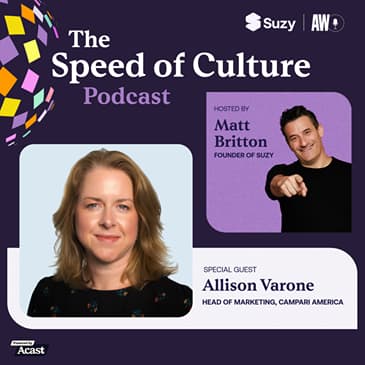
This episode of The Speed of Culture Podcast welcomes Allison Varone, Head of Marketing at Campari America. The conversation explores how heritage brands can evolve with changing consumer behavior without losing the rituals and emotional connections that made them distinctive. She breaks down the growth of the spritz category, the rise of mindful drinking, the role of experiential marketing, and bartender education, and why curiosity and commercial awareness are becoming essential skills for modern marketers.
Follow Suzy on Twitter: @AskSuzyBiz
Follow Allison Varone on LinkedIn
Subscribe to The Speed of Culture on your favorite podcast platform.
And if you have a question or suggestions for the show, send us an email at suzy@suzy.com
Hosted on Acast. See acast.com/privacy for more information.
[00:00:00] [SPEAKER_01] I think it depends. I think it depends on the category. I think it depends on the brand. I do think that AI has a place in planning, the place in creative inspiration. But how that actually translates into content, I think, is going to be very different for every brand.
[00:00:18] [SPEAKER_00] To thrive in a rapidly evolving landscape, brands must move in an ever increasing pace. I'm Matt Britton, founder of Suzy. Join me and key industry leaders as we dive deep into the shifting consumer trends within their industry, why it matters now, and how you can keep up. Welcome to the Speed of Culture. Up to the Speed of Culture podcast, we're thrilled to welcome Alison Payne, the head of marketing at Campari America.
[00:00:45] [SPEAKER_00] Alison and STEM were in two decades building some of the world's most recognizable lifestyle brands with leadership roles spanning LVMH, Martha Stewart Living, Time Inc., and now Campari America. Today, she leads marketing for an iconic portfolio that includes Aperol, Campari, and a growing range of Aperitivo brands, helping introduce a new generation of consumers, the Italian tradition of gathering, connection, and celebration. Alison, so great to see you today.
[00:01:08] [SPEAKER_01] Thanks for having me.
[00:01:10] [SPEAKER_00] Absolutely. You built brands across publishing, luxury, fashion, and of course, now you're working in the spirits category. What did those industries teach you about kind of the difference between a product that people buy and a brand that people actually invite into their lives, more lifestyle brands, if you will?
[00:01:25] [SPEAKER_01] Yeah. I mean, I think at the end of the day, even from my experience from publishing Martha Stewart Living all the way through luxury and Campari, is the idea of being part of human connections and the brand being woven into consumers' lives in ways that are impactful, right? And I learned that firsthand in my earlier years at Martha Stewart Living, seeing that a product or a brand can really transcend its category if the consumer really emotionally connects,
[00:01:52] [SPEAKER_01] right, to the brand or the experience that is being in front of them in their lives. And at Campari, we're seeing now that we have a lot of a big portfolio in Campari Group, which is fabulous. And obviously embracing Italian heritage brands with the Petitibo, but we also have brands such as Espolòn Tequila. We have Cavossier. We have Wild Turkey. We have Sky Vodka. We have Grand Marnier. Lots of brands that connect to consumers, you know, emotionally and have that tie over time and over people's lifetime.
[00:02:21] [SPEAKER_00] And of course, Campari really helped build the modern spritz category, if you will. But obviously there's a lot of competition in the space. The category that you inhabit has an increasing amount of new entrants, new brands. How do you continue expanding the category while making sure that your brand kind of remains a category leader at the same time?
[00:02:40] [SPEAKER_01] Yeah, I mean, we love the enthusiasm of the category. Aperol really started the kind of spritz movement and it's very, very alive and well in Europe. And it is now becoming really a category in its own right in the U.S., which is really exciting for us. So for us, we started it with Aperol. We see an amazing gravitation towards spritz and kind of this idea of a lower alcohol light offering that's very much about being social, which is where we play in that space.
[00:03:08] [SPEAKER_01] So for us, Aperol again started it, but we have an evolving portfolio. So we have Aperol spritz, obviously. We have Campari. We also have Crudino, which is our non-alcoholic spritz option. And then we've just launched Sarti in the U.S., which is very exciting. So for us, in terms of we see this leadership continuing as we expand the portfolio and offering different types of spritzes for people with different taste profiles at any given time.
[00:03:33] [SPEAKER_00] Yeah, you know, I'm glad you mentioned the kind of lower alcohol consumption habits of consumers. We just had Alison Payne, the CMO of Heineken, on the podcast, and she was telling us about just the tremendous growth that she had with their non-alcoholic beer brands and how they continue to invest more in that. How do you see that trend impacting your category? And is that an area that Campari has looked at in any way?
[00:03:58] [SPEAKER_01] Yeah, I mean, I think for us, Crodino is a great example of a product bringing it to round out our spritz portfolio with a non-alcoholic option. And Crudino actually has been around since 1965, if you can believe it, in Italy. So it's not even a new-to-world product. It's new to the U.S., which a lot of people don't realize. So the Campari Group was ahead of its time in Europe, and we brought it over here. So the way we see it is that consumers, I think, are being much more intentional, you know, mindful about their drinking habits, which is a great thing.
[00:04:27] [SPEAKER_01] But we also see them really still wanting experiences. So that has not changed. So the beauty of Crudino or our spritz lineup is that we're offering consumers the experience that they want. Getting together with someone could be a big moment, could be a small moment. Having maybe a light bite to eat, having a refreshing, colorful, vibrant cocktail that brings them joy and elevates a moment. And they can do that with a non-alcoholic version as they switch between alco and non-alcoholic,
[00:04:55] [SPEAKER_01] which is what we see through a lot of consumers and also the younger generation.
[00:04:58] [SPEAKER_00] Yeah, it's interesting. I mean, it's such a, I think, compelling consumer insight when you think about the notion. And you even see it with something like liquid death, which is basically instead of drinking bottled water, you're drinking it out of a can. And there's this sort of like the human dynamic when you're at a bar, when you're at a restaurant, where you want to feel like you aren't really the topic of conversation. So maybe you don't want to drink that night, but you can still be drinking something that looks like a drink.
[00:05:25] [SPEAKER_00] I think socially somehow that becomes more acceptable where people aren't saying, why aren't you drinking tonight sort of thing? And I wonder how much of that has also driven this sort of big movement we're seeing in brands such as yourselves, such as Heineken's kind of going deeply into that category.
[00:05:42] [SPEAKER_01] Yeah, because I think consumers ultimately want to be social, right? And they want in real life experiences. And it's okay that, you know, you're not necessarily having an alcoholic product, but you're part of the moment. So it's great to see. It's a great thing.
[00:05:53] [SPEAKER_00] Absolutely. So I know, speaking of experiences, that has been a big part of Campari's sort of advertising strategy. You're at major festivals like Coachella, and you're trying to be where the consumer is. How have you found it impactful to activate in these platforms? How are you measuring these activations? And how do you come up with sort of the creative ideas in terms of what to do there so you actually fit in and you're not disruptive to the consumer experience?
[00:06:18] [SPEAKER_01] Yeah, I mean, I think for us, our Appetitivo lineup really is right for people to have in real life experiences, as I've mentioned before. So we show up in big moments and small moments in people's lives. So for instance, festival life, which we know is alive and well, the music space, younger consumers, huge. Everyone's wanting to have a great experience, and they'll pay good money to have that great experience. And we want to be a part of that. So at the festivals that we're at, such as Coachella, you know, Lollapalooza, and even
[00:06:46] [SPEAKER_01] smaller moments, we try to create our brand world, particularly with Aperol, where we really immerse consumers in the color of our brand, the idea of joyfulness, sociability, conviviality. So it really drives home the idea of having a really great time with people that you want to be with in a fun environment. The contagiousness of Aperol orange color just brings joy to people. So we're really infiltrating and bringing the brand in those big kind of festival moments.
[00:07:16] [SPEAKER_01] But then we also do other things. We have talent partnerships like Hilary Duff, which is wrapped with her concert series across the U.S., which was a great fun.
[00:07:24] [SPEAKER_00] Which did so well. I was surprised by how well that concert tour did. I didn't know she was still so popular, but my Instagram feed was full of people going to see her concert.
[00:07:33] [SPEAKER_01] Yes. I mean, she sold out shows. And again, this whole idea of having an experience that people can't have and don't happen often. And it's joyful. And Aperol was there as part of it. And she's a big brand fan as well, which was great. So we kind of bring that notion of joy, that notion of levity, of sociability into people's lives in those big moments, but then also small moments. So we'll do what we call is an Aperol day club. We did it in Chicago during Looza weekend as an example, where there was a lot of people in Chicago, obviously for Lollapalooza.
[00:08:02] [SPEAKER_01] But then we outfitted a bunch of places along the Chicago River and people that were just having brunch and enjoying life really got to see Aperol come to life. And you saw the orange Aperol spritzes all on many, many tables in those restaurants right on the river, enjoying a nice moment together. So we're really touching people in different ways outside of classic advertising.
[00:08:23] [SPEAKER_00] Yeah. And I think what I like is above and beyond even tapping into these big festivals and concerts, you also kind of create your own bespoke experiences. I read about the Campari Spritz Square, about transforming neighborhoods. You would love to talk a little bit about that as well. I thought it was a really innovative approach. Yeah.
[00:08:39] [SPEAKER_01] So Campari has been obviously such a jewel for us. And it's a beautiful brand that started this whole thing in terms of Italian Aperol So we did, yeah, Spritz Square, which is this idea of Campari Spritz coming to certain cities. So we've done New York, we've done Miami, we've done LA, where we're partnering with local businesses and championing artwork and championing small businesses and really creating a sophisticated moment with Campari to really drive connection. And again, that whole idea of sophisticated sociability for Campari.
[00:09:09] [SPEAKER_01] So that's been a really great activation platform for us that rounds out our Spritz leadership.
[00:09:14] [SPEAKER_00] And how in your role do you look at on premise? Obviously, it's incredibly important in terms of drawing volume. And obviously, I'm sure you spend a lot of time thinking about how you're going to invest in those partnerships, whether that be restaurants or nightclubs or bars, et cetera. But talk to me about what that approach is like, because I think a lot of people listening to the podcast probably don't realize that the job of a marketer such as yourself isn't just about creating buzz at really cool events, but it's making sure that you're on the shelf
[00:09:42] [SPEAKER_00] and you're being recommended by bartenders at the moment where people are drinking when they're out.
[00:09:45] [SPEAKER_01] Yes. I mean, the bartender and trade community for the on-premise, so all restaurants and bars has been a key success factor for Campari Group in general, and particularly for our Perry TV portfolio. But first and foremost, we have what we call Campari Academy, which is an entity here that we train thousands and thousands of bartenders around the world on our products. Yeah, it's unique to Campari. And that enables us to really, we thought leaders in the industry, teach bartenders about
[00:10:14] [SPEAKER_01] our brands, our cocktails, but also cocktail trends, up and coming things that they should be thinking about for their particular establishments. So we've been doing that for many, many years, which helps us with our long-term equity within the bartender community. So we do that across the year, both from in-person sessions and educational series to digital. And then what we do in the actual outlets is we do a lot of training. We have something called PASS, which is essentially for spritz. It's the 3-2-1 recipe.
[00:10:43] [SPEAKER_01] A lot of people don't know how to make a spritz, which is three parts Prosecco, two parts the Aperol or Aperol, and one part club soda, soda water, and a slice of a garnish. An Aperol spritz is an orange wedge. So we drive training day after day to make sure that we're getting that perfect serve so that every time a consumer orders an Aperol spritz, a Campari spritz, a Sarti spritz, it's the same consistent experience for them.
[00:11:10] [SPEAKER_00] Right, because that's sort of an extension of your brand. Even though a bartender might be making it, when a consumer enjoys your product, they're not going to compartmentalize in terms of how it was made and what it tastes like. They're going to associate that experience with your brand. So I could see why investing in an academy like that makes a lot of sense.
[00:11:27] [SPEAKER_01] Yeah, and it's an investment for us because we need to make sure that the consumer experience is consistent every time. So that's the big investment for us. And that's how you brand equity for the long term, that the consumer has great experience every time they purchase our drink.
[00:11:41] [SPEAKER_00] We'll be right back with The Speed of Culture after a few words from our sponsors. So speaking of the long term, I mean, Campari is such an iconic brand. If you go to Italy, you'll still see cafes that have old billboards and posters of the brand from 10, 20, 50 years ago. It's such an iconic brand. And I would imagine a big part of what you do as a brand steward is making sure that you're pushing the brand forward, making sure it's speaking to the new consumer of your brand,
[00:12:10] [SPEAKER_00] but at the same time, holding on to the heritage of the brand. I would imagine it's a bit of a balancing act.
[00:12:17] [SPEAKER_01] Yes. I mean, the job that we have to do is to be always true to the brand, the history, the quality, the providence, prominence of where we're from and the ritual that we created. So I think we've been very singly minded focused, particularly on our Spritz portfolio on that, which is great. But then, as I was mentioning before, what are those parts of culture that we can insert ourselves and be part of people's lives? So again, music life, festival life, being out social when you're thinking about changing
[00:12:47] [SPEAKER_01] from your work day to your night day to your nighttime. Like, what is that transition? We want to be part of that. So it is a balancing act. It definitely is a balancing act. But I think that we have really smart people on my team that obviously understand the brand, but also understand the consumer and the consumer needs at the same time.
[00:13:04] [SPEAKER_00] So what does the process look like when you see a new opportunity in culture and you decide to jump in and you want to make sure that you are holding on to the roots of the brand, but you're moving forward, right? You're living by the brand ideals. What does that evaluation process look like?
[00:13:20] [SPEAKER_01] So we evaluate opportunities in various ways. Let's just take festivals as an example, as we really think long and hard about what is the consumer looking from an experience at festivals and at music? Like, they're there, obviously, to get an experience of music. Maybe they're seeing an artist. Maybe they're with a group of people. They want to feel free. They want to feel alive. They want to feel social. So that's a great mindset that we believe is right for Aperol because that is what the Aperol brand is all about and bringing that type of feeling to the consumer.
[00:13:50] [SPEAKER_01] So we really think long and hard about what is the consumer going to get out of that experience? What are they looking to get out of it? And then does it make sense for our brands to be present? That's kind of the lens that we always take for everything we do. And also, even you take that to talent collaborations. Does the talent like the brand? Does it make sense that the talent would consume our products? Do they embody kind of that vibe and that feel that the brand has? So we really start with kind of those questions.
[00:14:18] [SPEAKER_01] And if we can answer those in a way that connects back to the brand, then we evaluate going into that as an activation or part of culture.
[00:14:25] [SPEAKER_00] Got it. So we spoke a lot about the physical world, but obviously your target lives a lot of their lives in the digital world. I would love to hear about some of Campari's strategy digitally, whether it's within content creation, working within the creator economy, and obviously continuing to connect with consumers over social channels.
[00:14:45] [SPEAKER_01] Yes. I mean, social media obviously is a big part of what we do as a brand and many brands. But I think particularly for spirit brands, it's obviously important because everything that we have in a consumer experience is really innately social. So we have obviously influencer strategies. You know, we have content strategies. We also always want to make sure that we are in social conversation that's happening in real life, right? So lots of what we call community management within social, like what is the chatter happening
[00:15:14] [SPEAKER_01] in the world of social and how do we make sure that the brand is inserted in those conversations where appropriately? So we do a lot of obviously that. I think digitally also, as I mentioned before, we do a lot of education digitally with our Campari Academy, lots of education materials for our bartender and trade community, which is unique to us. And then in general, content, obviously, we work with content creators, paid advertising, paid media, all that as well.
[00:15:43] [SPEAKER_01] So it's really part of the ecosystem and our full marketing mix.
[00:15:46] [SPEAKER_00] Yeah. And how about AI? I mean, obviously, it's more than a buzzword now. It becomes sort of a central pillar in terms of how businesses and obviously the marketing world operates. How has AI impacted your work on a day-to-day basis? And have you used it to enhance or implement any of your consumer-facing programs? Yeah.
[00:16:05] [SPEAKER_01] I mean, I think AI is evolving and we're obviously in the middle of that with everybody else. And how do we leverage technology to our advantage, but at the same time, making sure we're staying true to our brands. So we use AI in different ways, mostly on kind of efficiencies, finding ways to do things quicker. But from a content perspective, we're very careful. We have legacy brands that have been around for quite some time and we have beautiful products. So we're definitely being strategic in how we're using it from a content perspective.
[00:16:35] [SPEAKER_00] Absolutely. I mean, it's a changing world. And a lot of brands, I think, are grappling right now with understanding how important and how impactful AI is in content creation. But at the same time, there seems to be sort of an underlying fear of using AI in a creative process. And just curious, like, what is your take on that? Do you think we're going to be heading towards a place where brand marketers are going to be using AI to build videos, to build content that they're going to push out? Do you think we're still a ways away from that?
[00:17:03] [SPEAKER_01] I think it depends. I think it depends on the category. I think it depends on the brand. I do think that AI has a place in planning, a place in creative inspiration. But how that actually translates into content, I think, is going to be very different for every brand.
[00:17:20] [SPEAKER_00] Yeah, it's definitely unprecedented territory we're entering here. So it'll be interesting to see how things evolve. Would love to shift gears a little bit towards you and your career. As I spoke about at the onset, you've worked for so many prolific lifestyle brands throughout your career, and you're continuing to do such great things at Campari. Just wondering, when you look back at your career journey to date, what are some of the areas where you think you appropriately leaned in, which unlocked opportunities to allow you to continue to evolve as a professional?
[00:17:47] [SPEAKER_01] Yeah, I mean, I think I've been very lucky in my career. And I think that coming to Campari was kind of a great example of choosing a company that was true to my values. And also really looking at the business of Campari as a really great portfolio that I was going to be able to grow into, right? And have lots of products to work on, which has been really great. So I think for me, I mean, the future is really about expanding the spirits category. As I was mentioning before, the consumers are migrating in different ways in terms of spirits
[00:18:16] [SPEAKER_01] in their lifestyle. And I really think that for me, particularly leaning into the kind of the Italian lifestyle has been very attractive to me. It kind of brings me back to when I was younger, going to Europe and kind of experiencing a Perry TV and wondering, you know, why don't we have this ritual in the U.S.? We finally, we brought it here. But now it's alive and well. I think everyone, I mean, you saw everyone on social going to Europe and then coming back to the U.S. and just being nostalgic of their experiences there, right?
[00:18:44] [SPEAKER_01] So I think there's a real appetite for consumers to learn about different cultures and Italy being obviously a really, really wonderful one to learn about. And through our brands, we're able to do that. So in my career, I think it's just about being open to and curious about what could be in the future.
[00:19:02] [SPEAKER_00] Absolutely. And when you think about all the changes and you did mention your team earlier, obviously all the changes are happening in the marketing landscape and obviously the high standards your brand has set to continue to activate to your consumer. What are some of the skill sets that you're looking for and you think younger marketers need to develop in order to remain competitive in today's world?
[00:19:21] [SPEAKER_01] Yeah, I think probably the biggest thing is be curious. And I always tell my team, like, let's learn about new technologies. Let's learn about what other brands are doing outside of our category. You know, try to really find the time to be curious about what's happening outside of your day to day because that's going to open your mind to different creative ideas. And then I would say, I always tell my team and I think all marketers, and you mentioned
[00:19:46] [SPEAKER_01] it before, it's not just about creating buzz for your brand, but really being close to the business too. Knowing where you're sold, how you're sold, what's the customer environment, what's the commercial environment, as well as obviously being very close to the consumer. Sure.
[00:20:02] [SPEAKER_00] That's right. As we wrap up here, we always ask our guests if there's a saying or mantra that helps kind of encapsulate their career journey of the day. Just wondering if anything comes to mind for you.
[00:20:12] [SPEAKER_01] Yeah, I think for me, I think a good mantra is being kind of openness to evolve as a marketing professional, but also as a brand and things are changing. So I think the constant changing environment, constant changing super habits, you need to stay ahead of that and being open to evolve what you do every day and how you show up as a marketing professional.
[00:20:33] [SPEAKER_00] Yeah, change is the only constant, as they say, right? And especially right now, you can't hold on to what you thought was sacred or get romantic on the past because obviously we're in a world that's changing faster than ever before. So you definitely need to be open to evolving. So I'm glad that you brought that up and I'm glad you took the time to share your wisdom and experiences with us and your great work on the Compare Your Brand with us today. It's been an amazing conversation. Thanks for having me, Matt. Appreciate it. Absolutely. On behalf of Susie and our team, thanks again to Alison Verone, the head of marketing at Compare Your America for joining us today.
[00:21:01] [SPEAKER_00] Be sure to subscribe, rate, and review the Speed of Culture podcast on your favorite podcast platform. Till next time, see you soon, everyone. Bye-bye. The Speed of Culture is brought to you by Susie as part of the Adweek Podcast Network and Agus Creator Network. You can listen and subscribe to all Adweek's podcasts by visiting adweek.com slash podcasts. To find out more about Susie, head to susie.com.
[00:21:27] [SPEAKER_00] And make sure to search for the Speed of Culture in Apple Podcasts, Spotify, or anywhere else podcasts are found. Click follow so you don't miss out on any future episodes. On behalf of the team here at Susie, thanks for listening.