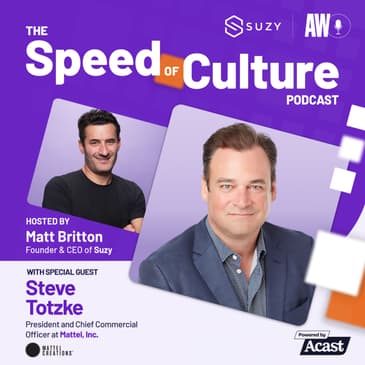
In this episode of The Speed of Culture, Matt Britton interviews Steve Totzke, President and Chief Commercial Officer at Mattel. Steve discusses the evolution of the toy industry, the power of iconic brands like Barbie and Hot Wheels, and how technology and nostalgia are shaping the future of play.
Follow Suzy on Twitter: @AskSuzyBiz
Follow Steve Totzke on LinkedIn
Subscribe to The Speed of Culture on your favorite podcast platform.
And if you have a question or suggestions for the show, send us an email at suzy@suzy.com
Hosted on Acast. See acast.com/privacy for more information.
[00:00:02] [SPEAKER_01]: We are celebrating 80 years next year of Mattel. That is generations of trust and credibility built up in our products and our brands, our characters and stories. And that has resonated. You mentioned nostalgia earlier, Matt. There's not someone that I have ever met that doesn't have some kind of Mattel story or Hot Wheels Barbie, American Girl. It is incredible. And that's incredibly valuable as a company.
[00:00:31] [SPEAKER_00]: To thrive in a rapidly evolving landscape, brands must move in an ever increasing pace. I'm Matt Britton, founder and CEO of Suzy. Join me and key industry leaders as we dive deep into the shifting consumer trends within their industry, why it matters now and how you can keep up. Welcome to The Speed of Culture.
[00:00:53] [SPEAKER_00]: Today, we're excited to be joined by Steve Totzke, the president and chief commercial officer at Mattel where he's been for 22 years and counting. Steve, it's so great to see you today. I'm so excited to dive into all things Mattel.
[00:01:04] [SPEAKER_00]: Matt, it's great to be with you. I'm really looking forward to this conversation.
[00:01:08] [SPEAKER_00]: Likewise. So you started at Mattel in really a completely different era in 1995. The internet was not a mainstream consumption habit amongst your consumer target. And we're living in a completely different world where today we're doing a podcast, two different locations with our computers. Like, as you think about the changes that you've had a front row for at Mattel, what do you think were the most impactful ones as it relates to your role and Mattel's business?
[00:01:34] [SPEAKER_01]: Sure. Well, look, let me start with what's remained the same over those last almost 30 years. When I first started, Mattel was the number one toy company in the U.S. And 30 years later, it's still the number one toy company in the U.S.
[00:01:47] [SPEAKER_01]: Barbie, number one fashion doll. Barbie is still the number one fashion doll. Hot Wheels was the number one vehicle brand. It still is. And Fisher Price was the number infant, toddler, preschool brand. And it still is.
[00:02:00] [SPEAKER_01]: But as you mentioned, Matt, almost everything else has changed. When I first started, it was all about brick and mortar. You would have your product. You get it on an end cap. You put it in an ad. Saturday morning cartoons. That was your ad buy. And you're off to the races.
[00:02:17] [SPEAKER_01]: Today, it is wildly different. Media fragmentation is real. The complexity of demand creation is like never before. There are so many tools to marketers. So everything pretty much has changed other than that.
[00:02:33] [SPEAKER_01]: In our category, omnichannel retailing is for real. It's 25 to 30 percent is now purchased online. So that is much different than it was. You have to make sure your digital assets are relevant and sharp and engaging. So everything pretty much has changed in the last 30 years in terms of how we go to market.
[00:02:53] [SPEAKER_00]: That's fascinating because when you talk about those iconic brands and the staying power they've had, I hadn't realized that. What goes behind a type of IP that can withstand so much cultural change? And I know that you've had there, especially with Barbie, really had to massage the brand in ways to make sure it stayed relevant with the changes in culture. But what is it about those brands that has given it such staying power?
[00:03:16] [SPEAKER_01]: Well, let me start with Barbie. This year we're selling Barbies 65th anniversary. And if you think about Barbie, Barbie has not only reflected culture. Many times Barbie has led culture. Last year was the summer Barbie. Barbie core was trending everywhere. You could not go anywhere on the planet Earth last year. Not being aware of the Barbie brand. And as Lisa McKnight, our chief brand officer often says it takes a village to keep this brand as relevant as she is.
[00:03:46] [SPEAKER_01]: Barbie's been on the cover of Time magazine twice. Barbie was a person of the year last year. So keeping this brand relevant is a journey for all of us. But it's not just Barbie. It goes beyond that. If you think about Hot Wheels, Hot Wheels is not far behind almost 60 years and everything from live events with the Hot Wheels Legends Tour to Hot Wheels Monster Trucks to content on Netflix. It is now everywhere every touch point you want to be. That's what's really
[00:04:16] [SPEAKER_00]: necessary to keep brands relevant to that.
[00:04:18] [SPEAKER_00]: Absolutely. And as we mentioned at the onset, I mean, one thing that has changed is just the impact of technology on the consumer. And ultimately with toys, the end consumer is younger children. But as we know, the people who are the buyer of those toys are the parents. I guess when it comes to the end consumer and it comes to the kids who play with Barbie dolls or plays with Hot Wheels, how has technology impacted the way that they play and the way that they interact with toys and how they spend their free leisure time?
[00:04:48] [SPEAKER_01]: Sure. Well, traditional toys has been growing for the last 50 years. COVID was definitely an accelerator for traditional toys. We had a bit of a dip last year, but we were about 25 percent above where we were pre pandemic. And I can tell you, Matt, largely the way children play with toys from zero to five hasn't really changed all that much.
[00:05:10] [SPEAKER_01]: Certainly in the youngest children learning and development. But when you get into the five, six, seven year old, that really hasn't changed too much the last 25 years. There was an issue of phenomenon. We used to call it K goi kids getting older, younger. And that kind of has already occurred where we no longer have that 11, 12, 13 year old playing with toys. But the fastest growing segment of toys right now is the adult consumer.
[00:05:37] [SPEAKER_01]: And the last two years, the adult consumer with toys is the fastest growing segment. And for us, you can see that in our collector segments, whether it's Barbie Collector or Hot Wheels Collector. But we launched Mattel Creations about three years ago. And that's one of our fastest growing segments of the business to capture that adult consumer.
[00:05:58] [SPEAKER_00]: And is that largely just being driven by nostalgia and people wanting to do what you're doing and kind of showcase something that they feel represents their childhood or their culture? Like, what's driving that growth? It's fascinating.
[00:06:12] [SPEAKER_01]: There's not really a lot of nostalgia involved. It's a yes. And I can tell you that as a marketing organization, we like to say we're making emotional connections that last a lifetime. And just think of your own life. I travel a lot and wear a hot little shirt. I'll be in an airport. I'll have a growing men
[00:06:28] [SPEAKER_01]: 50 year old man, they'll engage me in conversation. They find out I work for Mattel and they'll start telling their story and I can see them instantly transported back to their childhood. Sometimes they get emotional. So there's definitely an emotional connection. Even as young as three, you're of a certain age. You think about that Fisher Price record player was a lot of people's first record player was a Fisher Price record player. You remember these things for a lifetime. So nostalgia definitely is driving some of that. But for Hot Wheels, Redline,
[00:06:58] [SPEAKER_01]: Club, it's a lot of just adult vehicle lovers at every age. And they love our brands and how authentic we are. So it's nostalgia. It's some hardcore collectors. And we like to serve all these audiences.
[00:07:12] [SPEAKER_00]: Yeah, keys people young as well. I'm sure just anything that harkens back to when you were younger. As we get older, as you know, there's just so many things you have to stress out about worry about. And there's something peaceful and innocent about going back to maybe the brands and the things that you
[00:07:26] [SPEAKER_00]: enjoyed doing when you were younger.
[00:07:29] [SPEAKER_01]: Yeah, look, the power of play benefits all of us. It certainly benefits us when we're at our developmental age, but develop us all through our teenage and adult years. But the power of play and the importance of play never stops.
[00:07:43] [SPEAKER_00]: Yeah, it's interesting going back to like the young consumer and their interaction with technology. So I have a three and a half year old daughter, you probably heard of this product before it's called the Tony box. It's like a small startup where you can put basically different characters on top of it. So she intuitively knows that she can put the character on top of the box. She even knows how to turn it off or turn the volume up, etc. And I guess that's where my mind was going to in terms of kids are born learning in very young age, how to swipe the screen on an iPad, etc. So it is a different consumer. They just
[00:08:19] [SPEAKER_01]: Yeah, Tony box has started out of Germany, they become wildly successful. I know the company quite well. And yeah, they have captured audio play. And you're right. It's very intuitive. And as a parent, there's something magical about your child engaging in audio play. Like for us, we had the old C and say, and some of these products that we've always had, they do just tap into something a little bit more
[00:08:43] [SPEAKER_01]: innocent when it comes to the play patterns. And I think you have a great example there with Tony box.
[00:08:48] [SPEAKER_00]: Yeah, so as Mattel looks to innovate moving forward, because obviously you have these incredibly iconic brands we talked about, whether it be Fisher Price or Hot Wheels or Barbie, etc. But like any company, you need to continue to innovate come up with new brands, new
[00:09:01] [SPEAKER_00]: types, new stories. What does the innovation process look like? And are you doing direct research with the younger consumer that's actually interacting with the toys? Are you are you conversing with the parents and what is the innovation timeline look like as well?
[00:09:13] [SPEAKER_01]: Well, it's all of that. We have a very large insights group, not just a shopper and consumer insights, but a product insights group. We have them on site. They're staffed with doctors and scientists. And we observed how children are playing with our new
[00:09:28] [SPEAKER_01]: innovations. We make refinements all the time. We then test market with a wider group. We test market with mothers. And for the youngest children, that's the best way to see if your product is resonating. The timeline is typically about
[00:09:43] [SPEAKER_01]: 18 months. So from kind of concept to shelf, it's a fairly quick timeline. That's the one thing about the toy industry that's quite beautiful that you can innovate and have an idea and get it to show sometimes in 18 months. If you fast track it, you can get there even faster.
[00:09:59] [SPEAKER_00]: Yeah, it's fascinating. And I know that your business also has a big licensed business component that you do work with the likes of Disney where you sell Disney Princess Dolls, etc. As you look at the mix of business moving forward, do you see the licensed business growing versus developing or leveraging your existing brands as part of your overall portfolio?
[00:10:19] [SPEAKER_01]: Well, look at our strategies to be a grower, IP driven toy business and expand our entertainment offering. When it comes to our in licensing, we always want to partner with the best and be the best partner. That's been our mantra for many years. We famously lost the Disney Princess
[00:10:35] [SPEAKER_01]: business six or seven years ago and got it back a couple years ago. That was a huge moment of pride for us. But whether it's Disney or Universal or Warner Brothers, we have decade long relationship with these companies and they love to partner with Mattel. When we have that IP, we treat it like it's our own. And we honestly believe that we improve their IP with our global reach. But internally, we have such a library of IP, probably one of the best family and children in the world.
[00:11:08] [SPEAKER_01]: We have been going to that vault to relaunch four or five years ago. We relaunched Polly Pocket. It's been wildly successful. Master of the Universe with a Netflix series and now we've just re-launched a movie with Amazon. Monster High, we partnered with Nickelodeon to bring two series and a movie to life and that's been wildly successful.
[00:11:29] [SPEAKER_01]: So what tells ONIP is deep. It's well beyond our power brands and you can expect to see more of that. Barney is the next one up. We announced it. I can't believe the fanfare and reaction to Barney. Matt, you talked about nostalgia. The reaction to like one Instagram post with Barney with the hard hands. It was incredible.
[00:11:49] [SPEAKER_00]: To be able to tap into those super fans and influencers within that category, that brand, I'm sure is a huge unlock for you when you do roll out new products and you surprise consumers with new announcements.
[00:12:01] [SPEAKER_01]: Absolutely. That's part of the beauty about social media today. You can even just test it. You can put things out there into the world. You can gauge the response and if the response is kind of overwhelming, you can start to move to the next step.
[00:12:14] [SPEAKER_01]: This is one area where it's become a lot more affordable just to kind of gauge the interest. What's out there in society?
[00:12:21] [SPEAKER_00]: We'll be right back with the speed of culture after a few words from our sponsors.
[00:12:24] [SPEAKER_00]: So you mentioned earlier, Steve, just omnichannel strategies and the overall channel outlook for the toy business. Obviously Toys R Us is where I went as a kid to get toys and they famously filed for bankruptcy, I guess like three or four years ago.
[00:12:37] [SPEAKER_00]: But then they're apparently they're back in some iteration. But what does the retail landscape look like for toys? How important are channels like Amazon versus traditional big box retailers and then kind of the local toy stores that still exist in many markets?
[00:12:50] [SPEAKER_01]: First of all, they're all important. We have an all channel growth strategy. We like to design and develop for a channel. Every channel is slightly different.
[00:12:57] [SPEAKER_01]: Just think about a Costco or a club versus a CVS or your local pharmacy. Our brands show up there are wildly different, so we need to design and develop our product with intention from the beginning in close partnership with our retailers.
[00:13:12] [SPEAKER_01]: The toy category is incredibly important for research and in partnership with our retailers. The toy shopper shops more.
[00:13:21] [SPEAKER_01]: They shop more often. They spend more. They travel throughout the store more frequently. We track all this with our partners. So the toy shopper, it's the lifetime value. You just think about it intuitively.
[00:13:33] [SPEAKER_01]: It's young families with young children. So if they can capture that shopper and move them through, it's very important for retailers.
[00:13:40] [SPEAKER_00]: I'm sure one interesting thing I saw just in doing research for this podcast, Steve, is if you're on the Mattel site and you try to shop, you have your entire inventory there.
[00:13:50] [SPEAKER_00]: But then you're sending the consumer to a third party retailer and you're sending them to Target or Walmart or a variety of other stores. You can even locate a store, which I thought was cool.
[00:13:59] [SPEAKER_00]: So wherever you want to buy where Mattel is sold, you can buy from there in the quest for many brands to acquire first party consumer data, which you don't necessarily get when you're sending the consumer to the big box.
[00:14:10] [SPEAKER_00]: Has there been any discussion or are there any plans to actually have a direct to consumer channel to sell your toys directly to the customer?
[00:14:18] [SPEAKER_01]: We do have actually one of the largest direct to consumer channels in the toy business and it's through two areas.
[00:14:26] [SPEAKER_01]: One is American Girl, which is part of Mattel, which is 100% direct to consumer or pretty close, about 95% direct to consumer.
[00:14:34] [SPEAKER_01]: And Mattel Creations, which we just set up three years ago, which is growing rapidly. And that is all that is 100% direct to consumer right now.
[00:14:43] [SPEAKER_01]: So yeah, we do have millions and tens of millions of data points. But beyond that right now, our plans are we like partnering with our retailers when they come to our site.
[00:14:53] [SPEAKER_01]: We give them an opportunity to shop our main line and that's what we send them to convert with our core customers.
[00:15:00] [SPEAKER_01]: We like that strategy for now. And there's other ways where we can obtain data.
[00:15:04] [SPEAKER_01]: We do believe precision marketing is quite important for this category for sure.
[00:15:08] [SPEAKER_00]: Yeah, and of course, one of the benefits of First Party Data is obviously your ability to harbor stronger ties and loyalty with your customer.
[00:15:16] [SPEAKER_00]: I'm sure like any other business, repeat customers are a lot easier to drive revenue from than buying new customers.
[00:15:22] [SPEAKER_00]: What are some of the ways that you see Mattel over the years and more recently gained that loyalty with consumers?
[00:15:28] [SPEAKER_00]: So they're going back to Mattel when they're purchasing toys for their children versus other competitors.
[00:15:32] [SPEAKER_01]: Well, there's two ways. One way not to keep going on this collector component, but for Barbie Collector and Hot Wheels Collector,
[00:15:41] [SPEAKER_01]: we have deep sometimes decades long relationship with these consumers. We have people that have been the Barbie Collector Club for over 25 years.
[00:15:50] [SPEAKER_01]: We have fan conventions. We know them. They know us. They know our designers. It is truly like it's a family. It's an environment.
[00:15:57] [SPEAKER_01]: They are true fans, similar on Hot Wheels. When it comes to I would say the core consumer, it's Mattel's reputation.
[00:16:06] [SPEAKER_01]: We are celebrating 80 years next year of Mattel. That is generations of trust and credibility built up in our products and our brands,
[00:16:16] [SPEAKER_01]: our characters and stories. And that has resonated. You mentioned nostalgia earlier, Matt.
[00:16:20] [SPEAKER_01]: There's not someone that I have ever met that doesn't have some kind of Mattel story or Hot Wheels Barbie American Girl.
[00:16:29] [SPEAKER_01]: It is incredible and that's incredibly valuable as a company.
[00:16:33] [SPEAKER_00]: Absolutely. So shifting gears a little bit, Steve, to you and your career in your current role as president and chief commercial officer at Mattel.
[00:16:40] [SPEAKER_00]: Obviously very high profile, iconic American company that you are in a very pivotal role for.
[00:16:47] [SPEAKER_00]: How do you spend your time, prioritize what's most important?
[00:16:50] [SPEAKER_00]: And how do you look at building a team and making sure that you're grooming the next generation of leaders at Mattel?
[00:16:57] [SPEAKER_01]: I feel very privileged to be in this role. As you mentioned, Matt, I've been at this company.
[00:17:02] [SPEAKER_01]: I took a couple years off to go to a small startup for 28, 29 years.
[00:17:07] [SPEAKER_01]: So it has been a lifelong love affair with Mattel.
[00:17:10] [SPEAKER_01]: And how I spend my time today, I would say I spend 50 or 60 percent with my team or with our external partners.
[00:17:18] [SPEAKER_01]: There's a lot more internal time these days in this position, as you can imagine, with the management team, with our strategy team, thinking about earnings and the rest of it.
[00:17:28] [SPEAKER_01]: But I still try to make sure that I stay as externally focused as possible.
[00:17:32] [SPEAKER_01]: I think that's critical when it comes to any level of senior managers to make sure you stay externally focused and don't fall into that trap.
[00:17:41] [SPEAKER_01]: When it comes in succession planning and grooming next level leaders, I mean, the higher you get, the more critical.
[00:17:47] [SPEAKER_01]: That's a big part of your role. And quite frankly, that's the most enjoyable part of the role quite often.
[00:17:53] [SPEAKER_00]: And what are some of the skill sets that you see increasingly being needed at a company like yours in order for the next generation of talent to succeed?
[00:18:02] [SPEAKER_00]: Because there's obviously so much being thrown at younger professionals these days in terms of learn AI and learn management, learn and negotiate these things.
[00:18:10] [SPEAKER_00]: What are the core things that you've seen, I guess, attributes that make the markings of a successful professional at a company like Mattel?
[00:18:17] [SPEAKER_01]: First and foremost, the ability to manage complexity, I think, is a skill set that is even more important today than it's ever been.
[00:18:25] [SPEAKER_01]: But I've always had four or five key traits that I see, whether it's in my own company or any time I deal externally.
[00:18:33] [SPEAKER_01]: One is persistence. Persistence to me is I see whether it's entrepreneurs or are people in the film industry or people are retailers.
[00:18:43] [SPEAKER_01]: Second is persistence as a cornerstone. Staying curious and being open to ideas.
[00:18:48] [SPEAKER_01]: This is the idea of complexity, being willing to do hard things, take on challenges and fail.
[00:18:54] [SPEAKER_01]: And then finally, I'm a big believer in the power of personal accountability. I have a solution orientation.
[00:19:00] [SPEAKER_01]: These are kind of traits that I see that are consistent and high performers.
[00:19:03] [SPEAKER_01]: And how you hone those traits, I think will be important to how you advance any organization.
[00:19:08] [SPEAKER_01]: So I always love this idea of mentorship. Not really. It can be an official mentorship, but as you get out, you've got almost a responsibility.
[00:19:17] [SPEAKER_01]: I benefited greatly from excellent mentors and you try to pay that forward.
[00:19:22] [SPEAKER_01]: And when you get into any organization, I think finding some mentors will be critical to your success.
[00:19:27] [SPEAKER_00]: Yeah, I mean, I agree with everything you said. One thing you said that frankly we don't hear as much on the podcast that I think we should is perseverance.
[00:19:34] [SPEAKER_00]: I think we live in a world right now where the younger generation grew up with Instagram and they see all these what they think are instant successes.
[00:19:42] [SPEAKER_00]: As you and I know, there's really no such thing. And you have to persevere in anything you do.
[00:19:48] [SPEAKER_00]: And the saying that every no gets you closer to yes, in my opinion, couldn't be more true.
[00:19:53] [SPEAKER_00]: And I think it's a skill that can easily be lost in this day and age.
[00:19:56] [SPEAKER_00]: And one that I agree the most successful people who I've encountered in my career are just that. That they persevere and they don't give up.
[00:20:02] [SPEAKER_01]: 100%. You've seen it time and time again. And you're right. It's not as obvious these days.
[00:20:07] [SPEAKER_01]: People don't highlight their failures. You know, when everyone's successful, they blast it out.
[00:20:13] [SPEAKER_01]: But there's so much failure that goes behind that final success.
[00:20:17] [SPEAKER_01]: And it's the old cliche. You learn so much more in failure than you do in success.
[00:20:22] [SPEAKER_00]: And you just apply that forward. Absolutely.
[00:20:25] [SPEAKER_00]: So looking ahead to the future in the toy category, Steve, and where things are going, I mentioned a couple minutes ago in terms of.
[00:20:31] [SPEAKER_00]: Obviously, it's on the tip of everyone's tongues these days that are in the advertising, marketing or consumer product space.
[00:20:37] [SPEAKER_00]: Do you see AI being inside some of your toys moving forward?
[00:20:41] [SPEAKER_00]: Do you see younger children playing with robots in their homes?
[00:20:44] [SPEAKER_00]: Like, where's all this going five, ten years now given the rapid leaps in innovation and technology we've seen in the last couple of years?
[00:20:52] [SPEAKER_01]: Look, AI is everywhere.
[00:20:54] [SPEAKER_01]: And first of all, we're using AI right now quite a lot is in our design and development enhancement.
[00:21:00] [SPEAKER_01]: It's quite incredible how it can add in that everything from storyboards to packaging execution to fast tracking images.
[00:21:10] [SPEAKER_01]: So that is one area that we're really utilizing AI when it comes to marketing.
[00:21:15] [SPEAKER_01]: It's amazing how you can take content and it can cut it down from 30 seconds to 15 seconds to six seconds.
[00:21:23] [SPEAKER_01]: These things used to take a lot longer and cost a lot more.
[00:21:26] [SPEAKER_01]: Now it is almost instantaneous and close to free.
[00:21:30] [SPEAKER_01]: Everything from language translations.
[00:21:32] [SPEAKER_01]: If you're a global company used to have large external third parties that would do translations for you, these things are much faster now when it gets into product.
[00:21:42] [SPEAKER_01]: This is an area where you need to tread a little more carefully.
[00:21:47] [SPEAKER_01]: You got to make sure you're compliant.
[00:21:49] [SPEAKER_01]: It's safe, et cetera.
[00:21:51] [SPEAKER_00]: Data privacy and all that, especially with the younger consumer.
[00:21:53] [SPEAKER_01]: All of that.
[00:21:54] [SPEAKER_01]: We launched a product last year, Pensionary versus AI, which had an AI component.
[00:22:00] [SPEAKER_01]: AI was writing the title.
[00:22:01] [SPEAKER_01]: It was mildly successful.
[00:22:03] [SPEAKER_01]: But when we started going back to consumers to pull what they thought about it, some people were off-put by the fact that there was AI in there and they were wondering, what are you capturing for me?
[00:22:14] [SPEAKER_01]: So I think it's one to kind of tread very carefully.
[00:22:18] [SPEAKER_00]: Completely makes sense, especially in the category that you play in.
[00:22:20] [SPEAKER_00]: So I'm glad you elaborated on that.
[00:22:22] [SPEAKER_00]: So to wrap up here, Steve, I mean, you've obviously had a great run at Mattel and it seems like you're by no means wrapping up.
[00:22:30] [SPEAKER_00]: You're just getting started in a lot of ways in terms of your vision for the future and where things are going.
[00:22:35] [SPEAKER_00]: If you had to point to some of the things you think that you've done right, particularly your run at Mattel that has enabled you to start from your humble beginnings there to get to the seat that you're in today, what were some of those things that you think you did right?
[00:22:48] [SPEAKER_01]: Thank you, Matt, for that.
[00:22:49] [SPEAKER_01]: You're right. I started at the most entry level position in Canada.
[00:22:53] [SPEAKER_01]: They didn't have the position.
[00:22:55] [SPEAKER_01]: That's how entry level it was.
[00:22:56] [SPEAKER_01]: It was the smallest brand on the smallest account.
[00:22:59] [SPEAKER_01]: So what I try to do is, number one, as I said, take on hard things.
[00:23:03] [SPEAKER_01]: If there were projects or brands or customers that seemed to be very hard, I felt it was a no-lose situation.
[00:23:11] [SPEAKER_01]: Either I would go in and put the effort in and be successful and that would make me stand out.
[00:23:16] [SPEAKER_01]: Or if I failed, I would just be like it wasn't really expected to fail.
[00:23:20] [SPEAKER_01]: Staying curious, as I said, has been a cornerstone of my career for me in this company being mobile.
[00:23:27] [SPEAKER_01]: I do believe getting into another country or another culture, another environment, there's nothing better from a learning standpoint than getting out of your comfort zone.
[00:23:36] [SPEAKER_01]: That's when all kind of great learning happens, in my opinion.
[00:23:39] [SPEAKER_01]: And then just to kind of finish where we started on this conversation is persistence.
[00:23:44] [SPEAKER_01]: And when you fail and you will fail, especially in this industry, you fail a lot more than you succeed.
[00:23:51] [SPEAKER_01]: Just take those learnings, move forward, apply them the next time and just continue to refine it.
[00:23:56] [SPEAKER_01]: And then finally, and this is nothing new, just make sure you network.
[00:24:01] [SPEAKER_01]: It's amazing when you find the power of people, the power of connection, the power of mentors.
[00:24:07] [SPEAKER_01]: It just will enhance your career and enhance your life, quite frankly.
[00:24:11] [SPEAKER_00]: Couldn't agree more.
[00:24:11] [SPEAKER_00]: I think especially at times of transition or times when you really need help, your network's the crew you lean into.
[00:24:18] [SPEAKER_00]: And I think a lot of people overlook that.
[00:24:20] [SPEAKER_00]: And the most important time to build that network is earlier in your career because you can form career-long relationships that can be mutually beneficial along the way.
[00:24:29] [SPEAKER_01]: Absolutely. Some of the people I've met in this company almost 30 years ago are still some of my best friends and advisors to this very day.
[00:24:36] [SPEAKER_01]: So I think you hit it on the head there, Matt.
[00:24:39] [SPEAKER_00]: Fantastic. So to wrap up, is there a quote or mantra that you live by that you think sums up well your professional journey to date?
[00:24:46] [SPEAKER_01]: Todd, you're the one that I talk to my team a lot about when you're in a fast moving business that gets pretty intense.
[00:24:53] [SPEAKER_01]: I like to say let's keep a calm sense of urgency.
[00:24:56] [SPEAKER_01]: I like everything that happens good usually is with a sense of purpose or urgency.
[00:25:01] [SPEAKER_01]: But being calm about it is, I think, the key, especially in leadership.
[00:25:05] [SPEAKER_01]: Nobody wants to see you freak out.
[00:25:07] [SPEAKER_01]: So keeping a calm sense of urgency has been a mantra for me and my team for many years.
[00:25:13] [SPEAKER_00]: I love that, especially given your industry where ultimately you guys are just to make people happy and give them joy in their lives.
[00:25:19] [SPEAKER_00]: So I think having a calm sense of urgency makes all the more sense, especially for a role in a company like yours.
[00:25:24] [SPEAKER_00]: Absolutely.
[00:25:24] [SPEAKER_00]: Well, Steve, thanks so much for joining us today. It's been a great chat.
[00:25:27] [SPEAKER_00]: It's been awesome to hear about your journey.
[00:25:29] [SPEAKER_00]: And I can't wait for our audience to listen as well.
[00:25:32] [SPEAKER_00]: So I really appreciate the time.
[00:25:33] [SPEAKER_01]: Matt, it's been an absolute pleasure talking with you today.
[00:25:36] [SPEAKER_00]: Thank you very much and hope to see you soon.
[00:25:38] [SPEAKER_00]: Likewise on behalf of Suzy and the AdWeek team, thanks again to Steve Totsky, President and Chief Commercial Officer of Mattel for joining us today.
[00:25:45] [SPEAKER_00]: Be sure to subscribe, rate and review to Speed of Culture podcast on your favorite podcast platform.
[00:25:48] [SPEAKER_00]: Until next time, see you soon everyone.
[00:25:50] [SPEAKER_00]: Take care.
[00:25:55] [SPEAKER_00]: The Speed of Culture is brought to you by Suzy as part of the AdWeek Podcast Network and Agust Creator Network.
[00:26:01] [SPEAKER_00]: You can listen and subscribe to all AdWeek's podcasts by visiting adweek.com slash podcasts.
[00:26:06] [SPEAKER_00]: To find out more about Suzy, head to suzy.com and make sure to search for the Speed of Culture in Apple Podcasts, Spotify and Google Podcasts or anywhere else podcasts are found.
[00:26:17] [SPEAKER_00]: Click follow so you don't miss out on any future episodes.
[00:26:20] [SPEAKER_00]: On behalf of the team here at Suzy, thanks for listening.