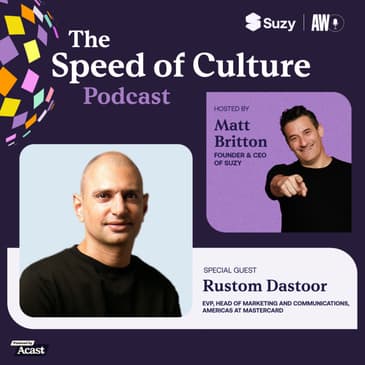
In this episode of The Speed of Culture podcast, Matt Britton sits down with Rustom Dastoor, EVP, Head of Marketing and Communications, Americas at Mastercard, live from CES 2026 in Las Vegas. Rustom talks about why most brands are using AI to reinforce what already works rather than unlock what was never possible before. He introduces the concept of technical branding and explains why marketers will soon need to build their brands for AI agents rather than human consumers. The conversation also covers how Mastercard reads 150 billion annual transactions to spot real consumer behavior, why sports has become the most valuable media environment for marketers, and what resilience, and hustle still mean in a technology-saturated world.
Follow Suzy on Twitter: @AskSuzyBiz
Follow Rustom Dastoor on LinkedIn
Subscribe to The Speed of Culture on your favorite podcast platform.
And if you have a question or suggestions for the show, send us an email at suzy@suzy.com
Hosted on Acast. See acast.com/privacy for more information.
[00:00:00] During World War II, the Allies flew this bomber called the B-17. Very successful. They made about 12,000 of them. 8,000 came home, 4,000 never returned. Tragically lost in combat. So the 8,000 that came home, researchers plotted bullet holes on the fuselage and wings and tail and said, these are the places most likely to get hit. We should reinforce them. And that sounded logical until one person said, wait a second, that doesn't make sense because these planes came back home.
[00:00:28] We should be reinforcing the places that were not hit because you know the ones that went down, that's where they took the hits. And I feel AI and marketing, that analogy holds true. What I'm seeing today is a lot of reinforcing what works. And that's a good thing. But I think the real opportunity for marketing is what we couldn't do pre-AI. To thrive in a rapidly evolving landscape, brands must move at an ever increasing pace.
[00:00:55] I'm Matt Britton, founder and CEO of Suzy. Join me and key industry leaders as we dive deep into the shifting consumer trends within their industry, why it matters now, and how you can keep up. Welcome to The Speed of Culture Podcast. We are live in Vegas here at the Speed of Culture podcast. And today we are thrilled to welcome my friend Roberto Ramirez-Liverde, the EVP Head of Marketing and Communications Americas at MasterCard.
[00:01:22] Rustam continues to help MasterCard stay culturally relevant more recently with its CAN winning Gaga campaign and its leadership across sports, music and experience driven marketing. Rustam, so great to see you here in Vegas. Likewise. Thanks for having me. Yeah, absolutely. It's such a great way to start the year being here at CES. Just being here and part of the energy obviously gets you so motivated to dive into the year. Are there specific things here that you're particularly excited about?
[00:01:46] Yeah, tons. You know, I've started realizing that marketing is as much about technology as anything else. Yeah. Today you can't sort of separate marketing from technology, marketing from data. So what better place to kick the year off? You know, first week you're here in Vegas consumer electronics show and just get a sense of what's out there and what can inspire us to do cool things this year, next year and onwards. And of course, when you talk about marketing and technology, you can't put a sentence out there without mentioning the letters A and I. That's right.
[00:02:15] So we'd love to hear what your take is in terms of how AI has evolved. We spoke about six months ago and it's only gotten more, you know, central to the marketing framework moving forward. What is your overall take on where AI is today here in 2026 in terms of the way brands should be thinking about marketing and where you think it's headed? Look, it's a super exciting moment for marketers and marketing and for brands because we're at this pivotal moment where once again, everything's going to change. Yeah.
[00:02:44] It's not an exaggeration to say that. The last time we had this moment was like 25 years ago with the digital revolution happening, right? It's interesting to hear the conversations around the marketing community. It's a lot about workflow automation, process improvement, efficiency, which I think is great. But I do think there's a risk that we're not seeing the forest for the trees. Okay. So let's take a step outside the category and then come back. Sure. Have you heard of this concept called survivorship bias? Vaguely. Vaguely.
[00:03:14] I vaguely remember us speaking about it. Sure. So let me tell you a little and unpack it a little bit for you in the audience. Survivorship bias is a concept that came out of World War II, right? So during World War II, the allies flew this bomber called the B-17. Very successful. They made about 12,000 of them between 1936 and 1945. 8,000 came home. 4,000 never returned. Tragically lost in combat.
[00:03:38] So the 8,000 that came home, researchers plotted bullet holes on the fuselage and wings and tail and said, these are the places most likely to get hit. We should reinforce them. And that sounded logical until one person said, wait a second, that doesn't make sense because these planes came back home. Right.
[00:03:55] We should be reinforcing the places that were not hit because you know the ones that went down, that's where they took the hits. And I feel AI and marketing, that analogy holds true. What I'm seeing today is a lot of reinforcing what works. We know copywriting works. We know art direction works. We know market research works. Let's just automate it, make it more efficient, which is an end in itself. And that's a good thing. But I think the real opportunity for marketing is what we couldn't do pre-AI. Right.
[00:04:25] What AI will allow us to now do that we could not do. The blue ocean, so to speak. So to speak. Yeah. Right. So we don't want to get trapped in this survivorship bias moment. We want to start thinking about what can we now do that we could never do in the past. And I think that's where the game really is.
[00:04:42] So how do you as a leader get your teams to think differently? Because you're right, we are sort of in this hamster wheel, if you will, to continue to optimize and look at what's working. But to zoom outside that and say, wow, what are the completely new possibilities AI can unlock? That's right. I would imagine it takes a new way of thinking and a new way of leading. It does indeed. To your point is absolutely spot on. It takes a new way of thinking because for me, where marketing adds real value to an organization is that we're closest to the consumer.
[00:05:10] We're the eyes, ears, sight of the company in the outside world. Today, your cell phone probably knows more about you as a consumer than your wife and kids do. There's just so much data available. Marketers should really be able to harness these data streams to get signals, bring them into the company, and then have those signals shape product development, pricing, loyalty, and of course, selling.
[00:05:35] We could not do this pre-AI because when you've got a scale business like we have, there are just too many people with too many individual personalized journeys that we could not turn those into identifiable signals that could drive business outcomes. And personalization is really a huge unlock there. Personalization for sure, but more than personalization to me, it's about hyper relevance. Right. I can personalize for you and yet miss the boat because I'm not relevant.
[00:06:00] Right. So what relevance does and AI can help with is making it very, very motivating for you to take a course of action that I want you to take. So I think that's a step change in the way marketers have to think and act. And I think AI can really make that big unlock that we haven't been able to do before. So where does the magic happen? So say you have access to all these signals on a consumer, on Mary Smith, who lives in Chicago. Right. So you have all these signals.
[00:06:30] You're right. Mobile device is a great source of it. How do you make sure that the application of those signals aren't just personalization, but actually do unlock relevance? Yeah. Look, what is relevance firstly? Right. Relevance is location. Relevance is mood. Relevance is need. So you have now multiple data sets that give you clues about time to time. It's another one. Money is another one. But the reality is, in some cases, you have first party data. In some cases, you don't have first party data.
[00:07:00] But what AI can allow you to do is start passing out data sets, aggregating data sets, and out of that, helping you build structures, systems, practices, campaigns that are far more motivating than what we have today. We're also able to test and learn and move in a very agile manner than ever before. So, for instance, 24 hours ago, I was in New York. Today, I'm in Vegas. The weather in New York was cold and snowy. The weather here is dry and slightly warmer.
[00:07:28] Now, that is a contextual difference that a marketer would not know about me in the classical traditional sense. But looking at AI data streams and where I am and what I'm doing, you can instantly cater to my need here today relative to what it was 24 hours ago and what it would be 24 hours from now. That is relevance. That is what marketing now has to move towards. Yeah. So that's, I think, the difference that we now have to start teasing out.
[00:07:54] And obviously, a big part of that approach and unlock is creativity. And there's so much talk about what the future of creativity looks like in the age of AI. Because, of course, if I wanted to have a bunch of dancing pigs out there in front of the Bellagio Fountain, I don't have to figure out how to have the right shot, so to speak. I just have to have the idea and I can prompt it and I can see it and I can optimize.
[00:08:17] And that's different than what creative used to mean because it used to be as much about how to solve the problem as it is about identifying the problem to be solved. But now I think it's much more the latter. Yeah. Look, technology is an incredible competitive advantage until your competitor has it too. Right. So if you and I are sitting here today, you've got technology assisting you and I don't, I'm in trouble. You're going to win. But once I get the same technology, then it comes back to humanity. Yeah.
[00:08:42] Then we go full circle and come back to the old ways of doing things, which is how do I outthink, outcompete, outact you? I don't think this is ever going to go away. So there's a lot of talk about whether humanity just disappears in an AI-enabled world. I don't believe that for a very simple reason that human beings are wired for human connection. We create all these complex connections amongst ourselves, right? Language, religion, marriage, nationalism to bind us together.
[00:09:11] I don't think AI is going to unbundle any or all of that. So I think once the technology becomes table stakes and everyone has it. We're already basically there, right? We're basically there. Yeah. It's the new pen or the new tool. And now we've got to be practitioners at using that in more creative ways. So I'm not of the opinion that humanity would just disappear. Well, that's good. Because I like spending time with people like you. So we're kicking off the year.
[00:09:39] And if you are going to set an organization that can take advantage of this and lean into humanity, what are some of the skill sets, especially with some of the younger marketers that you bring on your team, that you really look for as people that you can really gain conviction that these are people I'm going to make bets on, that I can future-proof my business moving forward? Look, we started talking about this a few minutes ago that we're at this pivotal juncture, right? It is not an exaggeration to say the world five years, 10 years from now will look very, very different. We don't know exactly what that AI-enabled world will look like.
[00:10:08] What we do have some certainty about is to succeed with AI, you've got to be able to succeed with data. So for young people today to really understand data is critical. How it's collected, how it's sorted, how it's stored, how it's deployed, what it enables. If you're a young person looking to get into marketing or anything for that matter, at this point in time, learn how data works. That would be my advice.
[00:10:33] And of course, in your role leading marketing at MasterCard, you are in a very envious role when it comes to data. We'd love to talk a little bit about MasterCard, its business model, and how you're leveraging some of these trends and tools that we're talking about to really drive the brand and business forward. So we don't hold any first-party data. That stays with the bank. I always have to start off with that caveat. What we see is data in aggregate and data anonymized. We process about 150 billion transactions a year.
[00:11:02] So we have a great depth of aggregated anonymized data. And that data allows you to see trends. It allows you to see spending patterns. It tells you what the health of the economy is. It tells you where consumer spending is going, what segments in society are spending more or less, how corridor spending is working. So AI can only help make that sharper and then help businesses that leverage that data smarter in how they go to market. Got it. So that is our view with how we treat data.
[00:11:30] So based upon that, what are some of the things that aggregated data has uncovered that has led you to kind of make bets in certain areas, especially when it comes to injecting the MasterCard brand into consumer culture? So one of the trends we've seen post-COVID is a higher propensity for affluent people to spend. So that then shapes product portfolios. So there are more affluent products now that issuing banks, whether ours or competitors, are issuing out there. Those propositions have become more meaningful.
[00:12:00] More expensive too for the consumer. The annual fees are more expensive. That's right. Bigger rewards. That's right. And the reward structure is commensurate with the fee increase. Yeah. What we're also seeing is that people are cash-rich, time-starved. So even the benefits evolution that's happening on card products, et cetera, is more towards time saving. The affluent consumer. For the affluent consumer. At the base of the pyramid, at the more everyday spend level, you're just seeing more ways to pay. You're seeing more propensity with the likes of an Apple Card or an Apple Pay.
[00:12:28] You're seeing more contactless usage. You're seeing more cards on file. You're seeing more e-commerce spending. So these are all things that then shape how we as a business and we as a marketing organization evolve our processes and practices. I mean, it's interesting. Is that a good thing for the MasterCard business model that you have more ways to pay? Because it used to be you just wanted your card in someone's wallet. But now that's really not really the battle you're trying to win. For us, the more ways to pay, the better.
[00:12:54] As long as the payment is a digital payment, anything that gets you away from cash is a good thing for us. Yeah. And remember, consumer payments is only one element of our business. Another massive element of our business is commercial payments. Money movement, wire transfer, small business enablement, cybersecurity, data and analytics. So we look at the entire value exchange between how people get paid and pay and try and find where is our role in this in making it safer, simpler, smoother. Right.
[00:13:23] One thing you talked about was that especially the fluent consumer, their cash rush in time starved. And one place they are spending their discretionary expenses are is experiences. And we've seen a huge experience boom post-COVID. And I know that MasterCard has really leaned into experiences under the priceless banner of the brand. Wire experiences is something that can be so important for the MasterCard brand. And what are some of the areas that you think have been really effective in terms of consumer passion points? Sure.
[00:13:51] So look, experiential marketing is something we've been doing for a while now. What we found is that traditional advertising sort of had its moment and then the efficacy of it started declining. Right. So you were buying a lot of media, you were communicating a lot, but nobody was listening. When you go to experiential marketing, you're giving people access to something that's rare for them. We talked about the Gaga campaign the last time we were together. It's easy to buy a ticket to a Gaga concert, but there's no way you could get in a Gaga video. Right.
[00:14:20] I mean, that's only something that we can unlock for you. Now, we can only do that for about 30 or 40 people. But when you take those 30 or 40 experiences and use social media to communicate them, the power of the brand then becomes available to a lot more people. It's a storytelling playbook. That's right. Right. And people sort of start seeing themselves in your journey and in your brand and say, OK, they did that for that person. They could do something else for me. So how do I now participate with the brand, engage the brand, and make available those experiences that they're offering?
[00:14:48] And some of the experiences that you lean into, you mentioned, Gaga, so obviously it's music, sports. Sports is a massive one. And why does that continue to grow and become so important for a message? Look, it's no secret that media has fragmented massively over the years. We went from four networks on TV to cable, which led to fragmentation, deregulation of radio, more fragmentation, the internet, social media streaming. Today, the media is so fragmented and polarized that for a marketer, it is extremely challenging to operate.
[00:15:16] Multiple pieces of content, multiple media plans, attribution models, brand safety. But the world of sports has gone in the opposite direction. More consolidation. Whether it's basketball, baseball, football, and Formula One. Yeah. They've really sort of taken control of their ecosystems. So distribution rights, broadcast rights, licensing, merchandising, fan experience. There's a real scale. Scale and vertical integration and common data streams.
[00:15:44] So you can follow a consumer very accurately from one element to the other, one channel to the other, and build on that engagement that you've got. So I can't reinforce how important a through line of data is to anything marketers do. It's not just slapping your logo at the stadium or... Not at all. That's what it used to be. It used to be. And for many years, that was great. It worked very well. But today, you want to be a lot more efficient with your dollar, and you want to be a lot more pointed with how you deploy it.
[00:16:13] We'll be right back with The Speed of Culture after a few words from our sponsors. I actually think in sports, the athlete now has the opportunity to become a storyteller in their own right. For sure. When I was growing up, we just had to wait until they were on TV on Sunday to watch Magic Johnson play basketball. But now, you can follow an Anthony Edwards. You can follow, you know, Victor Wambanyama, NBA star, on Twitter. And you can see what they post. And you actually see them walking into the arena and what they're wearing.
[00:16:41] And that becomes a great palette for storytelling. So we work with Lando Norris, who's the winner of the Formula One Driver Championship last year. He's both a social influencer as much as he's a performing sportsman. Right. He's got about 10 million followers on social media. And everything he does, from who he dates to the clothes he wears, the car he drives, where he vacations, is of tremendous interest. And then that gives you different ways to engage his audience. So in him, he's a brand in himself and he has an audience of his own that is extremely
[00:17:11] important to mine and tap into as well. Yeah. And when you talk about how just traditional media has changed over time and proliferated in so many different ways, the creator and the creator economy is something that obviously is growing in importance because they have a lot of the things that we've talked about. They have the ability to storytell. They have the contextual aspect. The person that's following them has vested in their life. So I would imagine that's also a big part of extending. To the extent that we're building products for creators, we see the creators of today as small businesses.
[00:17:41] Right. And at the scale at which they're growing, a Mr. Beast is no longer a small business. They're a medium-sized to big business. So a creator is actually today's small business that's ready for scale. So we've got products like the business builder product and the creator card that are catering to their specific needs. So it allows them to fund their business? Allows them to fund their business, gives them mentorship, gives them access to a community and really gets them to sort of scale up very quickly. That's fantastic.
[00:18:08] So, you know, we're here entering 2026 and that's what I love about CES is it kicks off the year. There's so many possibilities. Where do you see the MasterCard business in five years from now? Like what will be different then that exists today based upon all these changes? Yeah. I mean, as I mentioned, you know, most people know us for our consumer business. Yeah. We have a massive commercial business and we have a massive services business as well. So increasingly our brand is more than consumer payments.
[00:18:32] We're a true technology company that can impact many things from cybersecurity to AI to data analytics. We do marketing as a service. Right. All of these are things that grow the enterprise at large and what it means to be a partner of MasterCard evolves and grows with it. So my job as a marketer for the company is to lift all of these boats through the strength of the MasterCard brand. And that's what we're doing. So if I'm a business and I want to drive growth moving forward, what are some of the ways I can lean into MasterCard?
[00:19:02] Well, let's start with data. Right. As I mentioned, we're processing 150 billion transactions that are available to you in an aggregate, anonymized manner to spot trends and to spot patterns. Those could be very helpful for a small business when it comes to forecasting, when it comes to financing, when it comes to what to stock and what not to stock, when it comes to how to market. Those are huge benefits. People are talking with their wallets, which is the best way. It's the best way. I mean, there's a lot about CalShit.
[00:19:30] I don't know if you're following these prediction markets now, but one thing that they've really unlocked is that polling is nowhere near as accurate as the way that people spend their money. And if they're making big bets on something, there's probably something behind it. Exactly. Right. Cybersecurity is another area. Every business today that goes digital has to be thinking about cybersecurity. And that's where we have an enormous play and enormous footprint. So that's another area where we have small businesses, medium-sized businesses, large businesses
[00:19:57] really protect the environment in which they operate digitally. Right. And that's obviously in the world of AI, there's going to be... It's an arms race. Discussion yesterday. I mean, but it's also only a matter of time before AI is going to have some type of cataclysmic, unfortunately, impact on a business or on culture or society at large that is really going to wake us up. And I think the nefarious actors are going to be able to deploy AI in some pretty scary ways, which makes cybersecurity more important than ever before. That's right. That's right. Even in our personal lives, we should be very conscious of cybersecurity.
[00:20:27] So, Kieran, how are you using AI on a day-to-day basis to both enrich your mind, keep in touch with what's going on, and also to deploy it to make you more efficient in your day-to-day role? So, it's interesting. We recently did a study, and I'll tell you three patterns that came out, and then I'll talk specifically about myself. There are three ways, and this won't come as a surprise, that people are using AI in a step-change manner. The first is shopping, just being better-informed shoppers. Are you starting to see that a lot? Yes, we are. That consumers are using chatbots to purchase.
[00:20:57] 100% to make decisions, shopping decisions. The second is travel, which is massive. Yes. And the third is financial literacy. So, these are the three areas that have pulled away right now from everything else in terms of how consumers are using AI. For me, all three are relevant. I'm doing all three. I always tell the story about last year, we went on a family trip to Chicago. I planned the whole itinerary in ChatGPT. First time, no one in the family had an argument. We all got what we want out of it. It was within budget. Because you said, this is what my family likes. This is what they're interested in. Exactly.
[00:21:26] Put saying on the calendar. It shows the right hotel, the right flights, the right restaurants, the right- Did it book it for you, or did it just tell you? Not yet. Right. That's next. Yeah. Because now we have something called AgentPay, which is a token that enables AI platforms to do that booking for you. So, last year, I still had to go through the manual process of going on chatblue.com, going to the hotel. Sure. So on and so forth. That won't be necessary. But that, if you think about the implications of that, I mean, all these brands that you would have normally, and you do today, but you're saying, you know, tomorrow night
[00:21:55] fully agree with you, whether you're going to the Marriott Bonvoy site to book your hotel or JetBlue's website to book, those sites aren't visited in that consumer journey anymore. And you're relying upon an agent to make those decisions, which means for those brands, the way they have to build their brand is completely different. Well, I'd go a step further and say, do brands really need websites? Right. Or is this just system to system communication? Is a query you put into ChatGPT just communicated to a DMP that an airline has,
[00:22:26] JSON or XML being the medium, where you don't even need a website? But then if that's the case, who does a brand market to? An agent. Right. So, but what does marketing to an agent look like? Well, no different than marketing to any influencer, except that the influencer is not a human being, it's a machine. And so you've got a plan for what it's like to communicate with a machine. So this year and this past year, about 80% of my inbound inquiries for public speaking came from ChatGPT, for example.
[00:22:55] So people used to find me on traditional Google searches, and now they're searching for AI consumer speaker, and then they find me. So in order for me to have that agent, whether it's ChatGPT, Gemini, Claude, whatever, recommend me, I need to have a lot of content out there. But you're saying I'm making that content for the agent, not really necessarily even making the content for the consumer. That's right. You actually might not need a lot of content. You just might need the right content in the right place. So you might need to harness all your content, put it into a DMP,
[00:23:24] have that DMP almost like an intelligent decision machine, have that connected through APIs into the right environment, and then the API will call on that data that says, for this purpose, match the right guy, and you get into their search stream. But that also means that ultimately the arbiter of the consumer decision is an agent, and a consumer is going to be trusting these agents for where to travel, for what to buy, etc. Yes, but that is not new for marketers.
[00:23:52] For instance, when we market products to ultra-high net worth consumers, people who have 10 million or more in investable assets, invariably it's through a financial advisor or a wealth manager. Right. Right? When high-end apparel sellers or high-end furniture makers market to wealthy people, it's through a stylist or a... Right, and hotels market to travel agents. Exactly. Right. So this is not new. Except it's not a human. It's not a human. Which is kind of a big deal. Which is kind of a big deal. And you've got a plan for that and structure for that,
[00:24:19] and that's where things like technical branding will become very important. That's where... What is technical branding? So today when we look at branding, it's very physical and tactile, right? A logo, colors, fonts, tone and manner. But in an AI environment, that doesn't matter. So you've got to have your brand differentiate in an algorithm. That's going to require technical branding, which we haven't even scratched the surface of. This is the first time I've heard that phrase. Probably not the last. Right, right. You might hear it a few times this week.
[00:24:49] Another area, Matt, is content. So it's very easy for content to be spoofed outside. Yeah. Right? So you're going to have to start thinking about tokenized content that's hashed and with cryptography that's verifiable. So that an agent knows that that is true content, not a fraudster spoofing. Right. Because just like we saw, I remember there was a company called Demand Media. It was like a content farm. They were like the first company to try to game the Google algorithms. You're going to see that happen all over again. And at scale. Right.
[00:25:18] So again, these are all things that marketers are going to have to get savvy on, learn, which we will, and just get better at doing. But it is a mindset shift in terms of how you market. Especially for the CMO. So let's talk about that. I mean, what does all this mean for the future role of the CMO? How's it going to be different moving forward? Yeah. As I said a few minutes ago, it's a very exciting time for a CMO. Because once again, you can deliver true relevance to an organization.
[00:25:45] But it does mean harnessing technology very differently. Yeah. You clearly understand technology. There are a lot of CMOs that I've interacted with. They're much more about those big anthemic brand spots and working with a Madison Avenue at agency, which I think is important. But the picture you're painting makes it seem less important. But I think that's starting to happen. Yeah. More and more CMOs that I talk to are already in this mindset. And I think most people see this as very exciting. And there's a huge creativity unlock.
[00:26:14] That creativity might manifest itself differently. I think agencies themselves are going to have to think about creativity differently. But I think we're on that journey. So let's talk about your journey and how you ended up in the role you're in today. Obviously, the world's very competitive. You've been at MasterCard now for 12 years. 12 years. Yeah, moving your way up. And you worked at some pretty fascinating places prior. What are some of the areas you think you successfully leaned into across your career journey that put you in a position that you're in today?
[00:26:43] Look, curiosity is everything, especially in marketing. The more curious you are, the more you learn, the more you learn, the more opportunities you get. You know, being resilient to take a few knocks and get back up and not let it faze you. I always say the worst disappointment should not last more than three months. Yeah. If it's going beyond three months, you've got an attitude problem. So anything that disappoints you, get it over in three months and move on with your life. I think that's extremely important. And just be willing to lean in. Go places, meet people, have conversations.
[00:27:13] Even if you're tired, go have that dinner with someone who invites you out. Especially when you're younger in your career. You don't have family obligations. You should never be home. Go to every single event. One thing I find is people think sometimes they know what's going to happen at that dinner. Because they have a vision. I'm going to go to this dinner. This is what's going to happen. And it's not worth it. The reality is you have no idea. No idea. It's going to show up, what you're going to talk about, what's going to happen. So you create this world that gives you comfort in making a decision not to go. When that's the worst decision.
[00:27:42] I got my first job in marketing sitting in a lawyer's reception area waiting for a lawyer's appointment. I just happened to chat with the guy next to me and he was the CFO of a major ad agency. And I handed him my resume. That's how I got my first job. Right. Talk about right time, right place, right? So unless you get yourself out there, you're never going to know what happens. Hustle culture is a real thing. Yeah. And you never really know at the time I was watching one of my favorite artists ever is Billy Joel. And I was watching his documentary.
[00:28:12] And he went to this small radio station in Philadelphia and recorded a demo for the song Captain Jack. And then he went out to L.A. And the world was different back then. But what he didn't know is that song became so popular, people kept asking for the song he played. And then a record label caught wind of it and tracked him down in L.A. And that was his break. And he probably had so many reasons not to go and do that demo. And if he didn't, we might not know Billy Joel as we know him today.
[00:28:38] Like you just have to put yourself out there, do every interview, do everything you can to open up those opportunities. And once again, we bring this full circle to AI, right? In a world where the technology is table stakes, that's what's going to differentiate us. Right. Everyone's going to have the tool. You're not the only guy in town with ChatGPT anymore. So once everyone has it, the difference is going to be your hustle. Right. Your hustle and also, I think, your ability to storytell around yourself.
[00:29:05] Like you have a way of looking at the world, which I can tell you as somebody who interviews hundreds of people a year, is distinct. Like you look at, you're a good storyteller. You understand where the world is headed. And I think you need that. You need a distinct element to bring to the table. Because if you're seeing the things everyone else is, then you again, commoditize yourself. Part of it is also my journey in living in so many different countries. Yeah, let's talk about that. So many different cultures, right? I was born and raised in India. I came to Arizona about 100 miles from here as a student in the 90s. I then moved to Boston.
[00:29:35] I then moved to New York. I then moved to London. I went to Singapore. I came back to the U.S. So I've lived in three continents and multiple countries. And I oversee Latin America as well. So that gives you a perspective that the world is a complex, large place. And the more open you are to being agile and flexible and learning and not thinking that, you know, the world revolves around you, the better off you're going to be for it. Yeah. I remember last time we spoke, you had told a story about how like a soda or something that
[00:30:03] we take so for granted here in America is like a luxury in other areas in the world. So really being able to understand that I think is hugely important. So how do you spend your time? Because I think a lot of people listening to this interview are going to want to know this, keeping your finger on the pulse of where everything's headed. Again, curiosity. I'm a voracious reader. I watch hours and hours of YouTube in my free time. It's great for learning new things. It's great for sort of exposing yourself to new ideas.
[00:30:31] I like hearing things that make me uncomfortable. Interesting. Whether it's socially, politically, economically. I want to hear the stuff that eliminates the blind spots that I have. And then I can decide whether to embrace that or not. But I don't believe in this culture of just live within your eco chamber or your echo chamber rather. So just talk to people like you. I think you've got to talk to people who make you uncomfortable. You've got to hear things that make your hair stand a little bit. That's essential to covering those blind spots. Yeah, absolutely.
[00:31:02] So we're here at CES overlooking the beautiful Bellagio fountains kicking off the year. What are some of the exciting innovations at CES that you're particularly interested in seeing? Yeah, again, we started this conversation about marketing and technology, right? So I'm interested in seeing what's out there that really gives me a signal about consumers. So every connected device today is a data sourcing device that should give marketers signals as to what consumers want.
[00:31:27] I'm curious to see what's out there that makes me smarter about consumers, that helps me reach them in better ways. And that's why I'm here. Awesome. Awesome. We always wrap up our podcast asking our guests if there's a saying or mantra that helps guide their professional journey. I have a feeling that you have no shortage of them, but just want to know what comes to mind for you. So I heard something recently that had a profound impact on me. It's a quote. You ready for it? Let's do it. The one thing I've learned about life is that it goes on.
[00:31:55] The one thing I've learned about life is that it goes on. And so we get so caught up in the moment. We're so concerned about the world, our families, our careers, but life goes on. Yeah. Good things happen. Bad things happen. The sun rises again tomorrow. Life goes on. And I thought for someone who's sort of midlife as to where I am right now, that was profoundly moving and impactful. And to unpack that for a second, I mean, that is about resilience, right? It is about moving on.
[00:32:24] It is about knowing there's a new day and always more to uncover. That's right. Yeah. It very much is. And I think we need that resilience today. We really do. It's a world full of opportunities, but also a world full of, if you choose to, worry and doomsday scenarios and all these things. It all depends upon the scroll that you want to look into, the feed that you want to shape your life, I guess, so to speak. So, well, to no surprise, it's been a fantastic discussion. I can't wait for our audience to hear it. I just want to wish you nothing but success here in 2026 and beyond. Thank you, Matt. Absolutely.
[00:32:53] On behalf of Susie and AdWi team, we're here live in Vegas. Special thanks to Roberto Ramirez-Liverde, the EVP of Marketing and Communications at MasterCard for joining us today. Be sure to subscribe, rate, and view the Speed of Culture podcast on your favorite podcast platform. See you next time, everyone. Take care. Bye-bye. The Speed of Culture is brought to you by Susie as part of the AdWeek Podcast Network and Agus Creator Network. You can listen and subscribe to all AdWeek's podcasts by visiting adweek.com slash podcasts.
[00:33:22] To find out more about Susie, head to susie.com. And make sure to search for the Speed of Culture in Apple Podcasts, Spotify, or anywhere else podcasts are found. Click follow so you don't miss out on any future episodes. On behalf of the team here at Susie, thanks for listening.