
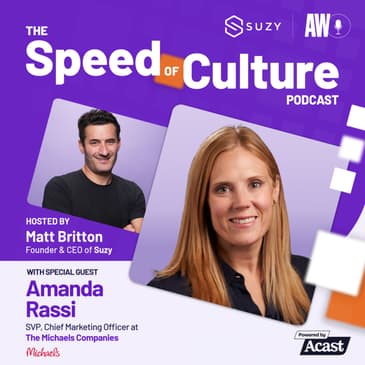
In this episode of The Speed of Culture, Matt Britton chats with Amanda Rassi, the Senior Vice President and Chief Marketing Officer at The Michaels Companies. Amanda explores the evolving retail landscape, the role of customer data in marketing, and how Michaels fosters creativity through its products and community initiatives.
Follow Suzy on Twitter: @AskSuzyBiz
Follow Amanda Rassi on LinkedIn
Subscribe to The Speed of Culture on your favorite podcast platform.
And if you have a question or suggestions for the show, send us an email at suzy@suzy.com
Hosted on Acast. See acast.com/privacy for more information.
[00:00:00] Hiring for your small business? If you're not looking for professionals on LinkedIn,
[00:00:03] you're looking in the wrong place. That's like looking for your car keys in a fish tank.
[00:00:09] LinkedIn helps you hire professionals you can't find anywhere else. Even those who aren't actively
[00:00:13] searching for a new job might be open to the perfect role. In a given month, over 70% of
[00:00:18] LinkedIn users don't even visit other leading job sites. So start looking in the right place.
[00:00:23] With LinkedIn, you can hire professionals like a professional. Post your free job on
[00:00:27] LinkedIn.com slash people today. If you're struggling to lose weight, you've probably
[00:00:32] heard about weight loss medications like Wigovie or Zepbound and you might be wondering if they're
[00:00:37] right for you. Meet Plushcare, a leading telehealth provider with doctors who are there for you day
[00:00:43] and night to partner with you in your weight loss journey. If you qualify, they can safely
[00:00:48] prescribe you medication from the comfort of your own home. To get started, visit plushcare.com
[00:00:53] slash weight loss. That's plushcare.com slash weight loss. Plushcare.com slash weight loss.
[00:01:02] Hey there, are you ready to elevate your personal brand or company?
[00:01:06] Meet Viral Growth, your one-stop shop for video content and audience building.
[00:01:10] Imagine growing your brain organically on social media without the hassle of editing videos
[00:01:15] for hours. With Viral Growth, it's a breeze. They handle the brainstorming, scripting,
[00:01:20] and editing while you simply just hit record. And don't worry about your niche. They cater
[00:01:24] to everyone from business and marketing to health and wellness. Are you ready to make waves in the
[00:01:28] social media realm? Visit Viral Growth.io and use code ADWEE, that's A-D-W-E-E-K,
[00:01:34] all lowercase, and get 10% off your plan. So I do think there are big pieces of our business
[00:01:42] that are a bit AI proof, if you will. If you think of someone who loves making friendship
[00:01:47] bracelets, that's inherently a physical thing you make. Put on your arms. And people do
[00:01:52] like doing that. There is the joy of making the thing with your hands that I think will
[00:01:58] continue to be a thing. That said, AI can be a tool for creativity as well.
[00:02:05] To thrive in a rapidly evolving landscape, brands must move in an ever-increasing pace.
[00:02:09] I'm Matt Britton, founder and CEO of Suzy. Join me and key industry leaders as we dive
[00:02:14] deep into the shifting consumer trends within their industry, why it matters now,
[00:02:18] and how you can keep up. Welcome to the speed of culture.
[00:02:26] Today we're thrilled to be joined by Mandy Rassi, the SVP and Chief Marketing Officer of Michael Stor's.
[00:02:32] Mandy is at the helm of sharing the mission of spreading creative joy and injecting her 20-plus
[00:02:36] years of marketing and analytics into all our exciting new innovations at the great Michael
[00:02:41] Store. Mandy, so great to see you, and thanks so much for joining today.
[00:02:44] Thank you for having me. Great to be with you guys.
[00:02:47] Absolutely. So it's interesting because I've mentioned this many times before,
[00:02:50] but so many of our guests at the Speed of Culture podcast cut their teeth, so to speak,
[00:02:55] at Proctor & Gamble. And your background is no different. You spent 14 years at PNG
[00:03:00] coming in in the early 2000s. Tell us about your experience at PNG and more specifically
[00:03:06] what it was like to play such a critical role in the insights and research function
[00:03:10] at Proctor & Gamble. I loved my time at PNG. So I joined PNG right out of undergrad.
[00:03:15] I had studied psychology and what was then called women's studies, which was part of sociology,
[00:03:20] and got a job in consumer and market knowledge at PNG coming right out of there. And thought
[00:03:25] I would spend a couple of years and then go back to grad school, but really fell in love
[00:03:29] with the company and with the work that we were doing. I spent about half my time on the global
[00:03:33] brand side, much of that on the global laundry business working on brands like Tide and Ariel,
[00:03:39] Gain, Downey. And then I spent the second half of my time there on the retailer side,
[00:03:44] so still part of the brand function, but working with the retailers across North America. So I spent
[00:03:50] a lot of time in the grocery channel working with Kroger, Safeway, Albertsons and a lot of smaller
[00:03:56] regional grocers. Then I spent some time in the club in whom improvement channel and then
[00:03:59] doing some innovation work across retail and across all the brands for North America.
[00:04:04] So it was a great experience where I got to do lots of things in the span of the
[00:04:09] 14 years, which I think is part of what's very cool about PNG is it's big, but that allows you to
[00:04:15] try lots of different things and learn a ton within the same company.
[00:04:20] So I'm fascinated with the laundry category with a brand like Tide because
[00:04:24] I've spoken before about why wouldn't a brand like Tide actually just buy a company that makes
[00:04:31] washing machines? And then you could have washing machines in consumers' households and they
[00:04:35] could be smart washing machines and every time they runs out, it just orders more Tide.
[00:04:39] And the washing machine only takes Tide and basically almost did the same model that you see
[00:04:44] Apple doing where they have a vertically integrated solution where they have the hardware
[00:04:48] and the software or so in the case of Tide, the software is a detergent and the hardware is
[00:04:52] the laundry machine. The conversations like that ever happen. I know you probably can't share
[00:04:56] what happened at PNG but just more generally in the category because it's always fascinated me
[00:05:00] why a brand like Tide wouldn't go in a direction like that.
[00:05:04] Yeah, so what I will say is lots of conversations happen. I worked in newfulness
[00:05:08] as part of my time there and things like Tide dry cleaners came out of that, which is
[00:05:12] a similar thing along a different vector of fabric care. And PNG's approach was always
[00:05:17] sort of billed by our partners. So figuring out like one, I think the discipline at PNG,
[00:05:23] and this is a lot of what we did in consumer and market knowledge, is really understanding
[00:05:28] the consumer and understanding the DNA of the brand and where your competitive advantage
[00:05:34] lies. So in terms of R&D, supply chain, retail, sort of arms into retail, etc.
[00:05:41] And I think PNG is not in the business of making appliances. So I think your take on
[00:05:47] partnership is more where something like that would have happened. And certainly you see lots
[00:05:50] of places where PNG did partner or frankly acquired technology. So if you look at
[00:05:55] Swiffer would be a great example of that where the technology or some of the components
[00:06:00] that go into the mobs that are more durable. Or Gillette too, right? Yeah, or Gillette.
[00:06:05] Absolutely. But always there was a discipline at PNG, it wasn't just like get into a space
[00:06:11] to play. It was you want to get into a space to win with that brand. And so there was always
[00:06:16] a great discipline of like one, should we do this from a consumer point of view? Is it within
[00:06:22] the DNA of this brand to do it? And do we have an ability to go in and do this in a way where
[00:06:27] we're going to win and have some potential to become the market leader? And if you didn't check
[00:06:32] a lot of those boxes really sufficiently, then there was great discipline to not just go chase
[00:06:38] the shiny object or thing that like we could do but maybe wouldn't be the best investment
[00:06:42] of resources. Sure. And to be clear, I wasn't suggesting it just because it was a fun
[00:06:46] place to play. I would suggest saying more that one of the biggest challenges I know for
[00:06:50] CBG companies is customer acquisition and driving loyalty. So if you actually had a built-in
[00:06:56] distribution channel, i.e. the washing machine in the home, then really it takes a lot of this
[00:07:01] customer acquisition costs away and in the world where consumers are more and more embracing
[00:07:05] IoT. I just thought it was an interesting concept but I totally, yeah, it was interesting here.
[00:07:09] I always wanted to hear about it from the client side because I have these ideas and
[00:07:12] it was just good to hear your take on it. So then you went over to Kroger and obviously
[00:07:16] Kroger's a retailer. So you went from being on the manufacturing side and overseeing CBG products
[00:07:22] to a retailer. How is that different? And what precipitated your decision to actually leave
[00:07:28] a company like P&G after being there for 14 years because many who've been in a company
[00:07:32] like that for so long just decided to be a lifer there, you made the decision to jump over
[00:07:36] the Kroger. Yeah. So to your first question, very different in many regards. So people will
[00:07:42] say like, oh, retail moves fast. And I will say P&G also moves fast especially sort of within the
[00:07:47] cohort of CBG but you really cannot underestimate how fast retail moves. We're watching the sales
[00:07:54] on a daily basis and not trying to overreact on that but you do react. Obviously P&G makes more
[00:08:00] premium brands and while discounting is a piece of it, Kroger is very high low and where I am
[00:08:05] at Michael's now is even more high low. So really the promotional nature of marketing on a
[00:08:11] brand where promo is such a core part of the brand is quite different as well. And then obviously
[00:08:16] the space of food is a really fun space. It also works very differently in some regard than things
[00:08:22] like laundry detergent, paper towels, diapers, you know, the kinds of things we were doing at P&G.
[00:08:27] So I was able to apply a lot of the same skills and core fundamentals. I think
[00:08:32] really the consumer understanding pieces, the brand strategy and customer experience
[00:08:37] fundamentals can go anywhere. You just have to really learn the industry and learn the consumer
[00:08:43] of the business that you're on and figure out how to best apply those things in a way that
[00:08:47] will grow loyalty with the customer, grow the customer base and then ultimately accelerate
[00:08:51] the business. Sure. And obviously one of the biggest differences working in the retailer is
[00:08:56] you have so much ability to capture that first party consumer data which is more challenging
[00:09:01] for a company like P&G which sells through the Krogers and targets the Walmart to the
[00:09:05] world. How did you like us lean into that at Kroger and what were your learnings in terms of
[00:09:10] your ability to build loyalty and leverage that first party data which is now more important
[00:09:14] than ever before? I went there at a really interesting time. So Kroger had bought out
[00:09:19] Dunhumby USA which had been a really important partnership doing all things customer data
[00:09:23] and loyalty for Kroger for quite a while. And I went there when they were not quite
[00:09:28] a year into the full acquisition and creation of 8451. So there was tons of customer data
[00:09:35] and I got to be there at a fun time where we were figuring out how to best apply it.
[00:09:41] Kroger had long used it for things like the loyalty programs and new coupons for things
[00:09:45] that you buy the most using it for pricing and promotion but we weren't really using it
[00:09:50] for marketing when I first got there. And so we got to really stand up what is now
[00:09:56] the marketing and retail media ecosystem at Kroger. Kroger has a ton of data to your point.
[00:10:02] Food also moves fast so if you think of even the number of trips your average customer is making
[00:10:09] in food it's more than once a week. So not only do you have a lot of household,
[00:10:13] you have a lot of depth in terms of the profile that you have because you've got the food side,
[00:10:18] you've got the more household goods side, you've got beauty, you've got general merchandise.
[00:10:24] To an extent we also had financial and healthcare. Obviously there's a lot of regulation around data
[00:10:29] in those two spaces but we've really had a great view of who the customer was and got to figure
[00:10:37] out lots of interesting ways of going beyond just sending really relevant offers but actually
[00:10:43] using the data through our paid media ecosystems and having the right series of clean rooms
[00:10:48] and a media ecosystem where we could push audiences and find look-alikes which a lot of people are
[00:10:53] doing now but back in like 2017, 2018 I think Kroger along with Walmart, Target and probably a few
[00:11:00] others were pretty on the front end of figuring out how the modern sort of more personalized
[00:11:07] media ecosystem is going to work. Absolutely. And a big trend we've also seen in the last
[00:11:12] couple years is just the explosion of retail media. I speak to so many
[00:11:16] brand managers at Big CPGs and they talk about how more and more of their budget is going there.
[00:11:22] Some of them question the value in terms of is it something that they're just doing because
[00:11:26] they need to get the shelf space where other retailers I think do deliver great value.
[00:11:29] Kroger has their Precision Marketing Unit. What is your take on retail media overall?
[00:11:35] How can it continue to drive impact for the brands that it serves and where do you see it going?
[00:11:40] If I were sitting on the CPG side, I think there are pros and cons. So retail media is fantastic
[00:11:47] in terms of being able to get very close to the customer near the point of purchase or the
[00:11:53] purchase decision and also the transparency I think is far and away better than a lot of what
[00:11:59] we get in traditional media. So the ability to close the loop on a media activation and then
[00:12:07] a purchase happening in the store is about as transparent as it gets in the likes of retail media.
[00:12:12] The attribution basically.
[00:12:14] Huge, yes. And I think especially over the last five plus years there's been so much
[00:12:19] conversation in the media industry about transparency as a brand. I'm investing in
[00:12:24] media. How much of that is really going to the working dollars of what's happening there?
[00:12:30] What is the reach? What is the frequency? Am I not over-frequencying? Am I not
[00:12:35] serving up garbage impressions that a bot is seeing and a human is not seeing?
[00:12:39] And I think retail media has a really interesting,
[00:12:43] sort of unique position of that ability to close the loop and give you very clear measurement on
[00:12:49] what you're getting. Now obviously it's not perfectly unduplicated because they all exist
[00:12:54] within their own sort of walled gardens, which we'll talk a lot about like a Facebook
[00:12:58] or a Google as a walled garden, but in some ways the likes of a Walmart, a Kroger,
[00:13:03] they're showing you the purchases within their ecosystem and you can't perfectly dedupe that
[00:13:08] of like was that person going to buy a tie at Walmart and I just got them to buy it at Kroger.
[00:13:12] So I think that's where the CPGs then need some other mechanisms to try to tease that out,
[00:13:18] even with more, I guess sort of old school things like marketing mix,
[00:13:21] which I know lots of us still use and it serves a purpose.
[00:13:25] That said, as every retailer is seeming to spin up retail media, I can see where
[00:13:30] CPGs might see it as a cost to serve, where it becomes part of the relationship you have to have,
[00:13:36] not just with the big retailers, but all the retailers. And I think that's what's going
[00:13:40] to be interesting to see is over time how many of these smaller ones can survive,
[00:13:47] especially if you're in more of a niche like if you're a PNG,
[00:13:50] you've got Walmart, Amazon, Target, Kroger, that probably covers a lot of your customer base.
[00:13:56] Right. When you talk about deduping, right.
[00:13:58] Exactly.
[00:13:59] Right. It gets over a lot.
[00:14:00] And managing all of them, right? It's like that's also a lot of buys to place,
[00:14:04] to measure, to have a point of view on, to optimize, et cetera.
[00:14:07] Yeah. And I think there's a lot of macroeconomic factors impacting the big box retailers, right?
[00:14:11] You have rising commodity costs, it's putting pressure on margins,
[00:14:16] increased costs to acquire customers. And then you have obviously other pressures
[00:14:21] like private label that are impacting the CPG companies on the other side.
[00:14:25] And I think the danger in all of this is that the retailers get too comfortable with retail
[00:14:30] media being part of their overall operating model and then just keep kind of inching up
[00:14:34] the costs. And then to your point, I like the way price to serve.
[00:14:38] And then ultimately the CPG companies say, well, wait, what are we really paying for here?
[00:14:42] At the same time, I think it's interesting that you see platforms get into the retail
[00:14:47] space. Like you have Uber who has tons of first-party data. And I wouldn't be surprised
[00:14:52] if you start to see companies like Uber get more into the retail space just so they're taking their
[00:14:56] data and getting the retail, just like retail companies are getting into the data and advertising
[00:15:01] space. I think you're going to see a lot of convergence moving forward.
[00:15:04] Yeah. It'll be interesting to also see how partnerships evolve in that space as well of
[00:15:08] how there was sharing could happen, especially as the big, big platforms like the Googles
[00:15:14] and the Metas of the world are increasingly walled gardens. But it'll be interesting to see
[00:15:19] others can sort of form some networks in collaboration to try to connect the dots when
[00:15:25] we increasingly can't do it across big pieces of our buy.
[00:15:28] You're right. But yeah, it's almost like they're frenemies, right? Because ultimately,
[00:15:32] Facebook and Google are going to be competing with the retailers for those dollars.
[00:15:35] Yeah, right.
[00:15:36] Right. But they need each other. There's obviously a lot of convergence going on.
[00:15:40] So obviously Kroger, I've always kind of admired them being a very forward-thinking
[00:15:45] retailer with what they were doing with 84, 51 after the
[00:15:48] that Humbly acquisition. And I'm sure that experience really gave you a much more broad
[00:15:53] ranging view of what marketing is being at a company like P&G and then going to Kroger.
[00:15:57] And all that culminated with you joining a couple years ago as CMO Michael Stores.
[00:16:02] And Michael Stores, I saw them post about a week ago on LinkedIn saying,
[00:16:05] Michael's our purpose is to fuel the joy of creativity.
[00:16:09] Talk to me about what that means and why the company thinks that's important as an
[00:16:13] overarching purpose to, I guess, impose on consumers.
[00:16:17] Yeah. So we just moved to that purpose in August and I am very passionate about it for a few reasons.
[00:16:23] One, creativity is joyful and we hear that from our customers who create in all sorts of ways.
[00:16:31] So it can be traditional sort of arts or crafts, but decor is a huge piece of our business.
[00:16:36] So you'll also see creativity in spaces like decking out your house for Halloween.
[00:16:41] And the common thread that we have seen across is the joy either in the excitement of starting to
[00:16:48] think about what you're going to create and sort of that spark of the idea moment, joy throughout
[00:16:53] the process that we also know people can kind of get stuck in their creative process a little bit.
[00:16:58] And part of Michael's role is to help them get unstuck. And then obviously the joy at the
[00:17:02] end when you get to appreciate what you've created. So as we look at really our purpose
[00:17:08] to fuel the joy of creativity, we want to be that partner for all creative people wherever
[00:17:14] they are in that cycle. So it could be where you are in the cycle of a project. It could be
[00:17:19] across types of creativity that people sort of want to play in or where people are in their
[00:17:24] journey. So we'll have people who are just getting started on a creative journey for the
[00:17:28] first time ever all the way to like on our maker place business. We have sellers who are
[00:17:34] professional creators who are actually selling handmade goods as part of their livelihood.
[00:17:39] So we love the new purpose because I think it paints the canvas of the role we want to play
[00:17:46] across that whole ecosystem of creativity and the spirit of joy. I mean, I will just say it
[00:17:51] makes for a really fun place to work when inherently you are anchored to joy as your purpose
[00:17:57] for being but it also really resonates with our customers and it's a fun place.
[00:18:01] You'll even hear customers say like, Michael's is my happy place. I love going to Michael's
[00:18:05] just to browse around and get inspired. And I will say that's something that's been fun for me
[00:18:10] coming from albeit great brands but brands that live more in the space of a chore, right? Doing
[00:18:15] your laundry, cleaning your house. Low involvement categories, right?
[00:18:18] Grocery shopping to be in a category where people are like, I can't wait to go to Michael's
[00:18:23] is a ton of fun. We'll be right back with the speed of culture after a few words from our sponsors.
[00:18:30] Mother's Day is around the corner. Find the perfect gift for the mom in your life with a
[00:18:35] stunning piece of jewelry from Blue Nile, from timeless pearls to dazzling gemstones.
[00:18:40] Blue Nile has something she'll adore. Need a fast? Most items can ship overnight. Plus,
[00:18:46] enjoy guaranteed free shipping and returns. Don't miss our special Mother's Day deals.
[00:18:51] Save big on the season's most beautiful trends. For a limited time, get up to 50%
[00:18:57] going to BlueNile.com. That's BlueNile.com. Hiring for your small business? If you're not looking
[00:19:02] for professionals on LinkedIn, you're looking in the wrong place. Matt's like looking for your car
[00:19:07] keys in a fish tank. LinkedIn helps you hire professionals you can't find anywhere else,
[00:19:13] even those who aren't actively searching for a new job but might be open to the perfect role.
[00:19:17] In a given month, over 70% of LinkedIn users don't even visit other leading job sites.
[00:19:22] Start looking in the right place. With LinkedIn, you can hire professionals like a professional.
[00:19:26] Post your free job on linkedin.com.
[00:19:54] I think it points back to what your childhood, right? Like when you're a child and I have
[00:20:15] a young daughter just watching her create things. It's so joyful for her because the world's open
[00:20:20] to possibilities. I think as we get older and life, we lose that. I think when you go into a Michael's,
[00:20:25] it taps into that childhood joy of unlimited potential. Yeah. Oh, I love that. That is very
[00:20:32] true. I think now we also do a lot of work around mindfulness. There is so much stress
[00:20:38] in especially young people. There is so much out there now about mental health and social media.
[00:20:43] It's nice to be able to work on a brand that is purpose-driven
[00:20:47] and where there's a lot of data to say that a lot of these creative pursuits actually help people
[00:20:54] decompress and de-stress the repetitive motion of something like crocheting or knitting actually
[00:21:01] is proven to show that it will lower your stress hormones. People will say creating is their way
[00:21:07] of working through feelings, through their artwork, things like that. I think
[00:21:11] even now where we are as a society, it's being reimagined and playing a role that maybe we've
[00:21:19] not thought of creativity or at least maybe not as overtly have thought of creativity to play in the past.
[00:21:26] Yeah. I think the personal crafts movement really got accelerated during COVID and we saw
[00:21:32] that with outsized performance with platforms like Etsy. Has that continued post-COVID and was
[00:21:37] that an accelerator that you think is staying power or did you see a bump from that and now
[00:21:43] it normalized to pre-COVID levels? Yeah. We definitely saw a bump. I will say I joined
[00:21:47] Michaels in 2022. I came right after what would have been record high years in 2020 and 2021
[00:21:55] because to your point, people were at home. They had kids at home who were bored. It was a great
[00:21:59] time to do creative projects while you were there. We have seen things normalize out a bit.
[00:22:05] We're not back to totally pre-COVID levels. I think there are people who picked up creative
[00:22:10] pursuits and have continued them, but then you definitely had people who were COVID crafters.
[00:22:16] I think especially the demographic of parents with younger kids at home
[00:22:20] who may have themselves been doing creative projects. Now that kids are back in school,
[00:22:25] you're back in work. All the activities have started up again. We hear a lot from those
[00:22:30] customers that just they're time for. While they would love to spend more time doing their
[00:22:34] creative pursuits, it just doesn't fit into life the way that it may have in 2020 or 2021,
[00:22:40] obviously. But then you have a lot of younger people. The point of market entry is really big
[00:22:45] in our category. As you think about even looking on social media, I think that's a big
[00:22:51] accelerator for our category. If you look at what's going on in TikTok or Instagram,
[00:22:56] people showing projects that they're doing, finding different ways to express themselves,
[00:23:01] simple things like friendship bracelets went crazy last year, unsurprisingly.
[00:23:06] Because of Taylor, right?
[00:23:07] Yes, exactly. The whole era's tour and it's really continued. That was one we saw pick up
[00:23:13] towards the very beginning of the summer. While there was definitely a peak in the
[00:23:17] summer, it has stayed as a really hot trend, if you will, that's continuing now.
[00:23:23] The other one is the decorating of the Stanley tumblers. You'll have these
[00:23:27] things that cycle in it.
[00:23:28] Remember, slime used to be a big thing amongst kids, but they were making slime at home. That
[00:23:32] was another big grass trend.
[00:23:33] Oh, yeah. We had to ban the slime in my household. This was before I worked at Michael's because
[00:23:38] it was like we ruined seats in a car where the kids brown slime and all this stuff.
[00:23:44] But yeah, slime. Rainbow loom was another one. Those rubber band things that kids
[00:23:49] used to make. Yeah.
[00:23:51] Yeah. It's crazy how those trends and fads come and go. But it all, I guess,
[00:23:56] is fueled by the same human emotion, which is again an inner desire to create and build things.
[00:24:01] It's interesting because last week I was giving a talk in front of a bunch of professors
[00:24:05] about the role of AI in education. And these were professors in higher ed. So we're talking
[00:24:10] about now slightly older consumer than kids at home. And they're trying to grapple with
[00:24:16] when do we allow AI in the classroom? Yes, we know it's going to be
[00:24:19] a big part of the workforce moving forward. But does that mean we shouldn't have kids
[00:24:24] going through the critical thinking of creating term papers? Because theoretically,
[00:24:29] I can do it for you but then you'll never learn how to write. Do you think Michael's and their
[00:24:34] business model and crafts in general is somewhat AI-proof just because it's based upon, I guess,
[00:24:40] the physicality of touching and feeling things? And how does AI play or you personally think
[00:24:45] it too well plays into the future consumer relative to products you sell?
[00:24:49] Yeah, so I do think there are big pieces of our business that are a bit AI-proof, if you will.
[00:24:55] If you think of someone who loves making friendship bracelets, that's inherently
[00:24:59] a physical thing you make. Put on your arms. And people do like doing that. There is the
[00:25:04] joy of making the thing with your hands that I think will continue to be a thing.
[00:25:10] That said, AI can be a tool for creativity as well. And I think you do see creative,
[00:25:16] I mean even people drawing on their iPads and using digital drawing as a way of expressing
[00:25:22] creativity. I think we'll find new ways through AI to sort of accelerate or create new creative
[00:25:31] pursuits. I don't think we're all the way there yet. We'll have to figure out what that means
[00:25:36] for Michael's but I think if you just look at from a consumer point of view, all the
[00:25:41] ways that people express their creativity, 100%, there is going to be a role of AI in that.
[00:25:47] And already you see some of that right with music, with imagery, people starting to play
[00:25:52] with things which I think opens up a whole broader discussion on sort of IP and where all of that
[00:25:58] goes. But I do think if I look at sort of the core business imagining like a map of our stores,
[00:26:04] a lot of that is about physically creating things. And I don't think that's going away.
[00:26:08] The same way people at one point maybe go back five or six years, it was like, oh,
[00:26:12] it's going to be all e-commerce. People won't want to go to stores anymore.
[00:26:16] People love to come to our store. So I think there is a world where both coexist.
[00:26:21] Yeah, I mean I look at AI, it could be facilitator in that a lot of people when they go to a Michael's
[00:26:26] are like, oh, there's all this great stuff but what do I make? What do I do? I can imagine
[00:26:30] if you're a mom and Zarene Dan, you have a five and three year old at home,
[00:26:34] you can say I have a five and three year old at home and I'm going to Michael's to make crafts.
[00:26:38] What should I make? And what should I buy at Michael's? And then basically it'll give you a
[00:26:42] shopping list and then basically come back almost like you're looking for ingredients
[00:26:46] to make a dinner. Because I think the creativity, the block comes in just
[00:26:50] understanding where to focus because it's almost like a restaurant with no menu. So I
[00:26:53] think that definitely provides opportunities for sure and helping people kind of get started
[00:26:57] in the world of Michael's. Yeah. And that is one thing we hear from customers
[00:27:01] is sometimes the getting started is the hardest part. Yeah, just like writing or any other creative
[00:27:06] pursuit. Yeah, it's like just looking at the blank screen, the blank sheet of paper, whatever it
[00:27:11] is like that needing the initial momentum is a big deal and I think you're exactly right. We do
[00:27:17] a lot of classes and events today. We also have tons of projects like hundreds and hundreds of
[00:27:23] projects online that you can go and look at exactly like a recipe, right? It will show
[00:27:28] you the thing and then give you the supply list of what you need to make that product.
[00:27:32] And I think to your point, AI could put that totally on steroids and probably make it far more immersive
[00:27:38] than it is today or where we might have one version of make this product or make this project.
[00:27:45] Maybe you could have 10 different or 100 different offshoots of that if AI could then
[00:27:49] iterate on the thing that we've created. Right now we actually have humans in a project room
[00:27:54] who are sort of ideating and creating those projects for us or we're partnering with influencers
[00:28:00] and creators on social to work with us to do it. Right, who are curating on your behalf.
[00:28:04] Interesting. So, and you mentioned earlier about Maker Place and I hadn't known about
[00:28:08] Maker Place until I was preparing for this interview but obviously it's an idea that
[00:28:12] makes so much sense. Tell us a little bit about what Maker Place is, what the impetus of it
[00:28:16] is and where do you see it going here in 2024? Yeah, so Maker Place is new which might
[00:28:21] be why you hadn't heard of it yet. We launched in November so still in our very early days
[00:28:27] but it is all about handmade so it is a place to buy handmade goods. We also have our sellers that
[00:28:33] are on there offering classes as well as how to so exactly to that point of even getting started
[00:28:39] or learning new skills, the makers can actually create their own classes or these projects
[00:28:45] with supply lists which gives them another way to earn money but then it gives our consumers
[00:28:50] another way to sort of interact with the brand and continue to build their own skills as well.
[00:28:55] Our aspiration with Maker Place as part of the Michaels ecosystem is really to become that end
[00:29:01] to end place for all creative people to get their needs met. So, whether you are a seller who wants
[00:29:08] to buy your materials at Michaels hopefully and then create whatever it is you're going to sell
[00:29:14] and then sell it on Maker Place or if you're just a customer who loves to buy handmade goods
[00:29:19] and support small businesses Maker Place is a great place to come and find those unique
[00:29:24] authentically handmade goods. And we saw a space in the marketplace around that really
[00:29:31] where there had been handmade goods marketplaces but as they have grown more and more mass produced
[00:29:37] things have come into them and we've worked from customers and we heard also from sellers
[00:29:42] who are like, look I'm a small business I'm making this stuff by hand and now I'm
[00:29:46] competing with things that are mass produced offshore it's really hard to grow your small business
[00:29:52] that way. Yeah, it's interesting. Yeah, so we have the luxury I think because we also have
[00:29:58] the Michaels side of it like we don't need Maker Place to offer all of the mass produced
[00:30:03] stuff because we also have our marketplace on Michaels.com that has tons of pre-made decor
[00:30:09] lots of supplies so there is a place for that we just don't need that place to be
[00:30:13] Maker Place so we can keep it really pure to the intention of being all about handmade and all
[00:30:19] about small business. Yeah, I think like what happened is some of these online marketplaces
[00:30:24] had a mission and then during COVID exploded and in order to keep the growth growing post-COVID as
[00:30:30] consumers habits change as we discuss they have to expand their remit and put more inventory
[00:30:35] on there they may slowly inch away from their core purpose in order to keep the growth growing
[00:30:40] because obviously they have shareholders report to you but to your point that's not your core
[00:30:43] business so you actually can stay true to that because you have this other brand and physical
[00:30:48] retail infrastructure so they could subsidize that business. So I think that does create a great
[00:30:53] opportunity it's an interesting case study in business for sure. Yeah, so moving on and
[00:30:57] shifting gears will be wrapped up here it's been a fascinating interview Mandy so thanks so
[00:31:01] much for taking the time to do it. You've had an awesome career and have worked at really
[00:31:05] big iconic brands and continue to grow as a professional. As you look back on your career
[00:31:11] what are some of the decisions that you think you made right? What are some of the areas that
[00:31:15] you focused on that you think really paid off that allowed you to put yourself in a position
[00:31:19] of CMO today? A few things that I would say one is I am naturally curious if you buy into
[00:31:26] string finders learner is my number one and I think that has served me very, very well.
[00:31:32] I joined P&G literally never having taken a business class so I had a ton to learn. I had
[00:31:38] amazing finance partners in my first few assignments who taught me a lot but I will say I'm never shy
[00:31:44] about asking questions or spending time. I mean YouTube is the most amazing resource if you
[00:31:50] want to learn about anything and so I think it has served me well especially with the way
[00:31:55] marketing has evolved that data science has evolved it is always changing so you have
[00:32:00] to be learning and I think that has always served me really well. I'm also curious about people
[00:32:05] and in general whether you're in insights, data science, marketing it all fundamentally is about
[00:32:11] understanding the needs that people have and then figuring out how you can align your brand
[00:32:17] to better meet those needs and do it in a way that sort of aligns with the purpose of why the
[00:32:22] brand exists. The other thing I would say is knowing when to move on has probably served
[00:32:27] me well which is not an easy thing to do I think even to your point earlier of like a lot of people
[00:32:33] stay at P&G forever and grow their careers really successfully there and I could have done that
[00:32:39] but I think it has served me well to know when it's like okay I like to be on a steep learning
[00:32:45] curve when I start to feel that leveling off it's probably time to move on to the next thing
[00:32:50] whether that is the next assignment within the company or the next thing outside of the company
[00:32:56] to move on and I think that's what allowed me to make some of the jumps that I did to go from
[00:33:02] data science and analytics into marketing was just making some smart moves even sometimes at a time
[00:33:10] probably before I felt 100% comfortable that like oh I know how to do that next thing it's feeling
[00:33:17] like you know enough and then taking the leap and learning the rest when you get there
[00:33:21] which I think a lot of us myself included can have a little bit of the imposter syndrome thing
[00:33:26] of like oh wow everyone else here seems to totally know how to do this and the reality half of us
[00:33:32] sitting in the room are all looking around thinking the same thing but sometimes it's just
[00:33:36] getting over that and making the leap anyways even if it's a little bit scary.
[00:33:40] Yeah it's about pushing yourself outside your comfort zone and I think on the other side of
[00:33:44] your comfort zone you hear so many people say is where all the real opportunities and growth lie
[00:33:49] and you've clearly been able to push yourself in that way.
[00:33:51] So the rap here is there any mantra that you like to live by or I guess go by every day and
[00:33:56] focus on your career? I don't necessarily have a career mantra but I will say what always has
[00:34:03] guided my career choices is one I want to have fun with what I'm doing so I do not subscribe to
[00:34:09] like work should be it's a job it can be a grind I love my work so I always I think do
[00:34:16] my best work when I'm inherently interested in what I'm working on when I'm trying to solve
[00:34:20] problems that I actually want to think about on the weekend or I want to think about on my run
[00:34:25] in the evening and then for me purpose driven is a huge piece of it probably 14 years at P&G
[00:34:31] will burn that into your DNA but really being clear about what we're doing good for consumers
[00:34:39] and how the brand can sort of play a meaningful role which doesn't mean it has to be a huge
[00:34:45] like world changing purpose I think to fuel the joy of creativity feels very purposeful
[00:34:51] and motivating to me but I think that's the other one that has sort of guided assignments I've taken
[00:34:57] are the way that I go about my work is always keeping the consumer front and center and then
[00:35:01] thinking about the role that that brand is playing to make their life a bit better.
[00:35:06] Absolutely well we're excited to see how you're going to continue to fuel that creativity
[00:35:09] joy moving forward and thanks so much Manny for taking the time today it was a great
[00:35:13] interview I cannot wait for our listeners to hear it. Awesome thanks for having me.
[00:35:17] Absolutely on behalf of Susie and every team thanks again to Mandy Rassie to CMO and SVP
[00:35:21] of Michael Stores for joining us today be sure to subscribe, rate and review the
[00:35:24] Speed of Culture podcast on your favorite podcast platform. Till next time see you soon everyone
[00:35:29] take care. The Speed of Culture is brought to you by Susie as part of the Adweek podcast
[00:35:38] network and AX Creator Network. You can listen subscribe to all Adweeks podcast by visiting
[00:35:44] adweek.com slash podcast to find out more about Susie head to Susie.com and make sure to search for
[00:35:50] the Speed of Culture Apple podcasts Spotify and Google podcasts or anywhere else podcasts are found
[00:35:56] click follow so you don't miss out on any future episodes on behalf of the team here at Susie
[00:36:01] thanks for listening. Hey there podcast fam are you ready to break free from the social media
[00:36:19] red hold on to your hatch because we've got just a thing for you meet Bible growth your
[00:36:23] one-stop shop for leveling up your online presence whether you're a personal brain or a company
[00:36:28] they've got the tools and know how to take you to the next level with viral growth forget about
[00:36:33] those endless hours of video editing they handle everything from brainstorming to polishing
[00:36:38] your content so you can just focus on being awesome and guess what working you up with
[00:36:43] the sweet deal use code adweek for 10% off when you sign up ready to take your social
[00:36:47] media game to the next level head on over to viral growth dot i o and let's turn
[00:36:51] those digital dreams into a reality a cast powers the world's best podcast here's a show that we
[00:37:02] recommend hi i'm ando and i'm fer and we host nina vim podcast we want to invite you to listen to
[00:37:15] our show nina vim means good girls in spanish but you have to know that this is not a podcast
[00:37:20] for good girls or for girls at all it is a comedy podcast so everyone is welcome to listen
[00:37:26] we talk about sex relationships technology we recommend movies and tv shows and discuss pop culture
[00:37:32] in general and there is cheap meh no too a section we have just to gossip about everyone so you'll
[00:37:38] find something you like here and you'll practice your spanish the cleanest spanish you'll find
[00:37:42] we promise and if you're ready a blast spanish we'll be your friends for the non-spanish
[00:37:50] new episodes every monday and thursday hosted by a guest and available to all audio platforms
[00:38:01] a cast helps creators launch grow and monetize their podcast everywhere a cast dot com