
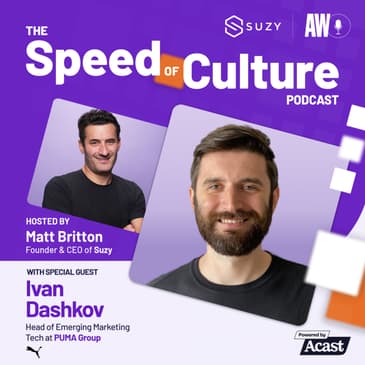
In this episode of The Speed of Culture, Matt sits down with Ivan Dashkov, Head of Emerging Marketing Tech at PUMA Group to explore the evolving landscape of digital innovation in the fashion industry. They discuss the profound impacts of virtual and augmented reality, the rise of digital fashion, and PUMA’s exciting new partnership with Meta.
Follow Suzy on Twitter: @AskSuzyBiz
Follow Ivan Dashkov on LinkedIn
Subscribe to The Speed of Culture on your favorite podcast platform.
And if you have a question or suggestions for the show, send us an email at suzy@suzy.com
Hosted on Acast. See acast.com/privacy for more information.
[00:00:00] I'm Sandra and I'm just the professional your small business was looking for.
[00:00:03] But you didn't hire me because you didn't use LinkedIn jobs.
[00:00:06] LinkedIn has professionals you can't find anywhere else,
[00:00:09] including those who aren't actively looking for a new job but might be open to the perfect role,
[00:00:14] like me. In a given month over 70% of LinkedIn users don't visit other leading job sites.
[00:00:19] So if you're not looking on LinkedIn, you'll miss out on great candidates like Sandra.
[00:00:23] Start hiring professionals like a professional. Post your free job on linkedin.com slash people
[00:00:29] today. Since 2013, Bombas has donated over 100 million socks, underwear and t-shirts to those
[00:00:36] facing homelessness. If we counted those on air, this ad would last over 1,157 days.
[00:00:43] But if we counted the time it takes to make a donation possible, it would take just a few
[00:00:46] clicks because every time you make a purchase, Bombas donates an item to someone who needs it.
[00:00:51] Go to bombast.com slash a cast and use code ACAST for 20% off your first purchase.
[00:00:56] That's bombast.com slash a cast code ACAST.
[00:01:28] In the social media realm, visit viralgrowth.io and use code ADWEEK that's ADWEEK all lowercase
[00:01:35] and get 10% off your plan. Yeah, I think the vision or the future is really AR glasses where they can
[00:01:44] kind of project right onto the lens. And I think that's like the technology is going to take off.
[00:01:47] So who knows? That's not going to be two years from now, five years from now,
[00:01:50] or 10 years from now when that's going to be viable. But when you have like a light pair
[00:01:53] of glasses that you can actually have something on the lens that kind of gives you directions
[00:01:56] or as if it acts like I overlay your real world environment, I think that's going to be the aha
[00:02:00] moment for a lot of people. To thrive in a rapidly evolving landscape, brands must move in an ever
[00:02:07] increasing pace. I'm Matt Britton, founder and CEO of Suzy. Join me and key industry leaders as we
[00:02:13] dive deep into the shifting consumer trends within their industry. Why it matters now
[00:02:17] and how you can keep up. Welcome to the speed of culture. We're live here at Commerce Week
[00:02:27] in the Adweek podcast studio in New York City and freezing New York City today.
[00:02:31] And we're thrilled to be joined by Ivan Dashkov, the head of emerging marketing tech at Puma Group.
[00:02:36] Ivan's responsible for Puma teaming up with Meta for a VR experience that captures the smallest
[00:02:40] gym in the world. Can't wait to hear more about that. Ivan, great to see you today.
[00:02:44] Yeah, thanks for having me. It's going to be back in New York. I lived here for six years,
[00:02:46] so I love coming back. I always get about 10 pounds when I come back because I just keep
[00:02:50] going to my food spots. And where are you based out of? In Boston,
[00:02:54] North Shore, right in the water. Okay. Very cool. So tell me, I know you launched
[00:02:58] this partnership with Meta. What do you feel about the future of VR in general? I mean,
[00:03:04] it's such a polarizing thing. I was just talking to some of my colleagues before this
[00:03:07] about the new Apple device, their VR device. And some people love it and then some people
[00:03:12] are saying, oh, everyone's taking it back. Where do you see that space going overall?
[00:03:16] Yeah, I think overall, I think the space is growing. Like if you look at Meta's
[00:03:19] headset sales, I feel like they're just keep going up and up and up. And obviously,
[00:03:22] Apple has brought so much attention to the space themselves. And you see all these kind of like
[00:03:26] funny memes of people like walking down the street or driving cars, wearing their Apple Vision Pros.
[00:03:30] So I think that's bringing a lot more attention to the space. I think the space is interesting.
[00:03:34] Like there's a lot, a lot of stuff that's happening that's bringing more people into
[00:03:37] the space. Meta has his new game, Ask Ars Rath 2, that's got incredibly high reviews
[00:03:41] from all the video game reviewers. So that's bringing an audience too. But for me,
[00:03:45] I think the vision or the future is really AR glasses where they can kind of project
[00:03:50] a lens. And I think that technology is going to take off. So who knows, that's not going to be
[00:03:54] two years from now, five years from now, 10 years from now when that's going to be viable.
[00:03:57] But when you have like a light pair of glasses that you can actually have something on the lens
[00:04:00] that kind of gives you directions or has different apps that kind of overlay your real
[00:04:04] world environment, I think that's going to be the aha moment for a lot of people.
[00:04:07] Yeah, we had Shahar Scott, who's the head of Meta Reality Labs on right before the
[00:04:11] holidays. And she convinced me about these new Ray-Brand glasses that came out and I bought
[00:04:15] them for the entire exec team. And I can tell you that then going on vacation with my family,
[00:04:20] they provide a great utility. And I could see what you're saying in terms of
[00:04:24] the form factor of Ray-Brand glasses on your already wear means that you don't have to
[00:04:28] change any consumer behavior. And then if you have an overlay where it provides a real
[00:04:32] utility where you can take pictures, see what's going on, see what you're looking at,
[00:04:36] I do think with some type of AI integration, that could be something that could be pretty
[00:04:39] powerful. Definitely. And the space has been evolving too. I remember when Snapchat Spectacles
[00:04:43] came around too, we were using it when I used to work at the NBA getting content there.
[00:04:47] So it's a fun space that's going to continue evolving and maybe one day it's
[00:04:50] going to replace the iPhone. Who knows? Yeah, who knows? Yeah, it'll be interesting.
[00:04:53] So let's talk about Puma. You've been there for five years. Puma is an interesting brand.
[00:04:57] I think if you look through our history, definitely had its peaks and valleys. It's
[00:05:02] not a company like Under Armour who had its challenges and arguably never recovered.
[00:05:06] And it's not Nike who was like a rocket ship, right? It's a company that has kind of ebbed and
[00:05:10] flow with culture. Today, how would you describe the Puma brand? What are the brand pillars that
[00:05:15] make it different and where are you hoping to take the brand moving forward?
[00:05:18] Yeah, it's been a fun journey for me being at Puma for five years. I think
[00:05:21] we had a new CEO come in. He helped turn the company around. We had Usain Bolt.
[00:05:25] He helped turn the company around. Rihanna came in, had some big collections that kind
[00:05:28] of made us culturally relevant. It's been really fun being at Puma because it almost feels
[00:05:33] like a startup in some ways. Every year since I've been there, it's been our best year ever.
[00:05:36] Not because of me, but I'll take some credit. But we're like continually growing and you see
[00:05:40] the company going to different spaces. And I think right now we're very focused on making sure that
[00:05:46] we're credible in the performance space. So we completely redid our running shoes about three
[00:05:49] years ago. We have some really high quality running shoes now. If you go to YouTube and
[00:05:54] you look at running reviewers, they absolutely love our shoes and give us a lot of credibility
[00:05:57] there. We're getting more and more market share in football, in European football. We're doing
[00:06:01] a strong job there. Basketball we relaunched about five years ago. And I think we've done a great job
[00:06:05] at basketball, like kind of finding our niche and how we kind of want to communicate ourselves.
[00:06:09] Because I think some of the other brands that are very established and if we just kind of copied
[00:06:13] their marketing, I don't think we would have succeeded. But we kind of came in with a different
[00:06:16] perspective. And I think that's given us some space in basketball that a lot of people didn't
[00:06:20] expect us to kind of grab before. Yeah, it's interesting. Frankly, it was a bit surprised
[00:06:23] to hear you say you're leaning to the performance side. There's this dichotomy
[00:06:26] in the sneaker space where you're either a lifestyle fashion brand or you are a performance
[00:06:32] brand. And some brands like Nike have been able to straddle both with their Air Jordans
[00:06:36] being in the popular lexicon, but also obviously on the court. Yeah, we were too focused on the
[00:06:40] style space for a long time. And that's obviously still like a huge part of our business. So it's
[00:06:45] not like we're transient though, right? It's not that staying power if you're just on that side.
[00:06:49] Exactly. We're not pivoting away from that. But I think we just need to make sure that
[00:06:52] we're also established in the performance space. We have credibility there because I
[00:06:55] think that's actually going to help our more like sports style collections as well.
[00:06:58] So if you're going into performance space, just curious, what are your thoughts on
[00:07:02] all the evolution with college athletics and the name interest likeness deals? I mean,
[00:07:06] do you think ultimately it's a good thing for your category and how are brands
[00:07:10] like Puma looking at that opportunity? Yeah. I mean, before Puma, I was a sport
[00:07:15] media majoring in college. This is something I kind of studied and looked at a lot. And
[00:07:18] I always thought that college athletes should be paid and should be making revenue based
[00:07:22] on how their likeness is used. So personally, I think it's a great move and a welcome shift.
[00:07:26] We've had some NIL deals in the basketball space especially. I think that we've had some
[00:07:30] great successes there. So it's pretty fun that we can kind of work with some younger athletes
[00:07:34] and kind of use their personalities and partner with them. So for us as a brand,
[00:07:38] we've experimented there, but we will continue to experiment there.
[00:07:40] Absolutely. And when you look at just Puma in terms of building the brand,
[00:07:43] so you obviously have your endorsement deals with athletes and you want to
[00:07:47] actually see them on the field or on the court. And then obviously we'll
[00:07:50] talk about some of the brand deals that you're doing like the meta deal that we mentioned.
[00:07:53] And then there's obviously you partnering with retailers and making sure... So
[00:07:57] how's that side evolving in terms of the digital versus in-store mix with the distribution of
[00:08:04] your products? Yeah, for me, one of my biggest focus is building our digital goods business.
[00:08:08] So it's like, how do we get digital Puma goods on our consumers avatars when they're
[00:08:12] playing Roblox or they're playing Full Diet or they're playing any other these other games?
[00:08:16] Or with Meta, we actually, with the first sportswear brand to be featured in their
[00:08:19] avatar store, the first brand in general to use their new diverse body features as well.
[00:08:24] Because people are spending more and more time in these digital environments and
[00:08:27] culture is happening in these digital environments. If you look at Fortnite,
[00:08:30] all these concerts that are happening, same thing in Roblox, more and more concerts
[00:08:32] are happening there too. So there's a convergence between culture and gaming.
[00:08:37] And now we need to be in that space because we want to be where culture is happening.
[00:08:41] So we've done a couple of great Roblox activations and we have I think over four million
[00:08:45] Roblox digital goods that consumers have claimed and are wearing these games,
[00:08:49] which is great to see that like these young consumers are actually taking Puma products
[00:08:52] and wearing them in their Roblox experiences. And at what point do you have to straddle the line
[00:08:56] between being cutting edge or bleeding edge, meaning like we're in a broader macro and
[00:09:02] economic environment, which is some days good, some days not so good. Obviously I'm sure
[00:09:06] your company like every other is pressured to show ROI and spend. So when you do things
[00:09:11] that are more edgy or non-traditional digital goods or doing something in VR or AR,
[00:09:18] is it harder to sell that through and how do you look at tracking ROI for something like that?
[00:09:22] I think for digital goods, it's an interesting one because there are opportunities that are
[00:09:27] just marketing based where we do something in Roblox and it's more because Roblox has a huge
[00:09:32] young demographic that we really want target. But there's also these other games that are
[00:09:36] looking for brands like Puma to kind of give them credibility. So we actually work with them
[00:09:40] and do licensing deals or do deals where we'll do revenue shares on the product sold.
[00:09:44] So it's actually also building a revenue share for us. So kids will pay to wear
[00:09:49] custom branded Puma shoes in a Roblox environment. Yeah, but I feel like people are so focused on
[00:09:54] kids that sometimes they don't think about these other games that might be like 35 or
[00:09:57] four-year-old like female demographic. That's completely different. Yeah, no, you're right.
[00:10:00] It's actually good. Yeah. So I think there's a lot of different opportunities out there and
[00:10:04] for us, it's like finding all these different opportunities and some of them we're not
[00:10:07] going to make money off. We're just kind of doing it there for the marketing,
[00:10:09] but some of them kind of makes more sense to us to do kind of revenue share deals
[00:10:12] or licensing deals and us to be in those environments. And it gives us like a double
[00:10:16] benefit, right? Because we're still getting marketing from it, but then we're also kind of
[00:10:19] building a new revenue stream. Yeah. So as head of emerging marketing technology,
[00:10:23] obviously you are looking at these new streams and making sure that your brand
[00:10:27] is where the eyeballs are gravitating towards how did the partnership with Meta come about?
[00:10:31] Talk to us about how a partnership like that gets established. How did you land on
[00:10:34] the actual idea and how was it brought to life? We've obviously had a relationship
[00:10:38] with Meta for a long time because of Instagram and our Facebook. As an advertiser.
[00:10:42] Correct. And also like organically. So we've built that relationship and I used to be the
[00:10:46] head of social. So I kind of had some of those ties there. And then this opportunity kind of came
[00:10:50] up to be featured in their avatar store. They were looking for a sportswear brand and again,
[00:10:54] we're kind of building our digital goods business. So our interest kind of aligned
[00:10:57] there and we launched there. And I think we just had a really good partnership with them.
[00:11:00] We enjoyed working with them. We enjoyed our meetings. And that was like the first
[00:11:04] project and that one went really well. Their executives are very happy with it.
[00:11:08] So then they had this second project they wanted to do where they were kind of focused on the German
[00:11:11] market and kind of getting people to actually try on VR. So they were talking to us because
[00:11:15] obviously we're a German based brand as well. So we came up with this idea of doing the world
[00:11:20] smallest gym and the idea is you just put on a VR headset and you could do this,
[00:11:23] some of these different workout apps. Is that idea that you came up with in your team
[00:11:27] at Puma or did you collaborate with Meta on the concept? Collaborate with Meta on it.
[00:11:30] We built these like small little pods that people can kind of step into. They were
[00:11:33] co-branded Puma and Meta. People could try on the VR headset and work out in our Puma flagship store
[00:11:39] and then a couple of big shopping centers in Berlin. And it's been a really nice success.
[00:11:42] I think both Meta is happy with it. Puma is happy with it. We're looking for other places that
[00:11:46] we could potentially bring the workout pods to. And it's open some other doors at Meta for us
[00:11:50] too that we're talking about potentially doing some other activations with that are still
[00:11:54] a little bit CBD. We'll be right back with the speed of culture after a few words from
[00:11:57] our sponsors. So is it...
[00:12:31] I'm Sandra and I'm just the professional your small business was looking for.
[00:12:34] But you didn't hire me because you didn't use LinkedIn jobs. LinkedIn has professionals you
[00:12:39] can't find anywhere else, including those who aren't actively looking for a new job but
[00:12:43] might be open to the perfect role like me. In a given month over 70% of LinkedIn users
[00:12:49] don't visit other leading job sites. So if you're not looking on LinkedIn,
[00:12:52] you'll miss out on great candidates like Sandra. Start hiring professionals like a
[00:12:56] professional. Post your free job on LinkedIn.com slash people today.
[00:13:28] Awesome. And guess what? Working you up with a sweet deal. Use code ADWEEK for 10%
[00:13:33] off when you sign up. Ready to take your social media game to the next level?
[00:13:36] Head on over to ViralGrowth.io and let's turn those digital dreams into a reality.
[00:13:41] Actual like physical space you enter or you're just wearing a headset and you just make sure
[00:13:47] that you don't like punch somebody accidentally when you're trying to work out.
[00:13:50] That's like an actual physical space that we built out actually like a really gorgeous
[00:13:54] design but you kind of go in there. There's a couple of little demos that you do
[00:13:57] where you're working out and it also kind of creates a little social video for you
[00:14:01] that you can do at home and post on your Instagram channel if you want.
[00:14:03] And I imagine when the activation like that, it's also as much about how do you take this story
[00:14:08] of what you're doing and scale it and connect it to your brand through social and other channels.
[00:14:13] That's equally as important as the amount of people that actually physically touch and feel
[00:14:17] the space which is somewhat limited by just the physicality of it.
[00:14:20] We brought in Dennis Schroeder from our side one of our basketball ambassadors.
[00:14:23] That's also German so that was the great person kind of bringing in great
[00:14:26] bastard Briggan. He did a couple of videos for us that actually did really well on social.
[00:14:29] I think one of them got over 20 million views.
[00:14:30] I actually saw one organically or really.
[00:14:32] Yeah, before he even knew this interview was happening.
[00:14:34] And then Metta obviously has so many great relationships with influencers,
[00:14:37] graders, so they brought in a few of theirs that they've worked with in the past.
[00:14:40] We brought in a few ours that we worked with in the past and we had a really
[00:14:43] great kickoff event that produced a lot of great content from it.
[00:14:46] That's awesome. And before you were at Puma, you spent six years at the NBA
[00:14:50] which would be a dream job for me. I'm a huge basketball fan.
[00:14:53] How do you get a job at the NBA? Because so many basketball fans, they would love to work there.
[00:14:58] How did you land that role? Well, the NBA kind of reminds you of that too.
[00:15:01] They're like, hey, we'll have 5,000 people ready to take your job tomorrow.
[00:15:04] But it was funny. It was the early days of social media and I really wanted to work in sports
[00:15:08] PR. So I actually applied for this role. I got the role and I was like, oh, cool.
[00:15:12] Like I'll do this for a year then maybe I can sneak into the PR department.
[00:15:15] You applied for a role at the NBA. Yeah.
[00:15:16] So you just sent in your resume and they hired you and you didn't know anybody?
[00:15:19] So I was actually a Boston Celtics intern in college. So that's the real, right?
[00:15:23] And then also we had LeBron's former publicist speak up my college as well.
[00:15:27] So I built a little bit of a connection with him. So I got recommended from...
[00:15:30] I think that's an important... The reason I'm asking that is we have a lot of younger
[00:15:33] listeners here at Spina Culture and trying to figure out how to get that dream job.
[00:15:37] And I think a misconception some people have, especially with what I think is a little
[00:15:41] bit of an entitled generation Gen Z which is like, oh, I worked hard. I have a great resume.
[00:15:46] I'm going to send it in. I should get the role. And I have kids that are late teens now
[00:15:50] that are thinking about internships and I'm telling them you have to go get it.
[00:15:54] And you have to find that right point of experience. So how did you intern the Boston
[00:15:59] Celtics? How did you get in there to begin with?
[00:16:01] So our college had a good relationship with the head of HR. So I got an email one day for my
[00:16:06] advisor and he was like, hey, they're looking for an intern. Like you're from Boston.
[00:16:09] Like do you want to do this? And I'm like, hell yeah, I want to do this.
[00:16:11] But even before that I worked at Walkins Glider International which is a small race
[00:16:15] track in upstate New York. I was a media center volunteer there that led to my Boston
[00:16:19] Celtics media relations internship and then also that connection with LeBron's former
[00:16:23] publicist. It's funny, I did dinner with him a couple years ago at an All-Star game
[00:16:27] and we were kind of talking about like that moment. And he's like, yeah, there was like
[00:16:31] you and this other guy that like were following up with me but then he fell off and you kept
[00:16:34] following up with me. That's what happens. And then when that role came up and you asked
[00:16:38] me to like recommend you, like I was like, hell yeah, I know this guy. So it was kind of
[00:16:42] important to kind of keep up that connection and kind of you gotta figure out like the right
[00:16:45] amount of times to follow up because you don't want to like be like 100%
[00:16:49] But you also don't want to fall off either. Yeah, I mean, but it's so much the case with
[00:16:53] so many opportunities that it's just a war of attrition. Just like I can tell you running
[00:16:57] a startup so many competitors at launch when Suzy launch are gone and maybe their
[00:17:01] product wasn't as good. Maybe it was, but just the founder just didn't want to deal with
[00:17:05] the headaches that COVID brought on or uncertainty in funding or whatever. And
[00:17:09] eventually just people just start to fall off and you're like, oh wow,
[00:17:11] we're the only one left standing. And it's very much how you succeed.
[00:17:15] Sometimes you just keep trying until you get it right. So you're at the NBA and I know that you
[00:17:20] help there as well identify lots of partnerships with companies like Reddit and Snapchat, etc.
[00:17:26] How are you as professional? Now obviously, fast forward to today as well, able to keep
[00:17:31] your finger on the pulse of emerging trends to know this is where things are going.
[00:17:36] This is a new platform coming out that we need to test out. How do you personally spend your
[00:17:40] time in terms of the information you consume that you think puts you in that position?
[00:17:43] I'll say it was probably a little bit easier when I was younger and I was 23, 24 and I was
[00:17:48] using Snapchat every day. My friends were using Snapchat every day and I was like,
[00:17:51] well, this is what people are using and this is what we should be jumping onto.
[00:17:55] So that's kind of how it happened with some of those platforms. I was
[00:17:58] on NBA Reddit, I still am on NBA Reddit every single day kind of seeing what's
[00:18:01] happening in the league. So I was like, we should be here. This is where our
[00:18:04] core fans are. This is like their clubhouse. So we want to be kind of engaging in
[00:18:08] that clubhouse. The Snapchat one's funny because I had to sell that internally and
[00:18:13] you're talking to these older executives and they're like, isn't this like a sexting platform?
[00:18:16] Right.
[00:18:17] Like why are we like this?
[00:18:18] Even Reddit had a lot of bad vibes early on.
[00:18:20] Of course. Yeah. I mean all these platforms have obviously gone through
[00:18:22] their different scandals.
[00:18:24] Some still are immersion scandals.
[00:18:26] Yeah, for sure. I mean they all really are.
[00:18:28] So it's kind of like an interesting place to kind of navigate but luckily with the league,
[00:18:31] like they're, this is always kind of stuck with me. For example, like when YouTube came
[00:18:35] along, the NBA didn't take down its highlights when people were posting
[00:18:38] highlights and the other leagues did. And then it was like, this is basically like
[00:18:41] free marketing for us. Like people are watching these clips and getting excited
[00:18:44] about NBA basketball. And now like all the leagues kind of allow people to put
[00:18:48] up highlights across all these social platforms.
[00:18:49] Yeah, they're giving them control.
[00:18:50] Yeah.
[00:18:51] These are the NBA stood for nothing but attorneys.
[00:18:53] Exactly.
[00:18:54] That's what I heard. So I guess eventually they had to relinquish some of that control
[00:18:57] if they wanted to be relevant.
[00:18:57] But in the social space, they're very progressive and really like kind of
[00:19:00] let people play with it and kind of help own the brand. I think if you look at
[00:19:03] like the NBA social following, a part of their success was because they really kind of let go,
[00:19:08] control, kind of let this community evolve around the NBA itself. Like NBA Twitter is
[00:19:12] one of the biggest Twitters out there too.
[00:19:13] Yeah, absolutely. I think the younger generation consumes sports by the song
[00:19:18] versus the album meaning they follow the players, not the teams. Obviously we've
[00:19:22] seen an explosion of fantasy sports and gambling for better or worse,
[00:19:25] which is infiltrating our society. So I think it's changed fandom in general
[00:19:29] and people are much more focused on the highlights and the clips than full game,
[00:19:32] especially younger consumers.
[00:19:33] Yeah, if you look at ratings, like NBA ratings are, I think probably be better in my opinion,
[00:19:38] but if you look at how many people are digesting social media clips of the top
[00:19:41] plays or watching condensed games, it's incredible. People love NBA content and
[00:19:46] it's kind of interesting. Almost what's happening around the NBA,
[00:19:49] like off of the court is almost eclipsing what's happening on the actual on-court
[00:19:53] action itself.
[00:19:53] Yeah, I mean you have a lot of players like Drey Mon Green starting podcasts
[00:19:57] and JJ Reddick and people who are on the inside. So I think when I was growing up,
[00:20:01] you didn't really have that type of access to players besides the awkward
[00:20:06] interviews after the game when they're sweating next to the reporter,
[00:20:08] but now you really can get so much access and they're talking all the time about
[00:20:12] what's really happening.
[00:20:14] Yep, and one really interesting thing that I think helped shift this culture to
[00:20:18] the time was so controversial, but when David Stern did that dress code policy,
[00:20:22] had players dress up and actually kind of vaulted these players into fashion icons
[00:20:27] and made really kind of like those tunnel walks more like runways where people
[00:20:31] are like showing off the latest fashion. Now you see every brand is trying to get
[00:20:34] like a basketball player to kind of wear their latest gear in these tunnels because
[00:20:38] that's where a lot of fashion culture happens.
[00:20:40] Yeah, you look at Beats headphones which ended up getting acquired by Apple and
[00:20:44] they'll tell you it was both the Olympics and those fashion walks like you said.
[00:20:47] When they showed up in China, they all came off the airplane wearing Beats.
[00:20:50] Absolutely.
[00:20:50] Like that was one of the biggest parking moments for them.
[00:20:53] Absolutely. So shifting gears a little bit to, you know, here at
[00:20:56] Commerce Week shout out to Adweek for access to this great Adweek podcast studio.
[00:21:00] Ecommerce has changed over time, continues to change.
[00:21:03] Amazon is now selling retail media so they're trying to get their piece of the pie.
[00:21:07] Google's changing with the advent of AI.
[00:21:09] You have platforms like TikTok are leading in the social selling as a brand who I'm sure
[00:21:14] makes e-commerce at the top of its list in terms of something to think about the drive
[00:21:18] growth. Where do you see those trends in the world of commerce?
[00:21:21] Yeah, I think for us like we want to obviously continue building our DTC business and that's
[00:21:25] been something that we focused on these last five years but I think there's still
[00:21:29] like such a big opportunity working with these big wholesale partners and that's
[00:21:32] still such a large part of our business. So for us, it's to continue working with
[00:21:35] being good partners, evolving with them and I always tell these partners like we
[00:21:39] want to be a guinea pig. We want to be the beta test partner.
[00:21:41] Like if you want to try something new, call us.
[00:21:43] Like we'll figure it out. We'll work with you. Think of us in that way.
[00:21:46] Awesome. So wrapping up here Ivan, you've had an awesome career and you're
[00:21:50] obviously very much in the middle of it. You kind of stole the thunder a little bit
[00:21:53] by talking about some of the lessons you've learned in your career in terms of
[00:21:56] not giving up, being aggressive, focusing on what you want and really going for.
[00:22:01] Are there any other pieces of advice you can give to some of our younger listeners in terms of
[00:22:05] making the right decisions earlier in your career to set yourself up to be in a position where
[00:22:08] you're on a lay, where you're on stage at Commerce Week and here talking with me about
[00:22:12] very cool stuff that you're doing with companies like Meta?
[00:22:15] So I think there's like this backlash against grind culture which makes sense.
[00:22:18] Yeah.
[00:22:18] I think like people working 70-80 hours a week that's crazy but
[00:22:22] you know in those early days at the NBA when I was 22, 23 and I had no responsibilities.
[00:22:26] Right. That's what you want to do it right?
[00:22:28] Like that's what I did it like my first NBA job I was literally making $20 an hour living in
[00:22:32] New York City. Like it was-
[00:22:34] Probably having the best time ever.
[00:22:35] Yeah it was so much fun.
[00:22:36] Yeah living in a shoe box.
[00:22:37] No pun intended.
[00:22:39] There was no heat in my apartment. Like that's how crazy it was back then.
[00:22:42] But I grinded it out. I got to do all these like awesome crazy partnerships with
[00:22:46] Snapchat. We know we worked and did these, I mean what's like every All Star game,
[00:22:50] you know met every single basketball player like got a lot of like cool things that I got to do but
[00:22:53] I also made so many great connections and built such a great network that I went like an opportunity
[00:22:57] to become the head of social at Puma. That was my first job at Puma. Like came up,
[00:23:00] I got it and then I brought in all this like wealth of knowledge of how to build a great
[00:23:04] social team for my experience at the NBA. And then I- It was funny because like Puma social
[00:23:08] was so early back then and I just kind of came in with like some simple learnings that I have
[00:23:14] from the NBA. Right.
[00:23:15] Bringing that in there completely transformed Puma social and made me look like a rock star
[00:23:18] or a Puma. Right.
[00:23:19] So kind of grinding it out there early kind of helped me succeed at Puma and now I think
[00:23:24] it's a little bit of the opposite where it's like I always used to think like I would give
[00:23:27] like 110% how like good that is but like now I feel like it's better to kind of do a little
[00:23:31] bit less and focus on a few big projects instead of trying to do way too many things.
[00:23:35] Because if you're giving like 110% across 10 projects versus 90% across
[00:23:39] three projects, like you're probably going to do better with the three projects than
[00:23:42] you would with the 10 projects.
[00:23:43] Also as you grow in your career, I'm sure leading a team, recruiting and retaining
[00:23:48] talent is also a huge part of your success.
[00:23:49] That's the big thing too. Like a lot of people are afraid to bring in talent because
[00:23:52] it might make them seem redundant but I was very lucky with my hires at Puma.
[00:23:56] They came in and they were all rock stars and they've all gone on to do amazing things
[00:24:00] at Puma or in other places too.
[00:24:02] So that made my life so much easier when I was like, oh I could just trust this
[00:24:05] person to do their job but I don't need to overlook with their shoulder.
[00:24:08] That frees up me to do other things too.
[00:24:09] Absolutely. So to wrap it up Ivan, is there a mantra or something that you live by and
[00:24:12] any kind of good sports analogies you're going to throw at me?
[00:24:15] Puma pays my bills like I say forever faster.
[00:24:18] In a band, you always got to move forward. You always got to push down below.
[00:24:20] Well we are on the Speed of Culture podcast so it fits really well with us.
[00:24:23] That's perfect.
[00:24:23] Thanks so much for joining and taking time of your busy schedule here in New York
[00:24:26] to speak with us today, Ivan.
[00:24:27] Thank you. This is awesome.
[00:24:28] Absolutely. On behalf of Susie and AdWee team, thanks again to Ivan Dashkov,
[00:24:32] head of Emerging Marketing Tech at Puma Group for joining us today.
[00:24:35] Be sure to subscribe, rate and review to Speed of Culture podcast on your
[00:24:37] favorite podcast platform.
[00:24:38] Until next time, see you soon everyone. Take care.
[00:24:46] The Speed of Culture is brought to you by Susie as part of the AdWee podcast network
[00:24:50] and Agath Creator Network.
[00:24:52] You can listen, subscribe to all AdWee's podcast by visiting adweek.com
[00:24:56] slash podcast.
[00:24:57] To find out more about Susie, head to Susie.com
[00:25:00] and make sure to search for the Speed of Culture
[00:25:02] in Apple Podcasts, Spotify and Google Podcasts
[00:25:05] or anywhere else podcasts are found.
[00:25:07] Click follow so you don't miss out on any future episodes.
[00:25:10] On behalf of the team here at Susie, thanks for listening.
[00:26:10] Here's the show that we recommend.
[00:26:20] Hi, I'm Ando and I'm Fer and we host Niña Vin Podcasts.
[00:26:24] We want to invite you to listen to our show.
[00:26:26] Niña Vin means good girls in Spanish but you have to know that this is not a
[00:26:30] podcast for good girls or for girls at all.
[00:26:33] It is a comedy podcast so everyone is welcome to listen.
[00:26:36] We talk about sex, relationships, technology.
[00:26:39] We recommend movies and TV shows and discuss pop culture in general.
[00:26:43] And there is Chidmejeno too.
[00:26:45] A section we have just to gossip about everyone
[00:26:48] so you'll find something you like here
[00:26:50] and you'll practice your Spanish.
[00:26:51] The cleanest Spanish you'll find, we promise.
[00:26:54] And if you already hablas español,
[00:26:56] vamos a hacer tus nuevas amigas.
[00:26:58] We'll be your friends for the non-Spanish speakers.
[00:27:00] New episodes every Monday and Thursday.
[00:27:03] Hosted by Agast and available to all audio platforms.
[00:27:12] Agast helps creators launch, grow and monetize their podcasts everywhere.
[00:27:18] Agast.com