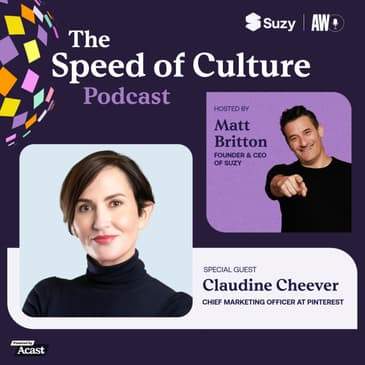
This episode of The Speed of Culture podcast welcomes Claudine Cheever, the Chief Marketing Officer at Pinterest. Claudine outlines how the platform is evolving from a space for major life projects to a daily companion for shopping and creative inspiration. She details the importance of the intention economy, the role of visual search in fostering human curiosity, and why encouraging users to step away from their screens instead of going deeper into it is actually a winning business strategy. The conversation also examines her career journey through the world of advertising and her perspective on radical ownership as a leadership superpower.
Follow Suzy on Twitter: @AskSuzyBiz
Follow Claudine Cheever on LinkedIn
Subscribe to The Speed of Culture on your favorite podcast platform.
And if you have a question or suggestions for the show, send us an email at suzy@suzy.com
Hosted on Acast. See acast.com/privacy for more information.
[00:00:00] We really think that the new thing now is intention, which is really that idea of making these deliberate choices. So we're really set up for advertisers to help them participate in the intention economy, which is again these highly considered purchase considerations, highly considered brand loyalty, really developing these deeper relationships. To thrive in a rapidly evolving landscape, brands must move at an ever increasing pace. I'm Matt Britton, founder and CEO of Suzy.
[00:00:27] Join me and key industry leaders as we dive deep into the shifting consumer trends within their industry, why it matters now, and how you can keep up. Welcome to the Speed of Culture. Up to him, the Speed of Culture Podcast. We're thrilled to welcome Claudine Cheever, the Chief Marketing Officer of Pinterest. Claudine leads Pinterest global marketing, creative, and communications, helping shape how the platform shows up as a trusted, positive, and intent-driven place to discover and shop.
[00:00:57] Claudine, so great seeing you today. Thanks so much for joining the podcast. It's a pleasure being here. I'm looking forward to this. We're big fans of Pinterest at the podcast and have had great interactions with your team over the last several years. And for those that are listening right now that don't know the state of Pinterest today, how the platform has evolved over the years, we'd love to hear from the horse's mouth, so to speak, how you would describe it. Well, Pinterest has always been a platform for inspiration.
[00:01:23] And over time, as we've had more users, and also our users have aged down, or more than half of our users are Gen Z now, we've gone from a place to go for really big projects, which we still are, you know, like your kitchen renovation and planning your wedding shower or planning a vacation to also just daily projects, shopping missions, small journeys of inspiration. And so we like to think of it as big C creativity and little C creativity.
[00:01:50] And the platform and the technology have evolved over time to really make that journey from inspiration to action easier, more discoverable. And so that's really become a shift. And also over time, 96% of our searches are unbranded, and over half of them are commercial and intent. And so increasingly, users are coming to us as a place to go shopping. You know, if you think of what's happened to e-commerce, e-commerce has made the internet an incredible place to buy things,
[00:02:19] but it's sort of sucked the joy of shopping out. Very transactional, right? Yeah, exactly. It's very transactional, which is awesome for a lot of things and for a lot of use cases. But one of the things that we've done, I think, really well over time is brought back that joy of shopping when you're in a digital environment. Yeah, it's interesting. If you look at low involvement categories like you're looking for a drill or a hammer or even like deodorant or toilet paper,
[00:02:44] you kind of know the brand you want or in the case of a tool for your tool shed, you don't really care what the brand is. But when you're thinking about how you express yourself, how you can design your home or your life, that's kind of when you do care. And I think it's interesting to make that dichotomy in terms of the consumer journey. Yeah, 100 percent. We'll often, you know, on our X, Y grids and we're plotting stuff out, we'll often have things like utility and joy was one of the through lines, too, because some people find different things. You know, my husband might disagree with you on the drill thing.
[00:03:14] He might actually he might actually want to do a lot of research on the drill that he buys. But in my life, it's kind of like what's on subscribe and save? Maybe I'm just not as handy as them. Yeah, like dog food. Do I ever want to think about buying my dog food? No, I never have to think about it because it comes every two weeks or whatever automatically. Yeah, it's interesting to climb because Pinterest for a very long time was kind of bucketed into this broader sort of social media category.
[00:03:39] Right. Along other companies like Facebook and Instagram and Snap and TikTok, et cetera. But Pinterest is really different because the way I look at it is it kind of has this counter positioning where it's really about getting you offline and helping you live your life offline versus other platforms, which I think are meant to kind of suck you into the scroll. And love to hear about why you think that positioning is impactful moving forward, just given how culture has evolved.
[00:04:07] Well, you know, Matt, it's one of the reasons I came to the company was for that differentiation. I thought it was so sharp and so unique. And it really is about not how much time you spend on the platform. And when you think of all of us are in the business of monetization and attracting advertisers. And so in some ways, the more time someone spends, I get to serve a lot of ads. But we think of it as time well spent. And so one of the key differences in Pinterest is you come here and as a user, you have agency.
[00:04:36] You usually have a mission in mind or a spark or something you want to do versus you're looking for passive entertainment. And so that sort of state of mind is how we've really built the platform. And we've also really built the platform to really help you develop your taste and what you care about. And often when we're on social media, we're kind of being told what other people are into. And that's what we should be into. Esquire had a great article a few months ago, like, do I even know what I like anymore?
[00:05:05] You know, the sort of feeling of, wait, is that brand hot or is this brand hot? And Pinterest, there's a little bit of this privacy almost to it where I can really figure out what it is that I want and what I like. And so in some ways, that really goes against being social, although you share your boards. And my husband and I, I always say Pinterest saved our marriage because we have so many shared project boards where we can arrive at a decision together. So it's this very selective community you might want to create with. What kind of decisions would you use it for?
[00:05:32] Tell me. I'd love to hear, like, give me a use case, either personally or professionally. New Adirondack chairs for the yard. This could be a highly debated subject in some decisions. For some people, just pick the chair. But do we want modern? Do we want Rusket? Do we want this size table, that size table? And so we ended up picking a pair that we liked and then we bought them and it worked out great. We've been in this house for 10 years. We still haven't furnished the entryway. We have like four boards now on what that entryway might look like. So we're going to make a decision.
[00:06:00] But it's how we both of our tastes together and kind of figure out what it is that we like by having lots and lots of examples. It's interesting when you talk about this, the echo chamber in terms of personal taste, because I was in an event a couple days ago in Hamptons and I swear every single woman there was wearing basically the same exact thing. And they probably all follow the same influencers. And it does become this sort of echo chamber. And I think you're right. We are at risk at losing our view of individualism.
[00:06:27] I think for a long time, youth culture had this sort of paradox between the need to fit in and the need to express yourself. And I think we still feel as individual. And I still think that still exists. But the more and more time people spend on their phones, the algorithms are meant to sort of reinforce whatever it is everyone else likes. And it does risk sort of pulling you away from that sense of individualism. I totally agree. And I love that insight, Matt, that age old, you know, we sort of say only young people go through that stage.
[00:06:57] But I think you're absolutely right. I think, in fact, social media has maybe kept us all in that state of insecurity much longer than we would have been otherwise. So I love that. Yeah. I mean, I think people have a need to fit in. So that's why brands matter. That's why you have communities and traditions, because people want to feel like they're a part of something, but not to the extent that they're just sort of like a cog in the machine. No, 100 percent. And, you know, that's one of the nice things about our platform is it really you develop your taste over time.
[00:07:26] And then sometimes when you see something that's surprising you like that often is that like, ooh, I could like that. I might like that and that discovery. But when you see one black T-shirt, you don't really know what kind of black T-shirt. But if you see a thousand of them over a period of time, you're really, really going to know this is my style of black T-shirt. And you can make that choice with confidence.
[00:08:16] No matter how old we get. Right. Yeah, absolutely. Absolutely. And one thing I've noticed about Pinterest relative to other technology, consumer technology platforms, publishers, social platforms, et cetera, is that Pinterest has really prioritized sort of like the real world experience. I remember first interacting with Pinterest at an event at CES. I was just blown away by your brand's ability to sort of bring it to life in a physical way.
[00:08:40] And I know there's been many different activations that you focused on, one of which is this really cool phone free Coachella activation, as well as the Pinterest Manifestival. Tell me why real life matters for a digital company and how that's positively impacted your brand in ways that maybe others have not experienced going down this route. I love this question.
[00:09:02] And sometimes it can strike one as counterintuitive to think, OK, all of us as marketers, whether we're marketing a digital platform or not, have to spend a lot of time with our consumers in the digital surface areas. So why should I tell them to not be there? But the reality is when you're helping someone make decisions with intent, that's going to have a positive impact on their life. If it leads to an offline interaction, that is the ultimate feeling of productivity and satisfaction.
[00:09:30] So someone leaves having made a real decision that's going to impact their real life. And so they leave feeling like I just moved my life forward. And then if you spend a lot of time in a digital platform, you didn't decide anything, you didn't do anything, nothing materially changed except that some time passed. We find that you tend to leave feeling drained and you tend to leave feeling like you just wasted your time. We have research saying that Gen Z increasingly are saying the time they spend on social media feels like a waste of time.
[00:09:58] And so we believe that as brands, if we can really help customers feel like they spent their time well, then that actually is really commercial and also really contributes to user well-being. And user well-being, actually, when people are in a positive state of mind, they tend to make better commercial decisions. So it's kind of good for people, good for business is how we think about it.
[00:10:18] I mean, do you think we're going to look back 20 years from now at this era when people were sharing their lives and this gloom of the crater economy, et cetera, and say that was a fad or a phase of culture? What is going to stick, do you think, from this current era of people obsessed with their phones and this sort of vortex of people being pulled into? I love that question. And I think it's figuring out where the borders are, right? And I think we will look back and sort of look at our screen time.
[00:10:45] We'll have artifacts of like screen time sort of graphs of how much time we spent. And I think you mentioned Coachella and Manifestable. And I think that's one of those ways that we suggest to our users and to people in general, hey, where might you set some boundaries? And just play with the boundaries, you know, with itself. And so Coachella, we asked everyone to put their phone away at the most mobile phone documented event of the year. And we doubled our earned media. And so you entered our space. And I came into this job with that decision baked and done.
[00:11:15] And I loved it because it was bold. It was provocative. It was risky. And I was like, damn, I came to the right place. I'm going to love these people. And it was incredible how successful it was and how much it really drew people. It really drew crowds. We had lines for people waiting to get inside. And then, of course, they came in and they got makeup and they got sparkles. And everyone would ask them, where did you get that done? And so we had this incredible word of mouth. And then, again, we had all of this earned media.
[00:11:41] Just by having people, when they experienced the brand, they were highly, highly engaged. And they weren't trying to capture it and they weren't trying to do selfies. They were fully immersed in the experience. So they left with this memory structure of their Pinterest experience. And hopefully they didn't put their phones on in the concert. So the concerts, they left with really deep experiences. And then Manifestival is the same way. It's really a physical manifestation of what our users are doing on the platform. And it's great for both the advertisers to see.
[00:12:10] But also we are open to the general public. So, you know, we'll have a long line of attendees who just want to come and participate in the activities we have that are really reflective of that online creativity. Yeah, it's so interesting because it is counterintuitive that having an event with no phones would gain you double your media. But I like the notion of people walking around and saying, oh, where'd you get your makeup done? And it's sort of like mystery makes history sort of thing. I love that. Yeah. Yeah.
[00:12:35] You know, and you see like a lot of the private members clubs in New York adopting this sort of no phone policy. And I do think it's going to be more and more effective, especially in the age where I think a premium is going to be put on human in the age of AI. And I think we set a record now being what, 15 minutes in this podcast before I mentioned AI. So that is a record. Yeah, I think while we're talking about your brand really carves out a unique space. But that being said, AI is going to and probably already has a massive impact on your business.
[00:13:04] To me, the biggest impact AI is having from a consumer standpoint is that for the first time in 25 years, the Internet really has a new front door. Like consumers would go to Google to find nearly everything. And now when I speak at conferences about AI around the world, 85 percent of people at least versus maybe 20 percent of just a year ago are saying that they now use AI in the place of a traditional search engine where they would have used a search engine as recently as just a year ago.
[00:13:30] So I have to imagine that has a massive impact in terms of your consumer journey and the expectations that your users have of Pinterest. A hundred percent search is, as you said, it's up for grabs like never before, which is 12 to 14, you know, two years ago would have been unthinkable. And I think one of the things that we found is that our platform is really a place for visual search, because sometimes when you go to more of like a Gemini or something, you're talking to it basically.
[00:13:56] So you have a sense of like, you know, I was wondering about X, Y, Z. But when you come to Pinterest, you may not even know yet what it is. You just sort of have the spark of an idea. And so it's really that visual search is what we find is really a great experience for our users. And actually, the human brain absorbs visual information so much more quickly than words. And so you'll be clicking and you'll be going down a little rabbit hole of an idea that you have or a color you're pursuing or a look you're pursuing.
[00:14:22] And so that visual search, and that's really how our algorithms are trained, is just all of these rich. And these are all internal signals from our 631 million global users and years and years and years of data of people developing their personal taste. So all of that is then serving up to you these images, and then you keep refining and you keep curating. So I think all this multimodal search is really exciting. And there are two ways.
[00:14:48] One way you do it is you let all the technology do the work for you and you sit back. And I kind of miss the links and the left and right turns and the weird results that Google gave you, because you kind of discover something new that you didn't even think about. And you might just go down this wonderful and random. And remember when they even had the like surprise me on the results, they even encouraged you. Now it's like there's no more curiosity. Like here's your answer. Done and dusted. And you come in and you go. It's built around efficiency. It's better on trying to save people and make them more efficient.
[00:15:18] Exactly. But if you look at the maybe the greatest artists or musicians of our time, they probably wouldn't call themselves efficient. A hundred percent. I'm waiting for some performance artists to make like a search engine that just messes with you. Just to sort of like an answer, an answer AI that just messes with you to sort of keep that mental resilience going. You know, just keep that curiosity going. Because again, it is really efficient. And either you choose to go deeper or you get your answer and your go, right? You make a choice. We'll be right back with the Speed of Culture after a few words from our sponsors.
[00:15:48] So you mentioned, Corrine, one word that I want to pull out is taste. And I think obviously as AI learned our tastes and anticipates our needs, I think it's increasingly it's going to make decisions alongside us. But like what part of, I guess, consumer choice do you think has to remain distinctly human moving forward or will based upon just what makes us being living human beings special? I think taste is part of human development. It's a fundamental part of figuring out who you are.
[00:16:17] And I think it's one of the reasons why we have so many Gen Z users, because they're truly trying to figure out their identity and who they are and they feel that they're in a safe place. And so to me, it really is. And you think of Maslow's hierarchy of needs, which nerds like us love to reference. Self-actualization is the highest human need. And a lot of developing your taste is self-actualization. And the terms like self-expression are so bankrupt, but I truly think that's what it's about.
[00:16:43] It really is about this figuring out who you are by how you show up and the things you want to surround yourself with and then how you want to spend your time. And that's why we really believe that that taste graph, the human element is so important, because it's also important for our young people to develop confidence and to develop in a healthy way and to develop a good outlook on life is about developing taste. It's really not superficial. It's really a fundamental, important part of growing up.
[00:17:11] And I love looking back at myself when I was in college and think, oh, my God, did I really wear that? Like we can all look back on our journey with shame, but it's still part of who I am. It's still those choices I made are still part of who I am, unfortunately. So we've talked a lot today about the consumer and obviously consumer culture and how huge revolutions like AI are changing things and what's going to change what remains the same.
[00:17:31] We'd love to shift gears a little bit about the advertising side, because obviously you as CMO are driving consumers to adopt this platform ultimately for the sake of a business model. What are advertisers increasingly looking for on the platform and what are some of the more effective ways that you're partnering with brands? We are definitely a full funnel platform in terms of you can come to build that top of mind awareness and build brand.
[00:17:55] And then we're increasingly a much more powerful performance platform where we're really driving that decision that customers are making. We think, you know, one point seven five billion monthly outbound clicks to advertisers. We don't have a shop within the store. Our job really is to get people out to make that purchase once they've made a decision. And that's becoming an increasing part of the behavior. We're also really, really good at the messy middle. And I've talked to so many CMOs and in my former role, it was like, we're great at brand.
[00:18:25] We've got performance. But man, the middle is tough. And that middle journey of discovery, of curating, of deciding, we're excellent at that. We're really good at developing that middle marketing journey. And so we find that a lot of advertisers are seeing a lot of success with us figuring out that middle mile or that middle funnel marketing. So it's really a full funnel approach that you can take with the platform, depending on where and how you want to engage your customers. And do you find that education with brands?
[00:18:55] Because the Pinterest platform has evolved over the years and it's one of the OGs now in the space that you live in. And it's continuing in education about the platform and how it kind of collides with where the consumer is evolving to a big part of the storytelling of the brand. It is. There's kind of like two vectors. One is sort of updating them if they haven't used us in a while that we're really much more about this daily shopping inspiration companion.
[00:19:17] And then the second one is really around the benefits of being in front of a consumer that has agency and is in a positive state of mind and is in discovery mode and is looking for brands. They're not scrolling past them. They're looking for them. So part of that education of, OK, this is the state of mind of the customer that you're going to encounter. And so that becomes a really great story to tell, to sort of refresh advertisers who might not be on the platform every day about really the purpose that we serve.
[00:19:46] Yeah, because there's just so much noise in this space right now, right? And everyone's shouting in advertisers and it's all about carving out a space of differentiation, which certainly sounds like you're doing. I forgot to mention one other thing because I love what you said about the noise. And I feel like there's kind of like a trend that everyone catches on. And I remember a couple of years ago, it was attention. It's like it's not about reach. It's not about frequency. It's not about impression. It's all about attention. And how can we measure attention and going through my media plan and readjusting it by attention?
[00:20:13] And we really think that the new thing now is intention, which is really that idea of making these deliberate choices. And so we're really set up for advertisers to help them participate in the intention economy, which is, again, these highly considered purchase considerations, highly considered brand loyalty, really developing these deeper relationships. So that's kind of what we're also really educating advertisers on is the intention economy. Especially if you're playing in higher involvement category, decision making, right?
[00:20:40] I think attention works if it's like just clickbait, so to speak, right? Like you can kind of grab attention, like a car crash is good attention, right? But it's fleeting. People eventually drive by and go on with their day. And I think the intention generally has some type of staying power and probably has a much higher likelihood of converting at the bottom of the funnel. 100%. Yeah, exactly. So we'd love to, as we wrap up here, talk a little bit about your career journey.
[00:21:05] At the beginning of your career, you worked at sort of like a who's who of big advertising agencies from Ogilvy to Goodby to McCann, the Saatchi. Incredible firms, obviously. And one benefit, as someone who has spent a lot of time in the ad industry myself, is that you get to work across multiple categories, which I think is really interesting versus just being kind of tunnel vision. I couldn't agree more. Yeah. What are some of the other takeaways and what are some of the other benefits, I guess, to starting on Madison Avenue on the earlier parts of your career journey? Yeah.
[00:21:35] I just want to double down on that, Matt, first. Like, the joy of the portfolio is so real. And it was such an important part of my career development because you have to go so fast. And you remember, like, you have to move fast. You have to educate yourself on a client's business really quickly. The context shifting instantly, going from auto to, like, Oreos within the same hour. Yeah. But how fun, right? Like, oh, my God, how lucky were we all, you know, just doing that. And so that absolutely is part of it. And then for me, it's also was really developing my skills as a storyteller.
[00:22:05] And really, you know, I was a planner. Planning to me is still just a wonderful dark art that I love. And I love planners and have some on my team. And it really was finding that essential story. The through line for me is the human brain has not changed. You know, our attention spans actually are we're not goldfish. We just make decisions quicker. We pay attention to things that we care about. And we absorb information through stories and pattern recognition. And the stories are what, you know, what point of view do we have that we engage with? Is there tension? Is there emotion?
[00:22:34] And then does it look like the brand? Does this look like Pinterest? You know, and is this a recognizable brand? Do I pick up on the pattern recognition? And then differentiation. I mean, I loved the journey of finding differentiation. And it's one of the reasons I came to Pinterest is because it is so differentiated. It is such a great advantage. It is such a great advantage to getting our sort of unfair share of the attention and of like the stories that we want people to talk about. So that's really been a through line in my career.
[00:23:03] And then really staying close to brands and companies that really put the customer first. You know, if you look at my through line, then Amazon and now Pinterest, it's really that obsession with the end user, that obsession with the customer and what's really going to help them make their lives a little bit easier, better, more meaningful, more healthy, more positive. And of course, you spent nearly 10 years at Amazon. When you look back on your time there, what are some of the biggest takeaways as to maybe why that company has become a generational company and so very successful?
[00:23:32] Like, what are some of the takeaways from the culture and just how they operate that you want to take with you as you move on? I think it's their willingness to put the customer first and the relentlessness and the constant sort of dissatisfaction with, are we doing it well enough? Are we doing it well enough? And that juxtaposition of the sort of tenacity with this ultimate care for the customer, I think has just been really healthy for them. And also having a very clean point of view that they're there to bring, make people's
[00:23:59] lives a little bit easier and better and never wavering from that point of view. And I think that carries over in what I was attracted to in Pinterest is this place that's full of creativity and inspiration, but this courage to do really big and bold, provocative things to make sure that that space remains safe. You know, thinking when we decided that we were going to encourage kids to turn off their phones during school time and not use a platform or 16 is under and under is mandatory private.
[00:24:27] Some of these decisions impacted this stock price temporarily because the market didn't really like that we did them, but we believe they were the right things to do. So I think that conviction and that tenacity alongside this real care for the customer is something that has tracked me in both. And I think that really creates longevity in the company. Yeah, for sure. I love that. So to wrap up here, I'd love to hear from you when you were back in your career journey. What are some of the decisions that you think you made right along the way, whether it's
[00:24:55] a skill set or just a general practice that you undertook on a consistent basis to put yourself in the position to one day end up in the CMO seat where you are today? I think it was definitely early on figuring out what my superpower, like what I was really good at as an individual contributor, kind of. This is what I do. This is kind of when I'm in the zone. And then I think really becoming a manager and becoming and really, I think at Amazon and now at Pinterest, developing as a leader of people that becomes like more and more
[00:25:25] of the job as you get more senior and less and less about doing your thing. And so really going on that journey, which is a whole other thing that, by the way, nobody is natural at it. And some people are better at it than others. And you have to learn how to do it. You have to practice at it. And then I think maybe one of the things that I made at the time was painful and difficult I look back on now is going from the creative side to the media side. And I think we might have met when I was working in media when we first met. I went from Saatchi and Saatchi, yeah, to MediaVest and went and worked for Laura Desmond, who's
[00:25:55] still an incredible friend and mentor. I mean, she's the best. And that was about, OK, ad tech and all of that in the digital world was exploding. And so just the learning that I got there around measurement and around true incrementality was such an important part. I would not be the well-rounded marketer I am today if I hadn't gone from the creative side over to the media side. And then I think going into Amazon when they didn't have strong brand marketing and being able to build. So go to places where you can build things, which means it's going to look messy and
[00:26:24] kind of like an ugly piece of fruit when you walk in. You don't want to go where it's already perfect, where you like already like everyone else. Like you want to go where, oh, there's a gap here and not everyone is like me. And there's something I actually have to add and contribute and build. I think that's been a big success factor for me, too, is identifying sort of those opportunities. For sure. And obviously, it's not always clear when you're diving in like it is maybe in the rearview mirror. You have to have conviction. You have to be OK with bumpiness along the way. Yeah, absolutely.
[00:26:53] So finally, Claudia, we ask our guests always to wrap up the pod if there's a saying or mantra that's helped sort of encapsulate their professional journey today. Just what comes to mind for you? Oh, my God. I am such a like somebody's old uncle with full of sayings, but I'm going to go with we are the ones we are waiting for, which I think was last sort of used by President Obama. And what I like about it is it really reminds people what ownership is. Ownership isn't I get control and I get credit. Ownership is I have a problem. I'm not going to wait. I'm going to go fix it.
[00:27:23] I'm going to just take on the gap that nobody wants to walk into. I'm going to go in there and try and figure that out. I'm going to basically not accept the thing that we've all learned to accept. And so I think that spirit of ownership is something I really try to inspire in my teams and really try to take on myself. So I'm going to go with that one. I love that. I mean, I think it's about accountability and I think it's so easy to point fingers or find an excuse, but I've actually never heard of that quote before. And I know Obama is obviously an incredible speaker.
[00:27:52] And it doesn't surprise me that quote came from him, but I'm going to take that one with me as well. I really like that. It's fantastic. Awesome. That's great. Yeah. As for this interview. So thanks so much, Claudine, for taking time out of your busy schedule to share with us your journey at Pinterest. And I can't wait to see what's next for you as you continue to make your impact and marks on the brand. Thank you. This was really fun. It was great seeing you again, Matt. Likewise. On behalf of Suzy and Adelie team, thanks again to Claudine Cheever, the chief marketing officer of Pinterest for joining us today.
[00:28:19] Be sure to subscribe and review the Speed of Culture podcast on your favorite podcast platform. Until next time. See you soon, everyone. Bye-bye. The Speed of Culture is brought to you by Susie as part of the Adweek podcast network and A guest creator network. You can listen, subscribe to all Adweek's podcasts by visiting adweek.com slash podcasts. To find out more about Susie, head to susie.com.
[00:28:45] And make sure to search for the Speed of Culture in Apple Podcasts, Spotify, or anywhere else podcasts are found. Click follow so you don't miss out on any future episodes. On behalf of the team here at Susie, thanks for listening.