
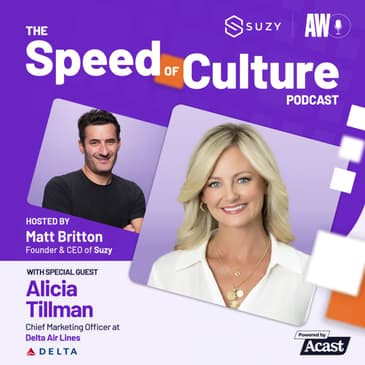
In this episode of The Speed of Culture, host Matt Britton sits down with Alicia Tillman, CMO of Delta Air Lines. They discuss the importance of core consumer expectations, the future of experiential marketing in engaging modern consumers, and how Delta continues to innovate and lead in the aviation industry.
Follow Suzy on Twitter: @AskSuzyBiz
Follow Alicia Tillman on LinkedIn
Subscribe to The Speed of Culture on your favorite podcast platform.
And if you have a question or suggestions for the show, send us an email at suzy@suzy.com
Hosted on Acast. See acast.com/privacy for more information.
[00:00:00] Hey there, are you ready to elevate your personal brand or company? Meet Viral Growth, your one-stop
[00:00:05] shop for video content and audience building. Imagine growing your brand organically on social
[00:00:10] media without the hassle of editing videos for hours. With Viral Growth, it's a breeze. They
[00:00:15] handle the brainstorming, scripting, and editing while you simply just hit record. And don't worry
[00:00:20] about your niche. They cater to everyone from business and marketing to health and wellness.
[00:00:25] Are you ready to make waves in the social media realm? Visit viralgrowth.io and use code adweek,
[00:00:30] that's A-D-W-E-E-K, all lowercase, and get 10% off your plan.
[00:00:37] As a marketer, when we understand that we have the ability to best position our brands,
[00:00:44] to be able to tell stories that are relevant and resonate, and use what we know about our
[00:00:48] consumers, be it how they're buying or where they're buying or how they're learning
[00:00:52] to shape technologies that will in fact be ones that they want to attach themselves to.
[00:00:59] To thrive in a rapidly evolving landscape, brands must move at an ever increasing pace.
[00:01:03] I'm Matt Britton, founder and CEO of Suzy. Join me and key industry leaders as we dive deep
[00:01:09] into the shifting consumer trends within their industry, why it matters now,
[00:01:12] and how you can keep up. Welcome to the Speed of Culture.
[00:01:22] Hey everyone, this is Matt Britton. Today we are thrilled to be here at the shiny,
[00:01:26] amazing headquarters of Delta Airlines here in Atlanta, Georgia with Delta Chief Marketing
[00:01:31] Officer Alicia Tillman. Alicia was recently named by Forbes as one of the most influential CMOs
[00:01:36] in the world. She's a well renowned expert in the field of marketing. I have regard
[00:01:40] and I'm just so excited to have this conversation today. It's great to see you.
[00:01:43] I am as well, Matt. Nice to see you.
[00:01:45] Absolutely. So, you know, I'm sure way back in the day when you started your career,
[00:01:49] you probably didn't imagine that one day you'd be here in Atlanta running the marketing for
[00:01:53] Delta Airlines. Walk us back to the steps that you took to get you here in a very high level.
[00:01:58] Of course. I dreamed I'd be here but sometimes like, well, I dreamed that I would be in
[00:02:03] a really strong influential consumer brand.
[00:02:07] Why?
[00:02:08] Always from the start of my career, I've appreciated storytelling. So how do you take
[00:02:14] product or service or an idea within a company and how do you tell it to people? How do you
[00:02:21] share it in a way where it's going to compel them to want to attach themselves to you?
[00:02:27] And so I think there's so much creativity in storytelling and even though I spent a large
[00:02:32] part of my career in B2B, which I'm so thankful that I've had that opportunity.
[00:02:37] Yeah, we'll get into that.
[00:02:38] Yeah, I mean taking it now just primarily into consumer, even though we service a fair
[00:02:45] number of business travelers certainly as well here at Delta, it's a dream come true.
[00:02:50] It's a beautiful company, beautiful culture and just super thankful to be here.
[00:02:55] Absolutely. And you cut your teeth so to speak by spending a while at MX looks like
[00:02:59] eight, nine years there. Tell us about that experience and what some of your key takeaways
[00:03:03] were from.
[00:03:04] Well, I always like to say that I feel like I learned how to be a marketer at one of the
[00:03:08] best marketing brands on earth with American Express. If we think about membership and
[00:03:15] access and just this whole-
[00:03:17] Being data driven.
[00:03:18] Data driven, premium focused. And how do we really build premium experiences that attract
[00:03:27] brand loyalty and AMEX is a real leader at that. And so my time there was spent largely
[00:03:35] on the travel services side of the business, but also a lot from a corporate perspective,
[00:03:41] membership, strategy, innovation. My time at AMEX was when digital started as a
[00:03:48] department in organizations.
[00:03:51] Before we became a layer to everything, right?
[00:03:52] It is the foundational layer for how we operate as a world.
[00:03:57] So things like social media and website communities that bring people together, these
[00:04:03] things were all just emerging when I was at American Express.
[00:04:06] If it even exists. I mean, when you started AMEX, there was no iPhone. There was barely
[00:04:10] YouTube, Facebook-
[00:04:11] They're making me feel very old.
[00:04:12] Well, I came out around the same time as you. And I think what's interesting with
[00:04:17] people like you and I who came out in the early 2000s in our career is the amount of
[00:04:21] transformation that we've witnessed and had a front row seat for. It was a completely
[00:04:25] different world. And I bet people coming out today are going to say the same thing
[00:04:29] in 20 years with a fast-paced movement of something like AI.
[00:04:32] So it's just keeping pace. How have you been able to keep pace with these changes
[00:04:36] as an individual? Because you wouldn't have had the success you've had if
[00:04:40] you kind of were static the way that you thought.
[00:04:43] Well, one of the things that I am always been a very curious person. So I studied
[00:04:49] a lot. I love understanding the emerging consumer and how are they learning differently?
[00:04:56] How do they think about purchase decisions? How do they communicate? How do they
[00:05:00] collaborate? And that changed a lot, as you were saying in the early 2000s.
[00:05:06] We were trying to think about how to fit into our businesses, things like technology or
[00:05:13] digital or social media, etc. Now if we think about some of the generations that are
[00:05:19] going to soon be in the workforce, think about Gen Alpha. Those are our 12 to 18 year olds
[00:05:24] or even Gen Z, which are kind of 19 to 25 year olds. These are generations that
[00:05:31] there's lots of things to know about them. Number one is, I mean, they're almost kind
[00:05:35] of born with a cell phone attached to them. How they communicate it's entirely over
[00:05:41] digital means how they learn is by watching videos on YouTube or TikTok. And certainly
[00:05:51] how they buy is become emotional and the emotional part of that, the other side that
[00:05:56] I study quite significantly is these are generations that have been raised within
[00:06:02] a crisis. So if we think about terrorism and a global pandemic and all the financial crisis,
[00:06:09] all the geopolitical challenges that we've had almost in every nation across the world,
[00:06:14] it's a very anxious culture. It's a very uncertain culture. We see it in certain
[00:06:18] behaviors like building equity and saving money. This is not a generation that believes
[00:06:24] necessarily in homeownership. They believe in our YOLO, right? Yeah, like I want it when
[00:06:29] I want it. And when I move on, I want to be able to do that in a very fast pace.
[00:06:35] Mental health as well, right? Mental health and how that really weighs on people's emotions in
[00:06:42] terms of how they buy. I mean, nearly 50% of all buying decisions today are emotionally driven
[00:06:48] decisions. And a lot of it is because of things like what people are carrying from
[00:06:53] a mental health perspective. Absolutely. They want to attach themselves not only to people
[00:06:58] in their lives, but in terms of brands to those that they can trust are going to bring
[00:07:03] them a sense of security and stability. And so all of those things are what's so compelling
[00:07:11] and inspiring to me because as a marketer, when we understand that we have the ability
[00:07:18] to best position our brands to be able to tell stories that are relevant and resonate
[00:07:23] and use what we know about our consumers, be it how they're buying or where they're buying
[00:07:27] or how they're learning to shape technologies that will in fact be ones that they want to
[00:07:32] attach themselves to. Absolutely. I mean, you raise a great point because if you think about
[00:07:35] Gen Xers that grew up in the 80s and 90s, it was largely a period of global prosperity. Yes,
[00:07:40] there was the Cold War, but it never got to the point with some of the geopolitical conflict
[00:07:45] we're seeing today. And it was a peaceful time and there was no social media. So it's not
[00:07:51] like it was perfect, but it certainly wasn't as volatile as the time that millennials and
[00:07:56] Gen Z are growing up in. And understanding that being consumer first, as you put it,
[00:07:59] allows you to have much more empathy, I would assume in terms of storytelling,
[00:08:03] connecting with that audience. And it also, it didn't happen as often as it happens today.
[00:08:07] Oh man, yeah, totally. It was so much more, I mean, I think back to when we were like little,
[00:08:12] little kids and when an act of terrorism or something like it happened, it was shocking
[00:08:21] to people. It was unexpected. And today, sadly, it's when it's going to happen,
[00:08:29] not if it's going to happen. And so that's a fundamental shift too. And we sadly not only
[00:08:36] see it here in the US, we see it in so many parts of the world. And we see it instantly.
[00:08:42] In graphic detail that they didn't in the past, there's no filter for it.
[00:08:45] There's no filter. And you're exactly right. On one hand, technology has been a great thing
[00:08:51] because it's helped us be more efficient. But on the other, it just gives us a view into the world
[00:08:56] that is no question. We're human. So we carry a lot of emotions with us. And when you see
[00:09:04] devastation happening in any part of the world, we know that it's friends, it's neighbors.
[00:09:09] It's just simply people that we care about that should have a life the way that we do.
[00:09:15] And it's one of the beauties of the generation that's coming in.
[00:09:19] It's not that any generation that's preceded them has thought any differently.
[00:09:23] It's just that they've grown up with more transparency to it. It's a very purpose-filled
[00:09:28] generation. They want to live in a world that is more equal. They're investing that way.
[00:09:34] When they think about brands, they want to invest in brands that they know,
[00:09:39] feel and believe have a responsibility to give back to their communities. That's a big driver
[00:09:43] of brand attachment. And that's a great thing about the generations that are coming in.
[00:09:49] And it's just another thing we need to think about as marketers in terms of how we shape our
[00:09:54] brands. That's a whole other layer. You said you just about your unique selling proposition,
[00:09:58] your price, and now there's so many other factors when crafting that brand story.
[00:10:02] And that's what I loved when you asked me about my journey. And I started with storytelling,
[00:10:08] the greatest stories that as an avid reader with my nose in a book on the beach along
[00:10:14] the Jersey shore growing up, I always found myself most immersed in stories that had so
[00:10:20] many different dimensions associated with them. Because it really does show the kind of complexity
[00:10:26] that the world is. And when you can pull that together and kind of really draw a conclusion
[00:10:32] or help you navigate your path forward, it's a really great thing. And I've always found myself
[00:10:38] loving complexity. And when you can extract out of that real meaning, real purpose and ability
[00:10:45] to put yourself on a path. And I think that that's what every company needs. Every company
[00:10:49] is complicated. Every time I'm anywhere, I'll say, how are you doing? Oh, it's so busy.
[00:10:53] We've got so much going on. There's not a company on the planet that doesn't have that
[00:10:57] same emotional feeling. And I think for marketers, we are at the forefront of being able to sort
[00:11:04] of distill that complexity into something that is really meaningful, really relevant,
[00:11:10] really purpose filled so that a customer can find themselves attaching themselves to it.
[00:11:15] Absolutely. And it's interesting because after your stint at Amex, you had a great run at SAP,
[00:11:21] which as we were briefly talking about, is a different animal in itself. It's an enterprise
[00:11:26] software company. You're marking to companies, not consumers though, I would argue that
[00:11:31] companies are made up of individuals. I'm curious to hear your thoughts on the distinction,
[00:11:36] how it was similar to consumer marketing, maybe how it was different and what some of
[00:11:40] your learnings were from your time at SAP. I think my experience at Amex on the consumer
[00:11:45] side is what helped me excel at SAP for the exact reason that you just said.
[00:11:51] Yes, in B2B, you're selling to a decision maker of technology within a company. Right.
[00:11:58] But because of how much evolution has happened in our world, people want to have a voice.
[00:12:04] They want to have a say. Those decision makers need to take on board so much more what the
[00:12:11] end user wants, what their feedback is. And so I led marketing at SAP and I've always said,
[00:12:20] you need to think like a consumer, but you need to make sure at the same time,
[00:12:24] you're appealing to what the decision maker of that technology wants. And on one hand,
[00:12:30] they're looking for technology that's going to help their companies run more efficiently
[00:12:35] and more effectively. At the end of the day, that's ultimately what you're looking at
[00:12:40] corporate technology for. But at the same time, that technology has to deliver an
[00:12:45] exceptional service for the users of it because that's what the end user cares so much
[00:12:50] about. So it is and needs to be such a beautiful mix of both customer service and how well it
[00:12:58] helps the individual do their jobs better, but it also has to speak to the buyer in terms of
[00:13:04] the more B2B types of stories, which is about cost savings and efficiencies and all of those
[00:13:12] types of things. And when you can marry the two, you have a great combination where it
[00:13:16] becomes a win-win not only for the decision maker, but you're also helping her or him
[00:13:23] message also to their consumers, which helps them with their jobs because they're trying
[00:13:28] to make sure that they're delivering technology that their consumers are going to appreciate.
[00:13:33] So if their supplier can support them in the quest, then it becomes a win-win for everybody.
[00:13:38] Absolutely. And when you make a decision to leave an American Express where you're
[00:13:42] obviously on the fast track and you're getting promoted and you're getting new roles to go to a
[00:13:47] place like SAP or any jump that an executive might make when they're in the upswing of their
[00:13:52] career, what goes behind that decision? Who do you take counsel from and what are some of
[00:13:57] your learnings from making those transitions? Well, it's such a great question because
[00:14:02] I believed I was going to be at American Express for the rest of my life. I married
[00:14:06] myself to the brand and every day I worked to sort of elevate our brand and evolve it
[00:14:14] into the places that we wanted to go to and the people that we wanted to associate our brand
[00:14:20] with. And so I had this amazing opportunity to move into technology, to move into another
[00:14:26] industry. I'd been at American Express at this point for 11 years and I thought, okay,
[00:14:32] financial services, consumer, B2B at AMEX. And it was also in the early part of my career journey.
[00:14:40] I had been through so many different roles that I was so thankful of. I had so many firsts
[00:14:45] really helping to build the first digital strategy for the company.
[00:14:50] And then I had some personal life milestones as well. I got married, I had kids. And so
[00:14:54] then I had this opportunity come my way to lead a business line for marketing for one of SAP's
[00:15:03] business units. And I thought timing will never feel right, but what did feel right was
[00:15:09] what I had felt like I had accomplished at AMEX to now allow me to expand, to learn about
[00:15:16] an industry that I had yet had experience in. And so even though there's always going
[00:15:21] to be a fair bit of sadness of what you're leaving behind, I felt more excited about
[00:15:26] what I could take with me from American Express to enable me to now think about success in a
[00:15:32] new industry that I'd be able to learn. Right. To tap into that sort of curiosity
[00:15:37] that I've always possessed and be able to sort of build something now extraordinary for SAP.
[00:15:43] We'll be right back with the speed of culture after a few words from our sponsor.
[00:15:52] Meet Viral Growth, your one-stop shop for leveling up your online presence. Whether you're a
[00:15:57] personal brain or a company, they've got the tools and know-how to take you to the next level.
[00:16:02] With Viral Growth, forget about those endless hours of video editing. They handle everything
[00:16:07] from brainstorming to polishing your content so you can just focus on being awesome.
[00:16:11] And guess what? We're hooking you up with a sweet deal. Use code ADWEEK for 10% off when
[00:16:16] you sign up. Ready to take your social media game to the next level? Head on over to
[00:16:20] viralgrowth.io and let's turn those digital dreams into a reality.
[00:16:25] So moving on to present day, we're here at Delta Headquarters as I mentioned, and
[00:16:28] you've been here a little over six months. What's it like to take on a role as CMO of
[00:16:34] an iconic brand like Delta? And what does the first six months look like on the job?
[00:16:39] Well, I will have to say, I mean, I not only took on this new role, but we also moved to
[00:16:45] Atlanta. So there was- Right, personal too.
[00:16:47] Personal and professional. And so it would not be right for me to say that I didn't have
[00:16:52] a certain level of fear. Everything's changing in your life. And you think, okay, well,
[00:16:59] if I'm going to take a leap, I hope that I get it right. I hope the company is
[00:17:05] everything that I believe it to be and more. And I will say Tim Mape and Ed Bastion
[00:17:12] and Joanne Smith, leaders here at Delta, they had said to me, hey, if you like what you see now
[00:17:19] from the outside looking in, just wait till you get on the inside. And they could not be more
[00:17:26] right. I am continuously humbled, number one, that I'm in this role because this is an
[00:17:33] extraordinary culture. I think it's absolutely a best-in-class culture for a few fundamental
[00:17:37] reasons. I mean, yesterday we just celebrated our annual profit sharing day, which happens
[00:17:43] every year on Valentine's Day where we award a portion of our profitability to every single
[00:17:49] one of the 100,000 people- That's amazing.
[00:17:52] That we have across Delta. So not only does every single employee at every level get to
[00:17:57] share in the profits, they get a piece of that that they can take home with them.
[00:18:03] But the investments that we make in learning and recognition, these are programs that I've seen
[00:18:09] most companies cut out years ago. Any period of turmoil or change and costs need to be extracted-
[00:18:16] Yeah, COVID would have been a great excuse for the company to pull the profit sharing
[00:18:20] program. And this is the beauty of Ed Bastion
[00:18:22] and his vision and his leadership. He is an absolute believer that the more you can create
[00:18:28] a really healthy culture that we're investing in people, the more that they are going to bring
[00:18:34] this authentic level of experience to our customers. And whenever I come in contact with
[00:18:41] someone who's a customer of Delta, they always light up and want to tell me about a great
[00:18:48] service experience they had or how much they value and believe in our product. And they too
[00:18:54] speak to the culture because the quality of the product, the quality of the service,
[00:18:59] they know is at the heart of how much we as a company are investing in all of those things.
[00:19:04] And I'm blown away. I will say the very first day I started, I was definitely
[00:19:10] that new kid feeling really anxious and will I be accepted and will I be embraced? And I had
[00:19:17] my whole team here waiting to welcome me and recognize me. And it was just such an amazing
[00:19:24] feeling. And we've just continued as a team to think about what are we delivering and can we
[00:19:30] be more efficient with that? How do we continue to tell the great story of what we know to be
[00:19:35] the culture of Delta? And then where are there sort of new and innovative ways that we can
[00:19:40] think about how Delta shows up in the lives of our customers? And those are some really
[00:19:45] fun and innovative things for us to think about. Yeah, I mean, obviously you inherited
[00:19:50] a great brand but obviously you're going to be putting your own stamp on it and taking the
[00:19:53] learnings that you had at some of the past experience we've talked about and try to
[00:19:57] elevate the brand and take it to new heights, which I know you will. What are some of those
[00:20:00] things that you hope to accomplish here in 2024 and beyond to evolve the brand and keep it
[00:20:06] pushing forward as a leader in the marketplace? One of the things that I think we have an
[00:20:10] opportunity for is how do we continue to show up in places that matter for the Delta customer?
[00:20:19] So our first and foremost obligation that we have, which is the core of our business,
[00:20:26] is we've got to get our customers from point A to point B. We need to do that safely.
[00:20:30] They need to have a clean and healthy experience associated with that. And we
[00:20:34] always got to make sure their bags are right. It's like the hierarchy of needs, right?
[00:20:37] It's the hierarchy of needs and how do we continue to perfect that? And there's always
[00:20:43] work to do. We are continuously investing in our operation every single day and we will never
[00:20:49] stop because that is, at the end of the day, the first and foremost reason why our customers
[00:20:56] need what they're depending on us for. In addition to that, when we start to think about
[00:21:01] brand evolution, there is so much about this notion of building a lifestyle brand
[00:21:08] and dissecting what that means and how that translates into other opportunities that we can
[00:21:13] offer. We spend a lot of time focusing on the benefits that we bring to our SkyMiles members,
[00:21:20] our loyalists, if you will. We're always innovating on what are the very core
[00:21:26] airline loyalty benefits that we can bring. There's another component that we've begun to
[00:21:33] introduce over the past year. We introduced free Wi-Fi as a benefit for our members.
[00:21:38] Just use it this morning. Thank you.
[00:21:40] And free Wi-Fi also helps to unlock these new content experiences that we're introducing
[00:21:47] on personal devices, as well as in flight with organizations such as Paramount Plus and
[00:21:52] Walmart Plus and Atlas Obscura and Rezzy. These are all very unique experiences that we are now
[00:21:59] offering as a benefit to our SkyMiles members as well. The third and more emerging component of
[00:22:05] that is creating this experiential layer that we can bring to our members. That is one
[00:22:13] that I am paying particular attention to architecting for us, which is essentially
[00:22:20] what are these experiences that we can bring to our members? One such opportunity that we
[00:22:27] introduced in the second half of last year, we introduced what we called our Window Seat Shop.
[00:22:33] This was a pop-up retail experience that we introduced at JFK right before the holiday
[00:22:39] season kicked off. We curated products from local artisans in priority destinations that Delta
[00:22:46] flies all over the world. And we sold them in this pop-up store, in addition to these products.
[00:22:52] And it was Think Pottery from Brazil, Think Liquor Making Kit from Madrid, very unique
[00:23:00] variety of price points. We also created these experiential packages with some of our
[00:23:05] sponsorship partners. So Madison Square Garden, New York Knicks, we did this pregame shoot
[00:23:10] around, we did courtside seats, we paired it with dinner reservation at Carbone, which is still
[00:23:16] very impossible to get your hands on in Manhattan. And so that sold all the way up to a price point
[00:23:21] of $2,500. Experiential packages we couldn't keep on the shelves, they sold out in the
[00:23:25] first 24 hours. And even the products that we curated from all over the world, they sold out
[00:23:30] in the first 72 hours. And so there's something there. That's an experiential offering that we
[00:23:36] offer to members, and they're attaching themselves to it. My goal is to think about
[00:23:42] what else can we offer that enables us to help in the lifestyle that our members are seeking?
[00:23:50] We helped them during a really busy time of the year to think about the creativity that
[00:23:56] everybody often wants to have when it comes to holiday shopping, but they have no time for.
[00:24:00] Right.
[00:24:01] And so we took the stress out of that. We enabled it with a high level of creativity,
[00:24:06] curating products from every price point from around the world. And we gave them that benefit.
[00:24:11] All you needed to do is be a Sky Miles member and every dollar you spent in the store,
[00:24:16] you got an MQD in exchange for it that counted towards future benefits that you'd have as a Sky
[00:24:22] Miles member as well. And so I want to scale opportunities like that because not only do all
[00:24:29] of our members seek experiential, but in particular when you look at Gen Z and Gen Alpha,
[00:24:35] all they want is experiential. Some of the airline specific benefits in particular to them,
[00:24:41] they just expect. But what's really appealing to them is give me access to things that I
[00:24:48] otherwise would not have access to if I was not a member of Delta Airlines' network. And
[00:24:55] so that's the opportunity that we have that we're really focused on innovating around.
[00:24:59] Yeah, I mean, in some ways, if you think about the product in its most traditional sense,
[00:25:03] it starts when you get to the airport and it leaves when you leave the airport.
[00:25:07] But I've read a lot about how a big vision that you have is actually extend what it means
[00:25:13] to be immersed in the Delta brand with what do you go after you arrive?
[00:25:17] That's exactly right.
[00:25:18] And how does Delta help play a role there?
[00:25:19] It's the journey.
[00:25:20] Yeah.
[00:25:21] How do we show up in multiple places of the journey? And this is not uncommon when you
[00:25:28] think of some of the world's most successful brands. Disney is a great example.
[00:25:32] AmEx being one of them too.
[00:25:34] AmEx is a great example. Starbucks is a great example. These are all businesses that
[00:25:39] at their core, there is a product that they have brought to market. Credit card,
[00:25:44] parks and Disney's case, coffee from a Starbucks perspective. But if you think about where the
[00:25:51] value and the growth from all of these brands came from, it came from all of these product or
[00:25:58] experiential adjacencies that they created around the product. Disney, known as a parks
[00:26:04] brand, the majority of Disney's revenue today is coming from their media, entertainment,
[00:26:09] and experiences businesses. It's not coming from the parks.
[00:26:13] And so think about Starbucks. This is a business that's a highly commoditized category.
[00:26:18] There's thousands of coffee brands on the planet, but yet Starbucks has had this ability to amass
[00:26:24] this incredible valuation. It's an over a hundred billion dollar brand because of
[00:26:30] the experience that they built around the core product to differentiate itself.
[00:26:34] People want to be part of the Starbucks brand because of what they enabled that
[00:26:40] surrounded the product. This is no different from what we have the potential to do from a
[00:26:45] Delta perspective. So us building these experiences across various stages of their travel journey,
[00:26:53] in the destinations that they find themselves in, in their home markets,
[00:26:58] there is just endless possibility that our members are saying they want.
[00:27:03] The generations that will soon be Delta members I know definitely seek. And so
[00:27:08] that's what's just so inspiring here for us.
[00:27:11] You're not limited by the airplane or the terminal. In some ways I would imagine this
[00:27:16] also forces you and your team to redefine what it means to truly understand your customer,
[00:27:21] because it's not like you just need to understand now the hubs they want to fly out of and what
[00:27:25] they're willing to pay or what they expect the in-seat experience to be. But you need
[00:27:29] to understand the full breadth of their life and their lifestyle and their interests and
[00:27:33] their passion points and all those things. That's exactly right. Because even though
[00:27:37] there is so much choice in the world, what I'm also finding from a consumer perspective is
[00:27:44] they want to marry themselves to brands for life. They want to have a very category specific
[00:27:50] brand. But if that brand has an ability to take them into other categories that feel
[00:27:57] relevant to that brand, but also meaningful to them, those are the brands that consumers of
[00:28:03] today and consumers of tomorrow that are coming in. That's the way they think about brand
[00:28:09] associations. Absolutely. And I know you also, we talk about marking the consumers, but
[00:28:13] you do have business class seats and you have Delta One, which is awesome.
[00:28:16] When you look at business travel post COVID, what trends are you seeing coming out of the
[00:28:21] business traveler that you think are relevant to how you're planning moving forward?
[00:28:25] Business travel in terms of it coming back to where it was, let's say in 2019, a lot of
[00:28:32] it has been driven by the kind of back to work policies that companies have put in place.
[00:28:39] Sure. Because as we know,
[00:28:40] coming out of the pandemic, a lot of companies went to this remote working structure. Then
[00:28:46] several evolved into a hybrid structure. And now there are certain industries that are calling
[00:28:53] their employees certainly back. And we started to see that in the fourth quarter of last year,
[00:28:58] making employees come back to the office, technology, financial services, five days a week.
[00:29:03] All of that impacts business travel because if companies are still in the remote and hybrid
[00:29:08] space, we don't see many people getting on planes. We saw an incredible growth rate in
[00:29:14] our business travelers in particular. And we saw a direct tie based on the construct of how
[00:29:20] industries were formulating what their back to work policy will be, but we're seeing
[00:29:26] tremendous growth. We see most every industry technology in particular is a big driver because
[00:29:32] of the role that they play in the world. The overall growth of the category.
[00:29:35] And how many employees you see in some of our largest technology companies,
[00:29:40] all of which we have the great fortune of having them as customers of ours.
[00:29:45] But they are all back as the economy returns, as we start to see interest rates and
[00:29:51] inflation begin to stabilize a bit than where it's been over the past 12 to 18 months.
[00:29:57] We're seeing businesses fully get back to work. And so we're seeing a lot of tremendous
[00:30:01] growth from a business travel perspective as a result. Yeah, you definitely see that
[00:30:04] your lounges in the airport are packed. They are packed.
[00:30:07] Business travelers. Yeah.
[00:30:08] It's great to see. And if they're going to go back on their road after
[00:30:12] two to three years of having a far different set up in their lives, they want an environment
[00:30:20] that feels like home. And so when we think of the construct of our lounges, it's everything from
[00:30:26] the service experience we deliver you by way of our people to the quality of the food,
[00:30:32] to the comfort of the furniture, to the aesthetics of how it's all set up.
[00:30:38] That has to feel like home. And so when we look back on the past 18 months in particular
[00:30:43] with all the expansions and new clubs that we have introduced across our network,
[00:30:50] and we have a new suite of clubs that is going to be introduced here over the coming months that
[00:30:55] we announced last week, which is now our premium level lounges, which will first introduce
[00:31:01] in JFK at the start of the spring. It is customer first, and it is all about,
[00:31:07] let's bring them an experience that feels like home. It feels like the comforts because
[00:31:12] companies are going to send them out on the road, their employees out on the road. They want to make
[00:31:16] sure that it is as comfortable and as efficient as they can be. And that's the style and the
[00:31:21] experience that we're trying to focus on giving our customers when they walk into a delta club
[00:31:27] on any level that we offer. Very cool. Definitely checked it out at JFK for sure.
[00:31:31] So shifting gears as we wrap up here, Alicia, I mean, you've had an amazing career. My
[00:31:35] observation about you is you have great energy and passion, but you also take pride in being
[00:31:40] a domain expert in what you do. And I think that's the powerful combination
[00:31:44] to be a successful executive in today's world. When you look back at your career,
[00:31:48] what were some of the things that you think you did right, whether it be personal development,
[00:31:52] leadership development that put you in a position you are today that maybe we can impart on some
[00:31:56] of our younger listeners here at the podcast? Well, it starts with having a really clear
[00:32:02] vision. Oftentimes leaders or organizations, they struggle because there's just not clarity
[00:32:08] and purpose. And by purpose, by vision, I mean, where do you want to go? And how are you going
[00:32:18] to get there? And with whatever role that I've taken, I have worked really hard and really fast
[00:32:26] to make that really clear in whatever team that I've led. Now, when it comes to
[00:32:34] the definition of how we're going to get there, I absolutely focus at a top level in helping to
[00:32:40] articulate what that journey is going to look like. But I embrace my teams to really then work
[00:32:46] together through whatever our given functions are to play a really meaningful role in helping to
[00:32:53] be very detailed then in terms of understanding what that journey needs to look like. And so
[00:32:59] having a clear vision, everyone needs to have. And I would say that even if you're new in a role
[00:33:05] or you're even new and starting out your career and you may not yet know where you want to go,
[00:33:11] what I would say is start with understanding what you're really good at and what you
[00:33:17] want to do. And I would also say in helping you to really formulate where you want to go,
[00:33:24] ask others that are close to you what they see as your strengths. And I will say early in my career
[00:33:31] and I still to this day, I always ask for a lot of feedback on where I'm doing well and
[00:33:37] where you think I can do better. And oftentimes people generally tend to lean on your strengths
[00:33:42] and what you're really good at. And I will say even when I was in high school, I had asked
[00:33:48] one of my friend's parents, I was like, what do you see me doing one day in life?
[00:33:53] And they had said, I actually see you in marketing. And I said, well, why? I don't
[00:33:58] even know what that is. And they said, well, because you're curious and you're articulate
[00:34:07] and you're passionate and you need to have those things to really be able to
[00:34:14] tell the great story of your company so that others want to attach themselves to it. And I
[00:34:20] really took that to heart because when someone was giving me praise for something, I started
[00:34:26] to understand what space I could occupy and I was relentlessly focused on perfecting my skills
[00:34:35] in those areas. Oftentimes, especially when you're earlier in your career, and I think even
[00:34:40] women in particular, they tend to focus more on where they're struggling. And yes, we always
[00:34:47] have to think about ways in which we can improve ourselves, but do not let that be what occupies
[00:34:54] the forefronts of the way you operate. Focus on where you know you are good and lead with
[00:35:02] that. So that would be my advice and how I've definitely sort of charted my journey through life
[00:35:09] so far. Amazing. Well, I can't wait to see how you continue to chart your journey here at Delta.
[00:35:14] And I have no doubt you're going to take this company to new heights and spread new heights.
[00:35:18] So thank you so much for joining today. It was an amazing interview. Thank you, Matt.
[00:35:21] It's been so great to spend time with you as well. Fantastic. Thanks so much to the great
[00:35:25] Alicia Tillman, the CMO of Delta Airlines for joining us today at the Delta Airlines
[00:35:30] headquarters here in Atlanta, Georgia. Be sure to subscribe, rate and review the Speed of Culture
[00:35:33] podcast on your favorite podcast platform. And we'll see you next time everyone. Take care.
[00:36:30] We've got just the thing for you. Meet Viral Growth, your one-stop shop for leveling up your
[00:36:34] online presence. Whether you're a personal brain or a company, they've got the tools and know-how
[00:36:39] to take you to the next level. With Viral Growth, forget about those endless hours of video
[00:36:44] editing. They handle everything from brainstorming to polishing your content so you can just focus
[00:36:49] on being awesome. And guess what? We're hooking you up with a sweet deal. Use code
[00:36:53] addweek for 10% off when you sign up. Ready to take your social media game to the next
[00:36:57] level? Head on over to viralgrowth.io and let's turn those digital dreams into a reality.
[00:37:05] 1800flowers.com is more than your birthday, anniversary or just because gift giving destination.
[00:37:11] We put our hearts into everything we do to help you celebrate all life's special occasions
[00:37:16] with friends and family. From our farmers and bakers, florists and makers, everything from
[00:37:21] 1-800-FLOWERS is made with love every step of the way because we know that nothing is
[00:37:26] more important than delivering a smile. To learn more, visit 1800flowers.com
[00:37:30] slash A-Cast. That's 1800flowers.com slash A-Cast.