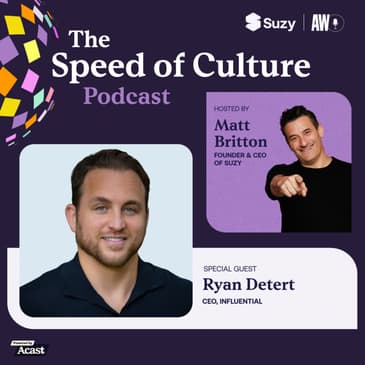
In this conversation on The Speed of Culture podcast, Matt Britton talks with Ryan Detert, Founder and CEO of Influential. Ryan details his path from running parody accounts with 30 million followers to building the largest influencer marketing company by revenue. He talks about how data and measurement turned a novelty into an enterprise media channel, the realities of bots and AI slop, and his experience of building a business with your closest friends and family.
Follow Suzy on Twitter: @AskSuzyBiz
Follow Ryan Detert on LinkedIn
Subscribe to The Speed of Culture on your favorite podcast platform.
And if you have a question or suggestions for the show, send us an email at suzy@suzy.com
Hosted on Acast. See acast.com/privacy for more information.
[00:00:00] The ability to actually measure offline sales, footfall, TV tune-in, all the things that have only been traditionally available on other mediums. We were able to actually build that for social and for creators. And that makes it so that every brand goes, well, if I can measure this, why would I not? To thrive in a rapidly evolving landscape, brands must move at an ever-increasing pace. I'm Matt Britton, founder and CEO of Suzy.
[00:00:25] Join me and key industry leaders as we dive deep into the shifting consumer trends within their industry, why it matters now, and how you can keep up. Welcome to The Speed of Culture. Up today on The Speed of Culture Podcast, we're thrilled to welcome Ryan Dieter, the founder and CEO of Influential. Ryan is one of the early architects of the creator economy, helping build influencer marketing to a measurable enterprise-scale business long before it came mainstream.
[00:00:53] Under his leadership, Influential became one of the world's largest influencer marketing platforms. And Ryan, we're thrilled to have you today. Can't wait to dive in. Thanks for joining. Matt, so excited. Let's talk. Let's get down dirty. Absolutely. I remember talking to you way back in the day when you first had this idea for this influencer, and it was called influencers back there. I believe it was before the words creator economy became in vogue. But take us back to that moment on why you decided to dive into this opportunity, what you saw then and what proved to be true over time.
[00:01:21] Matt, we tried to get you to invest. It would have been a nice outcome, but it didn't work out this time. It would have been an ex-venture. I know. You love to throw it at my face. It's all good. I deserve it. You, uh, yeah, you've done very well with yourself. I think you're okay. So, 16 years ago, I was an influencer first. I had 30 million followers on Twitter, then eventually on Instagram. I don't sing or dance. I have no talents. Instead, I built what I call niche accounts. So, for example, at travel, at automotive, at USA, at fashion.
[00:01:49] Like the dot-coms, but on these social platforms. And I realized very quickly that in order for me to actually build that content and then monetize it, I had to provide all the things that we now know and love in the influencer and creator space, which is brand safety, media and measurements, democratization of access to talents. So, early days, it literally was just me creating content and figuring out that there wasn't really a marketplace to get those deals from agencies or brands. So, I decided to build it myself.
[00:02:17] And when you went through that process, because a lot of people struggle with just creating content today here in 2026, what was your framework for creating consistent content? And what were the signals that you were able to successfully tap into to make sure you're putting out content that people liked and engaged with? Full transparency. It was a lot easier on Twitter back then when it was just photos and text. So, I was doing like a travel account, just had a bunch of great travel pics and like links out to top 10 travel locations.
[00:02:45] Same thing for fashion. For USA, it was all like patriotic content. So, it was really easy to do that, kind of almost like publisher style. Obviously, with advent of, you know, when Vine came out and then eventually TikTok and all the other platforms became video first. It's a whole different beast. And that's why Covers the Influential done so well to be able to supply that and augment that for the biggest brands. For early days, it was just simply content alignment to distribution. And I essentially went out to all the other travel influencers, had them retweet me back in the day if that was a thing,
[00:03:14] to get me to build up my follower base. And then as I built my up to about 7 million on the travel account, I was able to then start doing brand deals with major hotel companies and travel companies. Yeah, where I think a lot of people don't realize is the kind of multimodal aspect of social media took like well over a decade where at first it was just like I had pizza for lunch. And then, you know, that was during the Twitter heyday. And then it went to Instagram, look at the photo of the pizza I had for lunch. And then it was video. Hey, guys, it's Matt. I just had pizza for lunch.
[00:03:43] But that whole trajectory took a while. And there was definitely like this arbitrage opportunity when it was only text. There was another one when it was images. And obviously, so many people like the Mr. Beast of the world take advantage of the video era. Yeah, and there was even like an intermediate text to like image version, if you recall, the trending topics on Twitter. That was actually the first thing that that's when I realized that this had a moment or legs with actual branded content, not just driving conversation or driving traffic outwardly,
[00:04:12] but those top 10, top 20 trends that were there that some were paid for, promoted, some were just organic. On any given night, myself and my friends at the time, they had large accounts. We would just create trending topics that were fun or funny or that are topical. And that would overshadow like major moments like Coachella, because we decided to do our own things. The ability to actually do that and create conversation at scale was like a unique time and place in the early days of Twitter. Yeah, so you were an individual contributor, an early influencer.
[00:04:39] And then you made the decision at one point that you want to, I guess, help brands capture the same success that you were able to capture personally. So take us through that transition. It is very expensive to live in Los Angeles. And I was not making enough money creating content. So I simply figured out, well, if I were to give the checklist from these agents and brands of what I need to do to build and then partner with some developers to create that, and then it'll allow for an app for creators, a dashboard for brands and agencies,
[00:05:07] and be able to centrally make it so they can buy it programmatically as best you can in the influencer space. That was the first iteration. And that allowed for me to walk into rooms. So I had little to no brand relationships at the time. I just built them over time by going in and telling them what I'd solved in terms of the workflow as well as the audience I had access to myself or others. And that eventually became where we are today and influential. Now it's a full stack of identifying creators, validating their brand safety, creating content,
[00:05:35] measuring their efficacy down to offline sales. First and foremost, getting access to talent and solving for the main problems of agency or brand. Yeah. And you talk about some matter of factly, but very few people are able to achieve the level of success you have. And I'm sure there are so many learnings and so many obstacles you faced along the way. So in the early days when you were going, walking into the room of big brands, what were some of the challenges you faced to get them to actually buy in? And how were you able to overcome those challenges and get them on your platform?
[00:06:05] The biggest thing I would say is that we were put in the bucket of PR and sponsorship, which is not a bad bucket, but it's not as big of a bucket as media dollars. So we were fighting for $25,000 campaigns for like a three month period. Today, I'm sure like many others that are listening that are doing influencer campaigns, they are six, seven, even eight figures, depending on the brands. And we have clients that spend nine figures annually. And the idea of having an always on scenario didn't exist. It was like, oh, Super Bowl for this major launch, I'll do this.
[00:06:34] We had to change the narrative. And over time, it took us many years. I think really the moment that it started to truly shift from a size of budget was maybe 2016, 2017, because of the marriage of native influencer posting on their platform, on their feed, with the paid media amplification. And we can do that and show some sort of outcome, whether it's clicks or conversions. Then we became more of a media buy and took us multiple years. More dollars in that paid media bucket. It's no longer just experimental projects.
[00:07:03] Yeah. And as you know, the experimental budget is pretty small. The media budget is a hundred times that more. Yeah. And there's been so many shifts that have happened over time in the world of the creator economy, one of which has kind of been this constant, I guess, fluctuation, if you will, between it being about paid and it being about organic. How has that changed over time? And where are we today in 2026 in terms of what is the right formula? Obviously, the answer is always both. But I know recently a lot has changed in terms of the amount of followers you have doesn't
[00:07:31] necessarily mean you get reached like it used to. And paid doesn't necessarily have the impact that it used to if you don't have powerful creatives. So where has that changed evolved to and how does it impact your business as well? The very ad tech answer is it depends on your KPIs. If it's awareness and culture making, it may be more native with certain key creators that fit that narrative. If it's more lower funnel, it's probably going to be smaller creators with more paid amplification because you want to
[00:08:00] have lower cost of creative, but more working media to drive those outcomes. Or if it's highly specified to a certain city or certain region or certain country, all the things we know that we can't really map like on a geography side because Instagram or the TikTok algorithms or every platform YouTube, they're going to serve it wherever it goes. It's not going to necessarily be like only in these locations. And then obviously the answer is both, but some brands go, Hey, I just simply want
[00:08:26] it for this purpose. I still even bucket it partially in the PR content basis, or even a different team with that same brand will then say, I want to get capture that. And they have their own internal paid team. So I'd say about 80% of our business is a mixture of both on most campaigns, just 20% of our business where someone just goes, Hey, either we don't believe in paid media or we run it ourselves and we simply just provide ourselves. But do followers still mean as much today as they used to in terms of partnering with an influencer or even on your own, say you want to create a presence,
[00:08:55] whether B2B or B2C, and you don't have a big following. How much does that play into your ability to be successful relative to how it used to be maybe five years ago? I think the antiquated model was even previous to five years ago, like the old MCN models, which are the most like the full screens, the world, the makers, they were just selling like blitzing glamour of a million subscribers or whoever it was that didn't necessarily lead to outcomes. And I think what happened in around
[00:09:18] that same time as the paid media revolution, 2016 ish timeframe is the micro creator, someone that had 50,000 to quarter million followers became incredibly valuable because their audience, maybe 80% of them are female 25 to 34 with an affinity for NBA or DIY or whatever it is. And that became a media buy, as opposed to it being like, I love the rock, but it's 200 million Instagram followers, maybe only 10 million of them are actually a fit for
[00:09:48] what you care about. And how many of them are actually humans too, Ryan? Isn't that also a big issue that you have a lot of bots that are on social media? The bots are pervasive and they will always be involved in these platforms unless they find some way to stamp it out more quickly. But there's a mixture of it's wasted impressions either from a bot perspective or from a targeting perspective. And while celebrities have a tremendous amount of value and we apply them to a number of our campaigns, if it's someone saying, hey, I want to do more of a mid funnel, lower funnel campaign, it's larger going to be micro macro creators.
[00:10:17] And in terms of the state of the platforms today, like I'm going to shout out a platform and you tell me where is the platform today in terms of its relevance and its efficacy for brands. So let's start with TikTok. TikTok is still the joyful platform. I myself, they get me for at least half an hour an evening before I go to sleep. And they are known for both their awareness generating, but also on the TikTok shop side. I think a lot of that, we spend an entire hour on just the future of live
[00:10:45] and the current TikTok shop ecosystem. So for them, if you wanted to do by appointment watching and it's not on a major, it's not linear, it's not maybe Twitch, the next one down is going to be TikTok. And I think that's leading to, I think it's about, I heard several billion dollars are spent each year on virtual badges or tokens or gifting that happens on these platforms. But think about that. The number of product being sold, just the attention and people wanting to gift
[00:11:12] people, that is essentially creating it by appointment watching before you even sell a product. And now they're making it easy and frictionless to be able to sell products. That is a recipe for a future Amazon type product. What about X? Brands still look at it for live sports and live moments. It's probably been like that way since the last 10 years and more specifically the last five years. It's still a massive brand safety focus that needs to be mitigated, but we still see brands operating just not the scale maybe previously to when it was Twitter.
[00:11:41] And how about lastly, Instagram? What's the say of Instagram today? I mean, Instagram still is the undisputed champion of branded content. YouTube pays out far more money to creators and is the OG, the one that's been around forever that people will wrap. If you have a million subs anywhere or a million anything, you want YouTube as an annuity for the rest of your life. But from a branded campaign perspective, Instagram is probably where most brands least default. I rarely see someone omit Instagram from the plan. It's more
[00:12:11] so other platforms coming out depending on the vertical. And also the last one I guess I'll ask you about, and this is obviously not a consumer play, and I'm curious to hear your thoughts personally about it is LinkedIn. How has LinkedIn grown in its efficacy? And also you're talking to a lot of people who are in the advertising and digital marketing business. Like what advice would you have for them to build their own personal brands from a B2P perspective on a platform like LinkedIn? LinkedIn is my favorite personal platform. It's where I get the most engagement and I actually
[00:12:39] find the most time to creating great content and putting out good stuff. I will say another moment in time that happened, I think it was last year, in the last 24 months, is when they allowed for individuals and brands to be able to amplify with paid media through their video assets. Before that, it was a little more, it just didn't really fit the vibe to all of a sudden have like a branded content piece in between. We both work with LinkedIn, we are running LinkedIn campaigns for other brands. Like it's now one of the major channels. I think B2B, it's the channel for B2B.
[00:13:09] And I would say that if you want to grow there, if those that are listening in the marketing community, it's similar to how I built out my Twitter travel accounts back in the day. You find other like-minded people and you create content with them. You even maybe DM them and say, hey, I'm making this, please share it. Or I can create something with you. I can highlight you and I'll tag you. It really is distribution plus content. And also expertise. I mean, I think when you give your travel example, it's about deep domain expertise and about knowing what you're good at and knowing
[00:13:37] the type of content you can offer that people will find valuable. The content has to have a resonance for it to have value. And I think in our industry, finding a way to be consistent and differentiated enough in what you say besides the usual, I'm so happy for this, or I'm honored for this. Or AI is going to be big. Exactly. Right. So you mentioned earlier, and I'm glad you did about TikTok and live shopping. And obviously that has been a phenomenon in places like China that has long been a major way that brands were
[00:14:06] able to move product. And now it's starting to happen in the US. Just wondering what your thoughts are on the future of live shopping and if it's something that your business is also leaning into. So across every platform, there have been test budgets for the last several years. It's still a rounding error compared to just standard video units. But every year we all bet Gary Vee, everyone else they're all bet that it's going to happen because of what's happening with Duyin in China, that it's imminent. I just think it's been slower for us as we've gotten that
[00:14:36] bioportment watching. And I think we are in that timeframe over the next 18 months where it'll become more expected as part of the package with the creators. Right now, it's a very specific subset of creators that go live. I think it's going to become more standard across the career. Once most creators that are known for the video content that everyone knows and loves and has the audience that really engages with them, once they start going live more often because they see the incentives from the gifting or from the affiliate revenue, that will be a major unlock for brands.
[00:15:03] We'll be right back with the Speed of Culture after a few words from our sponsors. So I mentioned AI earlier, and obviously AI is having its moment in the creator economy as well. There are many accounts right now of essentially AI avatars that are really engaging. They're creating these kind of AI power personas that are living a life that isn't real, but it emulates real life. And of course, if you're somebody who's not comfortable with being in front of a camera, it can be a lucrative opportunity to build brands. And just what are your personal thoughts
[00:15:33] on how AI is going to impact the creator economy? And also, do consumers care? Like, are they turned off by it? What is your experience and how it's going to impact your service offering moving forward in the marketplace? The kind of pedantic answer on what's going to be most used for AI is similar to what's been used for the last decade by us, but also been elevated with generative AI. Brand safety, number one. Sourcing, number two. Three is just communication back and forth.
[00:16:00] It's just very manual with lots of people, lots of requires. You know, it's just a lot of influencer marketing is both the most impactful, both for the positive or negative sense. So having eyes on it is still important for the process. So I think that's helping to create less friction and deliver more campaigns and more value and volume. From a generative content perspective, I think for the Fortune 1000, they largely don't want to touch it. I think the perception is that there's a negative sentiment towards that content right now.
[00:16:27] Is that perception reality? I think as a consumer, if it's AI slop or kind of clickbait, they are getting lots and lots and lots of millions of views. So the view of this ownership is happening, whether it's because they are so engaging or they're duping individuals and they can't tell the difference. It's something sensational. I will say that right now, brands aren't saying similar like the metaverse craze from 2021, 2022. There still exists a number of
[00:16:55] people who have millions of followers that are purely production backend characters or caricatures. And those accounts will still get brand deals very haphazardly based off of it being a new innovative thing they want to launch for the brand. They'll go to them to make it seem kind of future and exciting. We don't see that happening where the Fortune 1000 are saying, give us augmented or fake humans. I think probably because of the fear of the sentiment piece. I do believe that if you look at like below the Fortune 1000, the DTC brands,
[00:17:22] they are looking at creating whether it's their own product in multiple ways through AI or other humans with AI. I've seen them testing. I see it from my own feed with paid media on that. I don't believe the Fortune 1000 are going to test that in any real capacity over the next couple of years. Maybe sentiment changes around AI gets so good that it's kind of immaterial. But for right now, I think it's actually the opposite. What previously would have been, oh, like AI is great. It's said that in our campaign. People are actually removing it from it and going the other directions. They believe that there's some negative headlines and concerns around AI.
[00:17:51] It's very polarizing for sure. And of course, I'm sure the platforms, some of them are probably suppressing AI content, although it's becoming increasingly, I think disclosure is such a big piece of it, obviously, right? If you mentioned being duped, I mean, I think a consumer should have a choice, but it's not disclosed. Just like we had that whole hashtag ad thing where for a while you had influencers sharing products, they were being paid for it. They weren't disclosing. I think it's the longest the consumer knows, then they should be able to make their choice of what is entertaining or not.
[00:18:18] 100%. And I can tell you just from experience that a number of clients have even required in the contracts, the influencers, they cannot use AI because there's editing tools and things. So it's gone so far as the brand wants to be able to say, just you can't even touch it in one capacity because they're afraid of my trigger that it says AI generated in some capacity. So there are brands that are literally even saying, just do it old school. Yeah. It's interesting though, because like there's electronic dance music, which is music that is made by computers and half a million people go to electronic Daisy carnival and dance like there's no tomorrow,
[00:18:48] even though the music was not made by instruments and there's just DJs on stage pressing buttons, but they don't care because it's about how the music makes them feel. And I often give the analogy is the content is probably the same. Now to be fair, the people in the audience watching a DJ know that it is produced by a computer. So I think that might be the rub, but I do think that there will be a world soon where some of this content is going to be incredibly engaging for consumers, just like they watch the movie Avatar. And that's, you know, that doesn't have real actors in it.
[00:19:18] Yeah. I don't know. I know my people actually are listening. We're at possible, but myself and my friend, Shelby Palmer, we did a fight on the main stage for the digital flight club, which is a great format. I'm a big fan of them. We did humans versus AI. Now I live at an advantage because a human crowd, as opposed to an AI is that were voted. But that whole discussion point was around what is better, but more importantly, what is right. And the influencers, whether they are Mr.
[00:19:44] Beast in the highest level or micro creator, if their NIL, their name, image and likeness is being used without their consent or control or their monetization, then that I think is the bigger issue that's plaguing the creator community. And then also the audience not wanting to essentially have all the people that they trust and like be able to just simply be used by anyone for anything positive or negative. And it's probably more likely to be negative in terms of creating content that the
[00:20:11] influencer themselves wouldn't make. So I think there's a series of like discussion points around rights, usage, compensation, and then disclosure. Yeah, absolutely. And if you were starting Influential again today, knowing what you know about the state of AI and technology in 2026, what would you do differently? Or what would be some of the areas that you'd build the foundation of a new business on? It'd be hard because there would be some massive incumbents to try to overtake. But I think
[00:20:37] number one, I think it goes back to what we see in the headlines, which is like the SaaS removal of importance because of AI's ability to create, you know, vibe coding, things of that nature. I don't believe that's actually a hundred percent true. We're actually out of SaaS business. It doesn't really apply to us, but we have a software as a service as part of what we do for media. I think that if I was a young scrappy individual, I would then be creating everything I can to make MCPs, ways to allow for everyone access to open source, to make my best interpretation of
[00:21:06] what creator marketing, influencer marketing should look like. And then essentially make that, try to make that the gospel that everyone essentially follows and then provide that as your value proposition, whether for consulting or whether actually for activation. So just give everyone else the playbook if you want to try and go after us. But ultimately it's difficult at the level of scale that us and several others have gotten to because part of it is also the trust that we have with creators. We've given them rent payments. We've paid out hundreds of thousands of dollars, millions of dollars to people over the last decade. And part of that is also that
[00:21:35] relationship is being built. And I think a lot of that is some USP that is by companies like ourselves and a few others. So shifting gears, we wrap up here, Ryan, would love to, you know, we touched on a little bit earlier, but it was well publicized that your company was acquired by Publicist. My former company, MRY, was acquired by Publicist. And I know what it's like to be in a large holding company and just curious, like what your experience has been bringing Influential into Publicist and what were some of the benefits that unlocked for the business's continued growth?
[00:22:01] I was most excited about it because our tour and team were all talking about, where's the puck going? What's the next piece of influencer marketing evolution? And fortunately they had Epsilon and Epsilon was the ability for us to match the influencers to deeper data sets to make better decisions for brands. Was that part of the thesis of the acquisition to begin with? That was the key part was how do you truly make influencer marketing a media channel? It's the data and the underlying information that lets you do that. And is that paid? Have you been able to bring that into practice? Because often there's the promise of it, but then when you get to the nitty
[00:22:31] gritty, especially within a large company, it's not as easy as you think. It has. And in fact, I mean, a lot of the biggest wins that we've had at Publicist and Influential around some of these larger pitches, that's been a key component of that and the ability to showcase that not only is it possible, it does drive outsized gains for our clients. Yeah. The other thing what they asked you about just in terms of the journey, and you've talked about this a lot on platforms like LinkedIn, is just the importance of your team. And after the acquisition, you were very intentional about calling out members of your team. And I know your brother is a partner in the business as well.
[00:23:00] Talk to me about how you've been able to build a successful team over time and what have been some of the attributes of great team members over the course of the great story of Influential. I believe in something very simple that always do something bigger than yourself that you couldn't do by yourself. And if you get people to buy into that, you pick out people that actually have domain expertise, but also just belief and hustle that want to drive towards this outcome,
[00:23:27] you're going to get a great result. And it helps to have my brother, I trust him implicitly, he's family. I have my best friend is our CRO, Chris Poydennis. I mean, the whole company essentially become family. And I know it's such a cliche thing to say in the ad tech world is like, we're all family, like Vin Diesel. But truly, like these are people that are lifelong, we were at different people's weddings, like we're all what becomes as you know, business is so all encompassing. And the things you're doing all day long, that becomes part of
[00:23:54] your life and your personality. And I guess I would say work with your friends. That's what I would suggest. And if you were to point something besides building a team, working with your friends, if you were to look back and point to one additional thing that maybe you focused on in the rearview mirror that you did right, that put you in a position that you're in today, what would you point to? Yeah. Our company became the number one company probably around 2016 at large for many reasons,
[00:24:19] but one of them was we said unrelentingly, we will innovate towards measurement. I know you've built on for measurement companies as well. The ability to actually measure offline sales, footfall, TV tune in, all the things that have only been traditionally available on other mediums, other linear, et cetera. We were able to actually build that for social and for creators. And that makes it so that every brand goes, well, if I can measure this, why would I not?
[00:24:45] Yeah, absolutely. And to wrap here, is there a quote or mantra we always ask our guests when we wrap up that they tend to live by and hopefully it's something that can encapsulate everything we've talked about today. Life is short, do things you love. I love that. And obviously you've done what you love and you've built an incredible business and have a massive impact on the industry. So congrats to you and all your success, Ryan, and wishing you a great activation at Cannes. I won't be there this year, but I know you guys always know how to throw a great party and appreciate everything you do. Thanks, Matt. Appreciate it.
[00:25:13] Absolutely. On behalf of Suzy and I, we came back to getting the Ryan, founder and CEO of Influential for joining us today. Be sure to subscribe, rate, and review the Speed of Culture podcast on your favorite podcast platform. Until next time, see you soon, everyone. Bye-bye. Speed of Culture is brought to you by Susie as part of the Adweek Podcast Network and Agus Creator Network. You can listen and subscribe to all Adweek's podcasts by visiting adweek.com slash podcasts. To find out more about Susie, head to susie.com.
[00:25:43] And make sure to search for the Speed of Culture in Apple Podcasts, Spotify, or anywhere else podcasts are found. Click follow so you don't miss out on any future episodes. On behalf of the team here at Suzy, thanks for listening.