
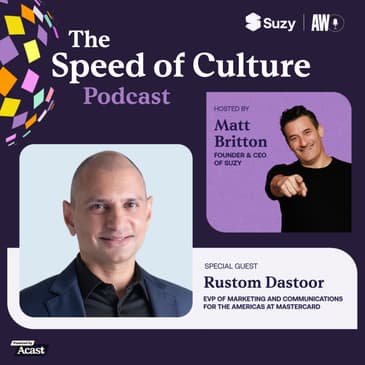
In this episode of The Speed of Culture, Matt Britton sits down with Rustom Dastoor, EVP of Marketing and Communications for the Americas at Mastercard, to explore how one of the world’s most iconic brands keeps evolving—from “Priceless” campaigns to AI-driven personalization and brand storytelling in the age of creators.
Follow Suzy on Twitter: @AskSuzyBiz
Follow Rustom Dastoor on LinkedIn
Subscribe to The Speed of Culture on your favorite podcast platform.
And if you have a question or suggestions for the show, send us an email at suzy@suzy.com
Hosted on Acast. See acast.com/privacy for more information.
[00:00:02] This episode is brought to you by Philo Ads. Want to get your brand in front of the right audience? Philo Ads is the way to go. With 98% of viewing on connected TVs and over 900 million monthly ad impressions, Philo gives advertisers unmatched accessibility, flexibility, and results. Power your next campaign with Philo Ads today. Head to ads.philo.tv to get started.
[00:00:26] Philo Ads. There's also a human need to really connect more individually to be able to deliver something that's personalized. The technology is only one half of the equation, but really understanding consumers on a more human level is more critical than it's ever been.
[00:00:48] To thrive in a rapidly evolving landscape, brands must move at an ever-increasing pace. I'm Matt Britton, founder and CEO of Suzy. Join me and key industry leaders as we dive deep into the shifting consumer trends within their industry. Why it matters now and how you can keep up. Welcome to The Speed of Culture.
[00:01:10] We're a special edition of The Speed of Culture Podcast, and today we're joined by Rustam Dastor, the EBP of Marketing and Communications for the Americas at MasterCard. A global brand leader, Rustam has helped shape MasterCard into a cultural icon, connecting consumers to unforgettable experiences in sports, music, dining, and more. Rustam, so great to see you today. Thanks, Matt. Likewise. Happy to be here.
[00:01:30] Absolutely. So the MasterCard brand is such a great brand over time, and to most people right now, it's known for its Priceless campaign, which I think is one of the more effective brand-level campaigns in modern history. Why do you think that campaign was so effective in terms of creating a clear message to consumers about the brand's value?
[00:01:49] Yeah, you've got to think back to when Priceless was conceived. The year was 1997. What do you remember about the 90s? The thing that reminds me of the 90s is conspicuous consumption. People just wanting to buy, buy, buy. The bigger house, the better car, the better vacation, the bragging rights, etc. And then along comes a brand that makes purchasing possible and says it's actually not about buying anything. It's about the fulfillment you get when you have an experience that is memorable for a lifetime.
[00:02:19] So the first ad that we ran was called Father and Son. It's a father and his eight-year-old son who go to a baseball game. And we talk about what it costs to get to the game, the cost of the ticket, the cost of entry, the cost of a hot dog. But what's really priceless is spending time with your eight-year-old. And that somehow struck a chord. It didn't matter that the campaign launched in the US. It then went global. The same insight was applicable everywhere.
[00:02:46] It was easy to translate. People knew what you meant instantly. And it survived. It's as relevant today, maybe even more so than it was in 1997. And the great thing is it's perfect for today's medium, which is social media. So that's what's made it such a great campaign and why we're so committed to it. Yeah, I mean, at the core of that insight is just the one thing you can't replace is time and love and relationships. And that's what really matters. And that experiences sort of unlock those relationships, unlock those memories.
[00:03:14] That's right. And what we sort of landed on in partnership with our agencies and partners is that people really aren't vested in the moment of payment, which is odd for a payments company to say, but it's really when you have the lowest emotional involvement in the buying process, is what am I paying with? They really love the part before the payment and after the payment. So if you're going to buy a pair of clothes, right, what you enjoy is the shopping experience, trying on different things and seeing how you look.
[00:03:41] And then you enjoy what you do after once you've bought it, going out with it, wearing it out on a date or with friends or whatever you want to do with it. That's the moment that we want to celebrate the before and the after, not really the payment moment, which is kind of counterintuitive when our product is a payment product. But that's what consumers love and that's what makes it so special. It's really interesting. It's also interesting that we mentioned 1997, because one thing that didn't come to mind when you first brought it up, but does now is that nobody was really on the internet in 1997. That's right.
[00:04:11] And now we all are and the world's changed. And obviously you mentioned social media, which is obviously a huge internet moment. One phrase I wrote about in my book, Youth Nation, is that status update is a new status symbol. So people used to kind of build their own brands by cars, houses, watches, and sneakers. But now a lot of people are building their personal brands through experiences. They're at the game, they're with the DJ, they're doing these.
[00:04:36] So how have experiences as an overall priority for consumers changed the way that you look at the brand and what it unlocks for consumers? Yeah, we often say that access is the new excess, right? I love it. Just having access to something gives you currency, gives you some kind of a calling card that others don't have. So we have these incredible experiences that we've invested in, in these different categories from sports to music to entertainment, et cetera.
[00:05:02] And really we make them available to cardholders in a money can't buy manner. So for instance, you can buy a Gaga album, but you can't be in a Gaga music video. That's only something that MasterCard can do for you. She definitely would never have me in her video. Maybe some people can hold on. Me neither. I believe you. But we've got 3 billion cards in force, 3.5 billion to be exact. So we have more than a billion cardholders, but only 32 get to be in a Gaga video.
[00:05:30] But just the fact that we can do that for someone, that's the access piece that gets the network excited and gets people to become a MasterCard cardholder. Not that they might want to be in a Gaga video or not that they might want to do something extraordinary, but the fact that it could happen to you is reason enough to participate. Yeah. And of course, when you roll out a promotion like that, you're sort of transcending from a functional product to a brand that really has a role in culture.
[00:05:59] Yeah. When we spoke to her the first time, I mean, it was quite interesting. The way we positioned it to her is almost every one of your fans has a MasterCard. And she chimed in and said, well, I have one too. And she pulled it out of her wallet, which was, I don't know if that was a setup for us, but it worked wonders for us. It was super exciting. But we instantly started working off the same page, which is your fans are our fans. And that's what we should start thinking about. What can we do for the fans? It's not about selling them on anything. We don't need to sell more cards per se.
[00:06:28] If we build affinity for our brand, the purchase will happen, whether it's six months down the road or six years down the road. For now, we just want to build affinity with consumers that translates to something bigger and better in the future. And I would imagine as much as you're servicing and creating a memorable experience for those 32 people, you're also using it kind of as a launching pad for content that you're creating to build the brand. Absolutely. And that goes back to sort of the magic of social media. To stay relevant in social media, you need a lot of content.
[00:06:55] And that content comes from people who natively create it. That's not a brand. We can facilitate it. But really, that content creation has to come organically from the community itself. So Gaga's community, and one of the reasons we were so keen to work with her, is prolific at engaging in social media. So whether it's the fans, whether it's the creators, or whether it's her or whether it's her choreographer, all of them are now involved for six weeks, eight weeks in intense content creation
[00:07:23] that can keep the fandom and keep the fun going on social media. So that is as important as identifying the artist and the message. I'm glad you mentioned creators because if we go through a timeline, talk about 1997 when prices launched, and we talked about the dawn of the internet, of course, social media, what came after that was the iPhone. And that was the big moment and the technology that really defines Gen Z. And now when you think about a generation that grew up with the iPhone in the household and it's now coming into the workforce, they are on their phones.
[00:07:52] I dropped my daughter off at college last year and nobody had TVs. They're all either watching YouTube on their laptops or they're on their phone. And when they're on their phone or on YouTube, they're watching content not so much from traditional TV networks, but from other people, which are creators. So when you look at building your brand, how has that shift evolved from focusing more on top-down awareness level, driving activities to networks to working with creators? You know, it's interesting. Even in 1997, there were influencers. Yes.
[00:08:22] There were celebrities, etc. But what the internet and social media and the iPhone and smartphone has done is democratize that entire genre. So we saw that happen with music as well. You had creators who made music, who we all followed as kids, the Michael Jacksons, the Princes, etc. But now the democratization of music has meant that there are so many more people who can play in this space. And there are so many more people who can be content creators,
[00:08:49] if not directly making music, making content around music. So this absolute explosion of content that we've seen is both an opportunity, but it's also pretty daunting. For a brand, it's like taking a cup of water to an ocean that already exists. Yeah. Right. Good analogy. So how do we become relevant in this space? How do we have a point of view in this space? How do we play in this space in a manner where we seem relevant, we seem needed, we seem wanted by our audience,
[00:09:17] rather than intrusion where we forced our way in? So again, how do you move from selling product to engaging with consumers and letting consumers then decide whether your product is good enough for them to consume? So that is what we're trying to do, whether it's with Gaga, whether it's with our golf, our baseball sponsorships, whether it's with our League of Legends gaming sponsorships, whether it's with our travel portfolio, it's all around what do you want to engage with?
[00:09:44] Let's start having a fun dialogue there, an engaging dialogue there. Let's get you to participate in our brand, and then we'll see where it goes. And when you talk about League of Legends or Lady Gaga, they're obviously major investments that your brand is making. How do you get conviction that that's the right property or asset or IP for you to land on to know it's really going to strike the right tone with your customers? Yeah, a lot of these properties that I talk about, we're in our third decade of partnership with. So Major League Baseball has been a partner for 27 years.
[00:10:14] We're in our third decade. We've been partners with the Grammys for more than 15 years, PGA Tour 30 years. So these are partnerships that we've had for so long. They've been honed over the years by many marketers who've come through the system, many of my predecessors who worked on this, shaped it, made it better and better. And I think the few things that we land on when we seek a partner is one, is there a commonality of values? That will this partnership sustain even during bad times? We stuck with every partner through COVID,
[00:10:44] even though there was no sports and entertainment, everything came to a standstill. But our values got us through. We recently signed a new partner, which was McLaren Formula One Racing. Same thing. Just huge growing mass of popularity. Absolutely. And a super successful team. So we like partnering with successful entities that have the same values as us and like to do interesting things for their fans and audiences. Absolutely. And of course, when you work with major properties, you have that mass reach that you can unlock.
[00:11:13] But increasingly, consumers are expecting at the same time some level of personalization. They don't want to be talked to as a monolithic market, as an 18 to 49 demographic. We're seeing so much personalization, especially in the age of AI unlocked, which we're going to get into as well. How do you look at personalization as part of your overall strategy? Yeah. So it's really interesting that when you look at Gen Z in particular, this is the most diverse generation we've ever seen. So almost 50% of them are non-white.
[00:11:42] Most of that is multi-ethnic. They're two times more likely to be part of the LGBTQIA community than their predecessors, millennials. More than half of them live in homes that have three generations living in the same home. So their experience as a cohort is collective, but they are individually very different from one another. It would be hard to find two who are exactly alike. So personalization then becomes extremely important.
[00:12:11] But personalization is a technological challenge, but it is also a human challenge. On the technological side, we have tons of tools, personalization engines. Mastercard acquired a company called Dynamic Yield, which is a leader in personalization services. So we do it for ourselves as well as our clients. But there's also a human need to really connect more individually, to be able to deliver something that's personalized. The technology is only one half of the equation,
[00:12:38] but really understanding consumers on a more human level is more critical than it's ever been. So we do a lot of work in that area as well, to understand what does the future consumer look like for us? So is a lot of that work around segmentation, understanding kind of different audience pockets and how they may differ by psychographics or demographics? So demographic segmentation, certainly. But beyond that, we try and look at what makes clusters of people come together. So for instance, you could have a teenager who has a love for baseball,
[00:13:07] and you could have a retiree who has love for baseball. So a segmentation model stands when you look at it through one lens, but completely falls apart when you look at it through another lens. So you need a multivariate level of even segmentation to say, OK, these guys don't fall in the same segment. They might not be the same age group, the same income strata, live in the same part of the country, but they're bound by something common, which is the passion for baseball. The same is true for music. We saw that with Gaga.
[00:13:36] The kind of entries we got were for people all over the country, young people, middle-aged people, older people, all bound by the love of music and the love of this artist. So segmentation is great to do certain things, but it falls apart in certain other areas. And then you go to human instinct and you go to passions and what binds them there. Yeah. And of course, underlying all of this is data. That's right. First party data has become so valuable more than ever before right now for brands.
[00:14:03] How are you looking at first party data given your business model? Yeah. So we're very careful when it comes to data. Firstly, we don't see any individual data, just the nature of our business. We only see the 16-digit PAN number, personal account number, and we can't link that to an individual. So our business does not depend on knowing what an individual's buying. No PII whatsoever. The cardholder is a customer of the bank, and the bank has that information, not the payments network.
[00:14:33] So we're very careful in always making that clear. So any data that we have is aggregated and anonymized. So we can look at a trend and we can say, how is consumer spending towards, let's say, the automobile segment growing in the United States? Or what is the likely impact of macroeconomic forces on spending? Say maybe like tariffs. Could be anything, right? And we've seen these moments come before where there is 60 years worth of a trend to say,
[00:15:02] what happens when there's an economic shock? What does that do to consumer spending? But it's in the aggregate and it's completely anonymized. Right. So when you're looking at that anonymized data, I'm sure using AI helps you unpack needle in a haystack type stories that maybe you weren't in the past. How is MasterCard using AI both for analysis of data and other areas in the overall marketing funnel? So we've actually been using AI for many, many years. AI is hot and sexy at the moment,
[00:15:32] but AI has been part of our business for a long, long time on a couple of different levels. One is it is incredibly valuable from a cybersecurity level. So when you swipe a card, there are so many systems that are running in the background to make sure that it is indeed you and not someone spoofing you who have either swiped that card or gone online to make that purchase. AI has been helping us prevent fraud for years and it's only going to get better and better. Now, the need is for us to get better at it because fraudsters use AI too.
[00:16:01] So it is an arms race. Hat and house game always. Absolutely. And one that we intend to win every single time. So AI becomes incredibly important there. We then throw off a lot of data in this aggregate, anonymized manner around consumer spending. So AI can help us tell fact from fiction when it comes to how merchants want to go about building their business. So for instance, should a merchant stock a product that is running out? Is it worthwhile reordering?
[00:16:28] Data can tell you what other merchants are experiencing when they do that. And what we can do through AI is just help that make it much more powerful. Same thing from a marketing perspective. We work a lot with small businesses. We want to provide small businesses tools to be able to stand up and compete with big businesses. So helping small businesses use AI to help drive their business forward, incredibly valuable. We have a partnership with Marcus Samuelson, who's a celebrity chef.
[00:16:55] Marcus is prolific in opening new restaurants, but he always wants to know what neighborhood or what town is there a demand for what he serves for him to go and open. So our data coupled with AI can really help him narrow down on where does he put the next Marcus Samuelson restaurant. Right. That's fascinating. Yep. So when you think about your category, credit cards in general, and just the payment space, so much change has occurred and will continue to occur.
[00:17:22] Obviously, there's a wave of fintech and there's crypto and there's just the modality in which consumers pay. You often see consumers going to a store and they're tapping their phone to pay. What is the future of a business model like MasterCard to miss all this innovation disruptions happening in the space? Sure. Firstly, we don't look at ourselves as a credit card company or credit card being the category. We are a fintech company. We're a technology company. And our business is really payments technology. We connect buyers and sellers through their respective banks.
[00:17:52] So our infrastructure is what we really depend on. The form factor that gets into that infrastructure, whether it's a piece of plastic or a phone or a watch or any other RFID device, is inconsequential. It can keep evolving and the more it evolves, all the better. When Apple Pay came around, it was a great thing for our business. It wasn't competitive at all. It runs on our backbone, on our rails, and we benefit from Apple Pay. It just meant that more use cases opened up. More people adopted it.
[00:18:21] More people started accessing our network for more transactions. So for us, innovation is an amazing thing. We don't worry about disruption. We are the disruptor. We have been the disruptor for the last 60 years. We will always be that. And whether it's traditional payments rails, whether it's blockchain that we're investing in, whether it's AI to enable it, we see the future as incredibly exciting. And we're very well positioned both with consumer payments, commercial payments to succeed as we have.
[00:18:48] And where do you see crypto playing a role in the future for consumers, especially younger consumers that are increasingly looking at it as an investment vehicle? It's not really a payments vehicle yet, but where do you see that evolving relative to your model? Yeah. So we allow people to convert fiat currency to crypto and crypto to fiat. So even literally every couple of months, we're launching a product. We recently launched one in Europe where you can literally use crypto exchanges through your payments product to pay any of our 150 million accepted merchant locations.
[00:19:16] So the ability to convert fiat to crypto, crypto to fiat already exists. For now, that's the space that we're focused on and we're working on. But again, we're constantly looking at innovating for the future. There's a whole work stream around stablecoin that is always occurring. There is a lot of potential and promise for stablecoins to sort of grow the category and the industry. And as that happens, I'm sure we'll be at the front of it. It's fascinating because there's so many layers. That's right. And players. Yeah. Yeah. Do you have any cash in your wallet right now?
[00:19:46] I do not actually. I can show you my wallet if it's helpful. I am fully cashed. I see a driver's license and a MasterCard for those who aren't here. Two MasterCards. Do you think consumers will have cash in their pocket five years from now? What do you see the future of cash? Because I know that's a big competitor in MasterCard is cash. Yeah. I mean, that's up to consumers. If you want to carry cash, carry cash. Our job is to make cash redundant. So we want to show every day that for every reason possible, we are a superior way to pay than cash.
[00:20:14] If you still want to use cash, by all means, use it. But our job is to out-innovate cash because no one's innovating on cash. It's the same damn cash that's been around six generations or more now. Yeah. But if you had to predict, do you think cash is going to dwindle? Yeah, that's the trend. That's the trend. And that's happening everywhere. And for the right reasons. It's safer not to carry cash. Corruption and all kinds of other nefarious dealings are generally done in cash.
[00:20:38] So we find that it's a very strong value proposition to have these digital products convenience as well. So the trend is definitely away from cash. I kind of agree. I don't have any cash in my pocket either. Awesome. And when I do, I always leave it in my pocket and it gets in the washing machine and it comes out and it's ruined. How many MasterCards do you have in your wallet? I've got two. I think I probably have one. Ah. Yeah. You've got to get one more to at least keep up with me. Yeah, I'm on it. We'll be right back with The Speed of Culture after a few words from our sponsors.
[00:21:09] If you're looking to connect with younger, highly engaged audiences on the biggest screen in the house, PhiloAds has you covered. From flexible buying options to powerful targeting and transparent results, PhiloAds makes premium CTV accessible to brands of every size. Visit ads.philo.tv and start building your next campaign today.
[00:21:37] So let's shift gears a little bit as we wrap up to you and your career. So obviously we've talked about so much changes during this interview from the advent of the internet, which when I tell my kids when I started in my career, there was no internet. They look at me like a total dinosaur. But it's crazy to think that 25 years ago, we really weren't on the internet. And then you look at the evolution of social media and mobile devices and now AI. There's been so many changes.
[00:22:00] How has that changed the definition of a leader in the marketing and advertising space in terms of the skill sets needed to really thrive? Beyond professional lives, I think our generation will experience the most technological change of any generation, unless things dramatically change in the future. But the likelihood will be that our generation from birth to death experiences more technological advancement than any other single generation has. You mentioned AI. This is the thing that I feel we have to master.
[00:22:30] We're all sort of somewhere around that halfway point in our career and there's still another halfway to go. And we have to master this new thing. I don't worry about losing my job to AI, but I very much worry about losing my job to a guy or girl who knows how to use AI better than me. And I'm not going to let that happen. So that's where I think all of us can either ignore this, surrender to it, or embrace it. And I think embrace is the way to go. And it's been the same for technologies leading up to this point, going back in time.
[00:23:00] So I think technology is in our favor. And the better we get at using it, the more successful we can be. Are there specific skill sets that you see in the marketing space being more in demand in the future than perhaps was in the past, just given all these technological changes? Look, I think the most valuable attribute to have in marketing is curiosity. Yeah, we hear that a lot on the podcast. If it doesn't start there, you're not going anywhere.
[00:23:26] I think curiosity leads you to doing something to fulfill that curiosity. That leads you to adapt, to change, to learn, to grow, to try new things, to fail, to succeed after failing. I think curiosity is the thing that we should look for in marketers. It was in the past. It will be in the future. But now there is also this sort of aptitude towards technology.
[00:23:49] I think marketing is increasingly going to become a technological profession as much as it's been about human insight, creativity. I don't think we want to lose that component of it. But I think much like many other professions, we have to master technology before we get left behind. Yeah, of course, that's a fundamental question right now. Art versus science, right?
[00:24:10] You have ChatGPT having these incredible tools where anything you can dream of, you can output this imagery and videos that in the past you would have needed a production studio or an agency to build. And it does call the question, what is the future of creativity? Is that going to become devalued in the new society? I can't imagine it will. For the simple reason that we've gone through these technological changes before. I'm sure that back in the day, there was a time where someone was sitting with an ink pen, literally sketching and doing calligraphy and stuff like that.
[00:24:40] I love to show Mad Men that you see they're laying out. That's right. You must have seen pictures of people designing buildings and architects in the past with those big rulers and set squares, etc. And then technology came, but creativity never went away. That has lived on forever and likely will live on forever. I don't worry about robots writing poetry and replacing us. I just don't think that's going to happen.
[00:25:04] Yeah, and I think ultimately it takes somebody with initiative and a certain level of critical thinking and creative abilities to understand what problems need to be solved by AI. Where are you going to focus? How are you going to spend your time? How are you going to move the ball forward? It's also as human beings, we're inherently wired to competing with one another and disrupting one another. If you have the same tools as I have, then what's going to separate us if not our imagination and creativity? That's right. So when you look back at your career, and obviously you've had a lot of success and you continue to do great things.
[00:25:34] What are some of the decisions that you think you made right along the way that put you in a position that you're in today? I think, look, I'm 25 years into my career. And the epiphany for me halfway through my career was that I was doing something wrong. I was just expecting that life had a way of working out and I could let that happen. And then I realized that's probably not the right way for me to be looking at it. And I started taking more risk. I started taking more initiative, more ownership of my career. Is that hard for you to decide to take more risk?
[00:26:04] A lot. Very hard. I think just getting over the hump that the world doesn't owe me anything and it's on me, it took maturity, time, and getting to a place where there was not much left to fall. When I hit that point, I realized that no one owes you anything. You're either going to take your shot or you're going to miss it. Dumb luck can always happen for the better or worse. But if you want to control your destiny, then it's on you. And you can see where that takes you.
[00:26:30] So I took a lot of calculated risks and I'm incredibly grateful for it. When you think about taking a risk, and for some people that means demanding a raise. For other people it means leaving their job. For other people it means learning a completely new skill set and repositioning themselves. What does it take for somebody to get enough conviction to take that risk? Because we all wake up every day and we are kind of in our routines and no one really wants to go outside their comfort zone to do so.
[00:26:55] But what you're telling me and what so many other people I've interviewed on the podcast is all of their success is on the other side of that fear for diving forward. How are you able to get that courage? Opportunity never comes when you're ready for it. It comes and then you decide whether you're going to take it or not. When that door opens, you're either going to walk through it or not. And I once read a quote and I think it was by Jeff Bezos actually, where he said, careers are often like a two-way door. But we think they're a one-way door.
[00:27:24] That if you cross into the other spectrum or the other room, you can't come back. But you can always come back. There is always redemption. You can always fail and come back to what you were doing successfully without any regrets. And I think that's a good way to look at things. That life is not that finite. You can take a chance. If it doesn't work out, maybe something else will happen. Maybe you'll come back to what you were once doing. So for me, that's always been the theme. I was born and raised in India. I came here as a student. I loved New York. I became a New Yorker.
[00:27:54] I went to the UK. That was on a whim. I spent two years in the UK. I came back to New York. I went to Singapore for four years. I had never been to Singapore. When I flew to Singapore with MasterCard, I landed at the airport and literally asked myself, what the hell am I doing here? I don't know a single person in this country, let alone a friend. And I lived for four years out there. I had a great career out there. I got married out there. I had a kid out there.
[00:28:19] So all of this happened only because I decided to get on a plane and go and do something that I wasn't expecting to do even six months before it happened. I also imagine it really built your experience and skill set by working in so many different markets around the world because there's so many cultural nuances. How has that helped shape you? Yeah. You know, it's interesting. People are people. If you're thirsty, you'll buy a Coke, whether it's in New York or London or Singapore or anywhere else, right?
[00:28:48] We're all actually wired much the same way. But the circumstances in which we live and the environment in which we live is actually quite different. So very often as marketers, we have to keep that juxtaposition in mind that buying a Coke in New York might be a frivolous purchase. But for someone in some part of the world, it's like a treat. It is a treat. It might be the entire day's living wage. So even though the motivation is the same, the means might not be.
[00:29:17] So I also oversee LAC, Latin America, and we find so many differences and nuance even with the products we have in those markets where very often we find competitors in local markets just better wired to exploiting opportunities because they understand those markets so much better. And I think that's where a large multinational company really needs to do a lot of thinking. You cannot legislate decision making from the center. You've got to be there.
[00:29:45] You've got to understand the market, the problems, the solutions, the people, and then let autonomy in the local markets make that decision. Yeah, it's well said. So to wrap up our podcast, we always ask our guests if there's a phrase or a mantra that they would point to to help define their career journey to date. What comes to mind for you? We sponsor a golf tournament called the Arnold Palmer Invitational. It happens in the first week of March. I love going down. I don't play golf. I still like going down. We're not missing anything, by the way.
[00:30:17] And there's a sign that is on one of the walls that Arnold Palmer, it was a quote from Arnold Palmer, and it's a very simple quote where he says, always play boldly. And I think he meant it both for golf and in life. And I think especially in the era in which we live, that is a critical phrase to remember. Always play boldly. And every time I'm down there, I look at that quote and it has an impact on me. Why is being bold stand out to you and strike a nerve with you? It's a big world.
[00:30:45] We all want the same things. Things are moving faster, changing fast. We talked about the rate of change with technology. We talked about having courage. And I think all of that stems from being bold. Even with marketing and creativity, everything we're doing for a payments company to go out and put consumers in a Gaga dance video sounds absolutely insane. It takes us being bold, which is what we were. And the returns have come for it. Absolutely. Well, I have no doubt they're going to continue to come to you and MasterCard in the future.
[00:31:14] I just want to thank you for taking the time with me today, live in New York, and bringing your great team and your partners here for the Speed of Culture podcast. I'm looking forward to continuing to see your success in the future. I think we're going to do some Q&A. So questions? Harrison, question. You reminded me of your Q&A. You have to have one. So, Rustam, given your career, you've been all over the world. What would you say are the most constant things that you've noticed from every situation that
[00:31:42] you've been in, company, country, wherever, no matter what you've done? Professionally? Yes. I mean, again, it goes back to people have the same instincts. They have the same needs. They want the same things. Everyone wants to grow. Everyone wants to do exciting things. Everyone wants to have an impact. That's no different no matter where you go. And as a manager, as a leader, your role is to sort of enable that, to give people the courage and the confidence to go out and be their best selves, whether it's creatively,
[00:32:11] whether it's analytically, whether it's in managing other people. That's consistent everywhere. And I think that's why it makes it quite a bit of fun to go into a new place and see a lot of those instincts played back to you. Other questions? Rustam, can you share you have a role model for your career or online? Well, thanks for putting me on the spot. I don't really. There are many things that I admire in different people that I try to take away.
[00:32:40] And sometimes I think even learning what not to do from people is a very valuable lesson to learn. The anti-role model? The anti-role model, right? So I don't have a specific individual, but at least in my career journey or even what you read about in the news and media, you can find something to take away, even from people who their entire persona might not be to your liking, but there might be aspects of it that you can learn from. Probably not the easy answer you were looking for.
[00:33:10] To your point around bowl, I like the word bowl with a far more used term bravery, which gets thrown around and pray to circles a lot. Right, I think it's sort of like a running into the fire without concern. And I think all sort of factors that in and it's more of an informed decision, you know, to tackle similar services. How can we, in a creative field, work to sort of change things from being brave to bold
[00:33:39] when making some of these more risky career decisions? There is no easy answer to that question. I don't think every decision should be a risky decision. I think there's a little bit of instinct that comes into play. I take a lot away from the world of sports. And whether it's tennis or soccer or baseball or football, the teams that win are the ones who know just when to change gears.
[00:34:06] There's a very interesting quote from, I think, Roger Federer, where he won 80% of the games he played, but only 50% of the points. I'm mangling it. Don't quote me exactly on this, but it's something of this nature. But it's the points that he won that counted. And I think champions in the world of sport and perhaps in business and life know when to take those risks,
[00:34:32] know when to step in from the baseline and fire a shot off versus doing it every shot. And I think it's the same for us in creative professions. It's knowing instinctively when to take that risk. What a fantastic answer. So you mentioned how, especially for the younger generation, social media is becoming the media and the first place to go for marketing. What are your favorite things to follow? Social. So I'm obsessed with Instagram.
[00:34:59] I'm embarrassed to say, you know, when you read those stats that people spend two and a half hours a day on it, I'm that guy. I love following sports. I love technology. I like pop culture. I like music. I like the news also being served up on social media. I know that's not the right thing to say because we feel it's all bias and echo chambers and all of that. But it's still a very convenient way to get bite-sized information about what's going on in the world. And it is kind of reflexive.
[00:35:27] And I'm going through this sort of little bit of crisis in my life where I have a three-year-old and I'm trying to decide how much technology is good technology for a three-year-old. How fast is he? He's already figured out how to unlock my phone and swipe through pictures and stuff. It's so native, so intuitive. But is it entirely the wrong thing? I'm not so sure it is in a world where he's going to grow up with technology, where the interface between human and technology is just increasing.
[00:35:57] So it is a bit of a question there. But I certainly lean into social media. I enjoy it. I'm not embarrassed to say it's a nice pastime to have. If you were a marketer, what would you be? I'm going to give you the George Costanza answer. It was always architect. For those of you over 40, you know the joke. Everyone else is like, whatever. He was also known for having a huge wallet, by the way. George Costanza. He was, which blew up at one point, I think.
[00:36:24] So my question actually has to be with you, is about the older community. One of the things that we've seen is people who are senior citizens at over 65 is that you'll try and get us through the younger. I mean, even though we have the disposable income, it's sort of come through what school with the younger generation. I was just wondering if that's what is given any thought about going directly to the older generation.
[00:36:48] Yeah, I'm surprised to hear you say that because, to your point, our consumer base is actually a little bit older, especially since Gen Z and millennials are just coming into the financial system, earning the disposable income, etc. So a large part of what we do is in the arts and culture space, which a lot of our older consumers gravitate towards. The New York Philharmonic, the Opera, Carnegie Hall, the ballet, we're sponsors of all of those.
[00:37:15] We do a lot in the world of travel, especially retirees and empty nesters are huge consumers of our priceless travel experiences. We do a lot in the world of culinary with celebrity chefs, with restaurant partnerships, with booking platforms, concerts with Live Nation is a huge partner of ours. So we actually focus, I'd say, more than 50 percent of our efforts is towards a audience that is older than 45.
[00:37:44] And it's a very important audience for us. It's we're not trying to get people through the route of Gen Z and millennial. At the same time, they will be our consumers of the future. They will have an increasing affluence and we do want to win their affection as well. So they're equally important, I'd say. I have a question on just the topic of technology. So I think lately as a society, you've never been more connected, but yet disconnected.
[00:38:10] I think even the fact that we don't watch TV shows at the same time, where do you serve different ads? We have the emergence of micro communities on Reddit and Discord. So thinking about how that's going to continually evolve, how does a brand like MasterCard see that affecting your future in social media and connecting with people? There's a stat that the average time that a human being can stay focused and engaged is eight seconds. I mean, just think about that.
[00:38:39] So as marketers, we do have to be choiceful and thoughtful about how we engage people when they're ready to be engaged. Just because you buy media doesn't mean anyone's listening. You've just got to work harder on finding ways to engage people. And it's not just with mass communication. I do a lot of presentations, whether it's to consumer, to our customer groups, industry groups, etc.
[00:39:34] What are the most important things that you admire or have learned something interesting from? Well, I'm trying to create a brand that they admire and learn something interesting from. I am an Apple aficionado or I like the brand. I use a lot of Apple products. I was pretty excited when Apple partnered with MasterCard. I came out with an Apple card. I was one of the early adopters. I use Apple Pay frequently. So definitely in the technology payment space, I think Apple is a brand I personally do use quite a bit.
[00:40:05] Over the last six months, what brand is that a piece of work that you've challenged on or a piece of work that you wish that you were part of? In the last six months? Bobby, you lost it. Over the last eight seconds? It's not a sexy answer. But again, going back to the social media point, I'm fascinated with social commerce because I see brands pop into my feed. I'm like, where did these guys come from? Like a worry. I never knew this damn brand existed.
[00:40:35] Now they've got physical shops everywhere. And it's like, how do they make that leap from getting into my feed, populating it, forcing me to try? Now they've got a physical presence. And it's not probably the creative answer of, oh, I love a Nike commercial that I saw or something like that. But I marvel at these newer players who can, back to the engagement question, break into your consciousness by engaging you, getting you to try something, and then turning you into a consumer. I want to learn how that's done.
[00:41:04] That's a fascinating skill set and one that I think all future marketers really need to hone that muscle on how do you get that engagement from nothing to everything literally through social media overnight. Well, that'll be it for today. Thanks, everyone, for coming today. It was a great discussion. Be sure to tune in to Speed of Culture podcast to check it out. We'll share the video with everyone. And I think we're going to have drinks outside now. Drinks outside. Cool. Thanks, everyone.
[00:41:34] The Speed of Culture is brought to you by Suzy as part of the Adweek Podcast Network and Agass Creator Network. You can listen and subscribe to all Adweek's podcasts by visiting adweek.com slash podcasts. To find out more about Suzy, head to suzy.com. And make sure to search for the Speed of Culture in Apple Podcasts, Spotify, or anywhere else podcasts are found. Click follow so you don't miss out on any future episodes. On behalf of the team here at Suzy, thanks for listening.
[00:42:21] www.pilo.tv With nearly a billion monthly impressions, 98% of viewership on CTV, and fan-favorite channels like Discovery, TV1, MTV, A&E, Own, Lifetime, and more, it's a smarter, more impactful way to advertise. So switch up your ad strategy and head to ads.pilo.tv to get started today.