
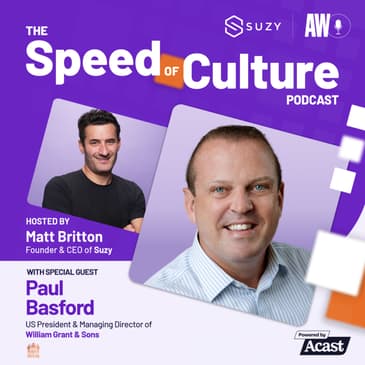
In this episode of The Speed of Culture, Matt Britton sits down with Paul Basford, US President and Managing Director of William Grant & Sons. Paul shares insights into driving growth, navigating shifts in consumer behavior, and embracing premiumization across William Grant’s portfolio of high-end spirits.
Follow Suzy on Twitter: @AskSuzyBiz
Follow Paul Basford on LinkedIn
Subscribe to The Speed of Culture on your favorite podcast platform.
And if you have a question or suggestions for the show, send us an email at suzy@suzy.com
Hosted on Acast. See acast.com/privacy for more information.
[00:00:01] The beauty of a bar is the interaction between bartender and consumer. The humanity that exists between those two relationships, the theatre that exists in watching a bartender create an amazing cocktail and then tasting it and then trying something else. I think it's just there's a unique chemistry there that we always want to protect.
[00:00:22] To thrive in a rapidly evolving landscape, brands must move in an ever-increasing pace. I'm Matt Britton, founder and CEO of Suzy.
[00:00:29] Join me and key industry leaders as we dive deep into the shifting consumer trends within their industry, why it matters now, and how you can keep up. Welcome to The Speed of Culture.
[00:00:44] Up today, we're thrilled to welcome Paul Basford, the US President and Managing Director of William Grant & Sons with a rich background in the beverage industry and a proven track record of driving growth innovation. Paul brings a wealth of knowledge and experience to the field. Paul, so great to see you today.
[00:00:58] Paul Basford, Great to see you too, Mark. Thank you for having me.
[00:01:00] Absolutely. Yes, for sure. And so for those who don't know William Grant & Sons because it's a holding company, tell us about some of the brands that you oversee.
[00:01:08] Absolutely. I know we have a tremendous range of brands that certainly by their own definition will be understood by your listeners.
[00:01:13] So we have some great brands such as Hendrix Gin. We have Glenfiddich Whiskey. We have Balveni Whiskey.
[00:01:19] We have a fabulous tequila called Milagro, a wonderful Icelandic vodka called Reka.
[00:01:23] And then we have Tullamore Dew, our Irish whiskey as well. We're about 12 to 13 brands in the US that are in play, generally covering lots of different categories, but all very high premium, ultra premium, super premium brands in their own right.
[00:01:37] So yeah, we're blessed to have such a good portfolio.
[00:01:39] And in terms of what drives growth for your business, is it more on the on-premise side where you're focusing on bars and nightclubs and the like, or you focus more off-premise at liquor stores, grocery, et cetera? What channel do you find drives the most growth?
[00:01:54] Yeah, no, it's an interesting question. I think that the whole channel makes us change quite a bit over the last three, four years during and post-COVID has been a real transition of where people were buying product. Some of the trends have slowly changed back.
[00:02:05] So we've always been a pretty heavy on-premise business, but through COVID, we really did develop our retail play, ultimately as a course to get product to consumers during that difficult time when bars, restaurants were closed.
[00:02:16] So quite almost in parity in how we approach each channel, but probably retail is our biggest channel out of the two, so off-premise.
[00:02:23] But we are increasing now the presence in on-premise and we are looking to support, have been supporting a lot, the re-emergence of the on-premise.
[00:02:30] It's such an important channel for us. It's where a lot of our brands were born.
[00:02:33] Hendrix, particularly, was a brand that has been born and on-premise has expanded to retail.
[00:02:38] Our single malts do very well in fine dining and restaurants.
[00:02:41] And we also believe very heavily in the bartender advocacy for our brands because ultimately, they're almost like our selling agent in the on-premise.
[00:02:49] Those guys, they're mixologists, they're very professional, they have high standards, they want to use high quality and the best liquor they can.
[00:02:56] And I think we play really well into that space.
[00:02:58] But again, we want to help them with their education.
[00:03:00] We want to help them with their footfall into outlet and get people back into buying in on-premise.
[00:03:05] So we have a balance.
[00:03:06] Retail's bigger, but we are pushing more on-premise SKUs to really help that trade come back from what was a really, really difficult time.
[00:03:13] Yeah, I'm sure.
[00:03:14] Makes complete sense.
[00:03:15] And in the world of spirits, I know that tastes are always changing.
[00:03:18] And looking at your portfolio, you have vodka, you have gin, you have whiskey.
[00:03:22] What are some of the trends in terms of, in the United States, where the consumer is gravitating towards?
[00:03:27] Obviously, tequila was super hot.
[00:03:28] And I noticed that you don't really play in that space as one of your core brands.
[00:03:32] So I would love to hear about that as well.
[00:03:34] But where is the consumer headed right now?
[00:03:36] Well, actually, we do play tequila.
[00:03:37] We have a brand called Milagro, which is actually our biggest volume brand.
[00:03:41] It is?
[00:03:42] Okay.
[00:03:45] Tequila and the cocktail of tequila, which has been a bit of an emergence.
[00:03:49] You know, the margarita has always been the standard cocktail.
[00:03:52] But actually, we found people experimenting and almost switching vodka out for tequila during COVID and post-COVID.
[00:03:58] That trend has continued.
[00:03:59] So Milagro is still one of our fastest growing brands.
[00:04:02] Milagro is still our biggest absolute case brand that we have in the portfolio.
[00:04:06] We see that tequila is slowing down.
[00:04:08] But in our price point, which has been, you know, kind of $30 to $40, that price point is still pretty active and doing really well.
[00:04:15] So we see that category doing well.
[00:04:17] We're seeing a relative growth in Irish.
[00:04:20] So our Irish whiskey is also growing really well.
[00:04:23] Tullamore Dew is a brand that we have in that place.
[00:04:25] I think people are experimenting outside of Scotch into something a bit different.
[00:04:29] And obviously, the people are used to bourbon.
[00:04:31] But Irish is another sector that's becoming really interesting.
[00:04:34] It has a different taste profile, obviously.
[00:04:36] And this year, we brought out a Tullamore Dew honey, which is bringing some natural flavor into Tullamore Dew to then expand that out into mainly on premise, but also in some retail.
[00:04:45] We're also seeing gin.
[00:04:47] So we have a really great old freemium gin called Hendrix.
[00:04:49] Hendrix continues to just grow.
[00:04:52] And grow and grow.
[00:04:53] We innovate around the brand because it's important.
[00:04:56] The brand has been around since 1999.
[00:04:58] It's important you continue to keep the consumer stimulated with different expressions, with different releases.
[00:05:04] We have a concept called the cabinet of curiosity.
[00:05:06] And if you know anything about Hendrix, it's quite a weird and wonderful Victoriana type brand where we can play some really off-the-wall marketing tactics that's not conventional for the gin category.
[00:05:17] And certainly Hendrix is far from conventional.
[00:05:19] We play different flavors.
[00:05:21] We play different variants.
[00:05:22] We have this cabinet of curiosity that comes out, which is a limited edition flavor once a year, which comes out and runs for two years.
[00:05:29] And ultimately, that is about bringing a different flavor to the base Hendrix gin.
[00:05:33] This year, we have an expression called Grand Cabaret.
[00:05:36] So it's Hendrix Grand Cabaret, which is effectively a Hendrix base with stone fruit undertones.
[00:05:41] Last year, we had one called Neptunia, which was more sea and kind of the sea herb, sea vegetable, the ozone tasting brand.
[00:05:50] And we do that every year.
[00:05:51] And it's just something that people look forward to.
[00:05:53] And it's quite collectible as a collection.
[00:05:55] We're on about our seventh expression now.
[00:05:57] So that's an interesting annual thing that we do.
[00:05:59] So gin's doing well for us.
[00:06:01] We've seen some upsurge in some traditional spirits.
[00:06:04] We have a brand called Drambui, which is a Heather Honey whiskey liqueur.
[00:06:09] Drambui is being used in different ways, being more cocktail oriented.
[00:06:12] There's a big push on the espresso martini.
[00:06:15] We do the Drambui espresso martini as well, which is helping the brand tick along.
[00:06:19] And it's just one of those traditional brands that does really well.
[00:06:22] And then clearly vodka.
[00:06:24] We have a great brand called Reker, which is Icelandic in Tation.
[00:06:27] It's very crisp, very clear.
[00:06:29] And Reker is really pushing forward.
[00:06:31] And people are looking for that tremium look that's a bit different to Tito's, but also tastes great.
[00:06:37] And I think the purity of Iceland comes through in that.
[00:06:39] So we have quite a few different growing categories.
[00:06:42] And that's the beauty of having the portfolio we do have for Matt.
[00:06:44] So you mentioned a bunch of things I want to unpack.
[00:06:46] The first thing you had mentioned is during COVID that there was a shift away from vodka to tequila.
[00:06:52] What drives a shift like that?
[00:06:54] Is it sort of celebrity infused?
[00:06:56] Is it driven by social media?
[00:06:58] Why do consumers suddenly adopt one scare versus another?
[00:07:02] I think there's multiple theories.
[00:07:03] I think undoubtedly the celebrity train just started and then kept going.
[00:07:07] You know, you've got significant scale celebrities, not kind of the A-list celebrities getting involved.
[00:07:13] When you look at people like The Rock and George Clooney, and they really pushed the whole thing along.
[00:07:18] I think there was actually an appetite from the consumers.
[00:07:20] So if you think about the consumer mindset during COVID, the consumer is trapped at home.
[00:07:25] They're looking for different things to do.
[00:07:27] They suddenly all become bartenders at home.
[00:07:29] And they start to learn about the craft.
[00:07:31] They start to learn about mixology.
[00:07:33] They start to learn about the difference in different products.
[00:07:35] And they're buying lots of different things.
[00:07:38] And some of our retailers are saying how their ancillary products or cocktails just blew up during COVID.
[00:07:43] People experimented at home.
[00:07:44] I think people were just curious.
[00:07:46] And I think we're always perceiving tequila as probably more of a shot than anything.
[00:07:52] And I think they got into the mixing and the mixability of the brand and how great some expressions such as reposado is in a cocktail.
[00:07:59] It's fabulous.
[00:08:00] And I think people have said, actually, I'm a bit bored of vodka.
[00:08:02] And I'm going to try something else.
[00:08:04] And I think tequila really played into that.
[00:08:06] And it became trendy at the same time with all the celebrity endorsements.
[00:08:09] So I think it was a confluence of lots of different factors.
[00:08:12] And I think then it became, during COVID, what can be the most expensive tequila I can buy?
[00:08:17] And there were some crazy price tequilas launched on the market.
[00:08:20] The market's now settled back down because people have just not got the income that they had disposable-wise like they had during COVID.
[00:08:27] And now I think we're now in the kind of $30 to $50 mark per bottle seems to be the hotspot.
[00:08:33] And we play in that space, which is great.
[00:08:35] We have a silver.
[00:08:36] We have a reposado.
[00:08:37] We have an anejo, which is the aged version of tequila.
[00:08:40] So again, people are experimenting between those three.
[00:08:42] And not a lot of people knew much about tequila before COVID.
[00:08:45] But people took time and had time to be able to understand the product, understand the category, and understand some of the mixability options.
[00:08:52] So plus a celebrity, plus a good price point, I think it was something that really struck home.
[00:08:58] And has continued as well.
[00:08:59] It's one of the few growth categories now still in the U.S.
[00:09:03] American whiskey and tequila are the two that are still showing signs of growth.
[00:09:07] And the growth from COVID was never going to carry on across all categories.
[00:09:10] But those two are still growing.
[00:09:11] So you had talked about, when you talk about Hendricks,
[00:09:13] you talk about the heritage and the story behind a brand.
[00:09:16] And one other trend we've seen in recent years, in addition to celebrity infusion into brands,
[00:09:23] is just the importance and focus on packaging.
[00:09:25] So if you look at like a class of Zool and how much they overspend on their packaging,
[00:09:30] obviously a lot of people do judge a book by its cover, so to speak.
[00:09:33] And that's sort of the spirit's analogy of buying a spirit based upon the packaging.
[00:09:38] How important is that?
[00:09:39] How much focus do you put in the area of packaging relative to other things that are drivers of success for a particular brand?
[00:09:46] It's a really good question.
[00:09:47] For Hendricks, it is absolutely fundamental and has been fundamental to the proposition since it was launched.
[00:09:53] I'll talk a bit about the packaging shortly.
[00:09:55] From a William Grant perspective, I would say our first focus is always quality and always quality of liquid.
[00:10:00] And that plays all the way back to when we were first kind of, I guess, incubated as an organization in 1887.
[00:10:07] The founder, William Grant, had the absolute notion that he would produce what he said was the best dram in the valley.
[00:10:13] And the distillery sat in the valley.
[00:10:16] And his view was he would always be the best quality.
[00:10:18] And that founding statement has really played across everything we do now.
[00:10:22] All our liquids, all our products are of the highest quality.
[00:10:26] So quality liquid is fundamental.
[00:10:28] We take time.
[00:10:29] We spend a lot of time on research.
[00:10:30] We take time to let the product mature.
[00:10:33] We give it the right time and we put the right ingredients and the right quality of ingredients in as well.
[00:10:38] So quality is first.
[00:10:39] The packaging on Hendricks, I would say, has been probably the, aside from an amazing liquid,
[00:10:44] which was a conception by our wonderful master distiller, Leslie Gracie, back in 1999, probably a bit earlier, actually,
[00:10:50] when her and the then kind of the Charlie Gordon, who was then the chairman of the organization at the time,
[00:10:57] decided he wanted to do a gin on Cain Lethfield.
[00:11:00] Charlie had a great instinct around products that he thought we should have in our portfolio.
[00:11:04] We'd been a heavy single malt whiskey-based business until that point.
[00:11:08] Hendricks was one of our really big forays into something a bit different.
[00:11:11] He decided he wanted a gin that wasn't a typical gin.
[00:11:13] He wanted a gin that wasn't a London dry gin.
[00:11:16] And he wanted everything that was different.
[00:11:18] So he wanted to add rose and cucumber to the base spirit.
[00:11:21] He wanted to call it something a bit off the wall.
[00:11:24] And Hendricks was actually the name of the rose gardener at the family home.
[00:11:28] So they called it Hendricks on the back of a guy who used to be the gardener and prune the roses at the family home.
[00:11:34] And then the third part he wanted was something step-changing in terms of packaging.
[00:11:37] And I think with whoever got the brief, absolutely nailed the brief because it is very, very distinctive.
[00:11:42] It remains very distinctive to this day.
[00:11:45] It actually was modeled off of an old apothecary bottle.
[00:11:48] If you think about the old, where they used to store really crazy potions and lotions in then pharmacies,
[00:11:54] it was modeled off of that because he wanted to show that it was almost a concoction of lots of great botanicals, herbs, spices, amazing spirits.
[00:12:04] So I think it's been our real trademark.
[00:12:06] I think it's very distinctive.
[00:12:07] People look at it and instantly know what the brand is.
[00:12:10] The brand is called, I'll have a Hendricks and Tonic.
[00:12:13] People call it instead of a Genna Tonic.
[00:12:16] We have a great brand call.
[00:12:17] And I think the packaging has been a real emphasis on that.
[00:12:20] And whenever we do these cabinet of curiosities, we always use a very, very similar base packaging.
[00:12:25] We articulate the label, change the colors up.
[00:12:28] But ultimately, it's always on that base bottle.
[00:12:30] So packaging for us has been absolutely fundamental alongside a very quirky advertising campaign and obviously the quality of liquid.
[00:12:38] Yeah.
[00:12:39] Another trend we've seen as of late is just that Gen Z, which is your future consumer,
[00:12:44] there's been sort of a notable trend of them consuming less alcohol compared to previous generations.
[00:12:50] We talked about COVID and health and wellness focus.
[00:12:53] Obviously, the legalization of cannabis gives an alternative to Gen Z.
[00:12:57] How are you looking at this next generation to make sure that your brands and your overall products can stay relevant to this new generation?
[00:13:06] Absolutely.
[00:13:07] I think it's a great predicament that everybody in our acquisition faces, not just in the spirits industry, but in the liquor industry and the wider wines and spirits industry.
[00:13:13] We have a notion that actually, whilst they're not drinking, they're drinking better.
[00:13:18] When they do drink, they drink better.
[00:13:19] They drink better quality.
[00:13:21] Their spend per head is probably higher than it would have been when I and you were those ages.
[00:13:26] They're spending on better things.
[00:13:27] They're spending higher quality.
[00:13:28] They're not quality aware.
[00:13:30] So we're plugging a lot of our quality cues and a lot of the messages around our advertising is around how the quality of the ingredients,
[00:13:37] how if there's no additives that we talk about, no additives for the first time in a long time,
[00:13:41] we talk about some of the other things we've probably never really talked much about that appeal to that generation.
[00:13:47] There's also a big movement around how do we look at other sectors, you know, from a responsibility perspective in this industry,
[00:13:53] we have to be on top of our game in terms of making sure we're promoting responsible consumption.
[00:13:57] How do we promote the non-alcoholic side of things as well?
[00:14:00] And making sure we always have non-alcoholic cocktails on our cocktail list,
[00:14:04] making sure that we're doing research and development and innovation in non-alcohol,
[00:14:08] I think is now the thing that lots of companies are looking at with this emerging trend and saying,
[00:14:12] actually, we need to be in that space.
[00:14:14] William Grant will not just jump into that space.
[00:14:16] It will be a very well thought through entry into a non-alcoholic.
[00:14:20] It will be a step change.
[00:14:22] It will be a very different non-alcoholic if and when we do that.
[00:14:25] I don't think it will be a regular, it'll be something off the wall, but it will be very appealing.
[00:14:30] So I think it's an exciting space.
[00:14:32] It's a different space.
[00:14:33] But yes, we have to market ourselves and prepare ourselves for a different consumption pattern.
[00:14:37] But ultimately, we think it gives us more opportunity because people do drink those
[00:14:41] premium stroke, ultra-premium stroke, super-premium brands when they do as Gen Zs.
[00:14:45] We'll be right back with the Speed of Culture after a few words from our sponsors.
[00:14:49] It's interesting because when you think about the new generation and just younger consumers in general,
[00:14:54] you have this juxtaposition because a lot of the most successful brands and spirits,
[00:14:58] they do link into heritage and that brand trust and a long story of, like you were talking
[00:15:04] about the story of Hendrix, and I'm sure each of your brands has a story.
[00:15:08] But at the same time, you have to juxtapose that with how younger consumers maybe don't
[00:15:13] want to drink their father's whiskey or their mother's tequila or vodka.
[00:15:17] So you almost have to balance that.
[00:15:19] So how do you think about, I guess, reading into the future while also maintaining the heritage
[00:15:24] as a differentiation?
[00:15:26] We do, and I think we do that really well with that Glenfiddich brand, which has the range for
[00:15:31] dad and granddad, let's be super clear.
[00:15:33] So it has a range of products, but it then has a really, really good, quite modern range
[00:15:38] called our Grand Series, which is a lot more trendy, a lot more kind of modern.
[00:15:42] The packaging is very different.
[00:15:43] It's a different orientation.
[00:15:44] Appeals to a completely different group to what the traditional Glenfiddich and the older
[00:15:49] entrant Glenfiddich would have done.
[00:15:50] I think you can play both in a brand.
[00:15:52] I think you can have almost two ranges within a brand that effectively make a big difference.
[00:15:57] And I think our grand range really plays into that.
[00:15:59] We do different expressions of that.
[00:16:01] So we do different ages and different cask finishes as well, whether it's a champagne cask
[00:16:06] or a Yozakura cask.
[00:16:08] We use different expressions of casks to also bring a bit of modernity to the play.
[00:16:11] So I think you can have a great traditional brand.
[00:16:13] Glenfiddich has been around.
[00:16:15] It was our first.
[00:16:16] It was 1887.
[00:16:16] It's been around for whatever that is, 136 years.
[00:16:20] And we're very proud of how that's evolved.
[00:16:23] We're very proud of the innovation we've had to have along the way.
[00:16:26] It created the single malt category.
[00:16:28] So actually, it will continue to appeal to lots of different age groups, ranges.
[00:16:32] And I think with the modernity of it, getting these brands into cocktails as well gives it
[00:16:37] an extra expression with the younger clientele.
[00:16:40] And we do a lot of, let's say, an old-fashioned, which is traditionally a bourbon drink.
[00:16:45] We will do it with Glenfiddich.
[00:16:46] We will bring different access to Scotch that actually hasn't been seen.
[00:16:50] A Manhattan, similarly.
[00:16:52] And we'll try and do some old favorites, but with actually new Scotch expressions.
[00:16:55] And that brings a bit of interest and brings younger people in as well.
[00:16:58] Actually, I quite like that Glenfiddich.
[00:17:00] I'm going to go and buy a bottle from retail.
[00:17:02] So that's the importance of the on-premise and how we see that
[00:17:05] influencing our brand building and our brand strategy.
[00:17:07] And that's why we see it so important to come back.
[00:17:09] So, Paul, I don't know if you heard about this new product, Bartesian.
[00:17:13] I was recently given as a housewarming guest, which is an in-home cocktail maker.
[00:17:17] And just speaking about new trends that occur,
[00:17:20] on one hand, I know that consumers look at sort of the homegrown,
[00:17:25] artisanal behavior of making their own drinks.
[00:17:27] But at the same time, you have this new generation embracing AI, embracing new technologies.
[00:17:32] And I'm curious, your thought on a product like that or just other technological-related
[00:17:37] innovations that are happening in the space related to consumer behavior
[00:17:40] and how that might be impacting your category?
[00:17:43] I think great.
[00:17:44] I think the at-home piece, I think everybody's about convenience now
[00:17:47] and trying to get something as quick as they can across all aspects of life.
[00:17:50] So I think there's a role to play.
[00:17:52] I think our brand is probably more traditionally fit with the time taken, the craft,
[00:17:56] the quality building a cocktail, literally pressing a button or doing different things
[00:18:00] to get one.
[00:18:01] Our brands are very much more in that studio of actually we want people to take the time,
[00:18:05] enjoy the experience, immerse themselves in our brands as part of that cocktail process
[00:18:09] and experiment.
[00:18:10] I think that's a big part of it.
[00:18:12] Technology is changing all over the place.
[00:18:14] I think we're, as a company, using technology ourselves to try and understand where the consumers
[00:18:19] are, let alone what's going on with the consumers themselves and what they're buying.
[00:18:23] There's a huge move forward now in terms of trying to track consumer patterns, trying to
[00:18:28] work out the age and the profile of people going into certain bars.
[00:18:32] There's a whole piece on bars and where they sit in different neighborhoods.
[00:18:36] We're even looking at things like cell phone data and construction permit data to triangulate
[00:18:41] where the consumers are now, which is a fascinating evolution and something that certainly our founder
[00:18:47] in 1887 would have never conceived will be something that we would use to decide on actually what
[00:18:52] is the range of products that should be in a certain bar based on the consumer that goes
[00:18:56] in there.
[00:18:56] What do we target our sales teams against and our distributors against and how do we use
[00:19:01] that data to do that?
[00:19:02] It's a whole different world.
[00:19:03] So I think technology is moving into the brand owners as much as it's moving to the
[00:19:07] bars.
[00:19:08] And the technology in bars for me becomes a bit concerning if it becomes too much because
[00:19:13] the beauty of a bar is the interaction between bartender and consumer.
[00:19:17] The humanity that exists between those two relationships, the theater that exists in
[00:19:23] watching a bartender create an amazing cocktail and then tasting it and then trying something
[00:19:27] else.
[00:19:28] I think it's just, there's a unique chemistry there that we always want to protect.
[00:19:32] And listen, if people want to be more convenient at home, great.
[00:19:35] But I would always implore them to have that interaction.
[00:19:38] Ask the bartender and these guys have such amazing knowledge of products and what goes
[00:19:43] together.
[00:19:44] You don't always need a menu.
[00:19:45] You just need some great liquid on the bar, some fresh ingredients and a bartender can
[00:19:50] make whatever their choice of the moment is.
[00:19:52] There's nothing better than asking a bartender, what would you have?
[00:19:55] And off they go.
[00:19:56] Yeah.
[00:19:57] Hopefully we're not going to be served by a robot bartender anytime soon.
[00:20:00] No, that'll be horrific.
[00:20:01] Horrific.
[00:20:02] So let's switch gears a little bit as we wrap up here, Paul, to you and your role as US
[00:20:07] president at William Grand Sons.
[00:20:09] Talk to us about how you spend your time, what you focus on in driving your organization
[00:20:14] forward across the multitude of brands that we've discussed.
[00:20:17] Yeah.
[00:20:17] The beauty of this industry, Matt, is it's so diverse and I wish I could tell you what
[00:20:21] I did on a daily basis.
[00:20:22] It's so different.
[00:20:23] It's a multifaceted, there's lots of different stakeholders.
[00:20:27] So I would say a lot of my job, first and foremost, is team and people and creating
[00:20:31] the right, the sustainable, the open and transparent culture that's so important in this industry,
[00:20:37] particularly.
[00:20:37] And having worked in lots of other beverage sectors, the need for transparency, openness
[00:20:42] and just general authenticity is really high in spirit.
[00:20:46] So setting the right frame of work for my team, and that involves a lot of mentoring, a lot
[00:20:50] of taking time with good talent, new talent to spend that time.
[00:20:54] And as my old boss used to say to me, sending the elevator back down for people that want
[00:20:59] to grow their career and they grow their journey.
[00:21:01] So I think the whole people piece and keep people motivated our journey, setting the strategy.
[00:21:06] So if you have a great team of people, it's kind of worthless if you don't have the right
[00:21:10] direction, you don't have the right North Star.
[00:21:12] So setting what the direction is so they can all mobilize and run towards it.
[00:21:17] And then I think setting the fundamentals.
[00:21:19] So making sure that our stakeholders are really pushing our brands.
[00:21:23] We have a great network of distributors in the US.
[00:21:25] We can't distribute a product ourselves.
[00:21:27] We work within the three-tier liquor system, which means we have to use distributors and
[00:21:32] distributors sell to retailers.
[00:21:33] Nobody can mix the levels within that system in the US.
[00:21:36] It's a complicated legal system.
[00:21:38] So making sure those distributors are appropriately animated, top to top and across our organization.
[00:21:44] And then I have a big job in managing my, I guess, group company.
[00:21:49] So we're based in the UK.
[00:21:50] We have a global presence around the world.
[00:21:53] Scotland is up natural home.
[00:21:54] Our offices are near London in a place called Richmond.
[00:21:57] A lot of my job is stakeholder management and actually asking for resources and the things
[00:22:01] that this business needs to grow.
[00:22:03] Whether that's investment, whether that's people, whether that's help and ideas, whether
[00:22:07] it's project support or however that is.
[00:22:10] And then obviously explaining a lot around the performance in the US.
[00:22:13] The US is our biggest business by some way.
[00:22:15] We're probably 35% of the group at a total level.
[00:22:20] And with that comes a lot of responsibility and a lot of ownership.
[00:22:22] And we get a lot of visitors to come and look at the markets.
[00:22:25] And actually we are one of the few markets that does sell so many of our brands.
[00:22:29] We are pretty much full portfolio in the US.
[00:22:31] A lot of other markets sell half of that or a couple of brands around the world.
[00:22:36] So it's a real mixed bag.
[00:22:37] And that's what I love about this industry.
[00:22:38] It's just never the same.
[00:22:40] And the other piece is, I would say, is you can really make a difference in this industry.
[00:22:45] I came in three years ago and reset the strategy, reset the culture, reset the people.
[00:22:50] And we've grown 14% year over year over year for the last three years.
[00:22:55] The business has grown 50% in value since then.
[00:22:58] And I think it's such a business that you can just be really tangible.
[00:23:01] And if you make things happen, things come.
[00:23:03] You've just got to dream and be bold and be big about your ambition.
[00:23:07] And so I spend a lot of time reminding people about how big our ambition is and how they should
[00:23:11] really make it bigger, which sometimes is good and sometimes it's bad for them.
[00:23:15] And how much time are you spending on just innovation and looking at new brands that
[00:23:21] you either want to acquire or you want to develop internally so you can build that next big winner
[00:23:26] for the company?
[00:23:27] Luckily, a lot of that for us in group.
[00:23:29] We are always looking at the next opportunity.
[00:23:32] We just recently purchased a brand called Cyberpool, which is an ultra premium gin based in the
[00:23:37] UK from the Surrey Hills, which is just south of London.
[00:23:39] A fantastic local product.
[00:23:41] And this is, again, what we look for in an acquisition.
[00:23:44] High quality, point of differentiation, great packaging, tastes incredible.
[00:23:49] It's actually a really well-distilled gin with local honey as a base.
[00:23:53] And it really does make a difference.
[00:23:55] So we're always looking to acquire products or categories that are something we don't play
[00:24:00] right now.
[00:24:00] So I spend quite a lot of time just pushing ideas or pushing brands that I get connected
[00:24:04] with into our business development group.
[00:24:06] And they take a look and decide if it's the right thing.
[00:24:09] And then obviously, as the brands come to fruition, we get input into actually, would
[00:24:12] it work in the market?
[00:24:13] How would you execute it?
[00:24:15] What creative would you use?
[00:24:16] Those sort of things.
[00:24:17] And it's forever innovating.
[00:24:19] And it's not just innovating in buying other things.
[00:24:21] It's innovating in variants, flavors, kind of finishes.
[00:24:25] You know, in Scotch, a lot of innovation is just in cask finish.
[00:24:27] And how you can do something different in cask finish with age is a very big innovation
[00:24:32] task or renovation task in Scotch.
[00:24:34] So trying to find what those next best things are in those existing categories as well is
[00:24:39] always good.
[00:24:39] But we've got a great portfolio that constantly needs attention and constantly is building
[00:24:43] itself.
[00:24:44] So we're not always getting distracted with innovation.
[00:24:46] You've got to look after your core as well.
[00:24:48] Yeah, makes sense.
[00:24:50] So as we wrap up here, we'd love to hear from you as you look back on your career.
[00:24:54] Obviously, you're in a really exciting position.
[00:24:57] Met Lindgren, Sunde, ever seeing some super iconic brands and obviously a lot of opportunity
[00:25:02] ahead of you.
[00:25:03] What are some of the decisions that you made throughout your career that you think were
[00:25:06] the right ones as you look back at your career journey that put you in a position that
[00:25:09] you're in today?
[00:25:10] I think there's a couple.
[00:25:11] So I was blessed with being brought up in a very hardworking family.
[00:25:15] Hard work was an ethos that was drilled into me from being very, very small.
[00:25:18] I think no matter what job you're doing, I always have the ethos, work as hard as you
[00:25:22] can in it and give everything you can to it and never be complacent that you're giving
[00:25:26] enough and always challenge yourself to give a bit more.
[00:25:28] I think the other part of it, some of the key points in my career was actually leaving
[00:25:33] the UK to come to the US 12 years ago.
[00:25:36] That was a big moment where it's quite a big decision.
[00:25:39] You're born and raised and you grow up in a similar region for most of your life.
[00:25:43] And then all of a sudden you get an opportunity to move across the Atlantic.
[00:25:45] I would encapsulate it by saying, sometimes do things that scare you.
[00:25:49] And I continue to have this mantra of actually do something that scares yourself now and
[00:25:53] again, because you know what?
[00:25:55] The results are so step change versus other things that you might come across.
[00:25:59] So moving to the US definitely scared me, but it was the best thing I did.
[00:26:02] And I would say some of the other decisions were never really say no to an opportunity.
[00:26:07] We're never offered an opportunity.
[00:26:08] Obviously take time to think about it, but never really turning it down and just going
[00:26:13] with it and being bold and going with it.
[00:26:15] And then I think trying to grasp different sectors within beverage was one of my big
[00:26:20] wins, which at the time I didn't really realize, but I moved from with the Azure selling again,
[00:26:25] premium spirits in the UK to a soft drinks company.
[00:26:27] And then I moved to a water company and they're all very different in their orientation.
[00:26:31] They're all beverage.
[00:26:32] So they're all competing for share of throats, but they're all very different in how they go
[00:26:37] to market.
[00:26:38] They're all very different in their consumer type, the types of data they use, how they
[00:26:41] distribute their products.
[00:26:43] The P and L is very, very different from those sectors.
[00:26:45] In spirits, we met, you know, the margins are a lot higher than they are in water.
[00:26:49] So when you do, when you're managing a P and L in water, every single cent counts.
[00:26:53] So you have to be very forensic in your P and L.
[00:26:55] And I think that's it.
[00:26:56] And I've always kind of been one where I put people first.
[00:27:00] I think the big ethos is there's the famous saying, there is no I in team.
[00:27:04] I always lead with team.
[00:27:05] I always lead with people.
[00:27:07] I base everything I do off people and making sure that we have the right motivation, the
[00:27:11] right culture, the right base.
[00:27:13] Without that, a strategy is dead in the water.
[00:27:16] So I would just say, so my advice would be always think about the people, either the effect
[00:27:20] that your strategy is having on those people or involvement of those people in your strategy
[00:27:24] or both.
[00:27:25] I think is pretty key.
[00:27:27] And like I say, always remember where you came from and always remember the elevator
[00:27:30] was sent down for you.
[00:27:32] Therefore, it's your obligation to send it back down.
[00:27:33] I love all those kind of tips, especially just the power of a team and how you can only
[00:27:39] go so far by yourself and how you really have to focus on building that surrounding cast that
[00:27:43] can help you accomplish what you want.
[00:27:45] So it's been so great today, Paul, hearing about your journey and your brands have been
[00:27:48] a fantastic discussion.
[00:27:50] And I'm going to have to pour myself and my Hendrix tonight to celebrate our great podcast
[00:27:55] interview.
[00:27:56] Maybe Hendrix cocktail, Mark.
[00:27:57] Maybe get a bit of expression on it.
[00:27:58] Maybe something a bit different.
[00:27:59] You got it.
[00:28:03] Thanks, sir.
[00:28:04] Fantastic.
[00:28:05] So great to connect with you.
[00:28:06] And yeah, cannot wait for our audience to hear the pod.
[00:28:09] On behalf of Suzy and Adweek team, thanks again to Paul Baxford, the U.S. President and
[00:28:12] Managing Director of William Grant & Sons for joining us today.
[00:28:15] Be sure to subscribe right now to the Speed of Culture podcast on your favorite podcast
[00:28:18] platform.
[00:28:18] So next time, see you soon, everyone.
[00:28:20] Take care.
[00:28:25] The Speed of Culture is brought to you by Suzy as part of the Adweek Podcast Network and
[00:28:30] A-Guest Creator Network.
[00:28:31] You can listen and subscribe to all Adweek's podcasts by visiting adweek.com slash podcasts.
[00:28:37] To find out more about Suzy, head to suzy.com.
[00:28:40] And make sure to search for the Speed of Culture in Apple Podcasts, Spotify, and Google Podcasts
[00:28:45] or anywhere else podcasts are found.
[00:28:47] Click follow so you don't miss out on any future episodes.
[00:28:50] On behalf of the team here at Suzy, thanks for listening.