
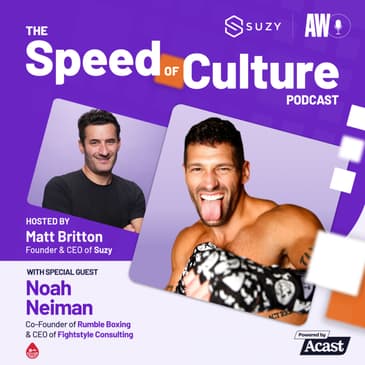
In this episode of The Speed of Culture, Matt Britton speaks with Noah Neiman, Co-Founder of Rumble Boxing and CEO of FightStyle Consulting. Noah shares how authenticity, community, and resilience have been the cornerstones of his success, redefining what it means to thrive in the fitness industry. Rumble Boxing first opened in NYC in 2017 and now has 85+ locations in the US with international presence in Australia, Japan, Dominican Republic, Kuwait, and Mexico.
Follow Suzy on Twitter: @AskSuzyBiz
Follow Rumble Boxing on LinkedIn
Subscribe to The Speed of Culture on your favorite podcast platform.
And if you have a question or suggestions for the show, send us an email at suzy@suzy.com
Hosted on Acast. See acast.com/privacy for more information.
[00:00:03] Jetzt ist Herbst und bald stehen schon wieder die Feiertage vor der Tür. Das kann auch für Hunde ganz schön stressig sein. Viele Vierbeine reagieren unter anderem mit einer gestörten Verdauung und das ist wiederum Stress für ihre Besitzer. Aber es gibt schnelle und einfache Hilfe, das Probiotikum Purina Proplan Forti Flora. Streu einfach einen Beutel über das tägliche Futter. Die außergewöhnliche Zusammensetzung mit lebenden guten Darmbakterien stellt das Gleichgewicht im Darm wieder her.
[00:00:31] Natürlich kannst du Proplan Forti Flora auch präventiv oder bei alltäglichen Verdauungsbeschwerden einsetzen. Es unterstützt auch bei Ernährungsumstellungen oder Antibiotika-Einnahme. Purina Proplan Forti Flora – jetzt auf shop.purina.de
[00:00:46] Wenn wir auf die
[00:00:54] Wir betrachten, um die
[00:00:55] Wir betrachten, um unsere Werte zu entwickeln, um
[00:01:01] zu entwickeln, um
[00:01:02] für andere zu werden, um
[00:01:04] stärker,
[00:01:04] um
[00:01:05] zu fühlen,
[00:01:07] um
[00:01:07] zu fühlen,
[00:01:08] dann
[00:01:08] wir wahrscheinlich
[00:01:10] werden
[00:01:11] ziemlich gut
[00:01:12] auf.
[00:01:14] To thrive in a rapidly evolving landscape, brands must move at an ever-increasing pace.
[00:01:19] I'm Matt Britton, founder and CEO of Suzy. Join me and key industry leaders as we dive deep into
[00:01:24] the shifting consumer trends within their industry, why it matters now, and how you can keep up.
[00:01:29] Welcome to the Speed of Culture. Today, we're thrilled to welcome Noah Neiman,
[00:01:38] co-founder and creator of Rumble Boxing and CEO of Fight Style Consulting. Noah has revolutionized
[00:01:44] the fitness industry, was innovative, boxing-inspired group fitness classes,
[00:01:47] has expanded Rumble into a global brand. Noah, so great to see you, man.
[00:01:51] Thank you for having me. I need that entrance. It's like a Game of Thrones entrance. Every time
[00:01:55] I walk into a room, I wish you would announce me.
[00:01:57] Bring me everywhere and I'll just announce you. It'll be like when they announced Michael Jordan
[00:02:01] in 1989 with the Bulls, right?
[00:02:03] Okay, well, it's not blaspheme, first off, to kick off the interviews. But I already like your energy
[00:02:08] because sometimes when I do these pods, they're like, the host, I'm like, how did you get a
[00:02:12] microphone? Your energy, like, do you even want to be here? So I feel like our energies are matching
[00:02:17] right now, which is great because mine's a medical diagnosis. Mine is from ADHD, but yours seems to be
[00:02:22] more natural.
[00:02:22] Me too. That's one thing we have in common. I'm sure we'll uncover many more things and this
[00:02:27] conversation unfolds.
[00:02:28] Well, thank you for having me. I appreciate it.
[00:02:30] Absolutely. So tell me about your background. You're an entrepreneur and I love interviewing
[00:02:34] entrepreneurs in the podcast because it's completely unscripted. You don't have a PR team behind you
[00:02:39] telling you what to say. You are who you are. And that's exciting to me. When did you first become
[00:02:44] an entrepreneur and how did you end up in the seat you're in today?
[00:02:47] Well, I don't even think that there was like a definitive moment where it happened. I mean,
[00:02:53] I always give the analogy. Have you ever seen the movie Slumdog Millionaire?
[00:02:57] Yeah, of course.
[00:02:58] So everything in my life, all the missteps, especially all the dark moments actually led me to this kind of
[00:03:06] wild path that leads me to be sitting here right now. So I'll give you the brief version of it
[00:03:11] because I know you only said we have 25 minutes.
[00:03:13] Yeah. And I want to hear about some of the dark moments too, if you're willing to share.
[00:03:15] I'm an open book because guys don't go to therapy. We go on podcasts and we talk about our traumas.
[00:03:20] So that's fine. I'm down to share because again, my entrepreneurial, I guess, journey was kind of
[00:03:25] by happenstance, to be honest. I never planned it. And if I did plan it, I probably wouldn't have
[00:03:30] succeeded because I wouldn't have been able to capitalize on these moments as I did. So I grew up in
[00:03:35] Pittsburgh, Pennsylvania diagnosed with ADHD and anxiety, depression at a young age. And I was
[00:03:41] overweight as a kid. I was one of those kids, like t-shirt on in the pool. And I just always had a lot
[00:03:46] of emotional problems. So I got put on medicine. I had to go to these therapy sessions and they never
[00:03:52] worked for me. I just had this boundless energy and I found, luckily, I'm going to date myself now.
[00:03:59] You might know this.
[00:04:00] You saying I'm old, Noah?
[00:04:02] I knew we're getting up there, but listen, this is why we take care of ourselves because age is a
[00:04:06] relative thing. So I would get me a mail, these AOL, 50 free hours of internet CDs. And my parents
[00:04:13] wouldn't let me on the internet. And so I would download, I would make a fake accounts and I'd get
[00:04:17] on the internet and I happened to find like bodybuilding.com or something. It was just like
[00:04:21] rudimentary website back in the, I guess the nineties that had all these bodybuilding tips
[00:04:27] and kind of fitness tips. And so for some reason, I started to just dive into this world, not
[00:04:33] professionally, obviously I was a kid. And I found out rather quickly that the more I took care of my
[00:04:39] physical body, the more my behavioral problems, the more my emotional problems, the more my
[00:04:45] spiritual problems seem to be easier to control. They didn't go away, but I was just able to focus
[00:04:50] them. So fast forward through a ton of just, I mean, I got my degree in accounting. My first job
[00:04:57] was at J.H. Cohen, a midsize accounting firm in Midtown Manhattan. And now to be sitting here talking
[00:05:02] to you about starting one of the arguably the most impactful boutique fitness concepts of modern time
[00:05:08] with its expansion and its impact on communities. That's a crazy journey. So again, it was just
[00:05:15] everything that I learned about fitness and martial arts, which I took up at a young age, boxing and
[00:05:20] strength training and jujitsu and football. All of these principles I applied to my personal life
[00:05:26] and my professional life. And it's taken me to where I am right now.
[00:05:30] So you're working in an accounting firm probably in your early twenties. And you talk about you
[00:05:36] always were an entrepreneur, but you weren't an entrepreneur when you're sitting in the seat
[00:05:39] at an accounting firm. So what happened?
[00:05:42] Well, listen, I kind of was an entrepreneur, a lot of entrepreneurs and the statute of limitations
[00:05:45] is up and I'm very open about this part of my life. I used to deal a little bit of weed and I
[00:05:49] used to sell some, I know a few entrepreneurs. I won't name them, but big fortune five.
[00:05:53] Every entrepreneur I know that's very successful either was a nightclub promoter,
[00:05:58] Dell weed, or was a bookie. One of the three.
[00:06:00] Well, guess what? I'm two out of those three.
[00:06:03] All right. I was just a nightclub promoter. That's it.
[00:06:04] That's why we get along. So my business partner, Eugene Ram, who founded 10 June,
[00:06:09] one of them.
[00:06:09] I celebrate my 30th birthday in 10 June, long time ago, back in the day.
[00:06:14] The universe is aligning. I don't know what I believe in right now,
[00:06:17] but I believe in some kind of serendipity and there's a reason we're talking right now.
[00:06:20] So I used to work. So after my accounting job, well, in college, let's, I sold a little bit
[00:06:26] to afford the things that I wanted to. Hey man, now it's legalized, right?
[00:06:30] Yeah. Well, this was a long time ago, FBI and all the cops all along. I think it's 15 years. It
[00:06:35] was like 20 years ago. You can't get me. And we're, this is all satire.
[00:06:39] Exactly. Creative liberties.
[00:06:41] So I used to run to the bathroom, like any good Jewish boy. I would call my mom in the middle of
[00:06:47] this accounting profession and job. And I'm like, I have to be destined for more than this. Like I
[00:06:52] would be crying literally in the stall. And the funny thing was, is I was actually pretty good at
[00:06:57] my job because I was kind of as accountants go, I was kind of outgoing and I kind of had a different
[00:07:02] personality and a unique flair. Like I had my tattoos and I was, I had my little thing. So I would always
[00:07:08] get books from clients because they wanted to hang out. They wanted me to audit their businesses.
[00:07:13] So my bosses, even though I was kind of checked out at the job, they would always,
[00:07:17] they would give me a raise. I would go in to quit and it'd be like, all right, how's an extra $5,000?
[00:07:22] And then there was this one pivotal moment where my boss at the time, he had this big corner office
[00:07:28] overlooking Rockefeller Center and it was beautiful. And he was like, Noah, you're really good at what you
[00:07:33] do, but you're just not focused. It's like, do you want to be here? He was like, look at this.
[00:07:37] And he pointed to his things in the office. And he was like, if you lock down and focus
[00:07:42] in a couple of years, like you too could have this. And when I tell you that my heart sank and
[00:07:47] I was like, I don't want this. That's what he wanted. I'm like, God bless. And so I quit on
[00:07:52] the spot. And the funny thing is, is listen, luck favors the prepared. And so I can't say it was luck,
[00:07:59] but I was certainly fortunate to be in New York city going through all this because I was able to
[00:08:03] leverage networks, unlike any other city possible, which I'm a big believer that entrepreneur is
[00:08:08] only as strong as their relationship network and their sphere of influence. So when I left my
[00:08:13] accounting job, I linked up with this kid and we started a promotional direction company where we
[00:08:18] would hire DJs, we would hire promoters. So we were kind of promotional directors and we would take
[00:08:23] over nightclubs and we would run them. And I actually learned more about the service industry,
[00:08:28] about hospitality, about exceeding and kind of consumer expectations, customer expectations.
[00:08:34] So I learned all this in the streets of New York city, growing up in this iconic era of
[00:08:38] New York city nightlife where 10 June and Kane and guest house and Susie Wong and pink elephant
[00:08:44] and sweet 16. Yeah. And Marti and sweet 16 and duvet and all these places that the rappers were
[00:08:49] rapping about. I was fortunate enough to learn how to, again, take care of a customer.
[00:08:55] And at the peak of hospitality in New York city. So I did that. It was like one of those things where
[00:09:01] it's crazy looking back because I always tell the story about how I hired Aoki, DJ Aoki at one of my
[00:09:07] clubs for like, I want to say it was like 750 bucks. Maybe it was like 1500. I'm remembering he
[00:09:12] was in the come up, right? He's trying to make it just like everyone else. And now he goes for half a
[00:09:16] million dollars a show. And so again, the timing was very fortunate for myself to do what I'm doing now.
[00:09:22] So fast forward to the housing crisis of 2008, New York city kind of bottomed out. My life went
[00:09:28] through a big riff, a big hit. So I had left and it was kind of like fortunate, unfortunate timing.
[00:09:33] I had some family members that were very sick. I will call them out because they hate when I do
[00:09:37] this on a match. It's not, it's not often you get cancer and then you have your family member
[00:09:41] talking about it on a podcast. So I try to be respectful of them, but people very close to me,
[00:09:46] one had just suffered a heart attack, almost lost a life. And the other one was diagnosed with
[00:09:49] stage three colon cancer. So I moved to Pittsburgh, back to Pittsburgh, to my hometown to deal with
[00:09:54] that and just kind of find my place again after New York city. How was that for you? Was that hard
[00:09:59] because you were like in the middle of the limelight and all of a sudden it was debilitating.
[00:10:03] It was like the child star that lost their space in front of the camera and their limelight.
[00:10:08] You're probably thinking, am I ever going to get back to New York or is that it? I'm going back home.
[00:10:11] Exactly. I thought that especially coming from that exciting time of my life and then listen,
[00:10:18] I love my family, but not only to just go back to your hometown, you feel like you're kind of,
[00:10:22] at least for me, regressing a little bit because I was building such a prominent name and I was
[00:10:26] having so much fun and I was meeting so many interesting people. I was with Kanye and Jay-Z
[00:10:32] and Rihanna when they were doing like New York State of Mind, like releasing a song. And I was at
[00:10:37] 10 June when Busta Rhymes would grab the mic and rap. And I'm like, I can't believe I'm here.
[00:10:41] So then to go back to your hometown, that's actually probably that moment right there in this year.
[00:10:49] And this is very important for, I think everyone to understand because I almost at the end of that
[00:10:53] year, didn't make it out. I almost like literally died. And I'll give you the brief story of that.
[00:10:57] Move home, taking care of my family members that are sick, trying to find a way to make a name
[00:11:01] for myself in my hometown and make some money. I didn't save any money. Obviously it was all spent on
[00:11:06] clothes at Neiman Marcus, which is again, not me, but no trouble. So I got back into drugs and I
[00:11:13] started doing drugs again and it kind of got out of control just to escape from the situation you're
[00:11:18] in. From my family being sick, from me not having a purpose, like idle hands of the devil's playground,
[00:11:23] especially with somebody with energy like me that needs to focus it somewhere or I'm very destructive,
[00:11:29] which is why I try to stay as busy as possible as often as possible still to this day.
[00:11:32] Right. So I remember I was at a Superbowl party and I was doing drugs and I was mixing drugs that
[00:11:39] you shouldn't just cause I was, I felt invincible. And honestly, like at the time I didn't really care.
[00:11:43] I was going through such a hard point, low point that I wasn't thinking clearly. And I remember
[00:11:47] waking up in the hospital and seeing all of my family there. And that moment right there,
[00:11:52] like seeing my nieces, my nephew, my baby brother who adores me and I adore him, my mom,
[00:11:57] my dad, my brother-in-law, like my whole family just looking at me, not with like anger or malice,
[00:12:02] but just concern. And I promised myself from that moment that I would never make my family feel that
[00:12:08] way again. When you woke up, did you remember like how you ended up there? Fuck yeah. I remember every
[00:12:13] single feeling. I remember the feeling of my eyes rolling in the back of my head. I remember the
[00:12:17] feeling of like, if I pass out right now, I'm not waking up. And I remember that vividly. And to be
[00:12:22] honest, that fuels to this day, even though that was 15 plus years ago, to that day, that fuels a
[00:12:28] lot of my hustle and my fire to continue to push away from that dark spot. I still, despite everything
[00:12:34] that on paper I've done, I still have that chip on my shoulder and I'm still just that same kid from
[00:12:39] Pittsburgh that doesn't want to give their family that look in their eye again. So it was such a
[00:12:46] beautiful, again, serendipitous moment where I got out of the hospital a few days later and I was driving
[00:12:51] down the street in Lawrenceville in Pittsburgh, Pennsylvania. And there was this guy was hanging
[00:12:57] the sign that said Warren Stout Enzo Gracie Jiu Jitsu Pittsburgh. That was a mouthful. That sign
[00:13:03] must've cost a lot, but they were literally opening the studio and I had trained Jiu Jitsu at Sarah
[00:13:08] Jiu Jitsu down the street from Hofstra in Long Island. And that was always kind of my sanctuary where
[00:13:13] I got to get my energy out and my aggression out. And so I was like, why don't I get back into
[00:13:18] Jiu Jitsu? So that moment, I'm pretty sure that Warren and that crew in Pittsburgh and saved my
[00:13:23] life to be honest. And I give them so much credit. So I started training with these guys five days a
[00:13:27] week. And I kind of essentially what a lot of entrepreneurs or especially people in fitness
[00:13:32] do, we traded addictions. So I traded the drugs and the partying and the sense of the lack of
[00:13:37] purpose, I should say with, let me train. Let me get with this community of people that just want
[00:13:42] to see you get stronger and better physically. And then again, it reminded me of me as a kid when I
[00:13:46] would go to the gym and I would submit to like strength training and football. And I was like
[00:13:50] lost in that world. It got me centered and focused and it got all of those like panic attacks and the
[00:13:56] anxiety I was going through when the drug withdrawals, cause I quit cold turkey with no help, no pills,
[00:14:01] which is very tough. And every time I would feel negatively, I would train Jiu Jitsu. So fast forward
[00:14:07] a year after that, my parents literally kicked me out of Pittsburgh. They were like, listen,
[00:14:12] you're destined for something more than this. They've always been my biggest advocates. Well,
[00:14:17] not everyone that has parents that believe in them, right? Not everybody has that. They've
[00:14:20] been my biggest supporters. Even when I didn't see any potential in myself, I've always had a great
[00:14:25] support system. And I'm fortunate for that because honestly, sometimes that's all it takes. When you're
[00:14:30] going through a dark spot and you just have people that believe in you, as opposed to reinforcing your
[00:14:33] own systems of disbeliefs and distrust in yourself, that could be the difference between success and
[00:14:40] failure. So I'm very fortunate. Again, what got me to the seat is that slumdog millionaire.
[00:14:44] Every single little thing that's happened in my life is why I'm sitting there right now. And I
[00:14:48] wouldn't change a damn thing, even though it literally almost killed me. So I got kicked out
[00:14:52] of Pittsburgh. My parents gave me again, very open with my story, 10,000 bucks. I had no money.
[00:14:58] I was literally broke and lost and they gave me 10,000 bucks. God bless them. But as you know,
[00:15:04] in New York city, that doesn't go very far. So I was doing odd jobs. I moved back. I got a
[00:15:09] Craigslist apartment from this guy, Alex Malyshev, who was a Ford model who wanted to sublease his
[00:15:15] apartment for three months while he was in South Africa. So he gave me a really good deal, really
[00:15:19] good guy. He was like, listen, don't even pay my full rent, pay half rent. I just want something.
[00:15:24] And so I could afford to stay there for three months. That was my timeframe. I had three months
[00:15:28] of living. So I'm bartending, I'm modeling, I'm doing like little odd jobs. I'm like just whatever
[00:15:33] I can do to survive. I'm trying to get back in the nightlife scene. And then one of my friends
[00:15:37] asked me, this guy, Micah Jesse, he was doing a writeup on this place called Barry's Bootcamp.
[00:15:41] Yep. We had JJ, the CEO of Barry's Bootcamp on our podcast.
[00:15:45] Exactly. So I always give them love. Again, talk about my origin story. You've got to respect the
[00:15:49] people that helped you get where you're at. So I almost didn't go because I was having a really
[00:15:53] bad week. I was still suffering from panic attacks and going through anxiety. So I almost
[00:15:57] canceled that. And again, I'm not sitting there if I cancel that moment. So I dragged myself up. I was
[00:16:02] like, listen, I feel like shit right now, but guess what? I'm still going to go to this class.
[00:16:07] I'm going to show up. So I showed up and I remember being in the bathroom before that class,
[00:16:11] literally I would get panic attacks and my arm would go numb. So my left arm was like feeling
[00:16:15] kind of funny and I was feeling like short of breath, but the class was starting. The mic came
[00:16:19] on and the music came on and kind of startled me a little bit. And I was like, all right, whatever.
[00:16:24] I got to do this. I told my friend I was going to do it. I got to show up for them. I walk into
[00:16:27] Barry's and I end up just having the time of my life. I'm sprinting up hills and I'm squatting and I'm
[00:16:33] like high-fiving my friend. And the trainer at the time happened to be Joey Gonzalez.
[00:16:37] Joey. Yeah. Joey's actually who we are on the podcast. Yeah. So Joey Gonzalez. So I don't know
[00:16:43] what happened, but we struck up a conversation. He was like, listen, I don't know what you do.
[00:16:46] He didn't know that I trained jujitsu, that I had studied every strength and conditioning book in the
[00:16:51] industry, that I had access to world conditioning coaches and strength coaches, got to learn again,
[00:16:55] not from a classroom, but from real life. Like I was out there learning and applying in the same
[00:17:02] light. So he asked me if I wanted to train there. They had just opened a week ago.
[00:17:07] And Joey is now the CEO of Barry's Bootcamp. So he was a trainer and he became the CEO.
[00:17:14] Well, he was a trainer, but at the time he was also a partner. So he wasn't the CEO at the time,
[00:17:18] but he was a partner at the time. So I didn't know that.
[00:17:20] But that's where he got started. He got started as a trainer. Yeah.
[00:17:22] As a trainer. So much like my story. So each one, teach one. So we ended up striking this
[00:17:28] conversation up and he asked me if I wanted to be a trainer there. And I was like, I never thought
[00:17:32] about this, but yeah, sure. So I ended up going through all the trainings and stuff and they gave
[00:17:37] me one class Monday night, 9 PM. And that's a very hard sell. 9 PM, New York city, it's late.
[00:17:44] So I would show up sometimes and three people would be there, then seven people and then one person,
[00:17:48] and then no people would be there. And I'd walk home all disheartened, but then 10 people,
[00:17:54] 20 people, 60 people, 60 people with a wait list. And it was because again, that chip on my shoulder,
[00:18:00] I was like, listen, if I can focus for this hour of training people externally and not focus on the
[00:18:06] panic attacks I'm having, not focus on the shitty situation that I'm in and not consistently
[00:18:11] reinforce how tough my life is right now. And I can just for that hour focus on is the music dope?
[00:18:17] Is the experience awesome? Are the lights going? Am I motivating and galvanizing the room? Am I
[00:18:22] connecting with people? So I'm authentically giving them this energy so that they can feed off of
[00:18:26] the community responded to that. And again, talk about luck, like to be in New York city and doing
[00:18:32] that is definitely a big advantage. So I was training producers and directors. And there was
[00:18:38] this guy, Michael Rourke, who I was training. He was the founder of Hudson media group.
[00:18:42] And he was doing this series for GQ about fitness. It was called fighting weight. It was short episodic
[00:18:48] content on little like four minute workouts you could do anywhere. And the host was Eric Valdez,
[00:18:53] I think a former soap opera star. And he was like, yo, your energy is so good. I know classical
[00:18:58] training. He was like, why don't you jump on camera for this GQ gentlemen's quarterly opportunity?
[00:19:04] And I was like, yeah, I'm like, I'm a bum. Like, I don't know anything. I've never been trained.
[00:19:08] I don't know what I'm doing in front of the camera. Like, sure. If you want to put your
[00:19:12] reputation online, he's like, nah, just be yourself. You'll be great. So I was like,
[00:19:15] all right, cool. I mean, I'm still again, filled with a little doubt because I've gone through this
[00:19:19] trauma and I've gone, I'm a little shell shock still about what I've been through in my past and
[00:19:23] all the dark spots, but I showed up. And again, when the camera went on, it was like us talking
[00:19:28] right now. I just, for some reason, even though I'd never been on camera, I just felt at ease.
[00:19:32] And so that GQ series led to media features and Vanity Fair and Harper's Bazaar and times,
[00:19:37] and I'm getting opportunities. I got a show on Bravo and all of it in a deal with Nike to host
[00:19:42] massive events for them. And I'm in the middle of Nike town, New York city.
[00:19:46] What was it about you that you think opened up those opportunities? Is it your personality?
[00:19:51] I don't fucking know, man. I don't know.
[00:19:53] Well, I mean, I can tell, well, I have my own thoughts.
[00:19:56] Well, I would rather hear them from you.
[00:19:57] Well, no, I can tell you come off somebody who's comfortable in their own skin,
[00:20:01] who's authentic, who doesn't try to be anybody else but themselves.
[00:20:04] You also come off somebody that's vulnerable, that doesn't kind of portray something. And I think
[00:20:09] those are the types of people that people want to work with and be friends with and be around.
[00:20:12] First off, thank you. There was a time when I tried to emulate what I thought I wanted to be,
[00:20:16] and I failed miserably, which is why I got into drugs and all of this.
[00:20:20] Of course, right.
[00:20:20] Everyone else is already taken, right?
[00:20:22] Exactly. Be yourself. And I think that I actually just did another,
[00:20:25] that I think you touched on it at the end. This is very important for entrepreneurs.
[00:20:30] entrepreneurs be somebody that other people want in the room. And being somebody,
[00:20:37] it's not about portraying something. It's about developing your own unique taste palette
[00:20:42] by ingesting as much as you can so you have a specific and diverse point of view.
[00:20:46] I try to do everything. I try to understand different walks of life, different points of
[00:20:50] view, different genres of music. I try to watch different movies that I might not like.
[00:20:53] And I'm trying to consume as much as possible so that one, I can identify trends and see kind
[00:20:58] of what's out there. But two, you find yourself. You're not in an echo chamber and reinforcing what
[00:21:03] you think you're supposed to be. You're being vulnerable and being out there. And one, meeting
[00:21:07] so many diverse people, you know, the Pink Floyd line, all you touch and all you see is all your
[00:21:12] life will ever be. We got one run at this shit. We don't have the reset button. We don't have
[00:21:15] gay genie to get more lives. So I try to Jim Carrey, yes, man, everything I can. And hopefully it's put
[00:21:21] me in a position to be articulate and educated and well-rounded enough where people want me in the
[00:21:27] room. And obviously for people starting out, you're not going to have that diverse taste palette. And
[00:21:32] you might not be as lucky to hang out with Kanye and to hang out and to get that input from
[00:21:37] extraordinary people. But it reminds me of one of my first clients, this guy, Rick Gerson, who was a
[00:21:44] mentor and a good friend. He said something that was pretty profound. He was like, listen, I didn't have
[00:21:49] two pennies to rub together. And this guy, Rick Gerson, self-made billionaire. There's no reason
[00:21:54] I should be in the room with him. But the reason what he said and why he wanted me in the room is,
[00:21:58] listen, you bring this consistent, boundless, positive energy. I want to be around that.
[00:22:04] So when you have nothing to give and you have nothing, I guess, tangible to offer,
[00:22:09] bring your motivation, bring your energy, bring your positive attitude. Because in a world where
[00:22:14] there's a lot of negativity and that negativity is consistently reinforced in social media,
[00:22:19] because that's what gets the clicks. Be that as authentically as possible. And sometimes you do
[00:22:23] have to fake it, to be honest. I don't always wake up like, hey, let's fucking go, buddy.
[00:22:27] But as authentically as you can, be that person, be that positive energy, be that well of inspiration
[00:22:33] and that backbone for other people who may need it. And you'd be so surprised at where that can take
[00:22:38] you and what rooms you'll be sitting in because of it. So again, I'm just here because of that and the
[00:22:43] rooms that I got to sit in where I'm very fortunate to be in. So fast forward out of berries to rumble,
[00:22:49] I'd build up my brand within the parameters of berries or I guess under the umbrella of berries
[00:22:53] for a long time, four and a half, five years. But it was like, all right, what's next? I'm always...
[00:22:59] ADHD is a very sinister but beautiful disease, I guess, or disorder, I should say. Because when we
[00:23:06] accomplish something, we don't ever give ourselves a medal or pat us on our back. We're just kind of
[00:23:10] relieved that it happened. We're like, all right, I did it. Now what's next? I learned from my mom,
[00:23:15] you're only as good as your last sale. So I accomplished all these things within berries
[00:23:19] and I was making great money and I had the Lambo and I had the things that I thought were going to
[00:23:23] make me fulfilled. But when I got those things, I was like, cool, what's next?
[00:23:27] Yeah. And that's what people don't understand about entrepreneurs and people like, how is he still
[00:23:31] working? He has so much money. It's like, it's not about the money. And it says, as soon as you buy
[00:23:35] something like, okay, what am I built? Because it's about what you're building. It's about the journey.
[00:23:38] Exactly. We'll be right back with the Speed of Culture after a few words from our sponsors.
[00:24:34] So it's been an amazing story just hearing how you got to the point where Rumble was created.
[00:24:40] And obviously Rumble is a brand that so many people have heard of. It's made such a big impact
[00:24:45] on the fitness industry. So tell us about the story of Rumble and given this crazy twist and
[00:24:51] turns of your background, how you got involved in this venture.
[00:24:55] So story of Rumble is, it was almost a thing that never happened, to be honest.
[00:24:59] So I was at Barry's Bootcamp. That was my first foray into the fitness industry.
[00:25:05] Now I'll quickly rehash. So I had this wild year of drugs and almost ODing and getting kicked out of my
[00:25:13] home city of Pittsburgh, Pennsylvania with $10,000 in my bank account and trying to make it in New York
[00:25:17] and go into this Barry's class. And fast forward a couple of years working with Barry's, becoming the
[00:25:22] master trainer, becoming pretty much a prominent face of that brand, which again, was not my brand.
[00:25:27] I was just leveraging that platform to build my own personal brand at the time.
[00:25:31] And Eugene Rem, who's the founder of Catch Restaurants, Nightlife Impresario.
[00:25:37] So she reached out to me and he said, hey, I see you posting all these videos of you boxing.
[00:25:42] And I had already built up my name in New York and kind of nationally by doing some national press and media
[00:25:47] and television within the Barry's brand. Would you ever want to start your own concept utilizing the boxing?
[00:25:53] Because in my classes, I was always trying to work in boxing in another brand. And I originally, I said no,
[00:26:01] because I had finally dug myself out of the hole, which there was a lot of hesitation because I was scared
[00:26:08] to go back to where I was. I had that chip on my shoulder. I had a path. I was on the train tracks.
[00:26:13] I was driving the train. I was shoveling coal into it and things were going great.
[00:26:18] So it wasn't like I left because there was anything bad going on in my life. It was just,
[00:26:23] I had this fear about losing everything. So Eugene hit me up. He's this Brighton Beach,
[00:26:30] son of immigrants, just, he's very headstrong. And again, he always tells the story differently,
[00:26:35] but Eugene, I'm gonna tell it the way it is. I said no for literally six months, but he is a very
[00:26:40] persistent man. So for six months, I was so, again, I let fear stop me literally in my
[00:26:47] tracks from achieving something. You just didn't know if you could deliver,
[00:26:51] like Eugene's been very successful and he's trying to get you involved and you're just like,
[00:26:55] can I do this or not? I don't even think it was the fear of not being good enough to start my own
[00:27:01] thing. It was literally like, I would wake up and think about what Eugene had offered. And I would
[00:27:07] flash back to being in my basement in my parents' house in Pittsburgh, like having panic attacks,
[00:27:13] sitting with my dog and just trying to figure out like what I was going to do with my life and being
[00:27:19] paralyzed. And I was so afraid because the momentum was there with me. I had Uncle Mo on my side and I
[00:27:25] didn't want to kill that momentum, especially to start something brand new in a very, as everyone
[00:27:30] will say, a very saturated industry, especially in New York City where fitness concept.
[00:27:35] Yeah. You had SoulCycle at that point. You had Flywheel, Barry's, they were everywhere. Equinox,
[00:27:40] etc. Everything. Not even that. Orange Theory, there was a thousand and then mom and pop's gyms.
[00:27:46] It was like Starbucks in New York City. So after six months of Eugene, hey, let's go for a smoothie.
[00:27:51] Let's just talk. Let's see, like, if you know of anybody that can help me start this new concept,
[00:27:55] because he was an investor at Flywheel and he wanted to balance out his portfolio with something
[00:28:00] healthy. He had cash, which is not unhealthy, but it was just a different pursuit. And he wanted to get
[00:28:04] into fitness, which was also a very important thing in his life. He was on his own little fitness
[00:28:09] adventure, getting strong and getting healthy and getting in shape. So fast forward the six months
[00:28:14] of him really hammering it home, like, we should do this. It's a great idea. There's nothing else
[00:28:19] out there like this. We can do it uniquely. He asked me to come to a meeting with these other two guys
[00:28:24] who ended up being the co-founders, Andy Stenzler and Anthony DeMarco at Soho House and Meatpacking
[00:28:30] District. So we all met up. And within those six months, I had a little composition notebook and
[00:28:35] had already been ideating the idea of Rumble. I want to punch things. There was literally, I think I
[00:28:39] mentioned this, but there were three principles, three tenets that I wrote on those college or high
[00:28:44] school composition notebooks. And the first principle, the first tenet was, I want to punch
[00:28:48] shit. Second one was, I want to listen to rap music. Because at the time, the fitness industry
[00:28:53] was very EDM, very poppy, very top 40. And that wasn't what I listened to growing up ever. So it wasn't
[00:29:01] really doing it for me. And I was always at Barry's trying to, instead of playing Taylor Swift,
[00:29:05] I was playing Method Man. I was playing DMX. I was playing Ice Cube. I was playing NW, like all that
[00:29:09] stuff. So that was the second principle. And then the third principle was, I want to do dope shit
[00:29:13] with dope people. Because again, when you're working for another brand, you have no control of who's
[00:29:18] involved in that brand. You have no control over who's hired. You're just kind of a mercenary.
[00:29:23] So I wanted something that was literally, I just wanted to surround myself with like-minded
[00:29:27] people that were fun to be around. So I met these guys and they gave me an offer I couldn't refuse.
[00:29:34] I don't have the cotton balls in my mouth, like Brando. But they gave me this offer and financially,
[00:29:39] and I was looking at it coming from the little kid that had, you know, minus $76.
[00:29:44] They gave you an offer to start the concept? Like to say, we're going to fund it and you're going
[00:29:48] to be running it basically? Essentially. They gave me a co-founder position, obviously. So I was
[00:29:52] right there with them. We had already, I think, almost been fully funded for the first location
[00:29:58] because they kind of proceeded as if I had already said yes. Because Eugene, again, is very persistent.
[00:30:03] So he kind of, for the month prior, was like, all right, we got this kid. We got him locked. So he
[00:30:08] went out to investors and ended up getting pretty much fully funding the first location, the bricks
[00:30:12] and mortar. So I remember they gave me this offer and I was like, minus $76 in my bank account,
[00:30:18] sometimes putting food back at Key Foods and Alphabet City because I couldn't afford it.
[00:30:23] And that's not easy in New York when you're that age and you're out and about and you have to
[00:30:27] portray a certain vibe. And the reality is you're struggling behind closed doors.
[00:30:33] A hundred percent. I mean, by the end of my Barry's tenure, I was very stable. That's why I didn't want
[00:30:38] to leave. But in the beginning, I had first moved and first started training as a profession.
[00:30:42] It was like credit card roulette. I would swipe back hard and pray to God that I went through.
[00:30:46] And a lot of times it wouldn't. I would have to put back like the chicken and I'd keep the
[00:30:51] cottage cheese because I needed my protein. And then I'd swipe it again and they'd be like,
[00:30:55] I'm still no good. And I'd have to put back the cottage cheese, but I'd keep the tuna fish cans.
[00:30:59] But New York, man, you learn to be scrappy. You learn to work with whatever resources you have,
[00:31:03] which is why I love that city so much. So they gave me this offer that was like something that I
[00:31:07] never, ever thought that I would ever be able to achieve. And I remember I ran out and I,
[00:31:13] first person I called was my mom and I called her and I go, listen, these guys are offering me this
[00:31:19] like insane offer to like found this company with them. I already know what we would do. I already
[00:31:24] know what it's going to look like. I already know exactly the presentation, like exactly the
[00:31:28] execution. I'm scared though. I don't want to end up back in Pittsburgh, Pennsylvania in the basement,
[00:31:34] looking at myself and praying to God that someone calls me to get me out of my situation.
[00:31:39] And she goes most profound thing. And this is a very important moment as an entrepreneur that
[00:31:44] a lot of people just don't have the luxury of having this support, family support. And she
[00:31:49] said, after listening to me, she goes, listen, no matter what you do, I'm going to be proud of you.
[00:31:54] And I was like, it's awesome. I got a little, I was like the little lip whiver. And I walked back in
[00:32:00] with the confidence of having the pride of my family behind me and the lion King. And I walked back in.
[00:32:07] You're playing with house money at that point, right?
[00:32:09] Yeah. And I'm like, you know what? I made my family proud after that moment when I woke up
[00:32:13] in the hospital and they were all looking at me very scared, very disappointed and very just
[00:32:17] uncertain of what their son was going to become. And that was one of those moments where I was like,
[00:32:22] listen, no matter what happens, even if I take a risk and fall on my face, because it was risky.
[00:32:28] When I was leaving my job, I was talking to a principal at my old company and he
[00:32:32] was kind enough to tell me that nine out of 10 gyms fail. And I was like, all right, cool.
[00:32:37] So thanks, buddy. So nine out of 10 gyms fail. So knowing that I felt I wasn't fearful anymore.
[00:32:44] And I had this tattoo that's from Shakespeare. It's from King Henry. That's his fearless minds
[00:32:48] climb soonest unto crowns. And so I looked at my arm, I got this in college and I looked at my arm
[00:32:52] and I was like, how dare I have this tattoo and fake the funk? I was like, I got to be fearless.
[00:32:56] I have to go for this. I have to. So I did. And then the rest is pretty much history. I mean,
[00:33:03] we opened up January 9th, 2017 to a wild fanfare. I think before we launched, we had over a hundred
[00:33:10] pieces of press because Eugene in his own right, myself in my own right, we had built up this kind
[00:33:15] of brand awareness, our personal brand awareness. Was it the newness of the concept, Noah, that it was
[00:33:20] boxing? No. Like besides the founding team, like what about it was unique and why do you think it
[00:33:26] ultimately took off the way it did? It could have been fucking badminton. It's the people.
[00:33:30] I always say this, it ain't what you do. It's who you do it with and how you do it. But that's really
[00:33:36] indicative of who you do it with. So it was just, we had a powerhouse of personalities. We just had
[00:33:41] a backbone behind the brand that was at least undeniably interesting to watch. So you have these
[00:33:50] kids that, you know, we've been building up our own thing in New York and Eugene has built up
[00:33:55] cash restaurants, iconic, 10 June, Aben Arthur's great. He's just a serial entrepreneur. I had
[00:34:01] built my name up at Barry's and was training some of the biggest people in the world. And obviously
[00:34:06] they have a big mouthpiece. So they're talking about me. So it's just, we had a lot of eyeballs
[00:34:11] on us, but that also put a big crosshair on our back because imagine if we opened up January 9th,
[00:34:17] 2017 and it was underwhelming, but I thrive under the fire. So again, not many, like I'm very
[00:34:23] fortunate. We're very fortunate because there's so many concepts, so many things in and outside of
[00:34:28] the gym that they open and shut without a whisper. And like I said, we were before we even had our
[00:34:33] first studio open, I'm doing morning shows. I'm doing cup of tour. I'm doing all of these really
[00:34:38] cool shake magazine, muscle and fitness, like all of like everybody who's been supporting Eugene for
[00:34:44] over a decade in New York, supporting me for over five years as a trainer, group fitness trainer in New
[00:34:49] York City. We had that support. And so when we launched, of course we had something unique. Because
[00:34:56] like I said, we listened to hip hop, which was pretty unique at the time in 2017. Not a lot of studios
[00:35:02] were playing hip hop. I mean, I think you had some yoga studios that were trying to play some hip hop.
[00:35:07] So that in itself was actually kind of... But boxing itself is something that was never,
[00:35:13] at least to my knowledge, something that you could consume in a class or was it?
[00:35:18] I will give all praise to what I think is the godfather of Rumble, Michael Olajone Jr., who had
[00:35:25] aerospace. So Michael Olajone Jr. was a professional boxer who ended up losing his eye in a match. And
[00:35:33] that obviously ended his career. So he had this cool eye patch. He would always wear the Jeremy
[00:35:37] Scott Adidas with wings. And he had this studio in Meatpacking District, coincidentally, not too far
[00:35:44] from where I had signed the deal to become co-founder of Rumble Boxing. So he had this thing
[00:35:50] called Aerospace, where in the 90s and early 2000s, he was training everybody. He was Adriana Lima,
[00:35:56] a supermodel's boxing coach. And Adriana Lima, aka Hot Lava, she was one of those early pioneers in
[00:36:03] making boxing cool and making it prominent and taking it out of the gyms of Gleason's and Mendez
[00:36:08] and Fortune and Trinity and bringing it kind of to the mainstream. So it was always around. It was
[00:36:15] just never kind of penetrated the zeitgeist in hip hop culture. It's interesting because there's a couple
[00:36:21] takeaways that I have from your story. One of which is like, if you weren't posting social media content
[00:36:27] like you did, then this opportunity... Doesn't happen. Right. So I think one lesson is like,
[00:36:33] put yourself out there, no matter where you are in your life and your career. Because if you don't,
[00:36:37] you're closing out opportunities. If you're not in the consideration set,
[00:36:41] then you have no chance of something fortunate happening to you. So why were you posting? What
[00:36:46] were you getting out of that? I guess what advice would you have for people that maybe were in the
[00:36:50] situation you used to be in that have something to say or do something different, but are afraid to
[00:36:55] put themselves out there on social media? Why did I put myself out there? To be honest,
[00:36:59] it wasn't for anybody else. It was for me. It was to keep me accountable because when you're vulnerable
[00:37:05] and you put out your pursuits, you put out your passions, especially on a bigger scale than your
[00:37:10] personal network as social media tends to be. Even if you have a hundred followers, that's generally
[00:37:15] more people than you have in your personal day-to-day life saying, Hey, you've been posting boxing.
[00:37:20] You haven't posted your workouts. You haven't posted anything in a few weeks. Like what's going on?
[00:37:24] Are you good? So social media definitely kept me accountable, but it also for so long,
[00:37:30] for those years that I was in the basement and I was inside and I was reclusive. I didn't like that.
[00:37:37] I didn't like that. It was very lonely. So social media gave me an outlet to share what I love with
[00:37:43] the world that I had repressed for years and it was fun. And it's the likes are cool. And that gives
[00:37:49] you a little shot of dopamine and you're chasing the treasure. But I was an early adopter of kind of,
[00:37:56] they say now, like you're your own personal brand and make sure that you're putting yourself out there
[00:38:01] and you're building your own brand. And oftentimes that becomes a little disingenuous because we're
[00:38:06] putting out what we want the world to see as opposed to putting out what we actually are. For me, I just
[00:38:12] wanted to showcase what I did. So it's honestly like when I, my first post on Instagram, I don't
[00:38:18] remember what it was. I was a late adopter to Instagram. It said it was a post of me holding
[00:38:22] my dog and flexing. And I was like, folks, this is pretty much what you're going to get forever.
[00:38:26] I'm not going to change because that's what I love. I love my dogs and I love to work out and I love to
[00:38:32] apply the principles of training into my entrepreneurial and personal life. That's it.
[00:38:36] That's what I like to do. And I talked about this for 10 plus years and I've never wavered in my
[00:38:42] execution. I've never changed and it might be boring and it might be redundant, but oftentimes the
[00:38:47] soil of success is that redundancy, is that commitment to doing what you have to do just
[00:38:54] with that same passion, even though you've done it 10 trillion times before.
[00:38:58] Yeah. So looking ahead, you talked about the origins of Rumble and why you think it was success.
[00:39:04] Where is Rumble today and where do you hope to take it moving forward to some of the opportunities
[00:39:08] you have your eye on? Tyson, he's very excited for this part, the future. He wants to know if he
[00:39:13] still afford gourmet Wagyu beef for his meals. So when you build something based on authenticity,
[00:39:21] you don't have to worry too much about the direction in the far future. I focus on putting
[00:39:29] one foot forward, one step forward every single day and executing on what I believe to be true,
[00:39:36] which is that composition notebook. I want to punch shit. I want to listen to rap music and I want to do
[00:39:43] incredible things with incredible people. If we follow those three principles, the music will change
[00:39:48] a little bit. The artwork that we adorn on the walls will change a little bit with the times,
[00:39:52] but in its essence, Rumble is going to remain Rumble until the last brick falls. So it's my goal as a
[00:40:01] founder, as much as I can to maintain that authenticity, to make sure that as we scale,
[00:40:07] to make sure the lowest analogy I can come up with is Roy Kroc. You want to make sure you're not selling
[00:40:13] hot dogs at McDonald's and you want to just make sure that as much as you can innovate in the margins,
[00:40:21] you don't want to completely reinvent your brand. You don't have to do that. That's where a lot of
[00:40:24] brands fail when they think they have to totally change their vernacular and lingo and how they
[00:40:29] present their brand just to adopt to times. I think those little kind of marginal innovations,
[00:40:34] as you progress while staying rooted to your original ethos is super important. And that's
[00:40:40] solely my goal. Solely my goal is to make sure that people are showing up, they're getting an
[00:40:46] incredible workout that's going to make them not just look better, but again, feel better. That was
[00:40:52] another differentiating factor where all these workouts in the early 2000s, late 90s and early
[00:40:56] 2000s, we're talking about, let's burn calories. Let's look sexy. Let's make sure we have summer
[00:41:01] bodies. We were just like, no, let's just feel fucking great. Let's develop something where you
[00:41:06] can literally tap into your visceral core desires to just throw your fists and fight or flight,
[00:41:12] where you can just fight and throw things and feel good and do it with great people.
[00:41:16] So my goal is as we scale, we have like, I think a hundred studios open. Now we opened in Tokyo,
[00:41:22] Australia from that one little January 9th, 2017 opening in Chelsea with another 250 on the way,
[00:41:29] 250 licenses sold. I just want to steer the ship the best I can as it grows like wildfire and just
[00:41:35] make sure, again, it's an authentic representation of what I wanted to bring to the world and the
[00:41:40] experience, more importantly, the experience and the feelings that I wanted our consumer,
[00:41:45] our clients to walk out with. So that's really it.
[00:41:48] What an incredible story. So shifting gears here, Noah, as we wrap up,
[00:41:51] it's been so inspiring to hear about your journey. As you look back on the whole story that we just went
[00:41:57] through from the earliest days when you first got to New York to the dark days, when you had to go
[00:42:02] back to Pittsburgh to where you are sitting today, what were some of the decisions that you think you
[00:42:07] made right along the way that set you up to be the success that you are?
[00:42:12] The best decision that I ever made was absolutely without a doubt doing what I had to do and not doing
[00:42:22] what I felt like doing. Because especially when you're dealing with, like I have diagnosed medical
[00:42:27] conditions. I have ADHD. I probably still have it, but depression, anxiety. I curb it with what I do,
[00:42:32] with what I physically do with my life. But there were so many times when, again, even something as
[00:42:38] simple as like not wanting to post boxing, not wanting to be in, you know, out. I remember when I
[00:42:44] was starting at Barry's, not wanting to show up because I was going through panic attacks and I had a
[00:42:49] bad week where I felt super depressed and dark and didn't want to be outside. And that's kind of the
[00:42:54] insidious thing about depression and anxiety is all of the things that it takes to get yourself out of
[00:43:00] that hole goes against the natural order of depression. Because to get out of that depressive
[00:43:06] state, you should be doing your normal routines. You should be out there in the public. You should
[00:43:11] not be insulated just thinking about every problem, not holding your wrists like I used to do,
[00:43:15] feeling my heart start racing and getting so worked up that it was racing. I would try to stop and I
[00:43:20] would actually lose my mind trying to like calm myself and it would actually make it worse.
[00:43:25] So every day, it's kind of like that Tyson approach, like being a champion is showing up every day and
[00:43:33] doing what you hate to do sometimes, but executing, performing like you love it. And that's not fake.
[00:43:39] That's not disingenuous. There's so many times where I don't want to do what I know that I have to do,
[00:43:44] but yet because I've trained that discipline for 10 years and it's something you train and you have
[00:43:49] to consistently train it. I was able to, like you said, put myself out there to consistently put
[00:43:55] myself out there to consistently showcase my skills, my attributes to the world, and to become
[00:44:00] that person that people wanted in the room, wanted to be around, wanted to give their time, attention,
[00:44:04] effort, and energy and money because I was consistent in myself and who I was and the energy that I brought
[00:44:11] forth even on days where I didn't want to fucking be that person. So that's my biggest takeaway is I
[00:44:17] learned the very hard way. So hopefully you don't have to learn that way and you can just take my
[00:44:22] word for it. Yeah, for sure. And with that, Noah, is there a kind of quote or mantra that you like
[00:44:27] to guide your life by given everything we've talked about today? Of course. I have a gang of them. I can
[00:44:32] sit here. I got quotables for days, bars, but the biggest one that I quote it pretty much
[00:44:37] almost every time I do a podcast or every time I talk in general, it's a Muhammad Ali quote that I
[00:44:42] always say. So if you've watched a few of my podcasts, I'm so sorry for the redundancy, but like I said,
[00:44:47] the soil of success is generally being redundant and being consistent and saying the same advice.
[00:44:51] So it's service to others is our rent for our room here on earth. And I'm trying to find a better
[00:44:58] quote. I can't find it, especially with what I do as my profession. Service to others is our rent for
[00:45:04] our room here on earth. When we focus on creating an environment to enrich others and we use our
[00:45:12] skills to create a space for others to get stronger, healthier, happier, to feel safer in society,
[00:45:21] then we're probably going to be pretty well off. We're probably going to do all right. Because the
[00:45:28] flip side of that is when we create an environment that's only for ourselves and we're only trying to
[00:45:33] self-serve. Even if we pretend in some clips or some encounters that it's for another person
[00:45:39] or for the greater good, people can sniff out that disingenuous kind of moral fiber, the fiber of a
[00:45:46] brand. So when you actually set up to create systems of service to other people, chances are one,
[00:45:53] you're going to feel really good about yourself. I wake up every day really happy with what I've
[00:45:58] accomplished. Not because of the things, not because of like what it's provided, but because
[00:46:03] I so many times get messages. I feel better. I got out of that depressive state that I know you were in
[00:46:10] because I went to rumble because I was able to walk into a space that was full of energy and life
[00:46:15] and vibrancy. And I got to work out all these demons and literally knuckle therapy. I call it,
[00:46:20] I got to have my daily knuckle therapy. That's incredible. And then hopefully,
[00:46:24] and more often than not, the profits, the revenues, the brand loyalty for your consumer
[00:46:30] is going to come from that. It all follows. It follows that. So Steve Jobs said the same thing.
[00:46:36] He said, focus on the product and not the profit. May he rest piqued. Same thing. They're all saying
[00:46:41] the same thing. Well, I think a lot of people lack patience and they chase the money too soon and put
[00:46:45] everything else aside. And when you do that, you're always chasing the money. And I think when you
[00:46:49] go through the hard work that you've gone through both personally and professionally,
[00:46:54] it's on the other side of that, that you really are able to achieve greatness,
[00:46:58] which is something that you're doing. So I want to thank you so much, Noah, for joining
[00:47:01] today and sticking with us through the technical issues. I cannot wait for
[00:47:04] our audience to hear about your journey. And I can't wait to be in person.
[00:47:08] Thank you so much.
[00:47:09] So on behalf of Susie and Adwee team, thanks again to the great,
[00:47:12] inspiring Noah Neiman, co-founder and creator of Rumble Boxing for joining us today.
[00:47:16] Be sure to subscribe, bring you to Speed of Culture podcast on your favorite podcast platform.
[00:47:20] Until next time, see you soon, everyone, and Rumble along. Thanks again, man.
[00:47:28] The Speed of Culture is brought to you by Susie as part of the Adweek Podcast Network
[00:47:32] and Agus Creator Network. You can listen and subscribe to all Adweek's podcasts by visiting
[00:47:38] adweek.com slash podcasts. To find out more about Susie, head to susie.com. And make sure to search
[00:47:44] for the Speed of Culture in Apple Podcasts, Spotify or anywhere else podcasts are found.
[00:47:49] Click Follow so you don't miss out on any future episodes. On behalf of the team here at Susie,
[00:47:54] thanks for listening.
[00:48:12] Jetzt ist Herbst und bald stehen schon wieder die Feiertage vor der Tür. Das kann auch für Hunde
[00:48:18] ganz schön stressig sein. Viele Vierbeine reagieren unter anderem mit einer gestörten Verdauung
[00:48:23] und das ist wiederum Stress für ihre Besitzer. Aber es gibt schnelle und einfache Hilfe,
[00:48:28] das Probiotikum Purina Proplan Forti Flora. Streu einfach einen Beutel über das tägliche Futter.
[00:48:34] Die außergewöhnliche Zusammensetzung mit lebenden guten Darmbakterien stellt das Gleichgewicht
[00:48:39] im Darm wieder her. Natürlich kannst du Proplan Forti Flora auch präventiv oder bei alltäglichen
[00:48:45] Verdauungsbeschwerden einsetzen. Es unterstützt auch bei Ernährungsumstellungen oder Antibiotika
[00:48:50] Einnahme. Purina Proplan Forti Flora. Jetzt auf shop.purina.de.