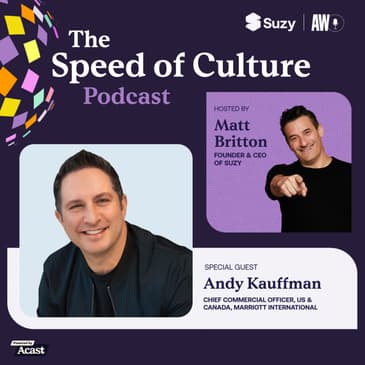
In this episode of The Speed of Culture, Matt Britton chats with Andy Kauffman, Chief Commercial Officer, U.S. and Canada, Marriott International, about the convergence of sales and marketing, the power of first-party data, and how AI is reshaping personalization and operations. Tune in to learn how Marriott is building travel experiences that feel truly one-to-one.
Follow Suzy on Twitter: @AskSuzyBiz
Follow Andy Kauffman on LinkedIn
Subscribe to The Speed of Culture on your favorite podcast platform.
And if you have a question or suggestions for the show, send us an email at suzy@suzy.com
Hosted on Acast. See acast.com/privacy for more information.
[00:00:02] Audible presents, A vampire-jägerin is a unerbittlich battle. If you do something to my sister, you will die in a terrible death. They only die, if you break the head of the head. The original Audible is the Impact Winter. Now, just by Audible.
[00:00:26] Perfect gets the enemy a good year. I said to the team, I'm like, we're not building like this massive AI solution. I'm like, build a small agent. What can you do in a day? And that work that you do in a day is creating hours and hours of savings for 100 people. And by the way, getting them to the right answer, that needle in the haystack faster. So let's keep doing that.
[00:00:50] To thrive in a rapidly evolving landscape, brands must move at an ever increasing pace. I'm Matt Britton, founder and CEO of Suzy. Join me and key industry leaders as we dive deep into the shifting consumer trends within their industry, why it matters now, and how you can keep up. Welcome to The Speed of Culture. Up today, we're live at the Possible Conference in Miami, and we're thrilled to welcome Andy Kaufman, the Chief Commercial Officer for U.S. and Canada at Marriott International.
[00:01:19] Andy leads a commercial strategy for over 6,000 hotels, driving growth across marketing, sales, partnerships, and loyalty, all while helping Marriott stay at the center of culture, travel, and consumer experience. Andy, so great to see you. Thanks so much for joining us today. Of course, thanks. It's a thrill to be here. Absolutely. So what a role you're in, and I know it's relatively new. You joined just this past January. What's one thing you've already experienced about Marriott that maybe you didn't expect? I know you were there for a while, and then you left for four years to go to the NFL, and then you boomeranged back. Yeah, I'm a boomerang. What's changed?
[00:01:49] Well, it's amazing. First of all, even as you just rattled off the roll, it's like a pinch me moment. Yeah. I'm like, that's seriously my job? $49 billion to oversee, right? Unbelievable. Right. And so my career started in travel. I spent 25 years in travel, and then the last four in sports. And when you work in travel, it just gets in you. Yeah.
[00:02:09] It's so like this notion. We call it internally, the company of Spirit to Serve. It's this idea of hospitality and being kind and working together. And not to say that the NFL didn't have that, but once it's in you, when you have it, you just want more of it. Yeah. And when I had this opportunity to come back and look at this role, which basically pulls all commercial services together, full top-line responsibility, I literally could not say no. It's been a dream come true. Right. It's interesting about the boomerang, right? You were there for a decade.
[00:02:39] Yeah. You left for basically half a decade, and now you're back. Did you ever think you'd be coming back to Mario after you left? My philosophy is very clear. You finish as strong as you start. Yeah, you have that option open for the future, and you never say never. I knew when I went to the NFL that that was literally a dream come true. It's ironic because I just described this job as a dream come true, but the NFL was amazing. But as I looked at my career progression, I looked at what's happening to the marketing space, specifically what's happening to the CMO.
[00:03:06] And I'd had discussions with my past boss, with mentors and like about my progression to CMO. And I said, you know, I'm not actually sure a CMO is going to exist in five years. Why is that? I think marketing will exist, but I think what's happening is predicated by this notion of performance marketing, changing really the definition of a CMO. Data and performance and everything. Attribution. Advertising, data sciences and attribution and measurement, everything that goes along with that.
[00:03:33] But also, I had this when I was at Marriott before, and I have it now. The marketer with Google and some of the major, major distribution channels that are, quote, performance marketing, become the largest sales engines for the company. Right. And so this notion of like marketing and sales. Bifurcation. Shepard. Right. No, it's a false prophecy in many ways. Well, it's about brand. I think the reason it was originally set up is because brand was important. I know it still is important. Yeah.
[00:04:00] Maybe not as much for a company like Marriott, which probably has like 99% on native awareness. Well, we do, but we also have 36 brands. Right. We have a challenge of making our customers and our future members and our current members really understand how each brand is different. But even more than that, like you bring up brand and you get into that brand versus performance argument, which I think is crazy. I was having a conversation with someone yesterday and they asked me like, what do you think of this in your new role? And I said, well, it brings it all together where actually that debate goes on in my brain.
[00:04:30] And I'll tell you, the debate is really clear. It's not one or the other. It's clearly an and. Let me ask you a question now. Yeah, please. So say you have an opportunity to buy a set of billboards along I-95. Yeah. Right. We're here in Miami now. So it came to mind. Right. Or you could spend money with Google, like driving leads, the bottom line.
[00:04:48] Like a case be made that if every time you in the chief commercial officer role is thinking about revenue, is thinking about just the performance and bottom of the funnel and the billboards stop, especially in the context of all the brands you oversee. Over time, the brands will erode, but the nature of your role has you so much more focused on those results quarter by quarter that it could potentially erode the brand over time. How would you respond to that? I think that's accurate. I think that's the trap that marketers can fall into. Yeah.
[00:05:15] I think there's been so many case studies done on in downturns. If you spend for the short term only, you come out weaker. Whereas if you spend for the short term and the long term, statistically, it's been measured through pandemic and every downturn before that, that when you invest in both building a brand as well as short term performance, you come out stronger. Right. I think a perfect example of that is if you think about paid search as like the ultimate performance channel.
[00:05:44] Google learned this early, early on. It's why there's a quality score built into the algorithm. Yeah. That basically says brands people know are going to get more clicks and thus they're going to make more money from a CPC basis and that's also going to convert better. So it's a better consumer experience too. Totally. And so I think it's just a fault. Now, in my role, I have to debate that. Yeah. I have to figure out the right mix. It's not one or the other. Where that line is, that changes.
[00:06:14] It does. But it changes based off of the environment that you're in and really what your performance is. Yeah. So you mentioned how you oversee a portfolio of brands. How do you look at creating kind of distinguishing factors between them and also understanding what segmentation looks like across those brands? This brand is good for this type of person. This brand is good for families or business travelers or et cetera. I think it starts in, this is a little cliche, but I'll say it starts with actually understanding your customer. Yeah. And if you're going to understand your customer, for us, they're guests. They're guests in our hotels.
[00:06:43] We want as many of those guests to be Bonvoy members so that we have deep, deep, deep relationships with them. I'm one of them. Well, thank you for that. I knew that. But we are very fortunate to have an incredible base of loyalty members, especially here in the U.S. But with that said, on any given time, your needs in travel, let's take you, for example. Your needs for this trip are going to be different than when you travel with your family. So basically trip purpose, business or leisure.
[00:07:13] And then what's the reason why you're traveling? Are you traveling for that once in a lifetime trip with your family? Or are you traveling to visit family and it's a quick weekend? The in-laws. The in-laws. You're like, it's a different need state. Yeah. And so if you start with the customer and you understand their need state combined with their trip purpose, you start to say, where do we have product that matches their needs? And then you architect your marketing around that. Yeah.
[00:07:38] That's different than I'm going to market brand by brand by brand by brand. And I have my core proposition and my tagline. In this world of personalization and AI, we don't have to have a monolithic message anymore. Right. It's interesting. I mean, that's really the definition of consumer centricity, right? Instead of focusing on my brand and its unique selling propositions, it's like, what does Matt care about when he wakes up at seven o'clock in the morning? And where do I, as Marriott and my portfolio brands fit in to meet those needs? Yeah. And I think that's what's so exciting. Yeah.
[00:08:07] With a loyalty base of 240 million members around the world, we have a lot that we can learn from our existing customers that we can apply to increasing our share of wallet with them, as well as acquiring new guests. Yeah. And as we do that, you're going to need more content. You're going to need more personalization. You're going to need more signals. You're going to need more data and ad tech and bringing it all together. And that's the beauty of, I think, what we're sitting on, where with our brands, we have more answers to their needs than anyone else on the planet.
[00:08:38] Now we have to find a way to really tailor that on a micro level in a one-to-one basis. Yeah. I mean, listen, you stole my next question, my thunder. So I guess great minds think alike, right? But you're in the fortune position at Marriott to have first-party customer data. At this conference, I've interviewed people from CPG companies that sell through big box retailers. They don't. And I think companies that don't are at a distinct disadvantage right now, given what AI can unlock, especially when it comes to hyper-personalization. I spent a lot of time building an AI.
[00:09:07] I built tools where I can send out now a million emails, and a million people get completely different emails based upon tens of thousands of data points that are available about that consumer. Your ability to do that based upon the history of where they stayed and all the other information I'm sure you collect really should unlock just incredible ways for you to really understand the customer on a unique level and unlock some of that personalization that we were just talking about. Absolutely. Yeah. And my philosophy on this has changed over time.
[00:09:36] We started in a world where it was algorithms and templates and machine learning, and we've been doing personalization at scale for years. But now the ability to generate the creative in billions of permutations on the fly... That's right. ...is really phenomenal. And I think that's another unlock. The other thing I think about often is, do you think about marketing as marketing versus marketing as a service? And in the same way that in our hotels, we train...
[00:10:06] Let's take the Ritz-Carlton example. We train the ladies and gentlemen at the Ritz-Carlton on something called anticipatory service. Listen, anticipate, and then provide a service that exceeds the guest's expectations. That same philosophy should be applied to marketing. Yeah. That means being respectful, understanding their needs, and delivering creative to them that moves them ahead of the journey in a delightful way that also we can monetize. I wish every marketer had that philosophy because there's a lot of junk out there. It's true.
[00:10:36] And when I think about what that unlocks for the experience that you can provide consumers with, like you're checking in and they know I'm a fan of the Eagles. And so if they're in town, it's very likely going there for the game. And you can help me with transportation or make sure that I have what I need. I mean, there's just a million things that can be automated. And maybe when I check in, like there's creative that I have on the app that's relative to why I'm going there. It's the colors. Or if you're a sponsor, it's the actual logo. I mean, there's just so many ways across.
[00:11:05] It's like, well, this is really custom built for me. Totally. Or you walk into your room and it says Go Birds. Right. You know, there's so many different pieces that just a little nod is so powerful these days that your members acknowledge they know me. Yeah. And when a consumer says they know me, they spend more with you. Yeah. It's very clear. Absolutely. What about the in-room experience? I was at the Wynn Hotels in Las Vegas and they have the voice functionality there where you can talk to it. It opens up the drapes for you, et cetera.
[00:11:34] Like what types of innovations are you looking at? What are consumers increasingly asking for when it comes to the in-room experience? Yeah. And well, one, consumers are increasingly asked for personalization across the board. And that comes in the form of the experience. It may come in the form of changing. We have concepts around how you change the room based off of personal needs. Unlike the Wynn, we have to scale to 36 different brands and 10,000 hotels around the world. Right. And that brings a level of complexity.
[00:12:03] But it also gives us an opportunity to say that need may not manifest itself in every brand. So I have a peer in the organization who leads our, what we call our lodging product model. And not unlike a tech company, she looks at the end-to-end experience across each of the brands on the development, the operations, the support, understanding the customer needs and how you want to change that. Now, she oversees it for all of the brands.
[00:12:30] And so she can say, where are the swim lanes to fulfill on that need in the luxury space? It might be different in the select space. But ultimately, it comes back to the same need. How it manifests itself may be different.
[00:13:09] Yeah. Services of choice. Yeah. It's right there on the screen. Sometimes it's in the guide or it's on the home screen. We also have capabilities to cast to the TV. Right. I think what you're saying is right, which is people are walking in with more entertainment in their pocket. Exactly. Then we've typically offered on the largest screen in the room. You can almost look at it like a docking station, right? Almost like a car. Yeah. I think the cars are made at docking station where you plug your phone in and boom, it knows everything. It knows your seat, like how tall you are.
[00:13:39] It knows where you want to travel to with your maps, knows your music, et cetera. And I think a hotel room could be really the same thing where if you plug in your proverbial phone, it just knows. And that might be the unlock of customization over time is your actual mobile device. Yeah. And you think if you bridge it to the world that we live in, in the marketing space, it's this notion of like logging into my room. Yeah. What does that mean? I love that. That's different than I'm checking into my room. Yeah. Logging into my room, what changes as a result of that? And then what goes with me versus what stays? Right.
[00:14:08] These are all concepts we're working through. And I know a lot of companies in your space are also focused on just like what happens when you're in market, like planning experiences, planning trips when you're there. What sort of work are you guys doing in that realm? So first, the fact that we are in more places gives us this like authority as a local expert. Yeah. We live in the cities that you're going to. And we do so in a way that is certified, not just some person off the street who you may be sharing a room with. Yeah.
[00:14:37] And so that lends itself to credibility, safety, but also this reliability that the app, there's some functions in the app. You check into your room, you can talk to the concierge through the app. You can be connected. You can get recommendations. You can sign up for more and more in hotel as well as local area activities. And that becomes really your remote control to your experience. And we do not think about ourselves as just a lodging company. Right.
[00:15:03] We think of ourselves as delivering travel experiences to our 240 million members in tens of thousands of destinations around the world. Yes, the hotel may be a launching pad to that. But while you're there, it may be a meeting. It may be to tour the city for the first time or maybe to see friends and family. This is that different back to the trip purpose. Yeah. We need to make that a better experience regardless of what your trip purpose is.
[00:15:28] So in that regard, like obviously a lot's being spoken at other conferences like this possible conference about agentic AI. And I just read this morning that now ChatGPT is rolling out a shopping engine. And now if I'm Amazon, it doesn't mean, I mean, Amazon's a great company. But now all of a sudden, if you're using it more and more for searching and it knows your history, maybe it can go find things for you and skip that layer over time.
[00:15:51] And when I look at Mariah, I mean, I think you have an opportunity to also be that travel agent almost where most people probably start with the hotel first. So is there any reason why that can't be your agent, your travel agent, so to speak? Yeah. And we're experimenting with all those. Yeah. It's early days. Of course. But there's a lot of security that you have to get built into it. We've tested it. For example, with our homes and buildings product, we've tested a number of different AI searching capabilities.
[00:16:19] We've learned a lot about what people search for, what's inappropriate searches, what actually creates liability for us that we be very careful about. But also what human behavior looks like. Yeah. So that becomes a bit of a test bed for the mothership, so to speak. So, by the way, I think the agentic AI, it's going to revolutionize so much. It's very easy to look at it solely as what it's going to revolutionize for us as travelers.
[00:16:44] But as we look, we're doing a lot of pilots on how it's changing how we sell. How do I get my salespeople? I was going to get them. Freed up from processes and finding those nuggets that I want them to follow up on. Yeah. Spending more time with customers, freeing up to improve their conversion in the same way that you would apply performance marketing to a marketing team. Right. And optimize that funnel. We're now doing the same for our sales team.
[00:17:13] And I'll tell you, it's freeing up a ton of bandwidth. We're taking disparate data sources, putting an agent on top of it. The analysis that comes out of it like that. Incredible. Unbelievable. It really is. What do you think upscaling looks like for employees in the age of AI? What are some areas you think your team should be leaning more into the future-proof themselves? Yeah, I think it's the right question. I mean, the path is not totally clear for me. But I'll tell you what we're doing is we're leaning in. It's like a test and learn.
[00:17:41] If you're scared of it, then you've already lost. Yeah. A lot of people talk about AI. How many people are actually using it? Right. We just had a big team meeting where I pulled together leaders across my organization. Inside of those two days together, I actually had a workshop around using AI. One of the most savvy guys on our team did a workshop. And every single one of us was in there. It was consuming documents for us. It was analyzing it.
[00:18:07] It was giving us business recommendations to just be like, wow, this works incredibly fast. Look, I think what's the phrase you hear a lot that people aren't going to be replaced by AI? They're going to be replaced by people. Oh, yeah. So workers that know how to work for AI. I can take your job. Someone understands AI. Perfectly said. Yeah. And I think that's right. And we're leaning completely into that. And we're already seeing the early stages. The other thing we're doing is like, perfect gets the enemy of good here. I've said to the team, I'm like, we're not building like this massive AI solution. I'm like, build a small agent.
[00:18:36] What can you do in a day? And that work that you do in a day is creating hours and hours of savings for 100 people. And by the way, getting them to the right answer, that needle in the haystack faster. So like, let's keep doing that. We'll be right back with the Speed of Culture after a few words from our sponsors. Shifting gears a little bit to the consumer side of things and just the brand building aspect. Obviously, the consumers aging and now your core customer are people who are digital natives, right?
[00:19:05] And the millennials are not a kid anymore, so to speak. And Gen Z is quickly becoming a core customer and a core business traveler of yours. And they, of course, are the iPhone generation. They grew up with the iPhone in the house. So when they're looking at the iPhone, they're looking at content not from big media companies, but from other people, i.e. creators. What role do creators play in your overall strategy in terms of brand building and making sure that you're capturing mindshare of the new consumer? Yeah, creators are a critical piece. And in spending time where our next-gen travelers, as we call them, are obviously congregating,
[00:19:35] it's easy to say the TikToks and the Instagrams of the world, but we have to enter that space authentically. Of course. And that's where I think creators come in in a very big way for us. We have amazing experiences. Creators love to work with companies that can deliver incredible experiences, and through that, they create incredible content. And so we work heavily with creators in all of our brands, as well as a way to amplify our partnerships, and our partnerships are built around people's passion points. Why one? Fits perfectly.
[00:20:05] They travel. Sports, music, culinary, entertainment, they travel for the fashion, they travel for these things. But also, when you spend time and energy as a brand in those spaces, people want to hang out with you more, and spend more with you, and be with you more. And so you want to enter people's circles in a pretty authentic way, and I think we're striking a pretty good balance there. Yeah, I mean, I think it's power in the travel space that creators, that is, is just profound.
[00:20:31] I would say probably four out of the last five nice family trips I've taken, the place we stayed was because my wife saw an influencer, she follows, stay there. I'm sure. And because the influencer doesn't just stay there, they're documenting their trip the whole time. They're in the Caribbean somewhere, and they're with their family. And then the person's like, well, I associate with them, that's why I follow them. And now I want that type of vacation. I could see it playing out, which is why content, I think, could be so much more powerful than traditional advertising, because it really is so much more authentic to how a consumer, I think, wants to learn about things in general.
[00:21:01] And I think you used the word learn. Some of the social platforms, we used discovery platform as an example. Who doesn't want to discover an incredible travel experience? Right. The data post-pandemic is so clear. People want to spend more on experiences. That's something. Material good. Yeah. Across all generations. And with a portfolio like ours, we can benefit from that, but we have to show them those places that they wouldn't necessarily consider. Influencers really help us do that.
[00:21:28] I wrote about my first book, Youth Nation, Status Update is a New Status Symbol. Because it used to be forever cars, houses, watches, sneakers. That was a status symbol. And over time became experiences where you travel to those incredible things. That's what builds your personal brand, which impacts everything in your life. Travel is the ultimate. The ultimate. Yeah. I mean, it's one of the reasons I came back to travel. Right. Because it's such an incredible, you know, I love to travel. I love to travel with my family.
[00:21:56] And even my kids, when I took this job, they said, Dad, we love the NFL, but we love fantastic hotels even more. You went either way. And so they were good. But it's so true for millions and millions of people. And so we want to make sure we deliver on that. Now, with that said, you started with that the iPhone generation and the younger travelers have different behaviors. And that's exactly right. That's where the app has to come in. Yeah. That's also where the product experience is changing. So outdoors is a big trend.
[00:22:23] More and more are like, so we've acquired different brands in the outdoor space. Postcard cabins is one of these incredible cabins in national parks and outdoor areas. That give you a unique experience is just one example. Yeah. And the other end of the spectrum are a bit more of like the efficiency, self-service, but cool digitally connected play. We just this week announced that we acquired a brand called Citizen M that is heavily catered
[00:22:50] towards the younger traveler, super digitally connected, spending energy in the public spaces, small footprint for the rooms because the younger generation actually doesn't hang out. Right. They would much rather... They're sleeping and living at sunrise and they're off. They would much rather, whether it's business travel or leisure, they would much rather be alone in the bar than sitting in their room. Right. And so you're seeing that the spaces in these hotels are changing. And take our Moxie brand, for example, you actually check in at the bar. Yeah.
[00:23:19] Built all around that notion that's just a changing traveler need. Yeah. The high end of luxury continues to expand in demand and growth. Some are saying it's creating wealth disparity. It's a whole nother podcast conversation. But regardless, there seems to be an insatiable demand for the luxury traveler and the prices keep going up and there seems to be a lot of elasticity there for that traveler. What are your thoughts on the Uber luxury traveler? And I know you have Ritz Carlton as one of your properties. Yeah. And where do you see that? Yeah.
[00:23:49] So my area has the deepest and broadest luxury portfolio in the world. Yeah. The 500 luxury hotels across Ritz Carlton luxury collection, St. Regis, Ritz Carlton Reserve, W, JW, always dangerous when I list them because I'm probably forgetting one. But, you know, incredible breadth of amazing luxury brands that I was actually just at a general managers conference where we brought all of our luxury general managers together. Where was it? And it was in the Ritz Carlton in Naples. Okay.
[00:24:19] Incredible hotel. Great beach. Great place. Talk about a humbling experience. I'm sitting in the room with 500 general managers from Bulgari, a brand I didn't mention earlier, to Ritz Carlton, to St. Regis, all of our luxury brands. The world's authorities on delivering luxury travel experiences. And it was so humbling to be surrounded by this, but also to recognize the power of what we can deliver for our luxury consumers.
[00:24:48] Now, that's going to be different. Yeah. Especially the high net worth or the ultra high net worth. They want different things. And they don't really care about the full portfolio of 500 hotels. They care about the hotel they're booking right now. Yeah. And make sure that that is an incredible experience. And if it is, then they will look at others, but they'll quickly shift. And so we have to make sure we deliver on that experience. And what we're seeing, back to your point, is for a great experience, they'll pay. Yeah.
[00:25:18] They'll pay a premium for that. And they expect a fantastic experience as a result of it. And we're delivering it. In fact, our internal gauges of intent to recommend and all of our measures are up and to the right, especially since the pandemic. As people come back, their expectations are more and more delivering on that. How much of your job is also just, you know, you talk about general managers meeting, like making sure that people that work for the company, who is like obviously the lifeblood
[00:25:47] of any hospitality organization, understand what you're trying to accomplish or inspired by the vision and mission. Yeah. I mean, it's a heavy piece of the job and it's actually one of the most enjoyable pieces of the job. We're a people powered company. That's what I love so much about hospitality. It's about people serving people. We have this innate, we call it our spirit to serve. It's just in us. And that means our customers. So my sales customers, that means our members. That means also how we're taking care of each other, whether it's our associates or general managers or hotel operators.
[00:26:16] You know, in a world where for the US and Canada example, the vast majority of our hotels are franchised. It's really important that we spend the time rallying everyone together, being super clear on what our initiatives are, staying aligned on what we want that evolving experience to be, and then how we're delivering value centrally through my organization or any organization to fill those hotels as an example, to move those brands forward, to make sure that we
[00:26:45] are selling the right room for the right price and optimizing not just the top line revenue, but the profit for the hotels or our company overall. And so with the scale of what we have, just like the scale of any franchise business, you have to spend a large amount of energy with your franchisees, with your operators. And we do. We have a lot of internal conferences. We have an entire support system built up. We have an incredible communication team that keeps everything in sync, but it's a major piece of the job.
[00:27:14] So shifting gears, we wrap up here. I would love to hear just in terms of your experience. First, I want to just touch a little bit on your experience of the NFL and what some of your learnings were. Obviously, the NFL is such a driver of culture, especially here in America. And it's really one of the only places where it can aggregate live eyeballs at once at scale. And you played a really pivotal role with the NFL for nearly half a decade. We'd just love to hear what some of your takeaways were. So you're right with everything you just said.
[00:27:42] And when I entered there, it was a dream come true. The NFL, not unlike my current role, is a platform. It's a football platform. It's a platform for so many things. While I was there, we were building a fan engagement platform. That platform spans the league, all of its partner touch points. It's 32 franchisees, which happen to be football teams. And really around this notion of how do we know our fan and how do we deliver even better, richer experiences with them that monetize in the short and long term.
[00:28:12] The way that you monetize there, it's about often eyeballs, ad sales associated with ratings, but also subscription services, e-commerce, their credit card program and the like. So it's not a wildly different model. When you look at how it's a multifaceted P&L and what we do at Merit. My time there, it was awesome. I mean, I'm a huge football fan. Go birds. You're an Eagles fan too? Eagles fan too. So the fact that you picked up the Eagles, that was awesome. And while you're there, you root for all 32 teams.
[00:28:42] Not, I mean, certainly we would say that's what we did as a business. But what you found was by working with coworkers at different teams, just like anywhere, you rooted for your friends. You wanted to see them be successful. And so that was an awesome experience. But a few things I really learned there. One, the place moves fast. It moves fast and it moves culture. And the notion of cultural relevance, not just they're a receiver of it, they drive it. And so that's something I'm bringing back as we're looking at what's our role in culture. Right.
[00:29:11] Where do we play? How do we play with partners that make us that much more relevant in culture? NFL is a partner of ours. So is NCAA. So is U.S. soccer. So is F1. So we're going to have a big presence here at F1 Miami this weekend. And all of those are how do we ensure that we're culturally relevant? The second is we talk a lot in a lot of businesses, a lot of industries around loyalty. They don't call it loyalty. They call it FAMPA. Why? Because yes, it occupies a place in your wallet. You spend more.
[00:29:41] You know, I buy Sunday ticket. I buy NFL Plus. I buy all the services. But more than anything, it's actually a part of my identity. I am an Eagles household. I'm a Cowboys household. I'm a Steelers household. It's multi-generational. It's family. It's at a level that every brand aspires to get to. It's incredibly emotional. And people pay a premium for everything. Yeah. Associated. They identify their identity. They tattoo their bodies. I know. With the IP. So it's like, that's a level.
[00:30:10] And so for me, coming back into a business that is such a heavy loyalty base, and we have amazing brands. We deliver great experiences. But I also check the team on, let's understand where we're playing because there's a level that now I have on what real fandom looks like that occupies such a big place in people's hearts that I want to check us to keep us on the right path, but doing so nowhere we can aspire towards. And so it's been really helpful as I come back in. I know I said it coming in.
[00:30:40] I said, I'm not doing a U-turn while I'm boomeranging. I'm not just flipping around. I'm coming back a different person with different perspectives, not only on what we should do, but how we should operate. And it's been fun. So when you get me to put a courtyard by Marriott tattoo on my arm, you know you've done your job, right? I mean, that's an incredible space. There you go. So it's funny. We were joking with some internal meetings with just that. Yeah. And so I'm like, maybe we'll create like the fake tattoos and do that. It's funny. That's fine.
[00:31:06] So speaking of teams, I mean, I know obviously you have a big team working for you and you can't be successful on your own. For some of our younger listeners on the podcast, what are some of the attributes of rising stars that you've seen consistent throughout your career that maybe you think younger people should be thinking of in terms of areas to focus on? Yeah. I think that's an excellent question. This one hasn't changed over years. It's very easy to talk about the skills. It's very easy to talk about like, you gotta be embracing AI and all those things. Yeah.
[00:31:35] But I think about it more as this philosophy of there's a idea out there called the pie method. Okay. It's performance, impact, and exposure. And think about that as a three-legged stool. So manage your career to the pie method. Kick ass in the work you do. Perform incredibly high, but don't do it for small things. Work on things that drive impact because that's what leaders and CEO and the C-suite notice. And then make sure once you've done that, you tell people about it. You have to tell people.
[00:32:05] That's why like LinkedIn and things like that are so important. And it's not just, it's like people like you just brag. I'm like, no, no, no, it's not for that. It's what you don't want. I say this to my team all the time in every organization I've worked at. Do not make me have to explain who you are when I'm in that performance review meeting with my peers. If they're like, oh, I don't know who Sally is or I don't know who Roger is, then you've lost already. What you want is when I say, oh, this is Sally. And they're like, she's amazing. Roger's incredible.
[00:32:35] Then you've won. And that to me is the pie method. Yeah. I think the E is really personal brand. And to people who think it's bragging, it's not just saying, hey, look at me. I did this. It's I went through this process. It drove impact. Here's what I learned. Here's how you can help. It's like, that's how you execute on social media. It's not about you. It's about you wanting to help other people through what you've learned, but in doing it, you're gaining exposure. Yeah. And do it for purpose. Yeah. So like when I come out on LinkedIn, as an example, I don't just come out on LinkedIn. I come out on LinkedIn in ways that link to what we're trying to accomplish. Right.
[00:33:03] And so they're important pillars of our business, not just me coming out randomly with random acts of content. Right, right, right. Absolutely. So to wrap up here, we always ask our guests if there's a mantra or saying that comes to mind in terms of what guides their career journey, what comes to mind for you? Yeah. For me, there's one that I've used for a long time and it's data over opinion. And that doesn't mean that you don't use intuition and opinion. I mean, we're professionals. We're really good at what we've done or what we do.
[00:33:32] We've gone through years and years and years, but the foundation of what we need to do has to be based in fact, has to be based in opinion, and then take that additional 10, 15% and layer your intuition on top of it. Yeah. And especially with the scale you're playing at. You have to. That's the only way you can really sleep at night, right? For sure. Well, and this has been an amazing discussion. I know it would be. And congrats on the new role and all your success. And continue to follow your journey. I appreciate it. Absolutely. We're live here at the Possible Conference in Miami and give special thanks to our guest today,
[00:34:01] Andy Kaufman, Chief Commercial Officer for US and Canada at Marriott International, Virginia today. Be sure to subscribe, rate, and view the Speed of Culture podcast on your favorite platform. Go Birds! Thanks again, everyone. See you soon. Bye-bye. The Speed of Culture is brought to you by Suzy as part of the Adweek Podcast Network and Agast Creator Network. You can listen and subscribe to all Adweek's podcasts by visiting adweek.com slash podcasts. To find out more about Suzy, head to suzy.com.
[00:34:31] And make sure to search for the Speed of Culture in Apple Podcasts, Spotify, or anywhere else podcasts are found. Click follow so you don't miss out on any future episodes. On behalf of the team here at Suzy, thanks for listening. Hey!