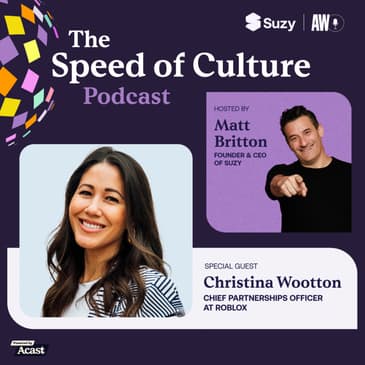
In this episode of The Speed of Culture, Matt Britton speaks with Christina Wootton, Chief Partnerships Officer at Roblox, about the evolution of virtual communities, the future of digital branding, and how Roblox is helping brands unlock new revenue streams through immersive experiences.
Follow Suzy on Twitter: @AskSuzyBiz
Follow Christina Wootton on LinkedIn
Subscribe to The Speed of Culture on your favorite podcast platform.
And if you have a question or suggestions for the show, send us an email at suzy@suzy.com
Hosted on Acast. See acast.com/privacy for more information.
[00:00:00] When you think about Roblox, it's about democratization of creation. We have a goal to hit 10% of the gaming market. And the way we're going to do that is by advancing our technology and our tools so people can create quicker, they can create better. To thrive in a rapidly evolving landscape, brands must move at an ever increasing pace. I'm Matt Britton, founder and CEO of Suzy. Join me and key industry leaders as we dive deep into the shifting consumer trends within their industry, why it matters now, and how you can keep up.
[00:00:30] Welcome to The Speed of Culture. Hey! Today we're thrilled to be welcoming Christina Wootton, the Chief Partnerships Officer at Roblox, the global platform bringing millions of people together through immersive shared experiences. Roblox recently reported record growth with over 85 million daily active users and over 73 and a half billion hours engaged in 2024, making it one of the most influential digital platforms in the world. Christina, thanks so much for joining.
[00:01:00] Thanks for having me, Matt. For those that don't have maybe young kids that are on Roblox, I know Roblox isn't just limited to younger kids, although I know it's very popular with young kids. How would you describe Roblox as somebody who maybe doesn't know what the platform even is? Yeah, so Roblox is a gaming and creation platform. And like you said, it's not just for kids. We now have 61% or over 13. So it's growing globally. It's growing in our cohorts and demographics. And where do people come to do things together?
[00:01:27] So they could be playing games, they could be shopping, communicating. And our platform has millions of experiences and they're all built by our community. So people all over the world who want to experience something, whether they see it or not, they can build it. And it's really fun because then they can upload it to the platform and they can share it with people from all over the world. So you can do anything. It could be like racing cars. You can be going in, you can be dressing up and walking the runway. You could be meditating in an experience for wellness.
[00:01:56] So there's so many things you could do together. But just think about doing things together when you can't in the physical world. Yeah. I mean, for a while, there was so much talk about the metaverse. And obviously, Facebook renamed their entire company, Meta after it. And I was never able to even log on to the metaverse. I'm a software CEO and I couldn't figure it out. So I knew whatever was being called the metaverse at that point probably wasn't going to take off. I couldn't see my mom getting on it anytime soon, right?
[00:02:24] But it sounds like how you're describing Roblox is kind of the metaverse, is it not? Yeah. So I always think of the metaverse as doing things together when you can't physically. It could be connecting, communicating. And I look back at the time during the pandemic and our platform's been around for over 17 years. And people have been connecting and doing these things for over a decade on Roblox. But during that time, it was especially important for people to find ways to communicate and find ways to be together.
[00:02:52] And we heard so many times parents and grandparents reach out and say, thank you for having this platform. When my kids were struggling at home and they couldn't be with their friends, they found ways to connect with each other. We found ways to connect with each other. I have three boys on the platform. And it's funny, when I travel, sometimes I'll be at the airport and I'll log on to Roblox and I'll meet them in a certain game. And it's so cute. They get so excited and they like write to me on their song and things like that. So it's really just a way for people to come together and do things.
[00:03:22] And it's been around for 17 years, obviously, when it launched the kind of technological landscape with nothing like it does today. What are some of the ways that you think Roblox is going to be able to take advantage of this new AI era to continue to evolve its offering? Because obviously, in a lot of ways, the barrier to entry in technology has been lowered. What used to take tens of millions of dollars of venture capital investment, a lot of people can build on their own now.
[00:03:47] So obviously, it puts the pressure on technological companies to continue to push the envelope forward. Yeah. So when you think about Roblox, it's about democratization of creation. And when you think about we have a goal to hit 10 percent of the gaming market. And the way we're going to do that is by advancing our technology and our tools so people can create quicker. They can create better. We have people all over the world who are creating. And sometimes today, it could take months. It could take maybe a year to create a game.
[00:04:15] Or you can create something in four weeks. So with AI and the advancement of technology, we're hoping that it'll allow them to create faster. It'll allow more people to be able to create. So lowering that barrier to entry. And then we're going to see more and more amazing content, which people will share. And it's a flywheel. The more they create, the more people come to our platform and experience this together. Yeah.
[00:04:37] And I also think that strategy has a lot of tailwinds that comes along with it because we're already starting to see on platforms like TikTok and Instagram, people building these kind of virtual influencers who are virtual creators who are going on platforms that aren't people. And a lot of times, obviously, there's great creativity behind it. But that's becoming mainstream now. And it used to be some far-off concept. And now you're seeing more and more of it.
[00:04:59] I would imagine that sort of muscle memory of consumers doing that in social carries over very nicely to what they would do on your platform and vice versa. Yeah, I think so. And I think the future is UGC. It's like you're seeing on all these platforms like Roblox and TikTok. It's content created by creators, anyone really. And we think about on Roblox, you might have an NPC that's enabled by AI that could take you through different experiences, whether it's education and learning experiences. NPC being non-player character. Yes.
[00:05:29] Or, you know, Roblox is about having an avatar. And you customize that avatar and you dress up that avatar in virtual items. So what if there's, you know, an AI stylist who's helping you find different items for your avatar and then navigating you through experiences? So it's really fun to see. Yeah. I mean, obviously, in the words you kept mentioning over and over as you're talking is creator. And obviously, the creator economy is such a big term. And a lot of brands are now pouring tens of millions of dollars into it.
[00:05:56] And it makes sense because Gen Z is quickly becoming the core household buyer. And one of the distinguishing factors of Gen Z is they were the first generation to grow up with the iPhone in the household. And that's where they go first for everything, especially content. And when they're consuming content on their mobile device, it's usually not from major television networks, but from other people, from other creators. So the notion of really tapping into creators, leveraging them as sort of the content that drives your game makes a lot of sense in terms of where things are and where they continue to grow moving forward.
[00:06:26] It's so unbelievable. We release these tools on the platform and we're constantly amazed by what our creators create. We couldn't almost create what they do. We can't foresee that sometimes. And they'll launch something that's absolutely amazing. And it's something that they're digital natives. A lot of Gen Z grew up, like you're saying, with phones and they grew up online. And so it comes very naturally to them. And they know how to experience it authentically. And they'll create something quickly and they'll share it.
[00:06:51] And I think that that's something that a lot of marketers are seeing too is that going along on that journey with creators and allowing them to either create with you or for you. And really that helps you to elevate your brand and stay relevant. Yeah. It's also such an evolution of where the video game industry is going in the gaming industry. Because for a while, it was just better graphics, more immersive experiences.
[00:07:14] And now when you see platforms like Roblox and Fortnite and others, it's not necessarily about the best graphics. It's about community. And in terms of what's more important to the consumer, it almost got to a point where a lot of video games were almost too realistic and wasn't the escape that maybe they once were. And now it's kind of come full circle again where the graphics are kind of less important. Would you agree with that? I do agree. And I think it's just around community. It's around something fun.
[00:07:42] Something that you love to do with like-minded people. And sometimes it could be like on Roblox. Sometimes it's a classic Roblox blocky character. And then sometimes you're in experiences where it does feel more high quality, realistic. And players can go, they navigate back and forth. And it's really around things that are fun and with their friends. Yeah. It's interesting because at the same time, a lot of like social media platforms have kind of lost the notion of community.
[00:08:08] Because I think they veer too much towards news or high-end creators. And because of that, you're also seeing a big surge on platforms like Reddit where people are going for community. You used to be able to see what your old high school friends were doing on Facebook. But now when you log in, it's more of like a traditional news feed, if you will, of news versus really a place where you have social connectivity. So I think these other burgeoning platforms are almost filling the void in that regard. That's right. And I think we're seeing platforms where you're more leaned in.
[00:08:35] I think a lot of times when you might be more of a passive consumer, you might come off these platforms and feeling a little bit less happy. When you're on Roblox, we see a lot of times our users are so, they're participants. They're leaned in. They're experiencing things that are fun or they're creating. And they come off the platform feeling like they had a positive experience. It's more joy. And I think that's where it's going too. As you're mentioning, you want to be with your friends. You don't necessarily want to just be filled with content that's maybe not something you want to see or at the time.
[00:09:05] Whereas you can control this experience. You can go in with your friends and do things that you want to be doing. Totally makes sense. I'm just curious to hear your thoughts in terms of you mentioned earlier that the population of Roblox has evolved over time. Obviously, when that launch was known for being for younger kids, and I'm aware just doing the research for today's talk that you have a much wider audience, many demographics. What do you think has driven that? And what are some of the use cases for maybe older consumers on the platform? So I started the company officially 11 years ago.
[00:09:34] And so when I started, it was a lot younger. And we have seen through the content, through the tools and technology, more creators come onto the platform. And really, they're building for each other. And so the more content that we've had for different genres and people all over the world, the more our audience has expanded. And that has caused us to have, you know, it's more global. It's not just kids, but we have a lot of over 13, a lot of over 18-year-olds on the platform finding things they love to do.
[00:10:02] We've seen content like Dressed to Impress come out that really is resonating with people of all ages, all over the world. And yeah, and parents are coming on. They're either playing with their families or they're finding content like puzzle games and things like that that they actually really love to do on their own. So we're really seeing it just expand not only in creators, but also our audience as well. Very cool.
[00:10:23] So, of course, you're in a really interesting role because you get to take this massive platform with over 85 million daily active users and offer it to brands to drive their business as your role as Chief Partnerships Officer. And I was really surprised to see that it's over a billion dollars in revenue that you're driving from your group. Not surprised because it's not a great brand or great platform, but it is something that's so new and unique and takes a lot of thinking, I would imagine, for brands to activate.
[00:10:51] What do you think has driven the success of your group besides your immense talents at driving growth and revenue for the Partnerships Unit? Yeah, so I oversee a business group at the company that really works on diversifying revenue streams. So we have this core business that we've had for over 17 years, really driven by creators and it's driven by the virtual economy. So you can sell game passes and virtual goods for your avatar in the experiences. And my group really works with external partners. And that could be brands and advertisers.
[00:11:19] We also work with our console and platform partners and app stores, prepaid gift cards and licensing and our education team as well. And it's bringing on another part of our community. So our community consists of creators, but also our external partners as well. And they're finding ways to build not just community on the platform, but build their own digital line of business. So when we think about all the brands who have been on Roblox, really, they started out seeing it as a marketing tool. And how do they build that community?
[00:11:49] How do they get this engaged consumer and audience to know about their products or their movies? And then they started to see something really amazing as people were wearing their virtual T-shirts and their hats and things like that. And going around a platform with 85 million people a day and talking about it and seeing their brand. And they thought, what if I actually could sell virtual goods and physical goods too now that we're testing commerce? And they're transitioning to have it still be marketing, but also how do they build this brand business on the platform?
[00:12:18] So we're seeing more and more brands really think about what is the future of how they build business on Roblox. So obviously, I mean, despite how exciting it is, it's not as easy as just throwing up a billboard. You really have to think about the technical aspects and what you want to bring in. What's the process like when you bring an advertiser on for the first time to the platform? And how much work do they need to do to effectively activate? Yeah, so we have the brands who want to build virtual items so they can work with our creators, our UGC creators.
[00:12:47] So you have your own network of creators. Yes, so we tap into this and connect them. We hear, what are you trying to create? What are your goals? And then we connect them with our community. Sometimes they're connecting on their own too, which is really great. And they'll work together to bring that to life. So if it's virtual items, typically that could take weeks. It's very processed. So sometimes they start off with creating virtual items. This is something NFL did six years ago. They created helmets for all the teams and jerseys.
[00:13:14] We'll be right back with The Speed of Culture after a few words from our sponsors. And now they're actually licensing their IP and building games. Or they could build a game or integrate into a game. And again, that's connecting with our community of developers and figuring out what is the best way that your brand can authentically come onto our platform. And it's really exciting to see something when we ask a brand like, what have you not been able to do on any other platform or even in the physical world that you dream of?
[00:13:41] And sometimes it's like them being innovative and thinking of those ideas and having a developer bring it to life on the platform has been something that they are excited about. But they haven't seen those engagement numbers before. Typically, our audience spends 10 minutes or more with a brand on the platform. On a billboard. Yeah, exactly. Yeah, but they're moving into how do we come on? Is it through virtual items? Is it through building a game? Is it through building a shop that integrates into a top game? So it really depends on what their goals are.
[00:14:09] And it's very much kind of a new and unique category. What are some of the challenges you've had in going to market with something where you're not in the established category where you're selling something amongst 10 other competitors? Because that obviously has benefits and obviously it creates challenges because you have to differentiate. Roblox is kind of a one-of-one. But that also means that you have to do a lot of storytelling to get them to buy in, I would imagine, for brands that are jumping home for the first time. Yeah, so there are things like actually we're launching 2D rewarded video.
[00:14:38] So it's something that they don't have to necessarily create an experience to have that product on the platform. And they know how to measure that. That's something that they measure on other platforms as well. And when it comes to the engagement that they're seeing and the games, it's helping to educate them on what our platform really is, how to think about it, how to view these metrics. And when you see this, sometimes that metric could be attention. How much time is that user spending with your brand? And like what impact did that have on physical world sales lift?
[00:15:06] Or if they're selling virtual goods, they see the sales numbers. But I think that that's the part where they're really excited about the platform and it's taking the time to understand it first. Speaking to our community, working with our developers, and then understanding how to view the measurement and the insights. So we're working with a lot of third-party companies that are helping them to understand what is that lift in sales? What is that lift in brand impact?
[00:15:29] And when you mentioned earlier virtual goods and the purchase of virtual goods, I know a lot of the talk around the metaverse has been kind of in this big Web3 umbrella of which the payment engines have been around cryptocurrencies and other blockchain-oriented applications. Is that a part of the current user experience on Roblox? And is it going to be something that you think is going to take a bigger presence in Roblox in the future?
[00:15:54] So right now we have limiteds, which are similar to when you think about a brand can launch 100 items and there's scarcity. Like an NFT almost. Yes. And so it's almost they could choose to do it as unlimited or they could choose to have it be a certain quantity. A digital collectible that's unique, authenticated and limited in scope. Yes, but it all is contained in Roblox. So we have our virtual currency, which is Robux. And that is how it's sold.
[00:16:19] But limiteds can be something where as the creator of that item, I could decide I want to be limited and resold and then they will get revenue on each sale. So it's something that's a big part of our economy and will continue to grow. And so when a brand activates, I'm just trying to think like you have so much data on these 85 million people. Obviously, you know what their interests are.
[00:16:39] So does targeting look like you're in a place in the game where you know that like almost like real estate where people are coming by or are you bringing these brand experiences directly to people when they log in? So they could integrate into a top experience where you're right, like we say spawn. I've never logged into Roblox and I need to. My son was super into Fortnite, but he never played Roblox in front of me and I really need to check it out. I will send you some experiences to jump in. Great, please do. Because yes, you could.
[00:17:09] So for instance, if I had a fashion brand or a retail brand, I might be in Dressed to Impress or Brookhaven or something where there's a lot of people coming in and they want to update their avatar. And so that could be a choice or you create your own experience and through user acquisition. So we have traffic driving ads on the platform that would drive into their experiences so they can really work on that strategy of like, I want to build this and this is how I'm going to get users into my experience. And we'll work together with them on that.
[00:17:38] Yeah, it makes sense. We've seen a big kind of push lately in terms of more immersive experiences in terms of how consumers consume content. So like the Sphere in Vegas, there's Cosm. And then you have obviously the Apple Vision Pro, which didn't do great the first time out. But I think over time, they'll probably crack it. And of course, Meta, Facebook's doing a lot in that realm as well. Where do you see virtual reality and mixed reality coming into play in the future in terms of how consumers interact with your properties?
[00:18:08] Yeah, so I went to this sphere, I saw the Eagles in concert and it actually reminded me a lot of Roblox because you're immersed in the experience. And I think through, you know, we did a watch party with Netflix for Stranger Things a couple years back where you're watching the 2D video and you're in this 3D immersive environment. And as the demogorgons pop up on the screen, that actually impacts your environment and they're teaching you through the environment as well.
[00:18:31] And then we see with the digital and physical, sometimes we can, for instance, Elton John had an experience on the platform where he had a concert. He had an exhibition with all of his great fashion. And then he had his concert at Dodger Stadium. And on the screen, you could actually see people experiencing his virtual environment. So it was really cool between the digital and physical. And I think we'll see that more. We could have a concert where maybe they're performing and then they do a virtual meet and greet with their fans
[00:19:00] so that they can meet people all over the world that maybe weren't able to meet them at the concert. So I think we're going to see more and more of this digital physical tie-in between Roblox and the physical world. I'm sure. I mean, as I talk to you now on a Zoom-like interface, it's hard to believe, but seven, eight years ago, this would have been a unique way to communicate. And now it's sort of the common place where people in business and personally, they're on Zoom or FaceTime or you name it all the time.
[00:19:26] And these two worlds are almost converging in terms of how me and you are interacting in a realm like this, like, again, a Zoom-like interface, and how people are interacting in a completely virtual world like what you're talking about on Roblox. And then, of course, you have these immersive experiences like Sphere and seeing it all come together amidst the landscape of AI where people can create their own experiences. It's going to be fascinating to see how people build community and create experiences with one another five, ten years from now. That's going to be so fun.
[00:19:54] And I think the more we see the value of it, the more it'll happen and the quicker it'll happen. For instance, you know, if you can't travel to see somebody, but you want to do something together, this is the space you can do it where you're actually experiencing something together. It's not like you're on the screen and you're reading something or you're watching something alone, but you're hopping into an environment and experiencing that together. And people feel that connection, even though sometimes it sounds strange, but they feel like they were actually together.
[00:20:24] And that is something I think that is so valuable to have that connection when you can't physically be together. 100%. If I run into a CES next year, it's going to be completely different after having this Zoom-based conversation than if we just had a phone call. So I think it's not going to be the same as if we got dinner together, but it's going to be, we kind of know each other well enough. And I think I could see how that would sort of manifest into a virtual environment as well. Yes. Awesome. So I want to talk a little bit about, as we wrap up here, you and your role.
[00:20:53] Obviously, it's such a unique position and Roblox is such a unique company. How do you spend your time in a way that enables you to, A, keep your finger on the pulse of like, where are all this headed? B, obviously, storytell around what Roblox is doing. And obviously, I'm sure you have to manage a team and do the day in and day out of business as well. Just curious to hear the pie chart of a normal week for you. Yeah, we have our teams that are growing and growing the business with our external partners.
[00:21:19] So there's a lot of time spent on what are the opportunities to help these partners with their businesses? And a lot of times if you're like, oh, well, you know what? This might not be a good time for them to meet or to be on Roblox because maybe they're working on something at their company. Well, what is it that they're working on? Let's find those opportunities and find ways that we can actually help them. I love speaking to CMOs who in the past, maybe it was seen as they are marketing the brand. And now it's, I think, evolving more to how can they market the brand but build that business for their company.
[00:21:49] And so I love to dig into where are the opportunities to help our partners with their company. And it's mutually beneficial. I also love spending time innovating and thinking of what are the ways that we can get those ideas out and innovate and talk really about what are you trying to achieve? And speaking to our partners and brainstorming, going to lunch and being creative and things like that. And then just learning the platform. I'm a constant student of Roblox.
[00:22:15] And so whether I'm playing it with my kids or I'm meeting with our product engineering teams to learn about what in the next year, two years, three years are we thinking of with the product? And how can I start actually helping our teams to understand how we can bring a brand to life by using those products and technology and getting ahead of it? Because as you know, sometimes you plan things six months a year in advance and not really ever too early to start brainstorming. 100%.
[00:22:40] And are there newer things that you're hearing from brands this year in 2025 in terms of new areas of interest or areas of exploration that you're leaning more into? It's really this brand business. So I would say, especially in recent events with the tariffs and everything like that, is like, how do we actually build a digital business? Like that is so valuable to a brand to think about not just the physical, but the digital. And using feedback and insights from the digital products to inform what you're going to produce in the physical world.
[00:23:09] I think that's something that more and more brands are thinking about is how do we build this community, get feedback, design together with our consumers, and also allow, share our IP, share our brand so that others are creating with us or for us, whatever they decide. So that's something that I think that we've been having that conversation for a long time with partners, but it's starting to be something that's becoming a common goal for all. And then last year, we saw five of the top grossing films activated on Roblox.
[00:23:36] So as we think about two, just how do you storytell? How do you get pieces of a movie in front of an audience before the trailers come out, before the movie comes out and build that fandom? Fandom is something that's really exciting for us, too, is how do you connect sports leagues with fans? How do you connect a movie and the content there or music artists with their fans all over the world? Yeah, especially with such an eight, 10-minute engagement that you can get with brands. It's really a great place for passion points.
[00:24:06] I imagine it might be a little harder with toothpaste or deodorant, but I think your ability to unlock that deep engagement, like you said, fandom, I would imagine would be a huge opportunity for any company in the entertainment, sports space, etc. That's right. Yeah. And when you can create that fandom and have someone almost talk about your brand or talk about your product or market it with you, it's like that is the power of UGC. And that's something that we're continuing to talk to about with our partners. Yeah. And what are you doing to keep your finger on the pulse of just all the changes that are happening?
[00:24:36] Obviously, you're in a role where you need to be on the cutting edge of where things are headed. So what are some of the things that you do to make sure that you do so? I would say just continuously talking to people and like, what are you working on? What are some of the challenges, whether it's people at the company, whether it's our partners and businesses, just having that conversation and being curious, I think is something. And obviously reading what's going on in the industry. But I'm going to have those real conversations because there's always something that sparks a deeper conversation from there that you don't get from just reading an article.
[00:25:06] So keeping that real conversation going. Absolutely. It's been a great chat. I find your business fascinating and I'm going to definitely take you up on the offer of having you help me enter the Roblox world. But before that, we always wrap up our podcast by asking our guests if there's a saying or mantra that has helped kind of guide their professional journey. I was just wondering what might come to mind for you. Yeah. Well, something that's simple, I think, is my mantra in life is work hard and be nice to people. I think that's something that's so easy that we can always do.
[00:25:34] But when it comes to kind of your professional career, I would say it's be comfortable with the uncomfortable. As you're progressing your career or working in different industries, you're going to be in rooms where sometimes you may not be comfortable. You may not know everything that everyone's talking about. And it's OK to be a student, to be curious. And your unique perspective that you bring to the room is something that is of value. So figure out, like, listen, learn, and then figure out how you can bring that unique perspective.
[00:26:02] I feel like that that will help you with really anything in life, but especially in the professional industry. I love that. Well, thank you so much for sharing your journey and all the great things you're working on at Roblox. And can't wait to see what's next for you and the company. Thank you, Matt. Thanks so much for having me. Absolutely. On behalf of Suzy and Iwitin, thanks again to Christina Wooten, the Chief Partnerships Officer at Roblox, for joining us today. Be sure to subscribe, rate, and view the Speed of Culture podcast on your favorite podcast platform. Until next time, see you soon, everyone. Take care.
[00:26:33] The Speed of Culture is brought to you by Suzy as part of the Adweek Podcast Network and Agass Creator Network. You can listen and subscribe to all Adweek's podcasts by visiting adweek.com slash podcasts. To find out more about Suzy, head to suzy.com. And make sure to search for the Speed of Culture in Apple Podcasts, Spotify or anywhere else podcasts are found. Click Follow so you don't miss out on any future episodes. On behalf of the team here at Suzy, thanks for listening.
[00:27:17] We're Teresa and Nemo. And that's why we switched to Shopify. The platform, which we used before Shopify, has used regularly updated updates, which have sometimes referred to, that the shop didn't work. Endlich makes our Nemo Boards Shop also makes on mobile devices a good figure. And the illustrations on the boards come now very, very clear, what us also important is and what our brand also makes us feel. Start your test now today for 1€ per month on shopify.com. www.shopify.com.au www.shopify.com.au