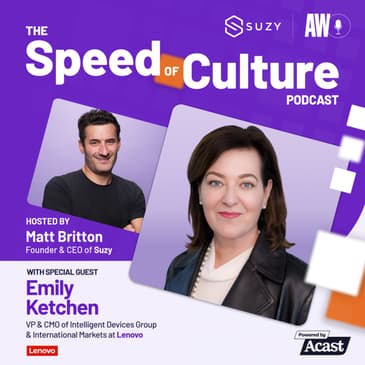
In this episode of The Speed of Culture Podcast, Matt Britton chats with Emily Ketchen, VP & CMO of Intelligent Devices Group and International Markets at Lenovo, about the transformative role of AI in technology and marketing. From on-device AI to next-gen innovations like rollable laptops, Emily shares how Lenovo is shaping a smarter, more connected future.
Follow Suzy on Twitter: @AskSuzyBiz
Follow Emily Ketchen on LinkedIn
Subscribe to The Speed of Culture on your favorite podcast platform.
And if you have a question or suggestions for the show, send us an email at suzy@suzy.com
Hosted on Acast. See acast.com/privacy for more information.
[00:00:02] Als mein Mitarbeiter plötzlich kündigte, musste mir schnell etwas einfallen, um die Aufträge weiterhin reibungslos ausführen zu können. Ich musste sofort eine Lösung finden. Da kam mir Indeed in den Sinn. Wenn es ums Einstellen geht, ist Indeed alles, was du brauchst. Mit gesponserten Stellen wird dein Angebot für relevante Kandidatinnen ganz oben auf der Seite platziert, damit du die gewünschten Personen schneller erreichst. Bevor ich von Indeed wusste, waren die Kandidatinnen oft nicht optimal, mal zu langsam oder unterqualifiziert.
[00:00:30] Dann fing ich wieder von vorne an mit einer neuen Stellenausschreibung. Das kostet Zeit und Geld. Wie schnell ist Indeed? In der Minute, in der ich mit dir gesprochen habe, wurden weltweit 23 Einstellungen über Indeed vorgenommen, laut Indeed-Daten. Es gibt keinen Grund zu warten. Beschleunige dein Recruiting jetzt mit Indeed. Und Hörerinnen dieser Sendung erhalten ein Guthaben von 75 Euro für eine gesponserte Stelle, damit dein Stellenangebot mehr Sichtbarkeit erhält auf indeed.de-podcast.de.
[00:00:58] Es gelten die allgemeinen Geschäftsbedingungen. Es ist wirklich um Gen Z. Das ist eine Population, die mit Technologie aus dem Grunde genommen hat. Kannst du jetzt imagine, dass Gen Alpha nur AI-enabled Geräte haben? Und was wird mit Beta, die vor diesem Jahr vorhin beendet werden, was es für sie für sie sehen wird? Und was sind die Implicationen für sie?
[00:01:25] Um in einem schnellen Landschaft zu leben, müssen die Branden in einem ever-increisenden Passe gehen. Ich bin Matt Britton, founder und CEO von Suzy. Join mich und die Unternehmen in der Zukunft der Zukunft der Trends, die wir in der Zukunft der Industrie, warum es jetzt und wie Sie können weitergehen. Willkommen zu den Speed of Culture. Up today, wir live in Las Vegas at CES. Ich bin froh, dass wir ein rareer zweitend-time guest auf den Speed of Culture podcasten.
[00:01:54] Emily Ketchin ist die CMO und VP des Intelligent Devices Group und International Markets Lenovo. Emily has a lot to say about the future of personal computing, and I cannot wait to dive in. Emily, so great to see you. So great to see you. Thank you so much for having me back. It's great to be here with you in Las Vegas. Absolutely. So what does CES mean to Lenovo? Why is it an important place for you guys to keep having a presence at? It is probably one of the greatest gatherings for technology and innovation.
[00:02:20] And so for us, the show is incredibly important for us to be able to talk about the innovations that we're bringing to the market for our customers. This year, there's a lot of emphasis, as there is for a lot of technologists on AI and the advent of AI and what that means in all of our different form factors. I'm super excited to share with you that we got Best in Show for our brand new Lenovo Legion Go 2. So super excited about that.
[00:02:46] And it's a great moment for us that other technologies that we bring to bear and sort of are able to be here as part of the market. So very excited. Yeah, so I mean, for desktop computing, AI is driving a whole new buying cycle because the power of the compute with all the increased needs and applications that's going to pull down, I would imagine part of it has to be on the device. Is that kind of what's driving?
[00:03:10] I think that's exactly what is driving this sort of seismic shift is that you will be able to compute on device versus computing on cloud. And so what that means is better productivity, better performance, and better protection. So if you're trying to keep something inside your organization, which you generally would be, you can compute on device versus computing on cloud. Will the model run on device? It will. Yes, it absolutely will, which I think will be fantastic for companies and for productivity.
[00:03:38] Also, imagine when you're traveling, which you do all the time. You want to be out there and productive. You can be productive in what would have otherwise been considered downtime. On an airplane. Exactly. If you don't have good Wi-Fi. You'll be able to reach the cloud or wherever your documents and things may be stored. So that's going to be a huge shift. I mean, that's crazy because they talk about regulation AI, but if you can put it on your local device, it's going to be kind of hard to regulate because somebody could just put it on a thumb drive and
[00:04:03] you have this incredible power of an LLM in your pocket and it really can't be regulated, right? I mean, it's out of the bottle to some extent. Well, I love that. Like I like to say, you can't put the toothpaste back in the tube, right? It's out. And many, many years ago, we all kind of thought, huh, the internet, right? People weren't really sure what that was. They weren't sure how they were going to use it. We had never imagined a smartphone. So we are there, but I think there will be, you will see a lot of dialogue, conversation and progress around the right ways to use AI and
[00:04:32] the wrong ways to use AI. And we are very, very committed to the ethical use of AI and thinking about guidance for that. Because of course, as you say, you don't want to train models in the wrong way. And so having it local, having companies think about their policies and their governance is going to be super important. And we certainly are spending a lot of time on that ourselves. What are some ways that this AI innovation era is different than the advent of the internet or the
[00:04:59] mobile device? Well, the first thing I would say is they're similar in that for a marketer, this is a once in a 30 year opportunity for someone like me to be able to get out there and market the benefits of something as incredibly different and sensational. So I would say there's a similarity. What I would say is the interesting part of this is as you think about who we're targeting in our consumer facing marketing, for example. It's really about Gen Z. Now that's a
[00:05:28] population that has grown up with technology from ground zero. Can you imagine now that Gen Alpha will only have AI enabled devices? And what's going to happen to beta who were recently announced for this particular year? What's it going to look like for them? And what are the implications for them? So I think what's going to happen is... I think about that all the time. It's going to scale much more quickly, right? Because you have these generations that have a proclivity to technology. They understand it. They use it. It is oxygen to them. So I think that's
[00:05:57] going to change how quickly and how pervasively this technology gets out there and their contributions to the technology as it grows. AI doesn't have emotion. It doesn't have feelings. But boy, can it be incredibly helpful in terms of productivity. And I think you'll see them participate in what that looks like. Yeah. I mean, Gen Alpha is going to redefine expectations for companies too. Without a doubt. They're going to want personalization. First and foremost, they're
[00:06:23] going to want any business they interact with to know them because that's all they will ever know. And once they start driving these new expectations through, then it spreads to broader markets. And that's what we saw with digital. That's what we saw with mobile, et cetera. You're 100% right. And what we saw with those was that interactivity between the customer expectation and the customer usage drove innovation. And so as an innovation company, we look forward to seeing how our audiences, how companies will have
[00:06:50] requirements that we then lean in to meet or that we're ahead of them and they're coming to us. So it's this wonderful interactivity between ourselves and our customers around this is what's useful. This is what's not so useful. So maybe we change that. And I think it's going to be super interesting to see how that happens. The key is, I think, to your well-made point and to your great question. It's the speed. We thought that was really fast. Whoa, this is going to be even faster. Yeah. I mean, I just wrote a book called Generation AI and it's how Gen Alpha and the age of AI will
[00:07:20] change the world forever. And the book was due last week and it doesn't come out till May. And it was like I was updating it till the last second because everything I write is going to be so dated in May. I mean, it's basically like AI is the fastest thing ever, book publishing is the slowest thing ever. I'm trying to make them both work, but it just goes to show how quickly things and it's really hard for companies to know how to plan because you can plan for something a quarter from now, but whatever you plan for might be irrelevant based upon new technology.
[00:07:48] This tension that you're pointing out between the incredible speed with which AI is coming to market, your idea to pen what this is going to mean and your consciousness that that's going to change in three months. You're exactly right. I mean, so we're thinking about the pace of that and the pace of change. And one of the things that we're doing that I wanted to share with you and with your listeners is we have set up an internal organization and a governance council on AI.
[00:08:14] Now, why is that important? Because you're going to ask me, how are we thinking about using AI in our marketing? So not just for customers, right? But how are we using it? So what we decided to do was put together a governance council that includes members of our security organization, members of our legal organization. And it's foundational to teaching our teams really how to use the AI first and then think about the implications for that AI when they're doing their marketing. So we have an 11 set of
[00:08:44] courses that everyone in the organization is taking. They're leaning in, they're using it. We've bought the licenses. We're working with a bunch of organizations to kind of understand how best to use the actual AI. And what's been fascinating is- In like everyday work. In everyday work. And like folks are taking it super seriously. We have this incredible subcommittee that's emerged, Matt, of this constituent of folks who call themselves like the AI marketing community. So there's the governance council, but this is a community of folks who are
[00:09:12] meeting themselves every five or six weeks to advance the work that we're doing. And do you know what they've done? They've come up with prompt engineering, prompt curation, and a prompt library. Wow. Which is like extraordinary, right? Yeah. Incredible. The passion they have for it. And I'm excited because we can't think about the implications for our customers unless we know what they are for ourselves. Sure. I think with all these changes, companies will need new and
[00:09:37] differentiated skill sets. We are going to see a big shift and it's not always going to be fun of companies who are getting pressured to move faster, be more efficient, and they're going to look at their workforce and they're going to say, do we really need that department? Do we really need these people? What's your advice to people to future-proof themselves amidst this change? I'm so glad you asked because it's really a great question and it's driving a lot of dialogue. The first thing I would say is the most important thing you can do is educate yourself
[00:10:05] and use it. And I'm not saying just educate yourself and just use it. Make yourself familiar, force yourself to do it. The other thing I will tell you is AI is not going to replace you. It's not. However, the people who are your peers and your colleagues who know how to use AI better than you do will replace you. So that's what you have to be conscious of. Can they curate? Can they
[00:10:31] query? Can they make their work better? Can they do research before they sit down with you and your listeners to have a conversation and just be better prepared? That's what's going to make the difference. It's not about replacing. It's about folks who know how to use the AI to their advantage. That's where I would say everybody needs to be focused. Yeah, I agree. And then I'm like delighted about the removal of menial tasks. What if I told you that an agent could come in from an AI perspective
[00:10:56] and take care of making sure that my expenses are read the right way, making sure that the right car is going to the right location? All of those kinds of things that seem a bit more menial things like checking the difference between an invoice and a statement of work. Fantastic. Great. Take those tasks. I can then focus on the bigger picture and driving my marketing forward and leading my organization. Yeah. What I found in terms of really a good path to understand AI is you don't just say I have to say I'm going to understand AI. I think what you try
[00:11:24] to do is figure out what's an interesting problem that you want to solve either in your life or in your career and then go down the path to trying to solve that problem with AI because then you're very intentional about how you're using it and you're methodical about doing it. I think companies that say, oh, we have an AI strategy. To me, it doesn't make you should have a business strategy and then figure out with these great new technologies how you can achieve that strategy in a much more efficient
[00:11:50] way using AI. So it's a different way of approaching it. I'm so glad that you wrote the book because I think you're exactly right. I mean, I would say that's exactly there is no such thing as a cogent and well-defined full strategy yet. It's all about how does it help you? How does it lift the work that you're doing? How is it additive and accretive? Right. And making us more productive. Yeah. And protected because I think to your point, you want to make sure that's the case. And then obviously personalized. Yeah. It gets to know me. It gets trained on the way that I think about things. And
[00:12:19] that's going to be huge. Couldn't agree more. What I'm fascinated with is the education system because the education system to date in America, especially has been predicated on memorization and regurgitation. Right. But many ways now the retention of facts has been commoditized in the world of Google and a word of, and it's less about information you can retain and how you're a problem solver, critical thinker, collaborator, all those things. What are your thoughts on just how kids should be educated given the world that we're heading into? So the first thing I would say, and I had a great
[00:12:49] conversation with, I have two Gen Zers in my house. We talked about this the last time I had a chance to chat. And my 21 year old is now a junior in college. And so we were talking about this over the break. Like, what do you think about this? Is it challenging you when you're at school? Like, how are you using it? What are you thinking about it in the context of education? She's a history major. So therefore implicit in that is that she's a writer. And so she's very much about, I never want the AI to write for me. Yeah. I don't mind if it checks my grammar. I don't mind if it helps me do a few
[00:13:19] bits and bobs, but I think the integrity of the idea and the hypothesis and the synthesis is super important, right? So if you take that to the educational system, you need to be a much better editor. You need to be a much better writer. You need to be able to sustain your idea. What is the thesis? How are you going to prove that one way or the other? How are you going to explain it? So I think it's going to turn out a generation of much better writers because to your point, it won't be wrote. It won't be, what was the vocabulary? What was the tense of that? What was the factoid? It's no,
[00:13:48] no, no. It's much more about creativity. What are you trying to say? Yeah. A hundred percent. A hundred percent. And how will you say it is what they, I think will be sort of graded against, if you will, the development of that argument, the ability to be persuasive because the facts will be so available. Yeah. I wrote my first book 10 years ago and the difference in the experience 10 years ago today is just so dramatic. One, in terms of research, like if I had a thesis that I want
[00:14:14] to prove with data, I have to give it to a research team and wait to hear back from them. If it validated whatever I thought, and then I couldn't really move on because I didn't want the next thing to conflict with it. And now I just put it in perplexity and it does it in the flow of my work. The second thing I did, and it's really relevant to a point that you brought up is what I would do is I'd write a chapter and I would then write a prompt saying using between 95 to 97%
[00:14:39] of my original words and writing, rewrite this for fluency because I have great ideas. I'm not the world's greatest writer, but I do have great ideas. So to your point, I can lean into what really matters, which is what I'm trying to say versus trying to, so what sentence comes first? How do I move that stuff around? That's what I can do better, but it has to come from my... I think that's exactly right. What you're talking about is the origination of the idea. The ideas are original to you now.
[00:15:04] Now, in Isabella's case, she's a student and she's graded on the integrity and the thoughtfulness and the ability to write, right? In your case, you're saying, I'm an excellent ideator. I am in the culture. That's really what you're doing, right? You're helping to educate us on the culture of Gen Alpha and the implications of that for AI. So your ideas are your integrity. This just makes you better at telling that story. I think that's perfect. It's a little different when you talk about the education system and they're evaluated. They're in trouble with that. The old and the new and, you know, the... How do we balance? Yeah.
[00:15:33] That's the right way to think about that. And it's going to be super interesting in that conflict or, like I always say, get comfortable being uncomfortable. Then what comes? What's the innovation out of that? What's the next horizon? 100%. Right? For kids to be thoughtful about their creativity. I don't think they'll be limited by, well, you must have your vocabulary correct and your spelling correct before you can go to X. They might be able to do all kinds of things because that won't be quite as important. I don't
[00:16:02] correct. But the problem is that a lot of the educators don't know about AI themselves. They're teaching textbooks that were written in 2015 before any of this existed. So it's going to take a whole reimagination. That's so important because how's America going to continue to be a leader if we are not embracing the future and how we're teaching? It's just going to be... And it's not just an American problem. Obviously, it's all around the world, but it's going to be fascinating to see how quickly. And I think that's a corporate problem as well. It's like you don't want to fire 90% of
[00:16:31] your team because you'll never build a culture that way. You'll never build anything. But at the same time, if you just put your head down and stick with the same skill set, how are you really going to evolve at the pace in which things are moving? So my answer to that, which will not surprise you, is the incredible ability of our technology to help you to solve that. Because what you're talking about is a conundrum that can be solved by educating teachers through the use of technology. We have personal devices. We are smarter technology
[00:16:58] for all. We believe in democratization of technology. So you have that device at your fingertips. That device, an hour a day, will help you bridge, will help a teacher understand gen beta, gen alpha. You're right. The teacher's 30 or 40 years old. They're not going to be able to relate. So if you're using technology to help you, it will bridge that divide. I think that's the promise for corporations. I think that's the promise for individuals. And it's our responsibility and
[00:17:24] opportunity to bring that to your fingertips. We'll be right back with the Speed of Culture chapter a few words from our sponsors. As my partner suddenly kündigte, I had to quickly add something to me to make the decisions further reibless to make the decision. I had to immediately find a solution. There came Indeed in the sense. If it's about setting, it's all you need. With sponsored places, your offer for relevant candidates is placed on the page, so you can reach the
[00:17:52] desired people faster. Before I knew of Indeed, the candidates were often not optimal, mal too langsam oder unterqualifiziert. Dann fing ich wieder von vorne an mit einer neuen Stellenausschreibung. Das kostet Zeit und Geld. Wie schnell ist Indeed? In der Minute, in der ich mit dir gesprochen habe, wurden weltweit 23 Einstellungen über Indeed vorgenommen, laut Indeed-Daten. Es gibt keinen Grund zu warten. Beschleunige dein Recruiting jetzt mit Indeed. Und
[00:18:17] Hörerinnen dieser Sendung erhalten ein Guthaben von 75 Euro für eine gesponserte Stelle, damit dein Stellenangebot mehr Sichtbarkeit erhält auf indeed.de-podcast.de. Es gelten die allgemeinen Geschäftsbedingungen. Wir sind Theresa und Nemo. Und deshalb sind wir zu Shopify gewechselt. Die Plattform, die wir vor Shopify verwendet haben, hat regelmäßig Updates gebraucht, die teilweise dazu geführt haben, dass der Shop nicht funktioniert hat. Endlich macht unser Nemo Boards Shop dadurch auch auf
[00:18:45] den Mobilgeräten eine gute Figur. Und die Illustrationen auf den Boards kommen jetzt viel, viel klarer darüber, was uns auch wichtig ist und was unsere Marke auch ausmacht. Starte dein Testen heute für 1 Euro pro Monat auf Shopify.de slash radio.
[00:19:24] We have wearables and all sorts of different ways that people can now interact with data and technology. Yeah, I think it's a great question. My view is the future is very bright for these devices. Because I think the other thing that you're going to start to see is AI is going to force the opportunity for the ecosystems to converge. So yes, you may have a wearable. Yes, you may have a phone and we have incredible Motorola devices that are extraordinary. What is the connective
[00:19:50] tissue between those devices? And so I think the future for the form factor is very, very bright. It goes back to what you talked about at the beginning of our conversation, which is resident on your device is all the data that you will need. Right. How do you then port that within your ecosystem? And we are absolutely thinking about that, innovating on that and thinking about how do we bring all of those things together? So it's very easy for you to go between these different devices. I don't think that things like content creation and the ability to get your work done will
[00:20:18] move off of that form factor. It's too fantastic, right? I mean, the laptop is there. It's perfect. We just announced a brand new product, our ThinkBook Gen 6, which is what we're calling a rollable device. I kid you not. No way. You are with the laptop and all of a sudden the laptop starts expanding up and giving you all of this new horizon. It is sensational. You have all this new real estate to get your work done. You can't do that on a smaller device. No. You need to be able to see
[00:20:45] what you're working on. What if you want to split your screen and do more than one thing? Yeah. So I see the future as very, very bright with a combination of these new and interesting form factors that we'll continue to innovate on. And then the advent of AI, which just makes it much more simple than with an ecosystem where you can go from one to the next. Yeah. Not to mention, as we talked earlier about, just the increased demand in compute to get tasks done. Like with all these new capabilities requires more compute and the laptop is a type of device that can actually handle that.
[00:21:14] That's right. That's exactly right. And the demands that we're talking about of children vis-a-vis education, of people in corporations, it's just going to mean they're going to need those devices even more to be able to stay ahead of the curve and do what they need to do for their jobs. Absolutely. Absolutely. So when you look at the Lenovo brand, which is obviously a big part of your job is shepherding the brand, the global brand. How do you look at the evolution of the brand
[00:21:38] itself and the storytelling and the key brand pillars in the wake of all these changes that you're going through? I think we have the most wonderful opportunity ahead of us and it anchors back to our mission and our vision, which is smarter technology for all. So think about it. Smarter is the AI part of the conversation and for all is the democratization of technology for everyone.
[00:22:03] So from my perspective, what our brand stands for and how we bring that to life now in smarter AI for all is a perfect, perfect, it's a perfect fit, right? So we are staying on message. We're staying on task. We are adding some layers of personalization, right? So smarter AI for you might be a take on that for the consumer. But there's no doubt that what our brand stands for, that equal measure of
[00:22:27] intelligence and AI being democratized to everybody means we stand for the ability for everybody to have access to technology, to devices and to the AI therein to make them even stronger and better at what they do. That's cool. So in 2025, obviously, you're going to want to be out in the market a lot and telling these stories and helping the customer understand how you're different and how you've really taken advantage of all these incredible new capabilities offered to the consumer.
[00:22:55] What are some of your plans on the marketing front to execute on that? Yeah, you will see us bold and bright in all of the work that we're doing. So we're spending a lot of time talking about our devices. We've touched on some of the great innovations and they've been recognized for a brand that isn't just doing the same thing over and over again, right? But really genuinely continuing to innovate for the customer, for the consumer, using those consumer insights
[00:23:20] in the journey. So you will see us come forth with continuations around our campaigns for our devices and our products. You will see us continue our partnership with the F1. So we are stepping up to the global level there and you'll see quite a bit. Which continue to grow. Which continue to grow. And it's a fantastic intersection point with our particular audiences. The highest growth in the F1 audiences are, wait for it, women and Gen Z. So what a perfect fit, right? NFL is the same way. Yeah.
[00:23:49] I mean, it's just incredible the growth that's happening there. We very recently announced a partnership with FIFA. So that is hugely popular, right? So if you have the world's most technical sport, which is the F1, and you have the world's most popular sport, which is FIFA, what a fantastic candidate for us. Why are sports important for Lenovo? I think from our perspective, it's really the connection to the technical side of it for the F1 and the ability to reach those customers telling that story who really appreciate technology.
[00:24:16] And then same with a journey into the most popular sport in the entire world. And global. Performance and global and emotional and being able to reach consumers and customers. And that's very nascent. We're just starting that. So I'm excited to see where the company takes that. But those are all things for our brand that are hugely meaningful. The last piece that you and I have talked about is, what about Lenovo's vision for work and technology for good? So that's very,
[00:24:44] very important to us, right? So we have our product diversity office. We've talked about that. Making sure our products are fit to everybody and all of humanity, but then also taking measures to work with Gen Z and others around work for humankind and the initiative we built there. Really, technology for good. That's a big differentiator for us and for our brand. So I see us continuing that next year. And you've mentioned personalization a lot in terms of the consumer
[00:25:09] use case of your devices, coupled with the power of AI. How do you look at personalization in terms of where it fits into the marketing strategy? Yeah, it's a huge opportunity for marketers, right? So it's a fantastic way for us to be able to finally use AI, which I think will be the key to unlocking this incredible number of data sets that are not useful until they're useful, right? So for us, that journey to personalization will be,
[00:25:35] how do you use AI to help you unlock the data, to give you the insights to actually deliver personalization, which in my own hypothesis, Matt, it needs to remove the friction. It needs to be additive and complimentary and good to my experience, not encroaching or uncomfortable, right? So that's the opportunity. That's the fine line always. 100%. Yeah. I mean, I don't think messaging moving ahead is going to be one to many. I think it's going to
[00:26:00] truly be one to one at scale. And obviously, first party data enables that. So when you sell food to third party retailers, you don't always collect that data. Although I'm sure you guys have warranties and all sorts of different ways where you can collect that. Where does first party data fit in your strategy? I mean, definitely. Right. Definitely. And first party data is incredibly important. I think we were all super, super concerned about the deprecation of- The cookie. Yeah. Right. Of course. Now, I think what I'm starting to see, and we're spending a lot of time thinking
[00:26:26] about our digital transformation as are a ton of marketers. It's very fun for me because I love technology. So talking about the stack and getting into that is a happy place for me. What I think we're starting to see is what is the role of AI in helping you to figure out that customer journey and where your customers are. Again, always in the right way, but where we thought there would be a hard wall, I now see a ton more opportunity through the use of AI in the proper way to be able to help you tell customers where they are in their journey, what the right intersection point may be for them.
[00:26:55] Yeah. So it's been an awesome conversation. We've been gone forever, but we have the busy schedules here at CES. I'd love to shift gears to wrap up here and talk a little bit about the role of the modern CMO. And you've been a marketing leader for a while and you've experienced a lot of change in the marketplace, et cetera. What is today's role of the CMO and what do you need to do to make sure that you keep pace and lead at the level in which you have? Yeah. I think there's a foundation layer of the things that you just talked about. You got to keep
[00:27:21] pace. You got to be prepared. You got to be conscious of all the trends and those kinds of things. My own hypothesis is that to be a great chief marketing officer, you have to be a great chief growth officer. We are here to grow the bottom lines of our companies. I am very business focused. You know that about me. I always have been. I think creativity is incredibly important and will continue to be the differentiator because that cannot be run by AI or anything else. But I really firmly believe
[00:27:45] it's seeking out those pools of profitability, knowing where the trends are going and intersecting your brand at the right place and growing the bottom line for the company. Being naturally data-driven ultimately. That's the job. A hundred percent data-driven. Yeah. And marketing has done sometimes a disservice to itself. The marketing and advertising industry of just losing sight of the business results. Yeah. Beautiful Super Bowl spot, but then no one remembers what the brand is behind it. Exactly.
[00:28:15] Yeah. Big, splashy parties. It's like, how is this driving business? There's a shareholder ultimately that wants a return and the dollars that you invest in marketing is dollars you're not investing in R&D or somewhere else. Couldn't agree with you more. And you see beautiful, just to add to your examples, beautiful out of home and you think, oh, that was interesting, but what was the brand and what was that for? Right. It's because folks forget what is the benefit of your product? Why? You know, that very simple question you learn in Marketing 101 that you're very kind a long time. Yes, decades ago
[00:28:43] in my case, right? When you're learning that process and you're inherently curious and asking those questions, I'm asking our product teams all the time. Why that innovation? What's it for? How does it help my customers? And if there's not an answer there, there's not a value proposition. So keeping your eye on that ball. And then of course, to your point, being memorable in how you deliver that. We've also seen great Super Bowl ads changed categories. I think it's a balance of that and the benefit of having the experience I have is having those years and some wisdom to be able to
[00:29:11] make those right decisions. But I would say as you and certainly your listeners are in that journey of marketing, stay curious and stay comfortable being uncomfortable, lean into the unknown and figure out what it means for you and for your company, especially. What is one thing that you spend time on that might surprise people that you find important that maybe people wouldn't think would be part of your job? Oh, gosh. The most important thing is the love and care of my team.
[00:29:41] Yeah. Right. I mean, I think people overlook that really easily and you are nothing without your organization. I had a super interesting conversation several months ago with Oscar Munoz, who is the ex-CEO of United, as you know, and he came and he spoke to us and spent some time with us. And one of the things that he and I talked about was that sort of conditional effort. People can clock in to their jobs and they can clock out of their jobs. But when they stay and when they put everything they
[00:30:07] have behind the success of the company, you know you have a great team on the side and you cannot take that for granted. I spend a lot of time thinking about my team, worrying about their careers, making sure they have opportunities. But Matt, what if you have somebody who isn't ready for an opportunity and they're at a point in their life where they just need to take a beat? You have to understand your people and you have to know what motivates you. Empathy is super important. And I would never
[00:30:33] underestimate the value of kindness. Yeah, I love that. So to wrap up here, as you might remember, we asked our guests here at the podcast to name a quote or mantra that helps define their professional journey. Anything come to mind today? You know, I love the Madeleine Albright quote, which is one that has always stuck with me. And she always said that there is a very special place in hell for women who don't support women. I could not agree more. But I also believe you can take that a step further and
[00:30:59] you can just say human supporting humans. We're all on the journey together. And I think that's incredibly important. And it pulls on those areas of empathy and kindness that I think we have to keep at the front of all that we do. Especially given the state of the world right now. A hundred percent. And such a scary place, so many unknowns, so much potential, but also there's so much fear and divisiveness. And I just think being kind and just giving people the benefit of the depth that everyone's kind of going through something is incredibly important. Unconditional positive regard. It works really well.
[00:31:28] Awesome. We're going to leave it at that. As always, great conversation. We will have you as a third time guest. I won't stop until I get there, but thanks so much for spending time during your busy schedule at CES. Always so inspiring to sit down with you. I cannot wait to see the book and read it and pick it up. I'll copy it on your right. Okay. Awesome. Thank you so much. Thank you. On behalf of Susie and Abby Team, thanks again to Emily Ketchin, the CMO and VP of Intelligent Devices Group and International Markets at Lenovo for joining us today. Be sure to subscribe, rate, and review the Speed of Culture podcast on your favorite podcast platform. We're here live
[00:31:58] at CES in Vegas. See you soon. Bye-bye. The Speed of Culture is brought to you by Susie as part of the Adweek Podcast Network and Agass Creator Network. You can listen and subscribe to all Adweek's podcasts by visiting adweek.com slash podcasts. To find out more about Susie, head to susie.com. And make sure to search for the Speed of Culture in Apple Podcasts, Spotify or anywhere else podcasts are found. Click Follow so you don't
[00:32:26] miss out on any future episodes. On behalf of the team here at Susie, thanks for listening. As my Mitarbeiter plötzlich kündigte, musste mir schnell etwas einfallen, um die Aufträge
[00:32:51] weiterhin reibungslos ausführen zu können. Ich musste sofort eine Lösung finden. Da kam mir Indeed in den Sinn. Wenn es ums Einstellen geht, ist Indeed alles, was du brauchst. Mit gesponserten Stellen wird dein Angebot für relevante Kandidatinnen ganz oben auf der Seite platziert, damit du die gewünschten Personen schneller erreichst. Bevor ich von Indeed wusste, waren die Kandidatinnen oft nicht optimal, mal zu langsam oder unterqualifiziert. Dann fing ich wieder von vorne an mit einer
[00:33:17] neuen Stellenausschreibung. Das kostet Zeit und Geld. Wie schnell ist Indeed? In der Minute, in der ich mit dir gesprochen habe, wurden weltweit 23 Einstellungen über Indeed vorgenommen, laut Indeed-Daten. Es gibt keinen Grund zu warten. Beschleunige dein Recruiting jetzt mit Indeed. Und Hörerinnen dieser Sendung erhalten ein Guthaben von 75 Euro für eine gesponserte Stelle, damit dein Stellenangebot mehr Sichtbarkeit erhält, auf indeed.de-podcast.de. Es gelten die allgemeinen Geschäftsbedingungen.