
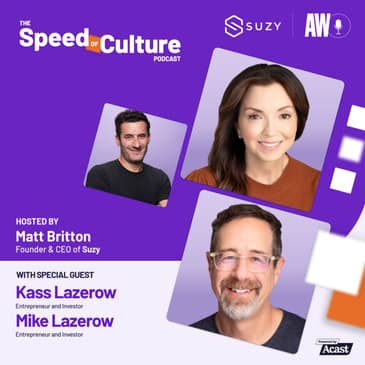
In this episode of The Speed of Culture podcast, Matt Britton sits down with entrepreneurs & investors, Kass and Mike Lazerow. The Lazerows explore the realities of entrepreneurship, sharing their journey from founding Buddy Media to navigating the challenges of venture capital. They discuss the importance of trusting your gut, the value of resilience, and strategies for maintaining strong partnerships in both business and life.
Follow Suzy on Twitter: @AskSuzyBiz
Follow Kass Lazerow on LinkedIn
Follow Mike Lazerow on LinkedIn
Subscribe to The Speed of Culture on your favorite podcast platform.
And if you have a question or suggestions for the show, send us an email at suzy@suzy.com
Hosted on Acast. See acast.com/privacy for more information.
[00:00:01] [SPEAKER_00]: And realizing that struggle, like there's quote by J Cole, there's beauty in the struggle.
[00:00:07] [SPEAKER_00]: And that's what entrepreneurs and I think all of us at this table share.
[00:00:11] [SPEAKER_01]: Yeah, it's miserable and there's nothing I'd rather do.
[00:00:15] [SPEAKER_02]: To thrive in a rapidly evolving landscape, brands must move in an ever-increasing pace.
[00:00:20] [SPEAKER_02]: I'm Matt Britton, founder and CEO of Suzy.
[00:00:23] [SPEAKER_02]: Join me and key industry leaders as we dive deep into the shifting consumer trends within
[00:00:27] [SPEAKER_02]: their industry.
[00:00:28] [SPEAKER_02]: Why it matters now and how you can keep up.
[00:00:30] [SPEAKER_02]: Welcome to The Speed of Culture.
[00:00:37] [SPEAKER_02]: Today on The Speed of Culture, we have a very special episode with two great friends of mine,
[00:00:42] [SPEAKER_02]: Kass and Mike Lazerow, two legends in the New York tech industry, entrepreneurs, thought
[00:00:47] [SPEAKER_02]: leaders and authors of the upcoming book, Shovelling Shit, A Love Story, which comes
[00:00:52] [SPEAKER_02]: out in March of 2025.
[00:00:54] [SPEAKER_02]: Kass, Mike, so great to see you guys.
[00:00:55] [SPEAKER_02]: It's great to see you.
[00:00:57] [SPEAKER_02]: So much to talk about and let's start with you, Kass.
[00:00:59] [SPEAKER_02]: Obviously you juggle a lot in everything that you do in your career and personally
[00:01:03] [SPEAKER_02]: etc.
[00:01:04] [SPEAKER_02]: What made you decide to have the conviction actually write a book at this stage in your
[00:01:08] [SPEAKER_02]: career?
[00:01:08] [SPEAKER_00]: Great question.
[00:01:09] [SPEAKER_00]: Thanks for having us, first of all.
[00:01:11] [SPEAKER_00]: I would say that the reason is I've tracked most of the concepts over the last 10 years.
[00:01:18] [SPEAKER_00]: So when Mike and I started several different companies, I started tracking what actually
[00:01:23] [SPEAKER_00]: worked.
[00:01:23] [SPEAKER_00]: And you'll see in the book when it comes out that there's certain phrases,
[00:01:28] [SPEAKER_00]: catchphrases, topics that are just hot button topics that I think every entrepreneur
[00:01:32] [SPEAKER_00]: would like to know about.
[00:01:34] [SPEAKER_00]: And these are kind of lessons that we wish we had known.
[00:01:37] [SPEAKER_00]: You know, we have three kids and now that our oldest is almost getting ready to go to
[00:01:41] [SPEAKER_00]: college, we thought it was time to get this information out in more of a mass way.
[00:01:47] [SPEAKER_02]: Yeah, because being an entrepreneur is a sexy thing still, despite the fact that
[00:01:51] [SPEAKER_02]: it's been harder over the last couple of years.
[00:01:54] [SPEAKER_02]: But when we were growing up, being an entrepreneur wasn't cool.
[00:01:57] [SPEAKER_02]: Like the prototypical entrepreneurs, Bill Gates, who looked anything but cool.
[00:01:59] [SPEAKER_02]: And now being an entrepreneur seems awesome.
[00:02:02] [SPEAKER_02]: So people are definitely more interested in it.
[00:02:05] [SPEAKER_02]: Yet you don't really get the information or knowledge you need by looking at Instagram
[00:02:08] [SPEAKER_02]: when it looks like everyone is killing it, right?
[00:02:11] [SPEAKER_02]: Like, I mean, it looks like it's so easy, but we both know it's anything.
[00:02:14] [SPEAKER_01]: But well, that's the whole reason we wrote this book, which is the most honest
[00:02:18] [SPEAKER_01]: look at entrepreneurship that we've ever read.
[00:02:21] [SPEAKER_01]: You hear about a hustle culture and what people have to do to create these
[00:02:25] [SPEAKER_01]: businesses they become your identity.
[00:02:27] [SPEAKER_01]: But what people don't realize is you start a business, you raise money,
[00:02:31] [SPEAKER_01]: which isn't an end.
[00:02:32] [SPEAKER_01]: It's like a means to an end.
[00:02:33] [SPEAKER_01]: People think it's in and of itself.
[00:02:35] [SPEAKER_01]: These are shoveling shit.
[00:02:36] [SPEAKER_01]: But things go wrong.
[00:02:37] [SPEAKER_01]: You got to hire people, got to fire people, got to get customers,
[00:02:40] [SPEAKER_01]: customers leave you, people sue you.
[00:02:43] [SPEAKER_01]: Just shit goes bad.
[00:02:44] [SPEAKER_02]: Right.
[00:02:45] [SPEAKER_02]: It's when people get congratulated for raising money, it's almost the
[00:02:47] [SPEAKER_02]: equivalent of congratulating somebody right when the marathon starts.
[00:02:51] [SPEAKER_02]: Congrats.
[00:02:52] [SPEAKER_02]: You've got to work hard.
[00:02:53] [SPEAKER_02]: Exactly.
[00:02:53] [SPEAKER_02]: Now good luck for the next 26 months versus when you're running
[00:02:56] [SPEAKER_02]: through the tape.
[00:02:56] [SPEAKER_01]: It's anything but that.
[00:02:57] [SPEAKER_01]: As you know, I mean, you've been an inspiration to us.
[00:03:00] [SPEAKER_01]: One of the great New York entrepreneurs who really built multiple
[00:03:03] [SPEAKER_01]: businesses we met at Mr. Youth and I saw MRY as you rebranded it.
[00:03:08] [SPEAKER_01]: I saw you hustling the world and how you built that.
[00:03:11] [SPEAKER_01]: And it was so fun.
[00:03:12] [SPEAKER_01]: You decided to do it again, which takes kind of a crazy mind.
[00:03:15] [SPEAKER_01]: It really does.
[00:03:16] [SPEAKER_01]: Jump into the shit again.
[00:03:17] [SPEAKER_01]: I know.
[00:03:18] [SPEAKER_02]: I don't know what I was thinking.
[00:03:19] [SPEAKER_02]: So for those who don't know Cass and Mike, they have the same
[00:03:22] [SPEAKER_02]: last name, Lazaro, and it's not because their brother and sisters,
[00:03:25] [SPEAKER_02]: because they're married and you guys are, you guys are husband and wife
[00:03:28] [SPEAKER_02]: and you were behind an incredibly successful company, Buddy Media,
[00:03:32] [SPEAKER_02]: which really I think set the New York tech scene on a certain path
[00:03:36] [SPEAKER_02]: and was an inspiration to me to start Susie and to so many others
[00:03:40] [SPEAKER_02]: to dive into technology, being from New York, not going to
[00:03:42] [SPEAKER_02]: Stanford and starting something in a garage, which is prototypical.
[00:03:46] [SPEAKER_02]: But let's talk a little bit about that journey for Buddy Media.
[00:03:48] [SPEAKER_02]: Cass, let's start with you.
[00:03:49] [SPEAKER_02]: I mean, tell me what you remember from when you guys
[00:03:52] [SPEAKER_02]: decided to start Buddy Media, where you guys were both in your
[00:03:55] [SPEAKER_02]: relationship and your career journey and talking about maybe
[00:03:58] [SPEAKER_02]: some of the most pivotal things that you took away from that experience.
[00:04:02] [SPEAKER_00]: So I was pregnant with our last child Vivian.
[00:04:06] [SPEAKER_00]: And I remember Mike, we had started and run and then sold Goff.com
[00:04:11] [SPEAKER_00]: and that brought us to New York.
[00:04:13] [SPEAKER_00]: So we were a little bit fidgety.
[00:04:16] [SPEAKER_00]: Mike was not working out in the corporate world.
[00:04:18] [SPEAKER_00]: That was just not his thing.
[00:04:20] [SPEAKER_00]: And we were nudgy.
[00:04:23] [SPEAKER_00]: Mike was really nudgy.
[00:04:24] [SPEAKER_00]: We wanted, we were consulting.
[00:04:26] [SPEAKER_00]: We had three small kids under the age of five.
[00:04:29] [SPEAKER_00]: Wow.
[00:04:30] [SPEAKER_00]: And we literally just rolled into New York City.
[00:04:34] [SPEAKER_00]: And I think I gave birth on May 24th, 2007.
[00:04:38] [SPEAKER_00]: And as I was being wheeled in, I just had a C-section.
[00:04:42] [SPEAKER_00]: Mike was on his phone, Blackberry, and he said,
[00:04:45] [SPEAKER_00]: I know what we're going to do next.
[00:04:47] [SPEAKER_00]: And I said, oh, shit.
[00:04:49] [SPEAKER_00]: Are you kidding me?
[00:04:49] [SPEAKER_00]: He goes, no, we're going to start a company.
[00:04:51] [SPEAKER_00]: That was May.
[00:04:53] [SPEAKER_00]: By August, I was building desks with my daughter in a pram
[00:04:57] [SPEAKER_00]: on the weekends while he had the boys going to do something.
[00:05:00] [SPEAKER_00]: And we just jumped.
[00:05:02] [SPEAKER_02]: And it was swag bucks at first, right?
[00:05:04] [SPEAKER_00]: Ace bucks.
[00:05:05] [SPEAKER_02]: Ace bucks, right.
[00:05:05] [SPEAKER_01]: Yes, which would have been a better name, but it was an awful idea.
[00:05:09] [SPEAKER_01]: One of Mike's.
[00:05:10] [SPEAKER_01]: But one of the things that we're good at is I come up with ideas.
[00:05:13] [SPEAKER_01]: Most of them are bad.
[00:05:15] [SPEAKER_01]: Cass let some of those bad ideas go and then we pivot.
[00:05:18] [SPEAKER_01]: So a big part of the book is when do you pivot?
[00:05:20] [SPEAKER_01]: How do you know when something isn't working out?
[00:05:23] [SPEAKER_01]: How did you know in the case of body to pivot to body?
[00:05:26] [SPEAKER_01]: So everyone knows when things aren't working out.
[00:05:28] [SPEAKER_01]: They may not verbalize it.
[00:05:30] [SPEAKER_01]: So entrepreneurs or executives, you know when things aren't working,
[00:05:34] [SPEAKER_01]: but then you convince yourself in the next two weeks after you know that,
[00:05:37] [SPEAKER_01]: oh, well, maybe it is working.
[00:05:40] [SPEAKER_01]: Maybe this is like I should listen to my pride about your ideas.
[00:05:44] [SPEAKER_01]: Yeah.
[00:05:44] [SPEAKER_01]: So letting down other people.
[00:05:46] [SPEAKER_01]: Yeah.
[00:05:46] [SPEAKER_01]: So our gut was that ace bucks wasn't working, but more importantly,
[00:05:49] [SPEAKER_01]: no one was using it.
[00:05:50] [SPEAKER_01]: So that's how we knew.
[00:05:51] [SPEAKER_01]: Right.
[00:05:52] [SPEAKER_01]: And so we continued to pivot.
[00:05:54] [SPEAKER_01]: We did custom apps.
[00:05:55] [SPEAKER_01]: And finally, after many conversations with brand marketers,
[00:05:59] [SPEAKER_01]: we'd show up and we'd say, hey, we can help you on Facebook.
[00:06:03] [SPEAKER_01]: And they said, what's Facebook?
[00:06:04] [SPEAKER_01]: We need to launch a page and do this.
[00:06:06] [SPEAKER_01]: So we launched technology to help them launch pages
[00:06:08] [SPEAKER_01]: and then launch their ads and listen.
[00:06:10] [SPEAKER_01]: And so that's.
[00:06:11] [SPEAKER_02]: So but neither of you guys are coders as far as I know.
[00:06:14] [SPEAKER_02]: No, we're not.
[00:06:14] [SPEAKER_02]: So this was not the AI generation, right?
[00:06:17] [SPEAKER_02]: When we're talking about timestamp here is what?
[00:06:19] [SPEAKER_02]: 2000 and seven.
[00:06:20] [SPEAKER_02]: Right.
[00:06:20] [SPEAKER_02]: So the iPhone had just came out, right?
[00:06:23] [SPEAKER_02]: It was in the dawn of the social media era.
[00:06:25] [SPEAKER_02]: Right.
[00:06:25] [SPEAKER_02]: Finding a coder was very hard to do.
[00:06:27] [SPEAKER_02]: The cloud itself was just a burgeoning technology.
[00:06:30] [SPEAKER_02]: So how did you go from I need to create software
[00:06:32] [SPEAKER_02]: to help brands with social media actually building that software?
[00:06:36] [SPEAKER_00]: Well, it was very hard back then, by the way, to find engineers.
[00:06:39] [SPEAKER_00]: It was 2007.
[00:06:40] [SPEAKER_00]: So they were very expensive.
[00:06:41] [SPEAKER_00]: Especially in New York, right?
[00:06:42] [SPEAKER_00]: Correct.
[00:06:43] [SPEAKER_00]: Mike bought the company of one of the engineers.
[00:06:47] [SPEAKER_00]: And that's how we started it.
[00:06:49] [SPEAKER_00]: So we actually bought a bunch of his apps, if I'm right.
[00:06:53] [SPEAKER_00]: Wasn't one.
[00:06:53] [SPEAKER_01]: Yeah, we bought.
[00:06:54] [SPEAKER_01]: So it wasn't just me.
[00:06:55] [SPEAKER_01]: Right.
[00:06:56] [SPEAKER_01]: But we do everything together.
[00:06:58] [SPEAKER_02]: Yeah, you had funds.
[00:06:59] [SPEAKER_00]: You had raised money at this point.
[00:07:00] [SPEAKER_00]: That's very cute, by the way, Mike.
[00:07:01] [SPEAKER_00]: Thanks for putting me back in there.
[00:07:03] [SPEAKER_01]: The idea was to get going.
[00:07:06] [SPEAKER_01]: There are all these people building apps.
[00:07:08] [SPEAKER_01]: And so I just reached out to all the top app developers.
[00:07:10] [SPEAKER_01]: So on Facebook, on the platform.
[00:07:12] [SPEAKER_01]: Facebook apps we're talking about.
[00:07:13] [SPEAKER_01]: Yes, yes.
[00:07:14] [SPEAKER_01]: And it said on the app like who developed it.
[00:07:16] [SPEAKER_01]: And because it was Facebook, it was like real identity.
[00:07:19] [SPEAKER_01]: So I just started reaching out and one happened to reply.
[00:07:22] [SPEAKER_01]: He'd built a bunch of the early dating apps right on Facebook.
[00:07:27] [SPEAKER_01]: And I said, listen, you could build these apps or partner with us.
[00:07:30] [SPEAKER_01]: We'll be the business people.
[00:07:31] [SPEAKER_01]: You be the developer.
[00:07:33] [SPEAKER_01]: And that's how we got started.
[00:07:34] [SPEAKER_01]: And then we ended up buying another, you know, another company.
[00:07:38] [SPEAKER_02]: Being buddy media.
[00:07:39] [SPEAKER_02]: Those apps, you basically turned.
[00:07:41] [SPEAKER_02]: And for our younger listeners here at the podcast, what you might not know is
[00:07:44] [SPEAKER_02]: when Facebook first started, one of their monetization strategies was having
[00:07:48] [SPEAKER_02]: brands build apps much like the iPhone did.
[00:07:50] [SPEAKER_02]: And that was something that kind of got phased out over time.
[00:07:54] [SPEAKER_02]: Right.
[00:07:54] [SPEAKER_02]: No one needed their own Facebook apps.
[00:07:56] [SPEAKER_02]: Exactly.
[00:07:56] [SPEAKER_02]: But it was an opportunity and it was a way for you to basically have
[00:07:59] [SPEAKER_02]: it, I guess, a technological base in which to build buddy media.
[00:08:02] [SPEAKER_00]: And fast.
[00:08:04] [SPEAKER_00]: We launched fast.
[00:08:05] [SPEAKER_00]: Yeah.
[00:08:05] [SPEAKER_00]: I mean, I'm telling you.
[00:08:06] [SPEAKER_00]: Which matters.
[00:08:06] [SPEAKER_00]: Which does matter.
[00:08:08] [SPEAKER_00]: And Mike was able to raise money very quickly as well.
[00:08:11] [SPEAKER_00]: So we had an office at 60th and Broadway in a matter of a month.
[00:08:16] [SPEAKER_00]: Granted, we had to guarantee it ourselves personally.
[00:08:19] [SPEAKER_00]: Right.
[00:08:19] [SPEAKER_02]: Is what you put skin in the game, which isn't easy when you have three
[00:08:22] [SPEAKER_02]: young kids and to take that on.
[00:08:23] [SPEAKER_02]: Yes.
[00:08:24] [SPEAKER_02]: Who does that?
[00:08:25] [SPEAKER_02]: Like what couple that has three young kids and starts to start a business?
[00:08:27] [SPEAKER_02]: Obviously, you guys are a little crazy.
[00:08:29] [SPEAKER_02]: Well, we just like me.
[00:08:30] [SPEAKER_02]: Like, but what gave you the conviction to even do it?
[00:08:32] [SPEAKER_01]: Well, first you have to understand us.
[00:08:34] [SPEAKER_01]: I met Cass in 1996.
[00:08:36] [SPEAKER_01]: I just graduated college.
[00:08:38] [SPEAKER_01]: I'll agree.
[00:08:39] [SPEAKER_01]: I was 22, first kind of woman.
[00:08:42] [SPEAKER_01]: I'd really ever met.
[00:08:42] [SPEAKER_01]: Like she's still is older.
[00:08:44] [SPEAKER_01]: I don't want to spill the beans.
[00:08:44] [SPEAKER_01]: Wow.
[00:08:45] [SPEAKER_00]: You hear that?
[00:08:46] [SPEAKER_01]: I'm much better looking.
[00:08:47] [SPEAKER_01]: Yeah.
[00:08:47] [SPEAKER_01]: Well, that for sure.
[00:08:48] [SPEAKER_00]: Thank you very much.
[00:08:49] [SPEAKER_01]: Why do you think we're on a podcast?
[00:08:51] [SPEAKER_01]: Love podcast.
[00:08:53] [SPEAKER_01]: And we did what all couples who were dating at the time do.
[00:08:57] [SPEAKER_01]: We started a company together while we were dating.
[00:08:59] [SPEAKER_01]: And so answering questions, why did you do that?
[00:09:02] [SPEAKER_01]: It's not our strength.
[00:09:03] [SPEAKER_01]: We do things that just feel right.
[00:09:06] [SPEAKER_01]: Yeah, right?
[00:09:06] [SPEAKER_00]: I would answer it also and add that I think there's a real big bond between us
[00:09:13] [SPEAKER_00]: in our work ethic, our passion for doing things the right way.
[00:09:17] [SPEAKER_00]: The moral conviction kind of part of us like we can do this together.
[00:09:22] [SPEAKER_00]: We can build teams that actually like coming to work more than they don't.
[00:09:26] [SPEAKER_00]: We can be great at pivoting when it's really hard.
[00:09:31] [SPEAKER_00]: And I think that was the love.
[00:09:34] [SPEAKER_00]: And if you think about why we called it shoveling shit, a love story,
[00:09:38] [SPEAKER_00]: because we think all entrepreneurs who love shoveling are unstoppable.
[00:09:43] [SPEAKER_00]: Yeah.
[00:09:44] [SPEAKER_00]: If you can learn to love shoveling, you will be unstoppable because that's all you do.
[00:09:49] [SPEAKER_00]: And so what we realize is part of our love language, if you will, as cheesy as that is,
[00:09:54] [SPEAKER_00]: is our respect for each other when we work and how we don't overlap.
[00:09:58] [SPEAKER_00]: Because that's one big thing everyone's got to know.
[00:09:59] [SPEAKER_00]: We do not overlap whatsoever.
[00:10:01] [SPEAKER_00]: They're days and weeks in our companies that we didn't see each other.
[00:10:05] [SPEAKER_00]: We saw each other when we went to work, maybe when I said hi at lunch and then we went home
[00:10:10] [SPEAKER_00]: because we had implicit trust.
[00:10:13] [SPEAKER_00]: And so he's more of the visionary salesperson and I took on all the operations and marketing.
[00:10:18] [SPEAKER_02]: Yeah.
[00:10:18] [SPEAKER_02]: I mean, you can tell us, I mean, I've brought several investment opportunities
[00:10:21] [SPEAKER_02]: to Michael over the years and more than one occasion, he's like, let me run a bike
[00:10:25] [SPEAKER_02]: cast and then he comes back and you're like, I think it's too expensive or doesn't make sense.
[00:10:29] [SPEAKER_02]: And you could just tell the respect is there.
[00:10:31] [SPEAKER_02]: Mike has been incredibly successful in his own right as of you.
[00:10:34] [SPEAKER_02]: But you could tell that you have that mutual respect where you, Michael,
[00:10:38] [SPEAKER_02]: respect cast his opinion and you very much partner in everything.
[00:10:41] [SPEAKER_02]: This was post buddy media.
[00:10:42] [SPEAKER_02]: And we'll talk about that later.
[00:10:43] [SPEAKER_02]: But I personally experienced that.
[00:10:45] [SPEAKER_02]: But going back to buddy media, so you mentioned Michael raised the money.
[00:10:48] [SPEAKER_02]: Right.
[00:10:49] [SPEAKER_02]: He went out there, talked to us about what it was like fundraising way back then
[00:10:52] [SPEAKER_02]: when dollars were much harder to buy.
[00:10:54] [SPEAKER_02]: Yeah.
[00:10:55] [SPEAKER_00]: Mike, tell him about the Howard Linsen story because that's really...
[00:10:58] [SPEAKER_01]: So we talk about a lot of these stories in the book because they're characters
[00:11:02] [SPEAKER_01]: who we all were younger, didn't know anything about anything.
[00:11:06] [SPEAKER_01]: Some of them have gone on to do great things.
[00:11:08] [SPEAKER_01]: I mean, we had as early investors, like our first investors, Mark Pincus,
[00:11:12] [SPEAKER_01]: who starred Zynga and Peter Thiel, who was on the board of Facebook
[00:11:16] [SPEAKER_01]: and Ron Conway who backed Google.
[00:11:18] [SPEAKER_01]: And it all started with the conversation with Howard Linsen,
[00:11:21] [SPEAKER_01]: who owns...
[00:11:23] [SPEAKER_01]: He owns...
[00:11:23] [SPEAKER_01]: He's not Twits.
[00:11:23] [SPEAKER_01]: ...not Twits and he's just a great kind of content creator and personality.
[00:11:28] [SPEAKER_01]: And we bonded over the golf industry.
[00:11:31] [SPEAKER_01]: He knew IsoldGolf.com.
[00:11:32] [SPEAKER_01]: He called, called me and I ignored him because he had a company called Golf Now
[00:11:36] [SPEAKER_01]: in a tea time business.
[00:11:38] [SPEAKER_01]: I eventually got back to him.
[00:11:40] [SPEAKER_01]: I helped him with that.
[00:11:42] [SPEAKER_01]: He was the first call I made at Buddy Media.
[00:11:45] [SPEAKER_01]: He committed on the spot at the Stone Rose Lounge in the Time Warner Center.
[00:11:50] [SPEAKER_01]: And he made a few introductions that we went from not having around
[00:11:53] [SPEAKER_01]: until like a week later, we had people like Roger Ehrenberg
[00:11:57] [SPEAKER_01]: and Mark and Peter and Karen Klein and all these people on board.
[00:12:03] [SPEAKER_01]: And entrepreneurs, you never know where you're going to get that break.
[00:12:07] [SPEAKER_01]: We'd have like 50 breaks meeting Howard,
[00:12:09] [SPEAKER_01]: meeting people early on at Golf.com who helped us find money.
[00:12:14] [SPEAKER_01]: And you kind of make your own luck, but a lot of the luck is luck.
[00:12:17] [SPEAKER_01]: A lot of the luck is like, oh, wow, that happened.
[00:12:20] [SPEAKER_01]: And getting yourself out there, being able to make your own luck
[00:12:23] [SPEAKER_01]: is kind of a big part of our career.
[00:12:25] [SPEAKER_00]: I think one of the big lessons there was that we realize why
[00:12:28] [SPEAKER_00]: and we deal with this of a lot of our companies that we invest in.
[00:12:31] [SPEAKER_00]: And we learned it too from the Golf.com days
[00:12:34] [SPEAKER_00]: because we actually had a time where we were bought by a company
[00:12:38] [SPEAKER_00]: that then went out of business and they didn't go public.
[00:12:40] [SPEAKER_00]: So we were like forced into bankruptcy and bought ourselves back out
[00:12:43] [SPEAKER_00]: and had to start it again.
[00:12:45] [SPEAKER_00]: So the lesson of never run out of money and always thinking that in our head,
[00:12:50] [SPEAKER_00]: Mike was so great at fundraising because he never stopped fundraising.
[00:12:54] [SPEAKER_02]: Yeah.
[00:12:55] [SPEAKER_00]: And I'm sure you do this too.
[00:12:56] [SPEAKER_00]: You close around.
[00:12:57] [SPEAKER_02]: I'll get you closer, yes.
[00:12:58] [SPEAKER_00]: But there's never a stopping point, even if you're round, you just had a round.
[00:13:02] [SPEAKER_00]: And so one of the things we did very well is he would continue to network.
[00:13:05] [SPEAKER_00]: And you talked about this before we started this podcast.
[00:13:08] [SPEAKER_00]: I would look at an opportunity of raising money and closing around as a way to reset.
[00:13:12] [SPEAKER_00]: So I would usually lay off people or fire them and clean up.
[00:13:17] [SPEAKER_02]: Because you're fundraising on a set of forecasts,
[00:13:19] [SPEAKER_02]: correct expectations that you have to deliver for.
[00:13:22] [SPEAKER_00]: And so I would like to actually shrink the team
[00:13:24] [SPEAKER_00]: and see who we needed, what was working, what was not working.
[00:13:28] [SPEAKER_00]: And while we celebrated the fact that we actually have money and we're moving forward.
[00:13:31] [SPEAKER_01]: Yeah, we always thought about everything we did in kind of headlines and marketing.
[00:13:36] [SPEAKER_01]: Right. So when we've raised money, it's like a great headline.
[00:13:39] [SPEAKER_01]: Right. It was like, oh, Buddy Media raised a hundred million.
[00:13:43] [SPEAKER_01]: That's the time to lay people off and to get all of to flush all the beds.
[00:13:47] [SPEAKER_01]: That's when all other talent wants to come into you.
[00:13:49] [SPEAKER_00]: Exactly. Redirection.
[00:13:51] [SPEAKER_01]: Yeah. So we're constantly thinking about how do we use this to build a brand,
[00:13:55] [SPEAKER_02]: which is really what we did.
[00:13:56] [SPEAKER_02]: And one thing that was clear from Buddy Media from the beginning is you wanted to go big.
[00:14:00] [SPEAKER_02]: You had huge aspirations.
[00:14:01] [SPEAKER_02]: I remember being at LaGuardia and seeing your billboard.
[00:14:04] [SPEAKER_02]: I remember coming down the escalator at CES in Las Vegas and you owned the biggest
[00:14:10] [SPEAKER_02]: out of home cast.
[00:14:12] [SPEAKER_02]: You obviously behind a lot of like decisions in terms like, well, this payback is how
[00:14:16] [SPEAKER_02]: do you act pragmatic, be numbers driven, but at the same time, have the conviction to go big?
[00:14:22] [SPEAKER_02]: Because those sometimes do two things conflict with each other.
[00:14:25] [SPEAKER_00]: Right. So when you are a startup, I think hiring a marketing guru is kind of very important.
[00:14:32] [SPEAKER_00]: I would say a lot of startups overlook that or they actually hire the wrong kind of marketing person.
[00:14:38] [SPEAKER_00]: The key is to box people out when you're small, to make yourself appear that you're bigger.
[00:14:43] [SPEAKER_00]: And so I knew Mike was going to get all of the deals that we needed.
[00:14:47] [SPEAKER_00]: And we also hired the best salesperson we've ever had in our life, Jeff Ragavan.
[00:14:52] [SPEAKER_00]: So I knew sales was there, but we were competing in a huge space.
[00:14:55] [SPEAKER_00]: How many competitors did we have?
[00:14:57] [SPEAKER_02]: We had 100 funded competitors.
[00:14:59] [SPEAKER_02]: Most of which ended up at a zero talking about like timing being right,
[00:15:02] [SPEAKER_02]: which we can get into in a second.
[00:15:04] [SPEAKER_00]: Right. And if they could actually get the right model.
[00:15:07] [SPEAKER_00]: So we had this idea with our team and our marketing person who worked with us for a
[00:15:13] [SPEAKER_00]: long time, Katherine Bateman. And I said, there's got to be a way that we can look bigger.
[00:15:17] [SPEAKER_00]: And she goes, I know no one's doing this, but there's a lot of space in airports.
[00:15:22] [SPEAKER_00]: And I said, wait a second, if we could actually reach these customers between Thanksgiving
[00:15:28] [SPEAKER_00]: and right after New Year's when they're traveling.
[00:15:31] [SPEAKER_00]: And if we could own things, it would be incredible because they would say, oh my God,
[00:15:36] [SPEAKER_00]: they're big. If they have enough money to do this.
[00:15:39] [SPEAKER_00]: Now listen, I pitched the board, it was a million dollars back then.
[00:15:42] [SPEAKER_00]: They thought I was crazy. We had a huge fight over it.
[00:15:45] [SPEAKER_00]: And I would not walk out of that meeting until they said yes.
[00:15:48] [SPEAKER_00]: Now, do I have exact numbers on whether that paid off?
[00:15:53] [SPEAKER_00]: No, but I think at the end of the day, we had eight out of 10 of the top brands.
[00:15:57] [SPEAKER_02]: That's what I was about to say. In order for you to have the General Motors and Fords of the
[00:16:01] [SPEAKER_02]: World of Marketing and Gamble, I know you worked with all those companies.
[00:16:04] [SPEAKER_02]: They're not going to hire you, especially as a technology company when you talk about data and
[00:16:08] [SPEAKER_02]: all those things unless they trust you and trust is in brand and brand is built by doing things
[00:16:13] [SPEAKER_00]: like that. Right. And it worked. And we also, even though we played a million over,
[00:16:17] [SPEAKER_00]: I think six big markets, most of the people, especially our competitors couldn't afford it,
[00:16:23] [SPEAKER_00]: there was nobody else in any other industry replacing those billboards.
[00:16:26] [SPEAKER_00]: So we actually got up there in some of the markets. We were there for eight months,
[00:16:30] [SPEAKER_00]: nine months before anyone else came and ripped ourselves down.
[00:16:33] [SPEAKER_02]: Before they were digitized. Exactly.
[00:16:35] [SPEAKER_02]: So you actually had to put up printed ads. You have to put up printed ads.
[00:16:37] [SPEAKER_02]: So another thing you guys have mentioned is talent. You mentioned Jeff Miles-Cleger went on
[00:16:41] [SPEAKER_02]: to become Chief Revenue Officer of Braze, an incredibly successful multi-billion dollar
[00:16:45] [SPEAKER_02]: SaaS business. So many people I know that are buddy media alumni that have gone and do
[00:16:50] [SPEAKER_02]: incredible things. And I know as an entrepreneur, there are a few things as rewarding as
[00:16:54] [SPEAKER_02]: seeing people go on and do great things. What was your strategy and what is your strategy now
[00:16:58] [SPEAKER_02]: for the companies you invest in terms of attracting diverse, talented people,
[00:17:03] [SPEAKER_02]: getting them to stay with you and go along the bumpy journey of being an entrepreneur?
[00:17:07] [SPEAKER_01]: Well, this is Cass's specialty. Okay.
[00:17:09] [SPEAKER_01]: So I'm going to pass it to Cass. What makes it your stuff for me, Cass?
[00:17:11] [SPEAKER_00]: I would say my background growing up, we call it a dysfunctional, functional family.
[00:17:16] [SPEAKER_00]: It wasn't the team. I was a very team-oriented person. I'm the last of four.
[00:17:20] [SPEAKER_00]: And I just felt like there was no cohesive team. There's a lot of
[00:17:24] [SPEAKER_00]: alliances and it just wasn't right. My dad is who is one of my best friends,
[00:17:29] [SPEAKER_00]: was always my coach in everything we did. I kind of learned from him and I thought, okay,
[00:17:34] [SPEAKER_00]: there's some great levers here with working. Part of the lever that I love is that
[00:17:39] [SPEAKER_00]: if you can figure out someone's baggage, personal baggage, and you can help them move
[00:17:44] [SPEAKER_00]: it just a little bit in their work life, they will excel. That's one. So that helps
[00:17:49] [SPEAKER_00]: having someone who cares that they're not doing or getting to the place where they want to.
[00:17:54] [SPEAKER_00]: And then the second part is have they put themselves in the right position and have
[00:17:58] [SPEAKER_00]: I put them in the right position? So we call it money balling. There was a time when Mike
[00:18:03] [SPEAKER_00]: and I would go on date nights, right? You probably do this with your eyes.
[00:18:05] [SPEAKER_01]: Of course. We had a time. We still do.
[00:18:08] [SPEAKER_00]: But a time where we had to schedule it. Sometimes Mike and I go on date nights too.
[00:18:13] [SPEAKER_00]: So we would go on a date night and we were running and you know what it's like
[00:18:17] [SPEAKER_00]: to be running at that pace. He said, let's go see a movie. And I said,
[00:18:20] [SPEAKER_00]: dude, I don't have time. Opportunity cost of time. That's three hours in and out.
[00:18:24] [SPEAKER_00]: You want to go to dinner? He said, no, no, you're going to love it. It's like field of dreams.
[00:18:27] [SPEAKER_00]: I'm like, okay. He's like, it's like Hoosiers. I'm like, okay, what's it called? He's like money ball.
[00:18:31] [SPEAKER_00]: And I'm like, oh, okay. So we go in. It's nothing like them. It's a great story.
[00:18:37] [SPEAKER_00]: But the end of the day, the message is you have to field people in the right position.
[00:18:41] [SPEAKER_00]: And if you do so, you don't need one just big hitter. You just get runs and they get over
[00:18:45] [SPEAKER_00]: the plate. I come out of that. He's like, wasn't that great? I am crying, which I don't do
[00:18:49] [SPEAKER_00]: often. I am crying. He's like, what's wrong? I'm like, I have fires like seven people.
[00:18:53] [SPEAKER_00]: I could have moved these departments. Oh my God, this is the worst. But I took that message and
[00:18:58] [SPEAKER_00]: I realized my dad had been teaching me that my whole life with teams, how to structure them,
[00:19:03] [SPEAKER_00]: how to place different people in different positions. So when you do that, there's some
[00:19:07] [SPEAKER_00]: magic there. Then if you can get people invested in camaraderie, sure you do this,
[00:19:13] [SPEAKER_00]: you probably have lots of different games and activities. It gets harder now when
[00:19:17] [SPEAKER_00]: companies decide to work from home. And then giving, we're very big into making,
[00:19:22] [SPEAKER_00]: giving a big part of our daily lives at our companies even now. It's a big part. So we
[00:19:28] [SPEAKER_00]: started, we were the first corporate team of Cycle for Survival and that started their huge journey.
[00:19:34] [SPEAKER_00]: What did they raise to date? About 400 million. 400 million.
[00:19:37] [SPEAKER_01]: That's for as long as I can remember. Half of the dollars are now from corporate teams.
[00:19:41] [SPEAKER_00]: So we kind of lit the fire under all the corporate teams, started challenging them,
[00:19:45] [SPEAKER_00]: doing games, competitions. Having a tech ride.
[00:19:49] [SPEAKER_01]: We got like Google, Facebook.
[00:19:50] [SPEAKER_00]: And we really work with that. But when you get those kind of four pillars,
[00:19:54] [SPEAKER_00]: there's a magic of like, again, I'm not trying to say you're gonna love work every day,
[00:19:57] [SPEAKER_00]: but if you can get people to show up and realize that they'll like it more than they don't,
[00:20:03] [SPEAKER_00]: that they're acknowledged, that we care about their life, their balance,
[00:20:07] [SPEAKER_00]: something good happens. And if you put them in the right position, they will soar.
[00:20:11] [SPEAKER_02]: Absolutely. I mean, it's easier said than done, but I think that strategy will
[00:20:14] [SPEAKER_02]: show up in your favor more often than not. Yeah, and the reverse is true too.
[00:20:18] [SPEAKER_00]: Like when people aren't working out, you got to get them out fast.
[00:20:20] [SPEAKER_00]: So you got to hire them, but fire them faster, right?
[00:20:22] [SPEAKER_02]: 100% couldn't agree more. So in 2011, I believe it was,
[00:20:26] [SPEAKER_02]: buddy media was acquired. 2012.
[00:20:28] [SPEAKER_02]: 2012. Okay, 2012. You were acquired by Salesforce at that time.
[00:20:32] [SPEAKER_02]: It was one of the biggest exits in New York tech history.
[00:20:35] [SPEAKER_02]: I remember Mayor Bloomberg spoke about it.
[00:20:37] [SPEAKER_02]: I remember where I was when I found out that, and we were nowhere near as close
[00:20:40] [SPEAKER_02]: Michael, you and I as we are today back then, but I remember just being so happy for you guys.
[00:20:45] [SPEAKER_02]: Walk me through what that was like to sell your company. What was behind that decision?
[00:20:49] [SPEAKER_02]: What was the journey like to get Mark Banyoff, one of the most influential entrepreneurs of our
[00:20:53] [SPEAKER_02]: era, to believe in both of you to have Salesforce acquire buddy media?
[00:20:58] [SPEAKER_01]: Yeah, so you really never sell a company. The company's bought.
[00:21:03] [SPEAKER_01]: Yeah. And so we were heads down. We had just raised $50 million.
[00:21:07] [SPEAKER_01]: We had most of it in the bank. We had recruited a woman named Susan St. Ledger to be our president
[00:21:13] [SPEAKER_01]: because we realized that for us to go public, away from sales, of course, she was epic executive.
[00:21:20] [SPEAKER_01]: For us to go public, which we were hoping to go public, we needed to up level ourselves,
[00:21:25] [SPEAKER_01]: not just like our team, but like people have that.
[00:21:28] [SPEAKER_01]: We just hired a CFO from Yahoo and I started to feel that there was something in the air,
[00:21:34] [SPEAKER_01]: inbound interest from Yahoo, inbound interest from Google. These corporate development teams call
[00:21:41] [SPEAKER_01]: Ryan Ate at Salesforce is like, oh, when are you out here?
[00:21:45] [SPEAKER_02]: Did you have relationships with them or did they just call that out?
[00:21:47] [SPEAKER_01]: Yeah. So a good lesson for entrepreneurs is you're never selling, but identify who's going
[00:21:52] [SPEAKER_01]: to potentially buy and just get to know them because by the time they're looking at your
[00:21:56] [SPEAKER_01]: space, you want them to be up to speed. Yeah. And trust you.
[00:21:59] [SPEAKER_00]: And you updated them a lot. Right?
[00:22:01] [SPEAKER_01]: Yeah. I kept them updated.
[00:22:02] [SPEAKER_01]: Mike was great about that.
[00:22:03] [SPEAKER_00]: Always just weeping out.
[00:22:04] [SPEAKER_01]: And I would tweak them. I wrote some stuff in the Wall Street Journal, criticizing Mark Benioff,
[00:22:08] [SPEAKER_01]: which I knew would get right to his desk. He launched the social enterprise and I wrote something
[00:22:13] [SPEAKER_01]: about welcoming him to the social party like six years late. And it just became apparent that
[00:22:19] [SPEAKER_01]: we're going to sell because we had very large companies offering a lot of money
[00:22:23] [SPEAKER_01]: for our business. And I love Salesforce. Still love Salesforce. Had a great time at
[00:22:28] [SPEAKER_01]: Salesforce. Spent four years there and Mark had written a book about how to build a company,
[00:22:35] [SPEAKER_01]: which was the blueprint for how he built Salesforce, which I was using at Buddy Media.
[00:22:41] [SPEAKER_01]: And so it's still that book still rings true today. So many of the
[00:22:44] [SPEAKER_01]: things that you get from that. Yeah. And he invited me over to his townhouse
[00:22:47] [SPEAKER_01]: and or his two townhouses at the time, one for his office and one where he lived. And
[00:22:51] [SPEAKER_01]: he was in workout gear, hat backwards just worked out eating an energy bar.
[00:22:57] [SPEAKER_01]: And I'm just showing him the software and Mark is like me that's hard to not show our emotions,
[00:23:04] [SPEAKER_01]: right? So he got really into it. He loved our ad product. And just right there, we negotiated
[00:23:10] [SPEAKER_01]: the deal and he had to talk to the board, all that stuff. And it just felt like home, even
[00:23:16] [SPEAKER_01]: though one of the companies I mentioned had an offer on the table for $100 million more.
[00:23:21] [SPEAKER_01]: We just thought that for our team and for us being a part of the Salesforce
[00:23:26] [SPEAKER_01]: story and their evolution, because they had the sales cloud and the service cloud,
[00:23:30] [SPEAKER_01]: what do you do next? Marketing, right? You got to find customers. And then you do that through sales
[00:23:37] [SPEAKER_01]: and you got to service them. So marketing was one of the pillars. Don't forget too that Mark has
[00:23:42] [SPEAKER_01]: this huge philosophy of giving back to 100% like his 111. So philosophically there's a line
[00:23:48] [SPEAKER_01]: in there. We had modeled a lot of our giving stuff off of his 111 model, which is 1%
[00:23:53] [SPEAKER_01]: of time, people's time, 1% of equity, 1% of capital goes to nonprofit. And so he was a first
[00:24:01] [SPEAKER_01]: executive who I love really respected, who was basically saying make giving part of your day-to-day.
[00:24:08] [SPEAKER_01]: You can do well and do good at the same time. And not only that, but by doing good, by helping
[00:24:16] [SPEAKER_01]: others more than just your shareholders, that's going to be good for business. So
[00:24:20] [SPEAKER_01]: we were just aligned and he went on to treat us great. And a lot of our people are still there,
[00:24:26] [SPEAKER_00]: which we're excited about. I mean, our CTO, Patrick Stokes is now an SEVP,
[00:24:32] [SPEAKER_00]: going around with Mark on stages. So that's like pretty big. We'll be right back with the speed
[00:24:38] [SPEAKER_02]: of culture after a few words from our sponsors. So I want to get the post-exit life in the
[00:24:42] [SPEAKER_02]: second, but before we move past the exit, I don't know if this is in the book or not,
[00:24:46] [SPEAKER_02]: but it definitely impacted me emotionally as it did hundreds of thousands of other people.
[00:24:50] [SPEAKER_02]: You posted a video the day the company was sold and it was about overcoming fear.
[00:24:55] [SPEAKER_02]: And I just think when I tell other people about you, it's one of the stories that always comes
[00:25:00] [SPEAKER_02]: to mind. I'm looking at Harrison Silverstein, our executive producer in the room, and I
[00:25:04] [SPEAKER_02]: showed it to him the first time the night before he was going to meet you for the first time
[00:25:07] [SPEAKER_02]: at CS. One of my closest friends somebody looked up to so much, look at this video he made
[00:25:10] [SPEAKER_02]: because I just thought it was so real and it really shows who you are. Tell us a little
[00:25:14] [SPEAKER_02]: bit about that video, what the personal story is behind it and why you decided to make it.
[00:25:18] [SPEAKER_01]: Yeah. So the story is I was in our office on a Sunday. Now we had a very vibrant office,
[00:25:25] [SPEAKER_01]: a lot of young people, always activity. You go in a Sunday, you're the only person and it's
[00:25:30] [SPEAKER_01]: like you're in a silent chamber. So I just went very into my head and I was there to sign
[00:25:37] [SPEAKER_01]: the paperwork for the deal. And so I signed the deal and like as an entrepreneur, a lot of
[00:25:42] [SPEAKER_01]: people look at overnight success stories, but at this time, this is like a 20 year overnight
[00:25:47] [SPEAKER_01]: thing. That is yet to matter of fact. Yeah. And so and this was like life changing money,
[00:25:52] [SPEAKER_01]: right? We're talking about, I mean, to me $800 million is a lot. I think it's a lot to most
[00:25:58] [SPEAKER_02]: people. And back then it was like 10 times more than it would be like an eight billion
[00:26:00] [SPEAKER_01]: dollar deal today. Yeah. And so you're looking at like generations of your family and
[00:26:04] [SPEAKER_01]: more importantly all these employees who were making money. And we had like a great,
[00:26:09] [SPEAKER_01]: we had purpose after the deal. It wasn't just like, oh, we're selling, we got to work for it.
[00:26:13] [SPEAKER_01]: It's like, no, we're working for a startup. Salesforce was valued at 16 billion at the time.
[00:26:18] [SPEAKER_01]: Right. Now it's 300 billion, right? So there's a feeling that this could really grow. We want
[00:26:23] [SPEAKER_01]: to be a part of that. And I just felt very grateful and I really went to two people, one,
[00:26:29] [SPEAKER_01]: Jen Goodman-Lynne who is no longer with us, but Start Cycle for Survival, who was a very
[00:26:33] [SPEAKER_01]: good friend who had passed. And I thought about someone else who had gone through,
[00:26:39] [SPEAKER_01]: Ben Breedlove, who people may not have heard of who had the same heart condition that I had.
[00:26:45] [SPEAKER_01]: I had this heart condition survive. They didn't. Ben had put together a video in the same format.
[00:26:51] [SPEAKER_01]: So in the same no card format with music. Mine was the Kerry Brothers Ride, Kerry Brothers
[00:26:57] [SPEAKER_01]: great musician. We went to Northwestern together. So he let me steal his song,
[00:27:02] [SPEAKER_01]: which is a very emotional song. And so I just put together a message and recorded it,
[00:27:07] [SPEAKER_01]: put it out there. Didn't really think about it. Looking back, it seems to be like a high douchebag
[00:27:12] [SPEAKER_01]: factor of not at all. Not at all. Not at all. Looking back, it could have-
[00:27:15] [SPEAKER_01]: It humanized you. Yes.
[00:27:17] [SPEAKER_01]: I agree. But it could have, like the fact, I didn't really think about it.
[00:27:20] [SPEAKER_02]: But ultimately it was about getting past your fear. So talk to me about how,
[00:27:24] [SPEAKER_01]: why that's important. So fear paralyzes people and it gets us to make the wrong decision
[00:27:31] [SPEAKER_01]: all the time. And I'm not talking about just fear of running away from tigers and sharks.
[00:27:35] [SPEAKER_01]: I'm talking about fear of what our parents think, fear of what other things.
[00:27:38] [SPEAKER_01]: Investor.
[00:27:39] [SPEAKER_01]: Fear of being a failure. Right.
[00:27:40] [SPEAKER_01]: Fear like imposter syndrome. Right?
[00:27:43] [SPEAKER_01]: Yeah. People not liking your social media posts.
[00:27:45] [SPEAKER_01]: Right. Yeah. And so you make decisions because of that that are not great for you.
[00:27:49] [SPEAKER_01]: I'd look back at like after 9-11 there were like 5,000 people who drove instead of
[00:27:54] [SPEAKER_01]: flying in a plane who actually died and car crashes. The fear caused all this stuff.
[00:27:59] [SPEAKER_01]: And Jen, who was fearless, Jen didn't say don't be scared. Don't live without fear.
[00:28:07] [SPEAKER_01]: Just don't let it really-
[00:28:09] [SPEAKER_01]: Stop you.
[00:28:09] [SPEAKER_01]: Kind of stop you from doing what you want and more importantly make an awful decision.
[00:28:13] [SPEAKER_01]: So I think when my basically heart stopped working, right? I have an artificial heart
[00:28:17] [SPEAKER_01]: valve and aortic valve. That was the first time I started living fearlessly,
[00:28:21] [SPEAKER_01]: just getting out there. And basically it comes down to what's the worst thing that could
[00:28:25] [SPEAKER_01]: happen. What's the worst thing that could happen if I asked Cass to dance?
[00:28:27] [SPEAKER_01]: What's the worst thing that could happen if I start a company?
[00:28:30] [SPEAKER_01]: What's the worst thing that could happen if I write a book? It just doesn't sell.
[00:28:33] [SPEAKER_00]: Or what's the worst thing that could happen if you ask for money and someone says no?
[00:28:37] [SPEAKER_01]: Or help or anything. Right.
[00:28:39] [SPEAKER_01]: You're still live, right? Yeah.
[00:28:40] [SPEAKER_01]: You all have like, no matter who you are there's something that like-
[00:28:43] [SPEAKER_01]: It's perspective.
[00:28:43] [SPEAKER_01]: You could be appreciative of.
[00:28:45] [SPEAKER_00]: And Mike, I would add that before your heart surgery that saved you,
[00:28:48] [SPEAKER_00]: you were a pretty anxious individual.
[00:28:50] [SPEAKER_01]: No, 100%. I had it at 19. I had ulcers because I was like that.
[00:28:54] [SPEAKER_01]: Yeah.
[00:28:54] [SPEAKER_01]: That anxious. Ulcer multiples.
[00:28:56] [SPEAKER_01]: And I was anxious about getting into the world, doing stuff.
[00:29:00] [SPEAKER_01]: Not knowing.
[00:29:00] [SPEAKER_01]: I just overthought things and afterward it's like, oh, I'm good.
[00:29:04] [SPEAKER_01]: Like this is like extra ending.
[00:29:05] [SPEAKER_02]: Well, there's that old adage like a wealthy man wants 1,000 things and a sick man wants one.
[00:29:10] [SPEAKER_02]: Right.
[00:29:10] [SPEAKER_02]: And once I think you're brought down to that level.
[00:29:13] [SPEAKER_00]: And yep.
[00:29:13] [SPEAKER_00]: Yeah.
[00:29:14] [SPEAKER_00]: His mom will say that he got out of that surgery and was totally different.
[00:29:19] [SPEAKER_00]: It was like the entire anxiety that had been sitting on his chest was gone.
[00:29:23] [SPEAKER_02]: Being married to Michael and seeing him go through that, I guess from an outside perspective,
[00:29:29] [SPEAKER_02]: how do you think getting past fear helped him and helped you and other people as entrepreneurs
[00:29:34] [SPEAKER_02]: achieve what they want to achieve?
[00:29:36] [SPEAKER_00]: I think as Mike said, you do not get stuck.
[00:29:39] [SPEAKER_00]: So having to make new decisions, having to pivot, having to change your mind,
[00:29:44] [SPEAKER_00]: having to do something over or redo something, that to me is just different software versions.
[00:29:50] [SPEAKER_00]: I look at no perfection.
[00:29:51] [SPEAKER_00]: Let's just ship imperfect products and improve them a long way.
[00:29:55] [SPEAKER_00]: Guy Kawasaki said that.
[00:29:56] [SPEAKER_00]: So when you have fear, you don't do that.
[00:29:59] [SPEAKER_00]: You get paralyzed, you stop.
[00:30:01] [SPEAKER_00]: You don't make the right decision.
[00:30:02] [SPEAKER_00]: You don't make any decision.
[00:30:04] [SPEAKER_00]: And I think being with him, that is always something that keeps me going.
[00:30:09] [SPEAKER_00]: I should have a lot more fear.
[00:30:10] [SPEAKER_00]: I did not have knock on wood any kind of health scare when I was younger.
[00:30:15] [SPEAKER_02]: But you started the business with three young kids.
[00:30:17] [SPEAKER_00]: Yes.
[00:30:18] [SPEAKER_02]: So you don't do that if you're scared.
[00:30:21] [SPEAKER_02]: Like, will I be able to be there for them?
[00:30:22] [SPEAKER_02]: Financing all that stuff.
[00:30:23] [SPEAKER_00]: I don't like companies where people are not seen.
[00:30:27] [SPEAKER_00]: And so I'd rather build companies and build teams where people can be seen and acknowledged
[00:30:33] [SPEAKER_00]: and appreciated.
[00:30:34] [SPEAKER_00]: And if I do my job and I get them in the right role, they will do their work.
[00:30:38] [SPEAKER_00]: I empower them to do it.
[00:30:40] [SPEAKER_00]: I don't need a micromanager or anything.
[00:30:41] [SPEAKER_00]: And I'd rather do that and take that risk than be like, okay, which corporation should I go to?
[00:30:49] [SPEAKER_02]: So one thing that I really admire about both of you guys is that you haven't really changed post-exit.
[00:30:54] [SPEAKER_02]: And a lot of people do.
[00:30:55] [SPEAKER_02]: A lot of people let money impact them.
[00:30:58] [SPEAKER_02]: They try to find new friends.
[00:31:00] [SPEAKER_02]: They up level in ways.
[00:31:01] [SPEAKER_02]: They set the wrong value system for their family.
[00:31:04] [SPEAKER_02]: And I honestly, I call us to people all the time.
[00:31:05] [SPEAKER_02]: You guys haven't.
[00:31:06] [SPEAKER_02]: And it makes you guys truly unique.
[00:31:07] [SPEAKER_02]: And not only that, but you still work hard and you start an venture firm and you're writing a book
[00:31:14] [SPEAKER_02]: and you're doing all these things.
[00:31:15] [SPEAKER_02]: I guess, Cass, from your perspective, what is the magic to doing that?
[00:31:20] [SPEAKER_02]: And what gave you the motivation to want to keep going after you have such a big financial
[00:31:24] [SPEAKER_02]: event in your life to keep going to build stuff and actually be here doing this podcast interview today?
[00:31:28] [SPEAKER_00]: Something that motivates me is helping others.
[00:31:31] [SPEAKER_00]: And it's a form of also gratitude.
[00:31:34] [SPEAKER_00]: So, yes, after Buddy Media, Mike stayed for four years.
[00:31:38] [SPEAKER_00]: I got out of there after six months and it was very nice of Mark to let me do so to kind of reset.
[00:31:44] [SPEAKER_00]: I had a lot on my plate with 350 employees as you can probably imagine us and the kids.
[00:31:49] [SPEAKER_00]: And they needed me.
[00:31:50] [SPEAKER_00]: It was time.
[00:31:51] [SPEAKER_00]: And you do need a little bit of a break, but I think I suffer when I'm not around people
[00:31:57] [SPEAKER_00]: who are teaching me something and then something I can teach them.
[00:32:00] [SPEAKER_00]: I want to do that.
[00:32:01] [SPEAKER_00]: So that motivates us.
[00:32:02] [SPEAKER_00]: On a daily basis, on a weekly basis, Mike and I still get calls from lots of people,
[00:32:07] [SPEAKER_00]: friends of friends, where you talk to about an idea, where you walk them through how you should
[00:32:11] [SPEAKER_00]: start something.
[00:32:12] [SPEAKER_00]: Can you help them with fundraising?
[00:32:14] [SPEAKER_00]: And at a certain point, I said, you know, Mike, I think it's time.
[00:32:18] [SPEAKER_00]: We have hundreds and hundreds if not thousands of people who've asked us the same questions.
[00:32:22] [SPEAKER_00]: So that was the motivation for the book.
[00:32:25] [SPEAKER_00]: And the motivation, I think, for being investors is I think we can really help.
[00:32:30] [SPEAKER_00]: And we know what it's like to shovel shit.
[00:32:31] [SPEAKER_00]: You know what it's like.
[00:32:32] [SPEAKER_02]: Yeah.
[00:32:33] [SPEAKER_00]: And what can we tell them so they avoid the pitfalls?
[00:32:36] [SPEAKER_00]: And can we help them choose the right founder, the co-founder, level up a team?
[00:32:41] [SPEAKER_00]: How do they communicate across and down?
[00:32:43] [SPEAKER_00]: How do they retain employees?
[00:32:45] [SPEAKER_00]: What about hiring?
[00:32:46] [SPEAKER_00]: So I think that is potentially the strength maybe that we have that we're willing to give away.
[00:32:54] [SPEAKER_02]: Right.
[00:32:54] [SPEAKER_02]: Which I think is fantastic.
[00:32:56] [SPEAKER_02]: So we hadn't gotten into this, but you have a venture fund and you guys have made some
[00:33:00] [SPEAKER_02]: awesome investments.
[00:33:01] [SPEAKER_02]: I'm sure you've had your fair share of misses just like every other investor.
[00:33:04] [SPEAKER_02]: Liquid Death being one of them, which is a great success story.
[00:33:08] [SPEAKER_02]: Talk to me, Michael, about just the journey of going from an entrepreneur to starting a fund.
[00:33:12] [SPEAKER_02]: What have you learned from investing in entrepreneurs and kind of being on the outside in?
[00:33:16] [SPEAKER_02]: And where are some of the areas that both of you guys are looking at today
[00:33:19] [SPEAKER_02]: for areas to invest in?
[00:33:21] [SPEAKER_01]: Yes. So we started making investments in 2009, 2010 and we just never stopped.
[00:33:28] [SPEAKER_01]: So we've done like a hundred of these both within a fund environment and our own personal.
[00:33:32] [SPEAKER_01]: And I love entrepreneurs and CAS does as well, but I love every deal.
[00:33:37] [SPEAKER_01]: And so like I sit down and talk to an entrepreneur and I immediately like,
[00:33:41] [SPEAKER_01]: yeah, it's great. This is how it's going to work.
[00:33:44] [SPEAKER_01]: And then I talked to CAS and she's like, oh no, that's right.
[00:33:47] [SPEAKER_01]: And so that is really good. Having that balance of I get the deal flow.
[00:33:53] [SPEAKER_01]: We're friends with so many entrepreneurs, people come to us like we were public
[00:33:56] [SPEAKER_01]: with throughout buddy media. Having someone who's so grounded to basically really be able to think
[00:34:01] [SPEAKER_01]: about how do we operationalize this? Is it going to work? What's truly the size of the market
[00:34:06] [SPEAKER_01]: when they scale? And we really look at companies through like who's the founder?
[00:34:11] [SPEAKER_01]: Is it the right founder for the right industry or the right company?
[00:34:14] [SPEAKER_01]: How big is the market? It's hard to build a really big business in a tiny market.
[00:34:19] [SPEAKER_01]: And so that's what we've gotten right and we got it right. And it's what we've gotten wrong
[00:34:23] [SPEAKER_01]: like a bunch of times, like the market you want to be early, but it's got to be a big market
[00:34:28] [SPEAKER_01]: in the next like one, two, three years. And then the last is who else is around the table?
[00:34:33] [SPEAKER_01]: We found that if entrepreneurs can get can convince people to be advisors and investors,
[00:34:39] [SPEAKER_01]: they're good at kind of telling the story, communicating.
[00:34:43] [SPEAKER_01]: In the meantime, customers are on the table too.
[00:34:45] [SPEAKER_01]: Yes.
[00:34:46] [SPEAKER_01]: Great employees and everything else.
[00:34:48] [SPEAKER_01]: We don't invest in people who we don't want to have dinner with,
[00:34:51] [SPEAKER_01]: who we don't want to hang out with. And we get it wrong sometimes.
[00:34:54] [SPEAKER_01]: But at the end of the day, the entrepreneur with the shovel is just so powerful.
[00:35:00] [SPEAKER_01]: We've seen people transform their lives. There's no reason that we should have
[00:35:03] [SPEAKER_01]: made all this money. We just put our heads down. We want to be independent.
[00:35:08] [SPEAKER_01]: And we were driven by not having a real job. And 20-some years later, it's like we made it,
[00:35:14] [SPEAKER_01]: but it was never about the money. And we look at kind of the investing as
[00:35:19] [SPEAKER_01]: our way to help entrepreneurs and align interests. We win together, we lose together.
[00:35:24] [SPEAKER_01]: One of our companies that we had provided seed capital to is called Scopely.
[00:35:29] [SPEAKER_01]: And Scopely sold last year for $5 billion in cash.
[00:35:33] [SPEAKER_01]: And there's just nothing better than seeing an entrepreneur, if you know really well,
[00:35:38] [SPEAKER_01]: you've seen grow.
[00:35:39] [SPEAKER_01]: You've seen the ups and downs. You've seen them shovel shit.
[00:35:42] [SPEAKER_01]: Yeah, you've seen this shit.
[00:35:43] [SPEAKER_00]: And when they win...
[00:35:44] [SPEAKER_01]: We've seen them show up at our house at Thanksgiving.
[00:35:47] [SPEAKER_01]: Walter literally was running out of money and he just nowhere to go because he was raising
[00:35:51] [SPEAKER_01]: money. So when they have an exit like that, I would say it's almost the same as when
[00:35:57] [SPEAKER_01]: we sold Buddy Media. The irony of when we sold Buddy Media is we announced it to
[00:36:02] [SPEAKER_01]: a company and it was like a happy moment. We were relatively miserable and burned out personally.
[00:36:08] [SPEAKER_01]: We were at each other's throats. We were fighting like crazy. I was like...
[00:36:11] [SPEAKER_02]: It's not easy to get down with the lawyers, the back and forth,
[00:36:14] [SPEAKER_02]: the ups and downs, this deal is gonna happen.
[00:36:15] [SPEAKER_00]: And the travel. How about the travel?
[00:36:16] [SPEAKER_01]: We've been in Singapore, we've been in London.
[00:36:19] [SPEAKER_00]: How about three months before the deal, Mike decides to surprise me.
[00:36:24] [SPEAKER_00]: It turned out to be great, but with a puppy.
[00:36:27] [SPEAKER_01]: As if three kids were not awesome.
[00:36:29] [SPEAKER_00]: Three kids. He traveled 24-7 and he got me a puppy.
[00:36:32] [SPEAKER_00]: Bernie's Mountain Dog puppy, which is 40 pounds.
[00:36:36] [SPEAKER_01]: And there's often like... I've talked to a lot of entrepreneurs who like...
[00:36:39] [SPEAKER_02]: I've seen that dog on Facebook throughout the years and it turns out well.
[00:36:43] [SPEAKER_02]: Yeah, we love her.
[00:36:44] [SPEAKER_01]: I mean, we love dogs, cats loves dogs, all animals.
[00:36:47] [SPEAKER_01]: But the entrepreneurial journey is both beautiful and miserable.
[00:36:53] [SPEAKER_01]: And when you do have an exit or accomplish something great,
[00:36:56] [SPEAKER_01]: it's often hard to enjoy it because you have this...
[00:36:59] [SPEAKER_01]: I'm not gonna compare it to like PTSD, that's like totally different.
[00:37:03] [SPEAKER_01]: But you're in this mentality that you can't get out of.
[00:37:06] [SPEAKER_01]: And it's always on your mind.
[00:37:07] [SPEAKER_00]: Yes.
[00:37:07] [SPEAKER_01]: In the shower.
[00:37:08] [SPEAKER_01]: Always.
[00:37:09] [SPEAKER_02]: Working out whatever it is.
[00:37:10] [SPEAKER_00]: That's the irony, right?
[00:37:11] [SPEAKER_00]: Like everyone said, we wanted to do this because we like our independence.
[00:37:13] [SPEAKER_00]: Well, we work more for this, for our companies than you would
[00:37:17] [SPEAKER_00]: if you just had a regular day job, right?
[00:37:20] [SPEAKER_00]: A desk job.
[00:37:20] [SPEAKER_00]: So it never ends.
[00:37:22] [SPEAKER_00]: You won't miss...
[00:37:23] [SPEAKER_00]: Like here's the other thing that people should know who want to start businesses.
[00:37:25] [SPEAKER_00]: You won't miss the big milestones with your kids and family or yourself or your
[00:37:30] [SPEAKER_00]: family of origin, but you will miss all the other stuff.
[00:37:34] [SPEAKER_00]: You will miss the in between.
[00:37:35] [SPEAKER_02]: There's a trade-off.
[00:37:36] [SPEAKER_02]: There's a trade-off.
[00:37:36] [SPEAKER_02]: People don't want to trade off.
[00:37:37] [SPEAKER_02]: No.
[00:37:37] [SPEAKER_02]: They want their cake and eat it too.
[00:37:39] [SPEAKER_00]: But you're gonna miss like...
[00:37:40] [SPEAKER_00]: I missed Viv's first crawl and first walk.
[00:37:43] [SPEAKER_00]: I didn't miss any of her recitals when she was older.
[00:37:46] [SPEAKER_00]: I didn't miss the day that they were celebrating her birthday at school
[00:37:49] [SPEAKER_00]: or Kohl's soccer games or Myles's, whatever.
[00:37:52] [SPEAKER_00]: But you do miss it.
[00:37:54] [SPEAKER_00]: You miss a lot in between and there is.
[00:37:56] [SPEAKER_00]: And I have a belief that you can only do one thing well at a time.
[00:37:59] [SPEAKER_00]: A lot of people think you can do a lot.
[00:38:01] [SPEAKER_00]: I don't buy it.
[00:38:02] [SPEAKER_02]: And the thing about being an entrepreneur is there's no guarantee
[00:38:04] [SPEAKER_02]: it's gonna be a success like Buddy Media.
[00:38:06] [SPEAKER_00]: Right, but the ones who know that and really grasp the concept of,
[00:38:11] [SPEAKER_00]: okay, I'm gonna shovel.
[00:38:12] [SPEAKER_00]: I'm gonna learn.
[00:38:13] [SPEAKER_00]: There's gonna be chaos.
[00:38:15] [SPEAKER_00]: Those are the ones, the ones who learn to love that.
[00:38:17] [SPEAKER_00]: Those are the ones who are successful.
[00:38:18] [SPEAKER_02]: Right.
[00:38:19] [SPEAKER_02]: Not chasing it, just being in it or whatever it is that
[00:38:22] [SPEAKER_02]: you're business does.
[00:38:22] [SPEAKER_00]: And realizing that struggle, like there's quote by J. Kohl,
[00:38:26] [SPEAKER_00]: there's beauty in the struggle.
[00:38:27] [SPEAKER_02]: Yeah.
[00:38:27] [SPEAKER_00]: And that's what entrepreneurs and I think all of us at this table share.
[00:38:32] [SPEAKER_01]: Absolutely.
[00:38:32] [SPEAKER_01]: It's miserable and there's nothing I'd rather do.
[00:38:35] [SPEAKER_02]: Yeah.
[00:38:35] [SPEAKER_02]: So to wrap up here and it's been an amazing interview
[00:38:38] [SPEAKER_02]: and I can't wait for our audience to hear it,
[00:38:40] [SPEAKER_02]: I'll start with you, Michael.
[00:38:41] [SPEAKER_02]: Like if you look back on your career from the golf.com days
[00:38:44] [SPEAKER_02]: all the way through today and the success you've been
[00:38:46] [SPEAKER_02]: in your life both personally and professionally,
[00:38:48] [SPEAKER_02]: and you had to point to a couple things
[00:38:50] [SPEAKER_02]: in terms of what drove your success.
[00:38:52] [SPEAKER_02]: We talked about getting on the other side of the fears,
[00:38:53] [SPEAKER_02]: maybe we could skip that but anything else comes to mind.
[00:38:57] [SPEAKER_01]: I always look at a few key relationships that without those,
[00:39:02] [SPEAKER_01]: I mean, I don't think we would have succeeded like we've succeeded.
[00:39:04] [SPEAKER_01]: Right.
[00:39:04] [SPEAKER_01]: So we had to buy golf.com back.
[00:39:07] [SPEAKER_01]: I happened to like network to meet a Chicago golfer who was
[00:39:12] [SPEAKER_01]: also had one of the few venture funds, Keith Bank
[00:39:16] [SPEAKER_01]: who agreed to put in money and made introductions to someone who then
[00:39:20] [SPEAKER_01]: made introductions to the other money.
[00:39:22] [SPEAKER_01]: Howard Linsen committing on the spot and making the introductions
[00:39:26] [SPEAKER_01]: and so being open always treating people with respect
[00:39:32] [SPEAKER_01]: because you just never know.
[00:39:33] [SPEAKER_01]: Things do what comes around goes around.
[00:39:36] [SPEAKER_01]: I helped Howard sell that business and figure out that business
[00:39:41] [SPEAKER_01]: just because I liked Howard.
[00:39:43] [SPEAKER_01]: He then turned around and helped me.
[00:39:44] [SPEAKER_00]: What was his email to you?
[00:39:46] [SPEAKER_01]: Well, listen, after we raised the first round and I thanked him for it,
[00:39:51] [SPEAKER_01]: he sent me an email in 2007 which I still have which says
[00:39:54] [SPEAKER_01]: he should get back to emails.
[00:39:56] [SPEAKER_00]: Like always.
[00:39:56] [SPEAKER_02]: Because I ignored his email like first.
[00:39:59] [SPEAKER_02]: And also Gary Vaynerchuk,
[00:40:00] [SPEAKER_02]: you gave him his first office space right now.
[00:40:02] [SPEAKER_02]: He's writing the forward to your book.
[00:40:04] [SPEAKER_01]: Yes.
[00:40:04] [SPEAKER_01]: I mean, Gary's Gary, you are you.
[00:40:06] [SPEAKER_01]: We met really early on.
[00:40:08] [SPEAKER_01]: It's not a surprise that you'd gone on to do great things.
[00:40:11] [SPEAKER_01]: Hopefully, I've helped in a little way for you and for sure.
[00:40:13] [SPEAKER_01]: I know you guys have helped me.
[00:40:15] [SPEAKER_01]: You have it.
[00:40:17] [SPEAKER_01]: Entrepreneurs have it,
[00:40:18] [SPEAKER_01]: but everyone can point to a few key introductions of people
[00:40:22] [SPEAKER_01]: who really made just an oversized contribution.
[00:40:24] [SPEAKER_02]: Almost like the supporting actors in the movie of your life.
[00:40:27] [SPEAKER_02]: Right.
[00:40:27] [SPEAKER_02]: The reboot coming at the right moment and help you get through.
[00:40:31] [SPEAKER_01]: They unlock hidden doors that open up a whole brand new world.
[00:40:35] [SPEAKER_01]: And when we moved to New York,
[00:40:37] [SPEAKER_01]: which we always wanted to do,
[00:40:38] [SPEAKER_01]: we sold golf.com for $25 million.
[00:40:41] [SPEAKER_01]: But we didn't own that much.
[00:40:42] [SPEAKER_01]: We made $3 million, which is a lot of money.
[00:40:45] [SPEAKER_00]: Total over eight years.
[00:40:46] [SPEAKER_00]: Right.
[00:40:46] [SPEAKER_00]: But we were psyched.
[00:40:47] [SPEAKER_02]: That's a lot of money.
[00:40:48] [SPEAKER_02]: We divided that by eight and divided by two.
[00:40:50] [SPEAKER_00]: And we also made zero.
[00:40:53] [SPEAKER_00]: We made zero income.
[00:40:55] [SPEAKER_00]: We had no salaries for the first two years.
[00:40:56] [SPEAKER_02]: Right.
[00:40:57] [SPEAKER_02]: So there you go.
[00:40:58] [SPEAKER_02]: So when we moved here with.
[00:40:59] [SPEAKER_02]: And that's most journeys in entrepreneurship
[00:41:01] [SPEAKER_02]: versus the buddy story.
[00:41:02] [SPEAKER_02]: Correct.
[00:41:03] [SPEAKER_02]: Right.
[00:41:03] [SPEAKER_02]: That's kind of the reality is you had to go through
[00:41:05] [SPEAKER_02]: something like that to get to something like buddy.
[00:41:07] [SPEAKER_01]: Yeah.
[00:41:08] [SPEAKER_01]: And we raised money, sold it, had to buy it back,
[00:41:11] [SPEAKER_01]: like all this stuff.
[00:41:13] [SPEAKER_01]: And so doing this type of work,
[00:41:15] [SPEAKER_01]: I can't imagine doing anything else.
[00:41:17] [SPEAKER_01]: And we feel like we're the luckiest people in the world.
[00:41:20] [SPEAKER_01]: And it fucking sucks.
[00:41:21] [SPEAKER_01]: Yeah.
[00:41:22] [SPEAKER_01]: There's so much to do.
[00:41:23] [SPEAKER_01]: But that's life.
[00:41:23] [SPEAKER_01]: And so holding those two things is often difficult,
[00:41:26] [SPEAKER_01]: but that's life.
[00:41:28] [SPEAKER_02]: Yep.
[00:41:28] [SPEAKER_02]: So, Cass, onto you.
[00:41:29] [SPEAKER_02]: What do you think some of the things you'd point to
[00:41:30] [SPEAKER_02]: in terms of your success personally and professionally?
[00:41:33] [SPEAKER_00]: I think I point a lot to my dad
[00:41:36] [SPEAKER_00]: and watching how he did things,
[00:41:39] [SPEAKER_00]: both as a coach to me and small example,
[00:41:43] [SPEAKER_00]: he was our basketball coach.
[00:41:44] [SPEAKER_00]: Can you imagine like girls' basketball at like eight?
[00:41:46] [SPEAKER_00]: The score is like two to zero.
[00:41:48] [SPEAKER_00]: But he had this way of figuring out what talent everyone had
[00:41:52] [SPEAKER_00]: and the talent was really slim picking.
[00:41:54] [SPEAKER_00]: So maybe running with their right hand out.
[00:41:57] [SPEAKER_00]: So knew to put that person up at the top right guard
[00:42:00] [SPEAKER_00]: for guarding.
[00:42:01] [SPEAKER_00]: And then watching him,
[00:42:02] [SPEAKER_00]: I had the opportunity to work for a marketing firm
[00:42:07] [SPEAKER_00]: for law firms.
[00:42:09] [SPEAKER_00]: And my dad's firm, Howard and Simon,
[00:42:11] [SPEAKER_00]: he was the managing part,
[00:42:12] [SPEAKER_00]: was the first client or one of the biggest clients.
[00:42:14] [SPEAKER_00]: So I actually got to see my dad a lot
[00:42:17] [SPEAKER_00]: when I would walk by certain offices
[00:42:19] [SPEAKER_00]: in the fishbowl conference rooms.
[00:42:21] [SPEAKER_00]: And I would see how he interacted.
[00:42:23] [SPEAKER_00]: He had humor,
[00:42:24] [SPEAKER_00]: even though there were intense miserable conversations.
[00:42:27] [SPEAKER_00]: This is law and antitrust law and lots of litigation.
[00:42:31] [SPEAKER_00]: There was this humanity of smiling,
[00:42:33] [SPEAKER_00]: of high-fiving people.
[00:42:35] [SPEAKER_00]: And I always think back to those things.
[00:42:38] [SPEAKER_00]: And I realized that laughter is like a big tool,
[00:42:42] [SPEAKER_00]: a big tool that breaks down barriers.
[00:42:45] [SPEAKER_00]: And so I just think about those moments of time,
[00:42:48] [SPEAKER_00]: of struggling in my family of origin and friendships
[00:42:52] [SPEAKER_00]: and just kind of lean back on laughter.
[00:42:55] [SPEAKER_00]: Like just being able to do the right thing,
[00:42:58] [SPEAKER_00]: say the right thing, mean well.
[00:42:59] [SPEAKER_00]: There's intentions here.
[00:43:01] [SPEAKER_00]: We never root for our success by stepping on others.
[00:43:05] [SPEAKER_00]: You want other people to succeed.
[00:43:07] [SPEAKER_00]: And you have to believe that.
[00:43:09] [SPEAKER_00]: So there's just some things I've learned from other people.
[00:43:12] [SPEAKER_00]: My mentor, Diane Hartley,
[00:43:14] [SPEAKER_00]: actually one of her daughters called us
[00:43:16] [SPEAKER_00]: because she just started a company.
[00:43:17] [SPEAKER_00]: She used to work at Buddy Media too,
[00:43:19] [SPEAKER_00]: which is just kind of mind-blowing.
[00:43:21] [SPEAKER_00]: But my mentor, she just taught me how to interact,
[00:43:25] [SPEAKER_00]: taught me not to be afraid of talking
[00:43:27] [SPEAKER_00]: to customers and clients and to be myself.
[00:43:31] [SPEAKER_02]: Yeah, that's super important.
[00:43:32] [SPEAKER_02]: So we end our podcast by asking if there's a phrase or mantra
[00:43:37] [SPEAKER_02]: that drives your life and Cass will start with you.
[00:43:40] [SPEAKER_02]: What's the first thing that comes to mind
[00:43:41] [SPEAKER_02]: in terms of a mantra for you?
[00:43:43] [SPEAKER_00]: Because I work with people a lot,
[00:43:45] [SPEAKER_00]: I would say do the job you have and do the job you want.
[00:43:48] [SPEAKER_02]: Elaborate on that.
[00:43:49] [SPEAKER_00]: Don't come to me saying that you think
[00:43:51] [SPEAKER_00]: you should be doing other jobs
[00:43:52] [SPEAKER_00]: or that you're good for this
[00:43:53] [SPEAKER_00]: or that you think you can help out over here.
[00:43:56] [SPEAKER_00]: Do the one that I've put you in
[00:43:57] [SPEAKER_00]: and do the other jobs too.
[00:44:00] [SPEAKER_00]: And then I'll see you.
[00:44:01] [SPEAKER_01]: Love that, Michael.
[00:44:02] [SPEAKER_01]: Mine, we mentioned part of this,
[00:44:04] [SPEAKER_01]: mine is trust your gut.
[00:44:06] [SPEAKER_01]: Very rarely does your gut drive you
[00:44:09] [SPEAKER_01]: into a ditch in the wrong direction.
[00:44:11] [SPEAKER_01]: Like your gut is usually right,
[00:44:13] [SPEAKER_01]: everything else surrounding the decision is wrong.
[00:44:17] [SPEAKER_01]: And so really hone into what do you truly feel
[00:44:20] [SPEAKER_01]: at the beginning?
[00:44:21] [SPEAKER_01]: Like what's your gut until your gut
[00:44:24] [SPEAKER_01]: proves to yourself that it's bad.
[00:44:26] [SPEAKER_01]: I have some friends who maybe like don't trust your gut.
[00:44:29] [SPEAKER_01]: But I hear over and over again, I knew it.
[00:44:32] [SPEAKER_01]: You hear that?
[00:44:32] [SPEAKER_01]: I knew it.
[00:44:33] [SPEAKER_01]: We should have done that,
[00:44:34] [SPEAKER_01]: should have trusted my gut.
[00:44:36] [SPEAKER_01]: And that has been just a huge part of our life
[00:44:38] [SPEAKER_01]: which is why it's hard to explain why we did stuff.
[00:44:42] [SPEAKER_01]: It just felt right.
[00:44:43] [SPEAKER_01]: It was just a gut decision.
[00:44:44] [SPEAKER_02]: That's so much of life.
[00:44:45] [SPEAKER_02]: Yeah.
[00:44:46] [SPEAKER_01]: And so this book doing the social media content
[00:44:48] [SPEAKER_01]: we're doing which feels a little uncomfortable.
[00:44:50] [SPEAKER_01]: We were in social media now,
[00:44:51] [SPEAKER_01]: we're getting out there again.
[00:44:53] [SPEAKER_01]: But seems like the right thing to do,
[00:44:54] [SPEAKER_01]: the right way to get this out.
[00:44:56] [SPEAKER_01]: We'll see if it pans out.
[00:44:57] [SPEAKER_01]: It's already been out.
[00:44:59] [SPEAKER_01]: Our gut is that it's worthwhile.
[00:45:01] [SPEAKER_02]: Yeah, it's going to be worthwhile
[00:45:02] [SPEAKER_02]: for everyone here at this podcast who reads the book.
[00:45:03] [SPEAKER_02]: You guys have so much wisdom to share.
[00:45:05] [SPEAKER_02]: I just want to thank both of you guys
[00:45:06] [SPEAKER_02]: for sharing all that with me here today.
[00:45:08] [SPEAKER_02]: Thanks for having us.
[00:45:09] [SPEAKER_02]: And so grateful for you guys.
[00:45:11] [SPEAKER_02]: So shoveling a love story is coming out March 2025
[00:45:15] [SPEAKER_02]: by a copy.
[00:45:16] [SPEAKER_02]: I know we are going to be buying copies
[00:45:17] [SPEAKER_02]: for every employee at Susie
[00:45:19] [SPEAKER_02]: because I want our team to learn
[00:45:20] [SPEAKER_02]: about the great learnings from Cass and Mike.
[00:45:22] [SPEAKER_02]: So on behalf of the Susie and the Adiwee team,
[00:45:24] [SPEAKER_02]: thanks again to Cass and Mike Lazarow for joining us today.
[00:45:26] [SPEAKER_02]: Be sure to subscribe,
[00:45:26] [SPEAKER_02]: rate, review the Speed of Culture podcast
[00:45:28] [SPEAKER_02]: on your favorite podcast platform.
[00:45:30] [SPEAKER_02]: Till next time, see you soon, everyone, later.
[00:46:01] [SPEAKER_02]: On behalf of the team here at Susie, thanks for listening.