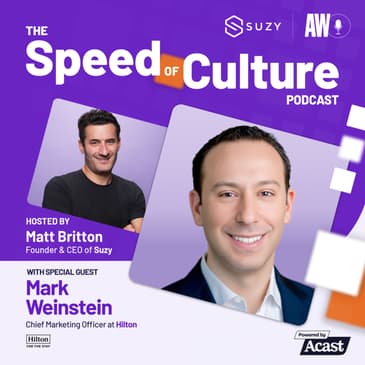
In this episode of The Speed of Culture Podcast, Matt Britton sits down with Mark Weinstein, CMO of Hilton, to explore how Hilton is shaping the future of travel. From personalization powered by first-party data to passion-driven partnerships with F1 and Taylor Swift, Mark shares how Hilton is evolving to meet modern travelers where they are.
Follow Suzy on Twitter: @AskSuzyBiz
Follow Mark Weinstein on LinkedIn
Subscribe to The Speed of Culture on your favorite podcast platform.
And if you have a question or suggestions for the show, send us an email at suzy@suzy.com
Hosted on Acast. See acast.com/privacy for more information.
[00:00:01] These passion points allow us to connect with consumers. These brands allow us to connect with our people. Those people then become their tribe and that tribe stays with us. And that's been a winning success for us, a really good formula. To thrive in a rapidly evolving landscape, brands must move at an ever-increasing pace. I'm Matt Britton, founder and CEO of Suzy. Join me and key industry leaders as we dive deep into the shifting consumer trends within their industry, why it matters now, and how you can keep up. Welcome to The Speed of Culture. Hey!
[00:00:35] Up today, live from CES, we are here with Mark Weinstein, the Chief Marketing Officer of Hilton, a global leader in hospitality. With over a decade at Hilton, Mark has driven transformational initiatives from the award-winning Hilton for the Stay campaign to the explosive growth of Hilton Honors. Mark, it's so great seeing you today. Thanks so much for having me, Matt. I appreciate it. Absolutely. You know, I think going to CES now for about 20 years, and it used to be everyone who's in electronics, then it went to everyone in media, now it's everyone who's anyone.
[00:01:02] In the advertising, digital space, etc. Why is it important for you as a CMO of Hilton to come here to CES in Las Vegas? You know, it's funny. I was thinking we took off a couple weeks for the holiday, was enjoying our hotels all across the world and really taking a chance to relax and reach out for you. And then you just jump right in the deep end with CES, right? Oh, yeah. You come right back in the knee, you're going on that plane, and off you go. So I think for us, it's important to A, see the trends in the industry, see what's going on in the broader circles of what's going to be influencing culture and customer experience and capabilities that might enable our stay experience.
[00:01:31] Things that are adjacent to us that may not be immediately apparent what they're going to do. And then for me personally, it's a great chance to reconnect with our agency partners, our brand partners, to learn what's going on in the broader space and reconnect with friends that I haven't seen in a year. Sure, sure. Good fun, yeah. Of course, you know, you mentioned innovation and things changing. Have you been at Hilton now since 2010? So about 15 years. How have you seen the hospitality space evolve over time? And what gets you most excited heading here into 2025?
[00:01:56] What's really interesting to me is if you go back to our founding, go back 100 years, which is crazy to start an innovation story going back that far, our founder believed in the power of hospitality. He believed in the responsibility of our team members to deliver the light and warmth of hospitality. He believed that a world that broke bread together would not fill as far, and then people would start to get to know each other as humans. And we might achieve, actually, he said, world peace through travel. So that vision actually hasn't changed in over 105 years.
[00:02:20] Our ability to deliver for our customers, disconnecting from their day-to-day life or enabling a great heightened experience like a wedding or business meeting, that hasn't changed either. Everything else around it has changed, though. Where customers go to dream. How do they are inspired by, you know, who tells them where to go on vacation or where to go on holiday. The kind of hotel they're looking for. You've seen us develop 24 brands now across every stay occasion for every travel budget and occasion. How we interact with our customers through the app, you know, letting you choose your room and go right to the room with the phone. All those things are new, and yet the core of it remains the same.
[00:02:50] And I think that dichotomy, that seemingly paradoxical dichotomy of one of the world's oldest professions that hasn't changed at all. Humans serving humans, people serving people, delivering hospitality in an ecosystem that is totally enabled by new technology, new capabilities, and new ways to create and tell stories. Absolutely. So what are some of the new things that consumers are looking for now when they go into a hotel room? And how is Hilton leading into those things unique to its brand? Yeah. When you look at our, you know, we've done a couple of trend reports over the last couple of years. And this year, what was really striking is there's almost, again, this extremeness in it.
[00:03:19] There's a desire to be technologically connected. So the ability to message our front desk through text messaging, we're so used to text messaging everybody. Why would you pick up the phone and call the front desk? You're used to text messaging. People hate the phone. Right. So people are happy to do that. And satisfaction goes up because the things are not going to bother stopping at the front desk where they're now doing over the phone. That becomes a high-tech moment in that regard. On the other hand, you have high-touch moments that are so analog, right, that people want disconnection. They want to have restorative sleep. They want to have a recharging, restful experience. They want a Peloton in their room, which we're able to do.
[00:03:49] They want the ability to have great food and beverage options that either elevate their lifestyle, you know, in a heightened moment of celebration with Michelin star chefs, or maybe recreate the diet they try to stay on when they're traveling for business. And so we're living in this world where both the technology is accelerating and enabling things like choosing your room by yourself, you know, from the floor plan, whatever room you want, automatically upgrading our Hilton Honors members several days in advance, allowing parents to confirm a connecting room at time of booking, which is huge for parents. Yeah, for sure.
[00:04:17] Versus waiting at time of check-in a year later. And then on the other hand, that the basics are just still this disconnection, this sort of retreat from it all. Interesting and iconic. Yeah. Yeah. So you had mentioned 24 brands and obviously Hilton is the master brand, so to speak. But when you look at the different consumer segments you serve from leisure traveler to business traveler, et cetera, across the 24 brands, how do you look at that overall spectrum? And how do you manage the nuances of all those brands to make sure that they're all unique? It's a great question.
[00:04:45] Look, at the end of the day, we are a consumer and a brand company. That's all we do. And so having distinctly defined 24 brands is really important. And every time we have an unmet need, rather than try to cannibalize or bastardize an existing brand, we can create a new brand or we can partner or buy a brand, as we've done the last couple of years with our acquisition of Nomad Hotels or Graduate Hotels or our partnership with AutoCamp or SLH, Small Luxury Hotels of the World. Those give us opportunities to serve new customer segments.
[00:05:10] If we take a step all the way back, we believe very much that we're for the state, that the branded state experience is the business we're in. And we think about that. We spend a lot of time refining what makes a Hilton stay a Hilton stay at any of our brands. And we realized it was the combination of great physical experience, this physical build out of a great place that motivates you, great service experience, this design of humans serving humans, people serving people to create human hospitality and great technology enabling it. That's common in all of our brands.
[00:05:38] And the state is allow you to make the most of why you came. This need to be somewhere to be taken care of in this moment is what we do best across all 24 brands. So there's common DNA of what we stand for. There's literal DNA and Hilton honors backing all 24 of our brands. And then each brand is standing for its own unique travel budget and unique occasion. And so for a lot of our customers, what that means is they're transversing the brands. They might prefer a Waldorf Astoria for their honeymoon and then a great Hilton for a powerful business meeting they're having.
[00:06:05] And then ultimately they find themselves their kid's soccer game at a Hampton. And so each brand needs to stand for something, but they all are powered by the same Hilton hospitality. Yeah, and you mentioned loyalty is kind of like the underlying layer and your Hilton honors program obviously is a huge bedrock to how you go to market. How has loyalty changed in hospitality space in terms of what consumers expect? Because I know a lot of companies, yours included, have ventured into non-endemic categories to basically round out a lifestyle approach for your loyalty offerings. Yeah, look, we make no secret about it.
[00:06:35] We want to have a brand, a hotel, a stay for every travel budget need and occasion anywhere in the world. And that requires us to have a range of offerings. Some of that is market driven. There's just certain market conditions. If you look at the rising middle class all around the world, if you look at that segment, we have to have brands in that space. So we launched Spark, for example. People got really interested in glamping during the pandemic in particular. I shouldn't even call it glamping. This auto camp partnership we have is just a great experience where there's these nine sites in the U.S. that are airstreams that you stay in and a great common experience with hospitality. And so very cool.
[00:07:05] Yeah, and each of these are designed for an unmet need. And so if we want to serve you for every occasion, we have to have something for everyone. Hilton honors is adding about 83,000 new members a day because of the relevance we're providing. And so whether that's the core offering of the stay itself, better value, better perks, treating you special, upgrading you and personalizing the stay experience for you, giving you relevant offers. And then some of our partnership work, you know, what we're doing with McLaren F1 and other things to make sure that people get these once-in-a-lifetime money-can't-buy experiences.
[00:07:32] Hilton honors the glue that keeps all 24 brands attached to stay. Yeah, I want to dig into a couple of things that you just mentioned, one of which is these sort of like pop culture-oriented partnerships. You mentioned F1. F1 obviously just occurred in Las Vegas. It's a huge pop culture phenomenon. I also know that you've had recently a collaboration with The Wicked, The Universal. So we'd love to hear what gives you as a CMO conviction in some of those partnerships. How do you know they're right for the brand? And why are they important areas for you to invest in? It's a great question.
[00:08:00] I think the first step is being confident in who we are. What do we uniquely bring to the world? What are we good at? What is our core space that we operate in? And what is not our core competency? And so being clear about what we stand for and what we believe in allows us to A, do that really well. But B, find partners who complement us. Yeah. We're not trying to white-label them. We're not trying to pretend they're us. We're actually trying to find great brands to partner with. That ranges from Paris. Paris Hilton, who's ultimately the granddaughter of the family and has been part of our legacy and is helping tell our story authentically and creating iconic suites that the Beverly Hilton
[00:08:30] to stay in. Partners like NBCUniversal, who we worked with for the years, brought us the IP of their movie slate and Wicked felt like a natural way to build out a room at the New York Hilton in Midtown. So you find those opportunities. McLaren F1, 20 years, we've been partnering with them now. They just won the Constructors Championship. It's one of the fastest-growing sports on the planet. And every weekend, they're playing an away match, right? Every weekend, they're somewhere in the world at one of 24 cities in the world as the season plays out where they're staying with us. We're making their stay feel like home, whether it's in Singapore where we flip the day so
[00:08:59] they stay on European time. Oh, really? Yeah, breakfast at night and flip around the housekeeping schedule and serve dinner in the morning and keep the blackout shades up. That's what we do for these fandom communities. And if you think about the passion points, I love what Dr. Marcus Collins talks about, finding your tribes and finding your people. And people in my tribe look, do, and feel this, and therefore they buy and associate with these brands. These passion points allow us to connect with consumers. These brands allow us to connect with our people. Those people then become their tribe. And that tribe stays with us. Yeah.
[00:09:28] And that's been a winning success for us, a really good formula. And I think that tribal mentality also impacts the way that people increasingly travel. Now, you look at passion points like the NFL or college football, they're increasingly becoming kind of travel rituals. Yeah. And I would imagine having your properties at the heart of those leisure stays actually provides more upside opportunity as well. That's right. And to your question earlier, our unique role is we don't control the Taylor Swift concert. We don't control the F1 race. We control the stay. And so we know you're there for those things, but our role is very unique in that moment
[00:09:58] to enable you to be connected with those communities, to retreat into our hotels, to either celebrate even more loudly at the bar and gather with friends or go quietly and do your work in the corner. Whatever that is you're trying to achieve, that's what we want to enable. And also for all guests, one of the things we did this year is partnered with Be My Eyes. And it's an AI and human powered app that allows those who are visually impaired to get assistance remotely so they can be guided around the room to help find the thermostat and set the right temperature where audio described, the view out the window.
[00:10:27] For the stay means for every customer for the stay. And so we talk a lot about passion points, but there's also communities that aren't being served as much. And we're here to be there for them as well. Yeah. It's been a hard, it's grudging. We'll be right back with the Speed of Culture after a few words from our sponsors. So obviously we've mentioned loyalty and the heart of every loyalty program is data and first party data. And your company has the privilege of serving customers directly, unlike say Coca-Cola has to sell through a Walmart or a Target. And first party data is only becoming more and more powerful in the age of AI.
[00:10:56] How do you look at first party data and crafting a go-to-market strategy to be able to unpack personalization and other opportunities to really drive more growth and efficiency for your portfolio? It's a great question. We have over 200 million guests a year, and we're fairly fortunate that we have over 200 million, you know, 210 million Hilton Honors members that we get to know even more personally along the way. The direct relationship we have makes it more efficient to engage with them, right? We have a direct connection with them. There's cost removal of the system sometimes when they're booking through us directly that
[00:11:23] we're able to then reinvest in their experience versus paying to acquire them again and again and again. And so that data becomes the backbone of enabling that experience. Some of it allows us to see macro trends. There are things that we see we're missing brands, for example. And so we went out and bought through a JV nomad hotels, right? We want to be in that luxury lifestyle space. We wanted to make sure we had more college campuses. We bought the graduate brand to have that in the portfolio. You see that from our customer data. You see what we're missing out on. You see the stays we're losing on. You see their preferences. You start to evolve the product, the partnerships we do, the way we do.
[00:11:53] We actually build out the brand driven by that. Certainly the offers we put in front of customers and the products content we put in front of them driven by personalization. And then ultimately the interaction with the customer, whether that's messaging them about key things we know that are relevant to them, whether that's a luxury hotel pre-booking you for the spa appointment they know you're going to want to have and saving space for you. We are always in the human serving human business, but the technology is powering that. It's enabling our team members to deliver authentic hospitality, taking them away from the mundane,
[00:12:20] complicated tasks of trying to figure out what guests want, what dinner reservation or what wine preference you have. Data can handle that for us. The team members become the point of delivery. And so that's how the customer relationship with Hilton Honors enables the data, which then enables a better stay experience. Yeah, absolutely. And in terms of obviously you being able to implement these strategies, you have to be able to reach and capture appropriate mindshare of your customers getting bombarded with millions of messages every day. And obviously your customer's changing. So your customer's increasingly becoming a customer that grew up with the iPhone in the
[00:12:50] household that's looking at their phone as an appendage to their body versus more traditional linear mediums, which means more importance in areas like the creator economy, because when they're on their phones, they're normally looking at content from other people. How do you look at the evolution of media and content and leveraging creators and influencers to drive your brands? Yeah, again, I come back to the basics. Storytelling is more important than ever. Yeah, of course. And it's always been at the heart. How we're doing that has changed rapidly. Being clear on who we are and what we stand for has been very important because it allows
[00:13:19] us to pick the right people to help tell that story for us. When it comes to creators, we're working with all kinds of different creator communities, whether it's a 10,000 person following or 10 million. Finding people that can authentically tell the safe story in their own voice is really important. Now, it's a little scary as a brand. You lose control. You don't have full control over what you're saying and doing, but the authenticity is worth with the connection to that tribe of fans they already have in that community they've already built. When you look at the media strategy overall, I do think the shift is more towards attention and engagement than it is from just reach and frequency.
[00:13:49] Yeah. At the end of the day, we are the most recognized hospitality brand on the planet. I don't have a brand awareness problem. What I have is a meaning, a depth of culture opportunity in front of me to connect with customers who don't yet consider us. Because some of that is actually putting new brands in place, introducing new products for them that maybe they didn't have a price point with us before or a type of staycation. We now have that available to them. But then how do you tell that story? I'm willing to trade off some of the engagement with the gen pop through mass media by finding more targeted ways to engage. I think the thing that's getting a little bit confused in that conversation, though, is
[00:14:18] it doesn't mean the mediums are changing. Video is still extremely powerful. Of course. It just may not be that I want to be on primetime. I may want to be in a more targeted place on a device that's more of a second or third screen, which actually then is more of a first screen at this point for a lot of the new travelers of the world. Right. Yeah. I think people get confused between the modality or the form factor of the television or the nature that people still want to watch long form video. Well said. Yeah. And I think we've gotten this whole issue confused between performance and brand. At the end of the day, we're here to build a brand. Yeah. Performance media will do the last step of that journey, but you're fighting in the auction
[00:14:48] market to get a customer to change their behavior. I'd rather establish preference up front by connecting in culture and passion points and fandom in such a way that we're the only choice for them. And then using performance media just to remind them at the last moment that, of course, we're here for them when they book that stay. Again, I think that gets confused with moving away from really powerful storytelling mediums that's different than the channel itself. Yep. So we're here at CES and you're a CMO of an iconic brand. There's CMOs of so many iconic brands that are here, all faced and grappling with the same
[00:15:15] things entering 2025, namely, where does AI play a role in how you go to market? Sure. How you think about creativity, how you think about the consumer and how it's going to change their lives. What are your thoughts on AI and how it's going to change your job as CMO of Hilton in the year ahead? Well, the first thing I like that we're done debating whether it's going to be a thing or not or whether it's a good idea. We're so past that point. This is real. It is a way of coming. I think the hype cycle is still a little hot.
[00:15:40] I think we're still over-rotating on tactics and sort of uses at the moment versus looking at the long-term implication. Always happens. Which always happens. And then eventually the good ideas settle in and become the new way of working and the new way of engaging. And the old ideas that are, you know, fads go away and drop off. We'll of course use what we are already using generative AI to do all the more routine stuff, right? Version controlling images and scoring our content. We have 1.25 million rooms. To have people go through all the photography is a cumbersome task. Yeah.
[00:16:08] AI is great at looking at the content, scoring it, writing descriptions as first drafts and kicking out exceptions for us to look through. So there's going to be a tremendous amount of effort on more efficiency on the more routine tasks that are not what humans are best at doing. On the creator side, look, I do believe very few consumer brands will create an AI solution that'll change the game. It's just not going to happen. That's just not what we do. The tech companies will play in that space. There'll be companies we haven't even heard of that will create in that space. Our job is to create great content and great storytelling that's extensible to that.
[00:16:36] So I'm not freaking out and geeking out which tool it's going to be, but I want to create a corpus of the best content. So when somebody says, what's the best thing for my stay? AI doesn't say, well, let me find the cheapest or the closest. It's looking at all the dimensions of what a travel agent would talk to you about. Right. The best friend would recommend. To do that, we have to bombard the world and fill the corpus with content in a way that we've never had to do before. Is it tagged right? Is it proliferated correctly? Is it being served up in all the places? That is, I think, the most pragmatic thing that a CMO should be doing right now is populating the
[00:17:05] world with our story in a way that can be consumed by the AI. And then over time, we'll do exactly what we did with social media or e-commerce or any of these other things that were massively disruptive once they settled down. You meet the customers where they are. You change roles and responsibilities to meet the moment. You add new roles. You evolve roles that go with it. You change relationships with partners and agencies to match the circumstance. But you don't get ahead of that by trying to anticipate it. You have to be watching for it and reacting to it, testing your way into it. And then when you see the trends become real, then you lean into them and make them the forefront of what you're trying to do.
[00:17:35] So as a CMO, how are you spending your time to make sure that you have your finger on the pulse of those trends and you understand where the world's headed? It's a great question. I look at it in two ways. One is I am just a voracious consumer of stuff. I'm just on social media. I'm reading magazine articles and watching TV programs and watching YouTube clips and all the things you do to stay relevant in culture and just kind of keep a pulse on what's going on there. I think the real answer is you have a platform as a brand. And that's what we focused on is that if you move away from just advertising campaigns
[00:18:02] or tactics or just one-off things and you create a platform and our for the state platform is just that it's a platform that will endure the test of time. It's our just do it. It's our powerful backing of American Express. It's our priceless. You can take more risks because each bet is a small bet to take. It's in service of a larger message. And so you don't have to be on top of every trend. You're trying a bunch of things. The ones that don't work, great. Don't do them again. The ones that do work, double down, triple down, quadruple down. And so the example I'll give you from a few years ago, we found out that TikTok was going
[00:18:30] to let you have a 10-minute TikTok, the longest TikTok possible. We said, well, if we're for the stay in a world that's kind of always on the go, can we get people to stay for 10 minutes in the longest possible TikTok? And we created this. And I didn't understand my idea, really. I mean, the team pitched it and the creators pitched it. I thought, well, that's interesting. Right. I'm not sure it's going to go anywhere. But it didn't matter because we have a platform. It wasn't our only advertising. It wasn't our only performance media. We have all these other things working in tandem that when that thing caught fire and we saw hundreds and millions of views, we were ready to double down and step on the gas and then move to
[00:19:00] the next thing. And I think that's how things are changed. That's right. It used to be you made these huge bets on 30-second spots and they didn't hit. Well, then you're kind of screwed until the next quarter. All your eggs were in the basket. You shot something a year ago. You hit play on it and you hope it works. Right. Today, we're reacting real time. We're adjusting. And if it doesn't work, that doesn't mean the whole thing doesn't work. It means one little part of it may not work. That's right. You may have to change the end frame or change the channel strategy or change the execution or whatever it is. Nothing is irreversible at this moment. I think that's what's interesting as a CMO. Yeah, for sure. So shifting gears, we wrap up here.
[00:19:29] You've, as I mentioned earlier, been at Hilton for 15 years. I've been in the CMO seat for about five. When you look back at your journey at Hilton and even your time before that, what are some of the decisions that you think you made right along the way to put you in the seat that you're in today? Yeah, look, the piece of advice I always give folks is do the project that nobody else wants to do. Do the thing that's not being focused on right now. You know, people always gravitate towards the shiny object. The problem with the shiny object is it's high pressure because it's often the biggest bet the company's counting on or the team is counting on.
[00:19:57] The roles and responsibilities are often super defined. So your swim lanes are super narrow. There's not a lot of room to learn. And there's not a lot of tolerance for risk taking, right? Because it's so high pressure. It's the thing that's been promised. I guarantee you, though, two years back, there are projects they're incubating that will become the next shiny object. And my entire career at Hilton has been finding the next thing, right? Finding the thing that nobody was yet thinking about or working on. Rolling up my sleeves. Getting involved. I think the balance of strategy and operations execution, you know, that makes you a sharper strategist. Yeah. And it makes you a sharper executioner in the best possible way.
[00:20:26] And so what my advice to younger team members is go on that journey. Go do the thing you're not that interested in, but you think could be interesting. And then when it becomes the shiny object, you're the expert. You're the leader of it. You're the one driving it. And now suddenly you're in prime time and you put yourself in a position of strength. And so for me, Hilton's always met me with another challenge that I could deliver against. And when I did, the next door opened up for the next opportunity. I think a lot of times why people don't do that is they just don't have confidence in your ability to dive into something new. It sits almost a little bit of an imposter syndrome. It's like, well, why would I go do that?
[00:20:56] I'm not an expert in that. Look, I started my career in consulting and the biggest epiphany a year into that one year out of school was, shoot, nobody here knows what they're doing. Nobody knows anything. We're all just making up. We're all just big babies. So true. Kind of grind our way through life by making things up as we go along. And people get fancy titles. And hopefully over time, we make more right decisions than wrong. And hopefully the past experiences inform the future. But the future is unknown. And none of us know what's going to happen. And all of us are just trying to do our best to muddle through it. It's so liberating once you give yourself permission to just try something. Yeah.
[00:21:24] Go for it and not be worried about the right way to do it. Or will I make a mistake? Or what happens if I fail? I think the gem in what you said is give yourself permission. I think so many people are waiting for permission and always waiting to be told what to do. And I think if you go down that path, you're going to go down the opposite road, which is not as appealing. Because most jobs where you just sit around and wait to be told what to do, those are jobs become offshore or outsourced, etc. That's right. And look, I can't guarantee anybody success. There's nothing you can do that will guarantee success.
[00:21:53] But not taking risks will guarantee you don't succeed. That is something I'm sure of. Absolutely. So to wrap up here, and again, thanks so much for taking your time during a busy CES. Yeah, it's good to be here. Is there a quote or a mantra that comes to mind to kind of guide your professional journey? There's two things that come to mind. I think they're both actually quite fitting for Vegas. The older I get, the more time I spend in the business, the more I think just play the hand you're dealt. Yeah, I think a lot of calories get wasted on debating why we're in the circumstance or why did this happen to me or why is my competitor doing this or why did, you know what, it doesn't matter. We are where we are, move forward.
[00:22:23] And all we can do is beat the opportunity that's at hand and play out what we've got in front of us. And so I spent a lot of time in my personal and professional life sort of playing the hand I'm dealt. And the second thing that I just really believe in, and again, it's been really a motivator for me, is there's a great quote from Warren Bennis who said, there's two ways to be creative. One can sing and dance or one can create in a world where singers and dancers can flourish. And increasingly, my job is to create that environment, to create that world, to create that platform for the teams to be able to be successful. Whether they're my team members at Hilton, our agency partners, creators, or brand partners, my job is not to do the work.
[00:22:53] My job is to create an environment with the context and the resources available and the coaching and the guidance so others can do what they do best, which is create. I love that. You heard everyone, the old hand that you're dealt with. Hope you get nothing but a world straight flush here. Likewise. In your time in Vegas. And again, thanks for taking the time. I'm a big fan of yours from afar. And it's been great to hear about your journey and the work you're doing at Hilton. Hey, really appreciate it. Thanks, Matt. On behalf of Suzy and Iwitt team, thanks again to the great Mark Weinstein, the CMO of Hilton, for joining us today, live from CES in Las Vegas. Be sure to subscribe, rate, and view the Speed of Culture podcast on your favorite podcast platform. Until next time, see you soon, everyone.
[00:23:23] Take care. The Speed of Culture is brought to you by Suzy as part of the Adweek Podcast Network and Agus Creator Network. You can listen and subscribe to all Adweek's podcasts by visiting adweek.com slash podcasts. To find out more about Suzy, head to suzy.com. And make sure to search for the Speed of Culture in Apple Podcasts, Spotify, or anywhere else podcasts are found. Click follow so you don't miss out on any future episodes.
[00:23:51] On behalf of the team here at Suzy, thanks for listening.