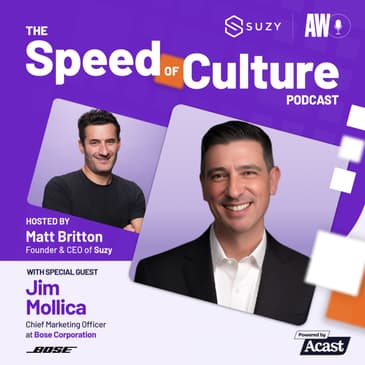
In this episode of The Speed of Culture, Matt Britton speaks with Jim Mollica, Chief Marketing Officer at Bose. Jim shares his journey as Bose’s first-ever CMO, exploring how he’s transforming the brand’s cultural presence through storytelling, innovation, and a music-centric ethos.
Follow Suzy on Twitter: @AskSuzyBiz
Follow Jim Mollica on LinkedIn
Subscribe to The Speed of Culture on your favorite podcast platform.
And if you have a question or suggestions for the show, send us an email at suzy@suzy.com
Hosted on Acast. See acast.com/privacy for more information.
[00:00:01] Demographics do not matter to me. It's behavioral, it's necographic. If you looked at my listening preferences, you would not know that I am the age that I am.
[00:00:13] It's I love music discovery and I go very broad in genres. And so for that, I think the opportunity that all this data provides to us and the processing power and speed that AI and personalization can provide
[00:00:28] can make these magical value added experiences for consumers.
[00:00:35] To thrive in a rapidly evolving landscape, brands must move at an ever increasing pace. I'm Matt Britton, founder and CEO of Suzy.
[00:00:43] Join me and key industry leaders as we dive deep into the shifting consumer trends within their industry, why it matters now and how you can keep up.
[00:00:50] Welcome to the Speed of Culture.
[00:00:57] Up today on the Speed of Culture Podcast, we are thrilled to be joined by Jim Mollica, the first ever Chief Marketing Officer at Bose, leading the chart in transforming the brand's cultural presence and expanding its audience reach.
[00:01:08] Jim, so great to see you today.
[00:01:09] Hey, Matt, thanks for having me. Really appreciate being here.
[00:01:12] Absolutely. So what took Bose so long to get a Chief Marketing Officer? And what does it mean to be the first CMO of the company?
[00:01:18] Well, I think, you know, as many founder led companies are sort of born in that manner that such a strong vision from the founder of both the product and the storytelling around the product.
[00:01:31] And there were years and years of success of innovation and it sort of told the story itself.
[00:01:37] And it just became a day in time with the Internet and crowded space for media and other competing products that came that challenged them.
[00:01:46] And they think about evolving their business in a different way.
[00:01:49] And I think that led to the opportunity of creating the position with a new CEO coming in.
[00:01:55] And that led to the opportunity for me.
[00:01:56] So as a CMO of Bose, how do you spend your time and what are some of the core focus areas you have heading into 2025?
[00:02:03] Yeah. So let me start.
[00:02:04] Whenever you're the first CMO in an organization, you know that you're going to have to establish credibility for the marketing profession,
[00:02:12] especially when such an engineering and product led organization.
[00:02:15] And so from that, it's helping the established credibility in each one of the disciplines from being really embedded in the commercial process and go to market process and things like performance marketing for the CFO down into like deep consumer insights and ethnographies for the research and development team within engineering.
[00:02:35] And each step of those things, each step of the way with those kinds of interactions builds a little bit of credibility in there.
[00:02:42] So my first real job there was to think about how the company had positioned itself into the marketplace and its competitive landscape.
[00:02:51] And for us, it was very clear to me that we were battling with tech giants that made laptops and phones and watching machines and had ad networks and movie studios.
[00:03:02] Ecosystems, basically.
[00:03:03] Yeah, yeah. Right. And we were the only ones solely dedicated to music.
[00:03:08] And so it became clear that it's for music fans by music fans because that's who works in the company.
[00:03:13] So that was step one.
[00:03:14] And then the rest was just setting up the organization to be able to deliver on on the positioning and the brand promise.
[00:03:19] It's interesting because I've always known Bose for being focused on sound the same way Volvo would be known for safety.
[00:03:26] And I know that the excellence in sound and the consumer experience that comes along with it has always been a focus and part and parcel with the brand.
[00:03:34] But to your point earlier, the world has changed.
[00:03:38] People listen to MB3s now, which don't sound nearly as good as vinyl.
[00:03:42] And a lot of people might bypass the excellence in sound for the convenience or the connectivity that comes with a larger ecosystem.
[00:03:50] So how do you see that evolution kind of impacting Bose's brand positioning moving forward?
[00:03:55] Matt, first, that's an insightful question, but it's spoken as a true music fan.
[00:04:00] And I think you can look at sort of the way that I grew up with the ritual of going to the independent record store on Tuesdays when the albums dropped, bringing that home, putting it on, reading the liner notes.
[00:04:13] We're saying to an album to Jim, right?
[00:04:14] Because now people listen to songs and not albums.
[00:04:16] 100 percent.
[00:04:17] And let's make sure we do it in order.
[00:04:19] And it is the way that the piece of art was created.
[00:04:22] And yes, you can look at, for example, the way my children both discover and consume music is a very different way.
[00:04:30] But I think the way that we're looking at this is, is that rather than, you know, focusing on the fact that it doesn't have the same level of ritualization around it.
[00:04:40] Instead, it's the people love music and sound so much that they want to fill every possible aspect of their day and their day part with music.
[00:04:52] And so if there's convenient ways to access that content and that entertainment, they will take advantage of it.
[00:04:58] And I think there's still an opportunity and you see this happening more and more and more with people coming back to vinyl, people coming back to in-home listening.
[00:05:07] Car stereos have become greater and greater, greater power, greater seat centric technology, greater delivery of incredible musical experiences.
[00:05:16] So I think there are room and place for both in this world.
[00:05:20] And I think it's our obligation to help create the deepest, most transformational listening experience we possibly have in each one of those settings.
[00:05:28] Yeah.
[00:05:28] And obviously, in doing that, you've evolved the form factor of the product.
[00:05:33] So obviously, I've for long known Bose for like larger headphones, but now you have smaller in-ear devices as well.
[00:05:41] How is the kind of form factor change over time?
[00:05:43] Does that have anything to do with just generational shifts or just evolution in technology that makes your ability to keep that sound experience at the same with the different types of products?
[00:05:53] Yeah, it's a little of both.
[00:05:54] The generational shifts are just the way that you described earlier, sort of the consumption of music, right?
[00:05:59] If you're on the go a lot and you're filling those down times or commutes with music, you need something that's a little more convenient to match that.
[00:06:07] And some people prefer the in-ear experience because it's just easier to carry around, right?
[00:06:14] You can slip your pocket.
[00:06:15] Yeah.
[00:06:16] Some people really, really like the over-ear because they find it more comfortable.
[00:06:19] It doesn't affect maybe some of their ear occlusion.
[00:06:23] And it's a style factor.
[00:06:25] You find out a lot with young women now really using like the big over the years as a fashion statement.
[00:06:31] So I think all of those things have sort of like, they've taken music consumption in multiple different directions.
[00:06:37] And again, it's just up to us to create the best experience for your chosen weapon of choice.
[00:06:43] What you have seen with us in the last year is rolling out these new open ear buds that have allowed people now to be situationally aware of their environment, but still have a soundtrack to their day.
[00:06:56] So interesting.
[00:06:56] Interesting.
[00:06:57] Yeah.
[00:06:58] Like imagine if you're out for a run, if you want to have awareness where you're walking home at night, if you're in the gym and you want to be able to talk to people and make sure that these things don't fall off your ears.
[00:07:10] If you're at home listening to a podcast, but still want to be available for your spouse or kids or the doorbell, these things allow you for that.
[00:07:19] For me, Uber drivers, I'll have to feel rude if I'm listening to something, I can now interact with the Uber driver.
[00:07:25] So it's finding those listening occasions and us creating the best experiences we can around them.
[00:07:31] So you mentioned what precipitated your role as CMO.
[00:07:35] And I think you're right for a long time.
[00:07:37] I think Bose really relied on the quality and excellence of this product.
[00:07:41] And then one thing I think that changed your industry is when Dr. Dre got involved with Beats, came out with a headphone.
[00:07:49] And now all of a sudden you have people that looked at him as a brand and an individual as a brand just as powerfully as a storied brand like Bose.
[00:07:57] And that kind of I imagine created competitive pressure because before that, I couldn't think of another option.
[00:08:03] Now, you know, Sonos came up with its headset and you have lower quality ones as well.
[00:08:07] So what does that mean for Bose?
[00:08:09] Like your brand for a long time has leaned into its like unique selling proposition, which is the quality of sound.
[00:08:16] But a lot of the modern brands are built on creators, storytelling content.
[00:08:22] So how does that play into your future strategy for the brand?
[00:08:26] Yeah. I mean, look, I think I think the world changed with the introduction of some of the other brands that came into the marketplace.
[00:08:35] And they started to do it through not functional expertise, but through storytelling and using marketing to be their entry point.
[00:08:45] And I think, look, we have a really long and storied 60 year history and built a ton of credibility from this functional expertise where our ones and zeros in engineering were just better.
[00:08:59] And for a long time with limited products out there and limited media channels, it was very easy to experience those ones and zeros and dominate in that space.
[00:09:11] Like we had lots of mall stores where people would come in and experience our products for elaborate in home and unbelievable headphones that people would try.
[00:09:21] Once that that model started to change where you have anyone can grab share of attention on a social platform, people can directly sell through D2C and they can use talent to help shape their message.
[00:09:37] It became more competitive marketplace.
[00:09:39] And so for us, you want to be a brand with heritage and sort of embrace what we built, but not be a heritage brand that cannot evolve to the future.
[00:09:52] Yeah, exactly.
[00:09:53] The reality is this entire company is built on the backs of rabid music fans.
[00:10:00] People that have worked in the music business, have been in amateur bands, grew up working in independent record stores.
[00:10:06] It's for music fans by music fans.
[00:10:09] And so for me, it's just making sure that comes through in all of our content, all of our storytelling, the places that we show up.
[00:10:18] And of course, it's what we show to the world, but it's much more important about those activities and experiences than a tagline.
[00:10:25] So you talk about music and at the same time, Bose has also been involved with other key passion points of the consumer.
[00:10:33] You've had some forays, I believe, into gaming and fashion.
[00:10:36] Would love to hear, in addition to focusing on music, how those other passion points play into the overall Bose brand ethos.
[00:10:44] Yeah.
[00:10:45] I mean, look, the way I look at passion points are is that they are an aggregation point for influence and attention.
[00:10:52] And so while we may work with fashion brands, we may work with athletes, we may work with celebrity bloggers, chefs, entrepreneurs, it's really around that attention.
[00:11:06] And then they have to have a special and deep connection to music.
[00:11:11] This doesn't work for us if it's somebody really doesn't have a deep passion and they can articulate it.
[00:11:18] So, for example, we did something with Joe Burrow when we first started working with him.
[00:11:22] And before we did, we found out, started sharing playlists and started talking about his favorite artists.
[00:11:28] And we found out that Kid Cudi was his favorite artist.
[00:11:32] And after he lost the Super Bowl, Kid Cudi brought him to his next show and let him create the playlist that Kid Cudi would play that night.
[00:11:41] So for us, it was like, this is awesome.
[00:11:44] So we brought those two together in a piece of content that talks about the story of their friendship.
[00:11:48] And it's that kind of very unique connection.
[00:11:52] We've done a deep partnership with Kith and Ronnie, the founder, serves as our creative director and a lot of the inspiration around a bunch of things that we do together.
[00:12:02] And it all started around our deep love of 90s hip hop.
[00:12:07] And again, the two of us spent time just sharing tracks and playlists.
[00:12:11] Add me to that list, too.
[00:12:13] Oh, yeah.
[00:12:13] Amazing.
[00:12:13] I've called Quest all day long.
[00:12:15] Yes, yes.
[00:12:16] And he talked about how music inspires him to create and the effect of music in his stores.
[00:12:22] So naturally, it has to be a connection like that so we can build off of the storytelling or else it feels really, really thin.
[00:12:29] And again, I look at one of our big responsibilities is to rally these passionate music fans in these communities together at focal points.
[00:12:38] And so we're just shining a spotlight on those.
[00:12:41] Yeah.
[00:12:41] So you mentioned content.
[00:12:42] And obviously, you mentioned earlier Bose and many storied brands kind of built their brands on the backs of a linear TV model, which is, while not gone, certainly not what it was in past years.
[00:12:54] So as you showed you leaning more into content, what types of content?
[00:12:58] You mentioned a Joe Burrow example, which I had known, and I'm a big sports fan as well.
[00:13:01] So that's cool.
[00:13:02] When you think about your content calendar and approach, is there sort of a framework that you think of on going into a year and what leads into that strategy?
[00:13:09] So not only have I been around long enough to have sort of worked in that model, but actually I was on the inside with my background with both Viacom slash Paramount and Disney.
[00:13:20] And so really, I credit my experiences there to really understanding how programming and programming slates are created and then the evaluation of the effectiveness of sort of engagement and viewership in that.
[00:13:36] So what I realized as one of the early on sort of marketers in the digital space, and I can say that because I went to go work for a dot-com startup in 99 and left a big brand gig.
[00:13:47] We came out at the same time.
[00:13:49] Yeah, yeah, yeah.
[00:13:49] And so it was like one of those moments that I realized that I'm not competing with advertising.
[00:13:54] I'm competing with content from your family, for a cat video, from Disney, from all these other places.
[00:14:01] And so it's really, I needed to learn how to gain your time and attention.
[00:14:06] And that's going to come through storytelling that is relevant and meaningful to you, not advertising first.
[00:14:12] And so that led to what we used to call branded content way back in the day.
[00:14:20] Webisodes, remember webisodes?
[00:14:21] Oh, God, yeah.
[00:14:22] Yeah, totally.
[00:14:23] And it was still soap opera-esque, like too heavy on the ad first and would slowly become better and better and better over time.
[00:14:31] But so the framework for this is we create, we have an editorial team.
[00:14:35] I've hired a lot of people that I used to work with from those companies that know how to create storytelling and story arcs that's engaging.
[00:14:44] It's not sort of broadcast at you.
[00:14:46] And we create a development slate that we test and we put out.
[00:14:50] And it's different in different formats.
[00:14:52] Sometimes it's very sort of content-led, created from a director's perspective.
[00:14:58] We run a long form on YouTube.
[00:14:59] And other times it's literally creator-led and has very little to do with us other than like a loose idea of the territories that you want to cover on TikTok and Instagram.
[00:15:10] And so we look at those development slates.
[00:15:12] We judge, we have a bunch of different models that judge the performance of that engagement and the stuff that does really well.
[00:15:18] We option those pilots and we push them out and they become regular occurring content.
[00:15:24] For example, we do something called Turn the Dial.
[00:15:26] It came out of an insight that while there's all this tremendous music that's being created by female artists, only 3% of the music produced and engineered is done by women.
[00:15:38] So there is a huge opportunity for us to say, let's shine a spotlight on this.
[00:15:43] Let's team up these up-and-coming producers with these emerging female artists.
[00:15:51] They get 24 hours in a studio to come up with an original track.
[00:15:55] And we film the whole thing and then release it.
[00:15:57] So those become like very prominent content features and have done incredibly well for us and we produce serially.
[00:16:04] We'll be right back with the Speed of Culture after a few words from our sponsors.
[00:16:08] So you had mentioned working for a dot-com startup in 1999 and we both came in the workforce at the same time, which is like the dawn of the internet age.
[00:16:16] Which when I tell my kids that, I mean, they literally, they're like, what?
[00:16:21] You didn't have internet when you were in high school?
[00:16:22] But we didn't, right?
[00:16:23] We barely had it in college.
[00:16:25] And because we came out during that time, we saw the advent of the internet.
[00:16:29] Then we saw the social media age.
[00:16:30] And we saw the iPhone and the mobile revolution that occurred.
[00:16:34] And now we're at the beginning of a new age, which is, of course, AI.
[00:16:37] How would you gauge the impact of AI relative to all the other major trends that you see in your career?
[00:16:44] And what is your personal and Bose's strategy in leveraging it moving forward?
[00:16:49] Wow.
[00:16:49] It's more philosophical on AI than I thought.
[00:16:51] But great, great question.
[00:16:53] Look, I think when the internet showed up, I was lucky enough to be there front and center right before there was a commercial application for it.
[00:17:04] And I learned firsthand.
[00:17:07] I knew that it was fundamentally going to change the way that people interact with brands.
[00:17:12] And that's why I quit.
[00:17:13] I left Nissan.
[00:17:14] I used to work for Nissan.
[00:17:14] And at that point in the 90s as an automotive advertiser, like that was an amazing gig.
[00:17:19] And I went to go and work for a financial services, a brokerage, one of the first that ever started online, which was not a traditional move to make for a brand strategist.
[00:17:28] And so what that transformation, it was so massive and so huge.
[00:17:35] I hesitate to say at this moment in time, AI is going to be even bigger.
[00:17:40] I don't know.
[00:17:40] It might be.
[00:17:41] But that, I mean, you think about the way that that's led to the disruption of content, the disruption of cable.
[00:17:47] Like virtually every business has been disrupted by that in some way and have had to have adapted to that.
[00:17:54] So I think AI has tremendous potential and it can be an incredible tool.
[00:17:59] It's yet to be seen if these foundational elements will shift the world as much as the internet has.
[00:18:05] It could.
[00:18:06] And I think from my perspective, I mean, we've been engaged in AI and AI related tools for quite some time now.
[00:18:14] I think, you know, the last couple of years it's gotten more and more visibility both in the boardroom and in the press.
[00:18:19] And I mean, we're using it from, I mean, we probably create between, I'd say now, probably between seven and 10,000 pieces of content a month.
[00:18:30] Wow.
[00:18:30] Yeah.
[00:18:31] How?
[00:18:31] Is it through creators, through agencies?
[00:18:33] Like how do you manage that?
[00:18:34] The answer is yes.
[00:18:35] It's all of the above.
[00:18:37] It's creators.
[00:18:38] And look, like every piece of content is, you know, bespoke for the platform.
[00:18:44] It's not shared across all these platforms.
[00:18:47] It always is, you know, and I'm sure your experience, you know, creator content on certain platforms like TikTok does better than anything that my team could ever produce.
[00:18:57] And so we have a large cadre of creators that are out there.
[00:19:01] The roster is constantly changing based upon our needs and performance.
[00:19:05] And we have some agencies helping us.
[00:19:07] There are a couple in particular that you'll have a lot of latitude around that same kind of briefing mechanism where they have specialties.
[00:19:14] And then a whole bunch is created internally.
[00:19:17] And then a whole bunch is created the most is coming from AI.
[00:19:21] And it's both still product shots, but video and variants and hyper localized things that would require a tremendous amount of work from an army of people in the past.
[00:19:35] And truth be told, you're probably not doing it all.
[00:19:37] You're probably saying, like, we're getting to a fraction of it.
[00:19:40] Now we can get to all of it.
[00:19:41] And it's helping us not just optimize, but lead to better outcomes.
[00:19:46] And I think a lot of people use AI as a, oh, my God, it's going to be a race to the bottom.
[00:19:50] But for me, we're looking at it as ways that we can challenge commodity product photography to make it better and more unique to us.
[00:19:59] And that goes across customer service.
[00:20:01] We're using it in personalization.
[00:20:03] We're using it product descriptions.
[00:20:05] Like, literally, we're thinking about an in-home product where I said, just as a, like, starting off point to be playful,
[00:20:12] how would this be described by restoration hardware and a Norm MacDonald voice?
[00:20:18] And it was, you know, like, yes, we're not using that, but it was just a really interesting approach to kind of kick off initial thinking.
[00:20:27] Very cool.
[00:20:28] So, of course, like, your ability to be able to use AI, one of the big drivers of that is data.
[00:20:33] And I think over time, one of the big changes we're going to see, and I know you're a big fan of psychographics and behavioral targeting versus traditional demographics.
[00:20:40] I've read some of your recent interviews, which I agree 100%.
[00:20:43] I don't think we're going to be much longer in an age of one-to-many direct marketing where you'll send an email and a bunch of people.
[00:20:50] I think the more data you get on individuals, it's going to be one-to-one at scale,
[00:20:54] where all the information you harness on people is going to be able to deliver something that is meaningful to them.
[00:20:59] Curious, like, what are your thoughts on first-party data as part of the overall importance to your strategy and how you plan on leveraging it?
[00:21:06] It's huge because, to your point, if we're creating all this content, the way it's going to be sequenced,
[00:21:12] because you're going to have multiple intersections with our brand,
[00:21:15] the way that's sequenced and what you get is very different.
[00:21:18] Like, one of our deliberate strategies is to go long tail with the artists that we work with,
[00:21:25] because it's what a music-obsessed brand would do.
[00:21:29] We've done things with, like, honored the bad brains for their heritage contribution.
[00:21:35] You don't see that from a lot of major companies.
[00:21:37] And we've gone the entire other way where we have breaking artists like Central C in the UK
[00:21:42] or Don Tolliver, who's getting bigger and bigger now,
[00:21:45] but they weren't huge names when we started to work with them.
[00:21:48] But to be able to specifically target, like, you are a fan of hip-hop,
[00:21:53] you're a fan of UK hip-hop,
[00:21:56] and have Central C show up as opposed to some generic other artist is very, very meaningful.
[00:22:03] And, again, being able to sequence that stuff becomes incredibly valuable.
[00:22:09] So, look, I think the key to all of this is,
[00:22:12] even more so than I think first-party data is incredibly helpful,
[00:22:15] but the context, right, the environment that you're in,
[00:22:18] the sequencing of that content that's coming to you is really important.
[00:22:22] And I don't think that that matters.
[00:22:25] Like, demographics do not matter to me.
[00:22:27] It's behavioral.
[00:22:28] It's micrographic.
[00:22:30] If you looked at my listening preferences,
[00:22:33] you would not know that I am the age that I am.
[00:22:37] It's I love music discovery, and I go very broad in genres.
[00:22:40] And so for that, I think the opportunity that all this data provides to us
[00:22:46] and the processing power and speed that AI and personalization can provide
[00:22:52] can make these magical value-added experiences for consumers.
[00:22:57] Well put.
[00:22:58] So let's shift gears a little bit as we wrap up here.
[00:23:01] I'd love to hear a little bit about your career journey,
[00:23:03] looking at the companies you worked at, Disney, Viacom, Under Armour,
[00:23:07] where you had a senior role before joining Bose,
[00:23:09] all great companies, all of which could have been the place that you stuck out around for a career
[00:23:14] and probably would have ended up the CMO role in those places.
[00:23:18] When you made the decision in the past that it was time to take the leap and go somewhere else,
[00:23:23] what gave you the conviction to do that in terms of making that career change
[00:23:28] and all the risks that have come along with it?
[00:23:30] So look, I think I've always been motivated by building and solving new and difficult problems.
[00:23:38] I like to learn.
[00:23:39] I think I'm pretty curious.
[00:23:41] And so as a matter of course, I get bored pretty easily.
[00:23:45] And so maintenance is not a good place for me.
[00:23:47] So I've looked at where are there trends, where are there things that are happening
[00:23:53] that I think are going to have material impact on the world of marketing and advertising?
[00:24:00] And how do I run there to get unbelievable experience deeper and faster?
[00:24:06] And so, again, I was in a very traditional sort of brand strategy track
[00:24:11] when I first started working for Nissan.
[00:24:14] Nissan, I left what a lot of people thought would have been a very plum job
[00:24:18] to go and risk it all for a big pay cut at a dot com.
[00:24:22] And I did it because I thought it was worth it for me where I was in my career
[00:24:27] to take the risk and to really learn all of these new things.
[00:24:31] And I bet that I would learn so much that it would allow me to use that currency
[00:24:38] for other more interesting roles.
[00:24:40] And it did.
[00:24:40] And I went to a real-time data and analytics company after the internet
[00:24:44] because I thought, OK, this startup, all of this data is going to lead me to another place
[00:24:49] that I could have deeper, richer, more effective storytelling.
[00:24:52] How do I learn about that?
[00:24:53] So I went to do that.
[00:24:55] Again, very nontraditional at that stage in the early 2000s.
[00:24:59] And those are bets on creating really unique, deep, interesting backgrounds
[00:25:03] on things that you think are going to matter in the future.
[00:25:06] And so that has led me each step of the way to say, well, let me go and be able to create unique value here.
[00:25:14] And what I eventually did is that I realized, OK, the most unique value I think now as a really senior marketer,
[00:25:23] for those of you out there, is to take accountability for the growth and the profit of companies.
[00:25:29] Right.
[00:25:29] Yeah, so true.
[00:25:30] Right.
[00:25:30] And so getting comfortable with the accountability that comes with that has sort of been each step.
[00:25:37] So at Under Armour, I started a P&L experience and that has flowed through to Bose.
[00:25:42] So I think it's the learning, the challenge and the new skill sets that you think are going to be valuable and make you unique.
[00:25:48] And it's interesting you just say like taking responsibility for the business results, because especially marketers,
[00:25:54] the reason why a lot of CMOs found themselves in the hot seat is that they just get disconnected from the things that drive the business results
[00:26:01] and ultimately the stock price and the CEO's job.
[00:26:03] And I think a lot of young marketers often focus on these vanity metrics when what you do every day is you move product.
[00:26:10] Amen, Matt.
[00:26:12] Amen.
[00:26:12] And look, we even make it worse because we do things like we use this inside baseball sort of marketing terms and buzzwords to obscure what really is driving the business forward.
[00:26:26] I mean, you have to provide unbelievable radical transparency.
[00:26:31] Always admit when things aren't working because it gives you a different level of credibility and things that failed.
[00:26:38] And then I think you need to learn to speak in the vernacular of business, which is a lot of the CFO's language and always attach all of your goals, everything you're doing to the CEO's goals.
[00:26:51] That will tell you where you need to go.
[00:26:54] And if you are misaligned in any one of those things we just talked about, things are going to go wrong for you and the team and the company.
[00:27:02] So speaking of team, when you're building your team and you're looking for your next star that you can help guide through the journey of marketing, what are you looking for?
[00:27:12] And what advice would you have to some of our younger listeners in terms of the areas they need to be focused on besides focusing, obviously, on the business results as you just explained?
[00:27:19] I am really lucky to have worked with a lot of really great people throughout my time.
[00:27:23] And some of them are still on this journey with me, and I'm super thankful for it because I think they give as much to me as I get from and I give to them.
[00:27:33] So I think there are some common denominators there.
[00:27:36] I think, one, you need to be a student of your craft.
[00:27:39] If you're not a student of your craft, then I think it's going to be hard to ultimately have big impact on the brands and the company.
[00:27:47] And being a student of your craft can be very, very focused when you're earlier in your career, but you can be curious and take stretch assignments as you're doing that to learn more broadly.
[00:27:58] I think you got to be passionate about what you do.
[00:28:00] And that doesn't mean that you have to love every aspect of it, but you have to like fall in love with the process.
[00:28:06] You got to love the process because if you don't love the process, too many setbacks are going to set you back and you're not going to be as valuable.
[00:28:13] And then I think ultimately this growth mindset of constantly learning, constantly challenging, constantly trying to come up with a bigger, different, better way of doing it, even if we don't do it, even if we do and it fails.
[00:28:29] Ultimately, it's like a portfolio with a bunch of different stocks in it with different beta values.
[00:28:36] It's going to perform.
[00:28:37] Some are going to miss.
[00:28:38] Tragically, some are going to hit.
[00:28:40] Some maintain sort of the base of what you think you need to drive as an average return.
[00:28:45] But that ultimately is going to provide outside returns for you, outsized returns for you.
[00:28:50] And I think that leads to ultimately both for the company you're in right now and your career, better results.
[00:28:56] It's great feedback.
[00:28:57] And for you, how are you continuing to evolve in your own right?
[00:29:01] We talked about these changes and AI and the thousands of pieces of content you put out, which I found fascinating.
[00:29:07] What are you doing in terms of how you spend your time to make sure that you're evolving as professional?
[00:29:11] Well, I mean, look, there are the things that I do outside of work, which is constantly consume information.
[00:29:16] Whether it's literally whether it's listening to your podcast or other podcasts, reading everything I can possibly get my hands on.
[00:29:24] Both incredible.
[00:29:25] I mean, there's so many incredible resources out there with newsletters and blogs out there.
[00:29:30] But also just like there's some incredible strategy books that still hold up all these years later.
[00:29:36] But where I find my time more and more is at this sort of intersection of how marketing impacts the rest of the commercial venture.
[00:29:45] And I think for too long, we've spent a lot of time focused on creativity as a 30-second spot or billboard or print ad.
[00:29:57] And to me, there's creativity in a go-to-market strategy.
[00:30:02] There's creativity, for example, just very quickly, I'll tell you how we introduced the open ear earbuds.
[00:30:08] Look, we knew it was a new form factor.
[00:30:10] And if you're going to wear it all day long, this could not be Google Glass.
[00:30:14] So we deliberately said this is going to be as much about style as it is about function and music.
[00:30:21] So therefore, we're going to introduce it with Kith in a really interesting way at Paris Fashion Week in this incredible experience.
[00:30:30] And that was the first beat.
[00:30:32] And then we took it to the NBA All-Star Game.
[00:30:35] And we had these incredible representations from Victor Solomon, who does the NBA Championship Rings and the NBA Trophy.
[00:30:41] And he gave it to a couple of our players, and they used it in warm-ups.
[00:30:45] And then we did a collab with Dior.
[00:30:47] And then, and then, and then, to make it safe, to signal to people that you can wear these things and confidently know that this is going to signal to the rest of the world that you are a music lover and music fan.
[00:31:00] And this isn't some kind of weird tech that makes you look bizarre and foolish.
[00:31:04] I think that kind of stuff, the impact on the materials that we use for that product.
[00:31:10] Marketing has a say in it.
[00:31:12] The drive of all of these aspects where it's material to the business performance.
[00:31:17] That's where I'm most interested in because we have really hard jobs.
[00:31:22] The people that are working at high levels or at any level within marketing.
[00:31:25] There's a tremendous amount of stress and pressure because of the high visibility and the ability to track all these things.
[00:31:32] So, if you're going to coach, you might as well own the roster as well and get involved in all of the selection of the team.
[00:31:40] Totally makes sense.
[00:31:42] Well, it's been a great chat.
[00:31:43] Obviously, we could chat for hours because you have such a unique perspective on so many different things.
[00:31:47] So, I really appreciate you taking the time and sharing your wisdom with our viewers.
[00:31:50] To wrap things up here, Jim, is there a quote or a mantra that you like to guide your professional journey by?
[00:31:57] Look, I think, I don't know what's a quote, but to hit on what I said before, I think being a student of your craft is incredibly important.
[00:32:05] And then getting extremely comfortable with accountability.
[00:32:10] Owning it, the hardest thing is moving from mid-level manager to senior level manager.
[00:32:17] And really understanding how close you are to the business results and what that means for you.
[00:32:22] And I know I had my own personal struggle when I first realized because no one sits you down and says,
[00:32:27] Hey, guess what?
[00:32:29] You materially affect the stock price with your decisions.
[00:32:32] It just dawned on me one day and it took me a minute.
[00:32:35] It took me a beat to understand that and then get comfortable with it.
[00:32:39] I think the sooner people get comfortable with that, the more effective and happy they can become.
[00:32:45] You are in control of your own outcomes.
[00:32:48] Absolutely.
[00:32:49] Sometimes the victimhood mentality doesn't really play out over the long term.
[00:32:52] 100%.
[00:32:53] And let me just say also in closing, thank you for all you do on the podcast.
[00:32:56] It's a great resource to the entire community.
[00:32:59] Yeah, you are highly recommended for many of our guests.
[00:33:01] I'm glad we finally made it happen and looking forward to seeing you real life soon.
[00:33:05] So thanks so much, Jim.
[00:33:06] Thanks, man.
[00:33:06] Awesome.
[00:33:07] On behalf of Susie and Iwi Keen, thanks again to the great Jim Malika, the CMO of Bose, for joining us today.
[00:33:11] Be sure to subscribe or review the Speed of Culture podcast on your favorite podcast platform.
[00:33:15] So next time, Susie and everyone, take care.
[00:33:21] The Speed of Culture is brought to you by Susie as part of the Adweek Podcast Network and A-Guest Creator Network.
[00:33:27] You can listen and subscribe to all Adweek's podcasts by visiting adweek.com slash podcasts.
[00:33:33] To find out more about Susie, head to susie.com.
[00:33:36] And make sure to search for the Speed of Culture in Apple Podcasts, Spotify, or anywhere else podcasts are found.
[00:33:42] Click follow so you don't miss out on any future episodes.
[00:33:45] On behalf of the team here at Susie, thanks for listening.