
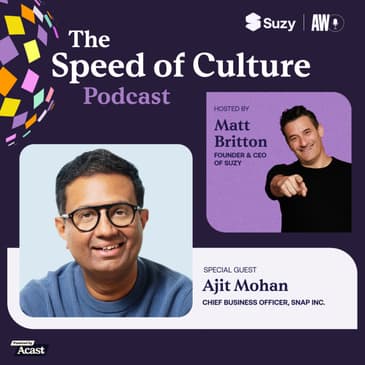
Ajit Mohan, Chief Business Officer at Snap, joins The Speed of Culture podcast to explore the fundamental shifts redefining the digital landscape. The discussion covers the transition from public feeds to private messaging and how augmented reality serves as a bridge to the physical world. Ajit shares insights into Snap's unique audience reach and the role of AI in creating neutral distribution platforms for brands. The episode concludes with a look at the future of wearables and the importance of adaptive leadership in a rapidly accelerating industry.
Follow Suzy on Twitter: @AskSuzyBiz
Follow Ajit Mohan on LinkedIn
Subscribe to The Speed of Culture on your favorite podcast platform.
And if you have a question or suggestions for the show, send us an email at suzy@suzy.com
Hosted on Acast. See acast.com/privacy for more information.
[00:00:00] The shift away from the feed to conversations and the shift away from performative to authenticity, along with all of the fabulous possibilities that AI is throwing into the mix. I think the decades happening in weeks, I think we are in the middle of a big shift and a big moment right now.
[00:00:30] As we dive deep into the shifting consumer trends within their industry, why it matters now and how you can keep up. Welcome to The Speed of Culture. We are live here in South Beach at the Possible Conference today. I'm thrilled to welcome Ajit Mohan, the Chief Business Officer at Snap. Ajit is a global business leader with deep experience across technology, media and streaming, from leading Meta's India business to serving as the CEO of Hotstar.
[00:00:56] Today at Snap, he's focused on scaling the platform into a must-buy for marketers. So great seeing you. Thanks so much for taking the time. Ajit Mohan, Thank you for having me here, man. Absolutely. I'm sure you must be quite busy here at The Possible Conference. So much action going on, so much innovation in our space. But I'd like to start off with just getting an understanding of the path that led you to Snap. Tell us a little bit about yourself and your career journey to date. Ajit Mohan, Sure. I spent almost a decade in management consulting. Okay. What was your biggest takeaway from that?
[00:01:24] Ajit Mohan, It's a good career not to be on the hook for ourselves every day. Ajit Mohan, Yeah. Ajit Mohan, I'm joking. I learned a lot from it. Ajit Mohan, But a lot of time was spent in Southeast Asia in the early days, you know, when mobile telephony companies were coming up. Ajit Mohan, Uh-huh. Ajit Mohan, And then I spent a bunch of time here in the US and in Europe, when media was in the beginning of a big shift from traditional broadcast media to digital streaming platforms.
[00:01:50] Ajit Mohan, And it's not a surprise, Matt. I think I'm now old enough where, when I look back at my career, one of the things that kind of that old quote about nothing happens in some industries for decades and decades happen in a few weeks. Ajit Mohan, Yeah. Ajit Mohan, I think for me, that's been the consistent thing that when you look at industries, people get into habits, leaders, you know, the wider set of teams and professionals, they get into entrenched habits that stick around for quite a long time.
[00:02:19] Ajit Mohan, Old Habits to Die Hard, right? Ajit Mohan, Then nothing happens and suddenly, you know. Ajit Mohan, Well, COVID is a great example of that. You look at something like online grocery shopping. Ajit Mohan, Yeah. Ajit Mohan, Like there are people that would say, I would never order groceries online. And then when you have no other choice, you do it. And then Instacart, it sticks. And now you're ordering groceries online. Ajit Mohan, Yeah. And it keeps recurring, right? I mean, I think you mentioned some of my background. After spending time in North America, I had the opportunity to go back to India.
[00:02:49] Ajit Mohan, Right. Ajit Mohan, And then you have the opportunity to build a streaming platform for what was then a very incumbent traditional media company. And the story repeats itself, right? When you're successful and you're being successful and being an incumbent, it's hard to kind of recognize the moment when things are shifting. Ajit Mohan, That's right.
[00:03:06] Ajit Mohan, And in this case, it was the big technology shift and Hotstar was really built on that. And I actually think now, clearly, I mean, it's so obvious to say this now, but I think with AI, and frankly, I think literally in the last four months, with the kind of advancements that we're seeing in AI, this is clearly a moment when companies like us, especially, everything is sort of being thrown into the air.
[00:03:31] Ajit Mohan, And we see that as a huge opportunity for us, especially because, you know, we're a platform of nearly a billion users. But when it comes to advertising, we have been way behind Meta and Google. Ajit Mohan, Right. Why do you think that is? Ajit Mohan, I think a lot of it is they are the new broadcast television, right? I mean, they've built great platforms and marketers are quite used to spending money on them.
[00:03:57] Ajit Mohan, Right.
[00:04:25] Ajit Mohan, And I think that is a big shift away from the feed or the scroll. I really think we are in the final stages of the age of performance that has defined social media for the last 15 years. Ajit Mohan, So what do you mean by that? Ajit Mohan, I think when you really look at the big backlash against social media, especially performative social media. Ajit Mohan, Performative meaning like, look at my Lamborghini. Ajit Mohan, Yes. Ajit Mohan, Gotcha. Ajit Mohan, And you know, everything around sort of, which really has been the last 15 years. Ajit Mohan, Yeah. Ajit Mohan, Yeah.
[00:04:56] Ajit Mohan, Yeah. Ajit Mohan, Yeah. Ajit Mohan, Yeah. Ajit Mohan, I think we are starting to move away from it. I think this is sort of the last stage of it where more of the energy is shifting to messaging. Ajit Mohan, Look, I mean, one of my ex-colleagues at Instagram, you know, said the scroll is dead, right? I think that's an exaggeration. I don't think it's dead yet. I think it's dying. Ajit Mohan, Right.
[00:05:17] Ajit Mohan, And I actually think people are starting to value, not just for all of the recognition of the impact on society, of what's been the larger impact of the focus on performative social media. But also, I think people are really starting to understand that the real conversations where you really engage with the people that you care about, your friends and family, is really your private messaging feed.
[00:05:42] Ajit Mohan, And I think that shift, the shift away from the feed to conversations, and the shift away from performative to authenticity, along with all of the fabulous possibilities that AI is throwing into the mix. I think the decades happening in weeks, I think we are in the middle of a big shift and a big moment right now. Ajit Mohan, It's interesting. One, I guess, build on that is what about discoverability? Because one thing the feed does do is allow people to discover new places to travel, new restaurants to eat at, new shoes to travel.
[00:06:12] Ajit Mohan, Where do you think consumers will get that in the world where the feed? Ajit Mohan, And I agree with you. I think the feed, as much as it kind of enabled doom scrolling, I also think it was a fabulous opportunity for a lot of products and categories and brands to introduce themselves to an audience in a way that was difficult for them in the previous media. Ajit Mohan, Creators.
[00:06:33] Ajit Mohan, And we all get creators too. I think when I specifically look at brands, I think what we are seeing with consumers embracing AI is people are engaging in conversations with AI platforms and agents. Ajit Mohan, And I think a lot of the discovery will happen through conversations. Ajit Mohan, Now, there's a part to it which I don't think has received a lot of scrutiny.
[00:06:58] Ajit Mohan, While I do think discovery on the feed has been a big part of the story of marketing over the last decade, the reality is we have always relied on our friends and family for recommendation. Ajit Mohan, And you know, of course, all of this is an argument that you would expect me to make given that I'm a part of Snapchat.
[00:07:18] Ajit Mohan, But I think what we see is that the conversation between friends and family is not just about what they're sharing and what are they doing and sharing the experiences, but it's also a conversation about which movie to go to, which shoe to buy. Ajit Mohan, So I think discovery has been happening on as a part of conversations forever. Ajit Mohan, I do think that is now going to get hyper fuel by AI, right? Ajit Mohan, Yeah.
[00:07:46] Ajit Mohan, I think if anything, you now have a layer where you're not just seeking recommendations from friends and family. Ajit Mohan, You can also have conversations with agents and platforms to kind of like discover more. Ajit Mohan, And I don't think we've all kind of stood back and really thought through what does it really mean for both demand and supply in a world where the answers that come back.
[00:08:11] Ajit Mohan, So it's going to be different for different people based on the context, right? Ajit Mohan, And I think that is adding complexity for sure, but I also adding a huge new vector of possibility when it comes to discoverability that finally you may well be able to surface in conversations products and categories and brands that may not have surfaced at all on the feed. Ajit Mohan, Right. Ajit Mohan, So I mean, it's changing.
[00:08:39] Ajit Mohan, A lot of the old ways will have to change and shift, but I think the canvas of what is possible in conversations, I think, is quite exciting. Ajit Mohan, And when we think about the feed, we're also thinking within the context of the iPhone. Ajit Mohan, And many believe that we are not going to be holding devices like this the way that we have for the last 15 years in the future. Ajit Mohan, I mean, I know that Snap, and I want to get into Snap's strategy in a second, but Snap has long been about wearables, right?
[00:09:06] Ajit Mohan, And glasses, and there's many other companies in your space that have as well. Ajit Mohan, What do you think the future is of a tool like the iPhone? Ajit Mohan, Do you think it's going to be replaced by glasses or wearables? Ajit Mohan, And when? Ajit Mohan, I think the iPhone has been such a huge innovation for the world. Ajit Mohan, Arguably the most successful product in history. Ajit Mohan, Yeah. And I think it obviously continues to be a big part of people's lives. Ajit Mohan, And I think there's been enough talked about this, right?
[00:09:30] Ajit Mohan, When you look back at the history of new products, one of the interesting things is that they continue even when big disruptive, innovative new products are built. Ajit Mohan, The old ones sort of have a decay curve that can sometimes last quite a while. Ajit Mohan, But I think to your question, Matt, Evan Spiegel, who is one of the co-founders of Snap and the CEO of the company, Ajit Mohan, You have this very clear view of the role of glasses wearables.
[00:10:00] Ajit Mohan, For a while. Ajit Mohan, For a while. Ajit Mohan, Yeah. Ajit Mohan, Right? Ajit Mohan, And as a company, we have been investing in building glasses that can work in the real world, where you and I wearing those glasses can engage with each other in the physical world. Ajit Mohan, And a lot of its clarity has come from, I think what you were hinting at, which is that we have all gotten so used to looking down at the phone, being disconnected from the real world around us.
[00:10:26] Ajit Mohan, There's clearly a live conversation now about potentially the negative impact of addiction. Ajit Mohan, If you look at pictures from 1994, and like I saw a video on social media the other day of like a bunch of kids who are graduating high school. Ajit Mohan, And you know, it was the last day of school and just the way they are interacting with each other without having phones. Ajit Mohan, Yeah. Ajit Mohan, Yeah. Ajit Mohan, Yeah. Ajit Mohan, Yeah. Ajit Mohan, Yeah. Ajit Mohan, Absolutely.
[00:10:54] Ajit Mohan, Walking up and down the beach here in Miami, I'm struck about 80% of the time, even folks who are walking, they're looking at the phone, right? Ajit Mohan, And obviously I think the good part is people have this huge appetite to remain connected and they're engaging with friends and family and they're checking out what's happening in the world.
[00:11:14] Ajit Mohan, I think the vision that we see is if you're able to leverage all of that power of the smartphone and package it into something that you wear on your face, Ajit Mohan, And you have the ability to connect with the physical wall and still be immersed in it. Ajit Mohan, And after investing for the last 12 years, we're going to launch the consumer version of Spectacles later this year. Ajit Mohan, Really? Ajit Mohan, Yeah. Ajit Mohan, And I think we are excited. Ajit Mohan, There's definitely a market for it.
[00:11:44] Ajit Mohan, We believe that. Ajit Mohan, And I think to your question, I mean, we do think about this as potentially the next canvas in computing, right? Ajit Mohan, That we can imagine that as much as the laptops and televisions and the wider screens play the role and the smartphone, that there would just be power. Ajit Mohan, If you're able to solve for some of the hard technology problems, both on the hardware and software front. Ajit Mohan, As a company, we made the choice a while ago that we're going to build a full stack, right?
[00:12:14] Ajit Mohan, Both build the hardware and the software around- Ajit Mohan, You're manufacturing yourself, you're not partnering with- Ajit Mohan, We are designing the hardware, right? Ajit Mohan, Of course, we'll have manufacturing partners. Ajit Mohan, You're not growing your technology and partnering with an eyeglass company, right? Ajit Mohan, You're building your own. Ajit Mohan, We're building our own. Ajit Mohan, And I think we're excited that that is definitely the next frontier in computing.
[00:12:33] Ajit Mohan, And the smartphone may still have a role to play, but a decade from now or even sooner than that, you can imagine that people will intuitively see the power of having a device that is easy to wear. Ajit Mohan, And it still allows you to connect to the physical world and yet augment it and unleash all the power of the digital in front of you.
[00:12:54] Ajit Mohan, And when we launch our first consumer version this year and start talking about what is the progressive build vision that we have, I do think people will start to see how compelling it is. Ajit Mohan, We'll be right back with the Speed of Culture after a few words from our sponsors. Ajit Mohan, So let's zoom out and talk about Snap because obviously when it first came out, it became famous for the ephemeral messaging where you could send text to somebody and it would disappear. Ajit Mohan, And then it was the first company to introduce, I believe, stories. Ajit Mohan, That's right.
[00:13:23] Ajit Mohan, Very early with the wearables and often it got imitated and duplicated by larger companies, has been well documented. Ajit Mohan, Quite often. Ajit Mohan, And over time it has ebbs and flows as a company in terms of its performance on Wall Street. Ajit Mohan, But it's still a major impact on consumer culture and it still has a huge audience and is a great platform for brands. Ajit Mohan, Just would love to hear from you. Ajit Mohan, What is the state of Snap today?
[00:13:47] Ajit Mohan, For people who are listening that haven't really thought about Snap as a business, from a business perspective, what is interesting about where it is and where it's going? Ajit Mohan, Yeah, I think, Matt, one, just to sort of lay out the facts, we're nearly a billion users around the planet. Ajit Mohan, Monthly active. Ajit Mohan, Monthly active and still growing fast. Ajit Mohan, So it is one of the large consequential consumer platforms in the world. Ajit Mohan, That's ever existed. Ajit Mohan, Yeah.
[00:14:13] Ajit Mohan, And I think one of the interesting things is, as you said, it started off with ephemeral messaging. Ajit Mohan, It started off with a very young audience. Ajit Mohan, And over the last decade we have seen that audience age up. Ajit Mohan, People stay with the platform. Ajit Mohan, I think depending on which country, half of the users could be more than the age of 25, one third above the age of 35. Ajit Mohan, And it still continues to be the place where people connect to their real friends and family. Ajit Mohan, Like it's the place for real relationships.
[00:14:42] Ajit Mohan, One of the interesting things from a marketing point of view, Matt, is when we look at Snapchat and look at the overlap with TikTok or YouTube or Pinterest, we find that there's a substantial community on Snapchat that is not on these platforms. Ajit Mohan, On a daily basis, I think 40% of Snapchat is on our own TikTok. Ajit Mohan, Wow.
[00:15:06] Ajit Mohan, The number is 50% of YouTubers on our daily basis and I think the number is close to 80% of people on Pinterest. Ajit Mohan, Right. Ajit Mohan, So it's a sizable community, right? Ajit Mohan, I mean, if you talk about the brass stacks of marketing, it's a community that you have to reach out to, right? Ajit Mohan, And who are unlike, I think there's still some sort of sticky memes around it's very young. Ajit Mohan, We would love to be super young forever, but that is not the case. Ajit Mohan, Every social platform is the same. Ajit Mohan, Yeah. Ajit Mohan, Yeah.
[00:15:36] Ajit Mohan, Yeah. Ajit Mohan, I think the second part is our strength, as you mentioned, is we continue to be extremely inventive. Ajit Mohan, Innovative, right? Ajit Mohan, Builders, AR, vertical videos, stories. Ajit Mohan, And I think that continues to be at the center of the company's DNA. Ajit Mohan, I think we are very good at imagining new products. Ajit Mohan, What is it that the culture enables you to do that? Ajit Mohan, I think, you know, multiple reasons.
[00:16:03] Ajit Mohan, I think it starts with the founders, maybe that we are in LA and not in the Valley. Ajit Mohan, But a lot of it is, I think there is extreme openness to experimentation. Ajit Mohan, I think we are very good with creating an answer and then looking at it a few days, a few weeks later and saying, Ajit Mohan, Let's kind of throw this out and let's find a new one. Ajit Mohan, Sometimes it can be difficult, right?
[00:16:24] Ajit Mohan, I think to be in an organization that is so persistently iterative, but it does create a, nurtures a great space for innovation. Ajit Mohan, I think what is equally true is, I don't think we focused enough on building a business around the things that make us unique. Ajit Mohan, I mean, I think when you look at our scale and yet sort of, you know, if you look at our revenue, there's a huge disconnect. Ajit Mohan, Yeah.
[00:16:54] Ajit Mohan, And one of the big reasons for that, Matt, is for the longest time, most people come to Snapchat to message. Ajit Mohan, 85% of the people kind of are obviously snapping, right? Ajit Mohan, And yet till last year, we didn't allow ads in messaging. Ajit Mohan, Right. Ajit Mohan, So there was a disconnect between the engagement energy of the platform and the marketing possibility for advertisers.
[00:17:21] Ajit Mohan, And we didn't do it for all the right reasons, right? Ajit Mohan, Sure. Ajit Mohan, The private messaging space is a sacred one, right? Ajit Mohan, For all the things that make us special, that you're able to be authentic, you're able to be in the moment. Ajit Mohan, It also kind of was like, okay, what does it really mean to open that up to ads, right? Ajit Mohan, Yeah. Ajit Mohan, But when we finally did it last year with sponsored snaps, putting ads in messaging, I think what we found out was that our community loves it, right? Ajit Mohan, I think they've embraced it so long. Ajit Mohan, What's a sponsored snap?
[00:17:51] Ajit Mohan, It's an ad on our messaging feed. Ajit Mohan, Okay. Ajit Mohan, And today I'm going on stage later to announce the next rendition of it, and we'll talk about it in a second. Ajit Mohan, But I think that's been the big shift. Ajit Mohan, We launched it last year about this time. Ajit Mohan, And then really the second half of last year was really scaling sponsored snaps. Ajit Mohan, And as more and more marketers are discovering it, I think we're finding that this is a game changer for us.
[00:18:16] Ajit Mohan, And I think to where this conversation started, it so happens we are at the right moment when the industry is transitioning away from the feed to private messaging. Ajit Mohan, I mean, I think that we're getting lucky that the big shift that's happening in the world, especially with AI, and both consumers and brands rediscovering the power of messaging because at least today almost all of your engagement with AI as a user is through conversations. Ajit Mohan, Right.
[00:18:46] Ajit Mohan, I think we're finding that we are in the middle of a great moment. Ajit Mohan, And for me, that is the opportunity now that we have this scale. Ajit Mohan, We have a community that is quite unique. Ajit Mohan, We continue to be inventive on new formats. Ajit Mohan, But finally, I think we're kind of realizing that there's the power for us to introduce marketers to the power of ads and messaging in a way that's already native to our platform. Ajit Mohan, Right. So I'm really excited to hear about the evolution of this product.
[00:19:14] Ajit Mohan, Yeah. And I think today we're kind of, we're announcing AI sponsored snaps, which is sponsored snap essentially is a brand can send you a message and you know, you can open it. It's a full screen ad and that's it. Ajit Mohan, Right. Ajit Mohan, With AI sponsored snaps, we're effectively introducing a two way conversation for brands with agents that they own.
[00:19:36] Ajit Mohan, That's awesome. So if Delta Airlines has a sponsored snap, you can ask it about its flight routes or maybe there's a discount or maybe there could be a celebrity voice coming in. There's so many. That's really smart. Ajit Mohan, That's right. And the good part is- Ajit Mohan, That's the best idea I've heard this conference. Ajit Mohan, I'm glad to hear that. Ajit Mohan, Thank you. Ajit Mohan, Yeah. Ajit Mohan, I think the power of that is one, it's happening in a space where a nearly a billion people are already used to the idea of conversation. Ajit Mohan, Right.
[00:20:04] Ajit Mohan, And very often they are talking about brands. Ajit Mohan, And we've seen through the adoption of ChatGPT and Claude and these tools that- Ajit Mohan, That's right. Ajit Mohan, Because there's no learning curve for conversations. You just talk, right? Ajit Mohan, That's right. Ajit Mohan, Yeah. Ajit Mohan, So that's one. But I think the other part of it is good or bad, we are not spending tens of billions of dollars building our own LLM models. Ajit Mohan, So we are a neutral party. We're not directing people to our own agent or our own AI platform.
[00:20:33] Ajit Mohan, We are telling marketers, you bring whichever agent you want to work with. Ajit Mohan, Powered by whatever LLM that's behind it. Ajit Mohan, Yeah. Ajit Mohan, I think I'm sure you're seeing this Matt as well, right?
[00:20:43] Ajit Mohan, I think the great thing about this moment is there is so much excitement about AI. Companies are really leaning into the idea of building useful agents, right? And this is going to evolve pretty quickly. And different companies will make different choices. So we are saying, come with what you have. Right? And then, of course, the third part of it is the conversation will, of course, go in different directions based on what the user is prompting. So you have the option of- Ajit Mohan, And you can capture data from it, et cetera.
[00:21:13] Ajit Mohan, And that's what the advertiser to decide, right? How they want to shape it. But it could have advertiser-led prompts, but the answers that come back will be on the basis of the specific conversation with the Snapchatter. Ajit Mohan, Are you going to help companies develop these agents as part of your advertising platform or they bring them? Ajit Mohan, They bring their agents. Ajit Mohan, They bring their agents. Ajit Mohan, And you're giving them the specs? Ajit Mohan, Yeah.
[00:21:34] Ajit Mohan, We're making it very easy for them to essentially bring that agent, put it inside Snapchat. I don't think, you know, people are- there is so much energy at the moment in terms of building agents and so many companies out there. Ajit Mohan, What that means though? Agents are thrown around in so many different ways. Ajit Mohan, I think it'll evolve pretty quickly. Ajit Mohan, Yeah. Ajit Mohan, But my point there was, there's enough companies who didn't even exist two weeks ago who have enough funding to kind of help other companies build agents, right? Ajit Mohan, A hundred percent.
[00:22:02] Ajit Mohan, Or leverage the current platforms and run different models. Ajit Mohan, So that's not where our power is. Ajit Mohan, I think our power is bring that into a conversation with Snapchat us. Ajit Mohan, Absolutely. Ajit Mohan, By the way, I mean, it's great you mentioned that word. Ajit Mohan, I think that's where we are discovering that there is a massive plethora of new AI platforms and agents. Ajit Mohan, They're all looking for distribution. Ajit Mohan, Of course. Ajit Mohan, Right? And we happen to be one of the few neutral-
[00:22:32] Ajit Mohan, You know, bodies without- Ajit Mohan, You're right. The cost of entry to create technology is lower than ever before. Ajit Mohan, Yeah. Ajit Mohan, We're not trying to direct people to any particular model or a platform or an agent ecosystem. Ajit Mohan, And I think there is power in that combination of scale, the neutrality, and then building really on all of the learnings that we have had with sponsored snaps in the last year. Ajit Mohan, Again, I feel like we have landed in a good moment.
[00:22:59] Ajit Mohan, It so happened that we introduced this a year ago and we really have a lot of good learnings, which I think some of the other LLM platforms will take a bit of time to discover what does it mean to put an ad that leads to a conversation with an agent in a way that is native and relevant to the snap to someone in the context of private messaging.
[00:23:21] Ajit Mohan, I don't think that's an easy one. And I think because we have had a lot of learnings, I feel excited about the launch of AI sponsored snaps and how we can really help companies as they think through how to build automation and how to build agents into everything from discovery to driving conversions, right? Driving real sales. This is a pretty powerful canvas.
[00:23:43] Ajit Mohan, Yeah. You know what's interesting is that companies have their official profile page on snap or on Twitter or, you know, anywhere and they don't have official agents yet. Ajit Mohan, I see. Ajit Mohan, And I'm surprised companies don't have, here's the verified consumer agent for Delta Airlines or Hershey's and then they can put in all the data that they want consumers to see. Ajit Mohan, They can bring the brand persona out and then you could interact with the official agent of that company. Ajit Mohan, I'm surprised it doesn't exist yet and I predict it will happen sooner rather than later.
[00:24:13] Ajit Mohan, Yeah. I think at the moment, I think if you think about it, if you go to many companies' websites, most companies are experimenting with having some agent present there. Ajit Mohan, Right. Ajit Mohan, But I think the reality is we don't need more places to go and find AI. Ajit Mohan, Right. Ajit Mohan, We need AI to come to where you are and that's the power of AI sponsor snaps is there are a billion people who are already engaging in conversations.
[00:24:40] Ajit Mohan, And if you can make it easier for them to engage with agents, that's the power, right? Ajit Mohan, And again, it's the power of distribution, but really I think it's really the power of making marketing come alive at a time when- Ajit Mohan, It's contextual. Ajit Mohan, And it's just shifting from the feed to conversations. Ajit Mohan, So you have this really exciting new product, which to me feels like the right product at the right time. Ajit Mohan, You're the chief business officer of Snap. Ajit Mohan, How are you spending your time and how do you plan on spending your time after you announce this on stage today to basically evangelize this?
[00:25:10] Ajit Mohan, I think it's a lot of conversations with marketers, right? Ajit Mohan, I think the reality is, again, I think Matt, to where we started this conversation, this is a time of big change. Ajit Mohan, It is. Ajit Mohan, But it's also true that it's a time when there are a lot of sticky habits that have formed over the last 15 years and marketers and brands, large and small companies, maybe less so in the case of small companies.
[00:25:36] Ajit Mohan, I think they're more innovative and they're always looking to optimize that last dollar, but especially large companies. Ajit Mohan, I think so much of the marketing system has been built around the scroll. Ajit Mohan, Yeah. Ajit Mohan, Has been built around the feed. Ajit Mohan, There are some pretty entrenched habits. Ajit Mohan, So I do think the task that I have and the task that my colleagues have is to help marketers understand that they need to now start thinking about solving for the next 10 or 15 years.
[00:26:04] Ajit Mohan, And a lot of that energy is around conversations and they need to start thinking that a lot of what they have built around the feed may change pretty quickly, especially when it comes to consumer habits and consumer attention. Ajit Mohan, So I think we have an exciting product, but I do think we have a lot of hard work to do to nudge CMOs and the marketing community to get over the inertia of moving beyond many of the systems and habits they've built over the last decade.
[00:26:30] Ajit Mohan, So shifting gears, we wrap up here. One common theme throughout this conversation has been change and innovation and embracing change. Ajit Mohan, And as I mentioned, Snap has been known for such a long time, diving in first and coming up with and executing on these incredible new concepts. Ajit Mohan, What does that mean in terms of who you're looking for? Ajit Mohan, So for some of our younger listeners in the pod who are starting off in their career and want to end up in a cool role at Snap like you in the C-suite, right? Ajit Mohan, Where are the areas you think they should focus given the state of the world today here in 2026? Ajit Mohan, That's a great question.
[00:27:00] Ajit Mohan, I think one, Matt, I mean, you and I both seeing this, right? I think, and I have two young boys, 12 and seven, and a lot of what I think about is like, where's this headed? Ajit Mohan, Yeah. Ajit Mohan, One of the things that's pretty clear is, if I look at the next 25 years, or even the next 10 years, versus the last 25, right, my career over the last 25, I think folks are in for a rapid acceleration in the number of things that are going to be in the next 25 years.
[00:27:30] Ajit Mohan, Yeah. Ajit Mohan, Unprecedented. Ajit Mohan, And it's pretty massive. Ajit Mohan, And you know, if you look at history at every moment, everyone feels like they are going through a time that is unprecedented.
[00:27:41] Ajit Mohan, I think some pretty big things are shifting, right? I think if you look at AI, obviously, if you look at what's happening in the world. So I do think what I look for, or the younger folks amongst your listeners is, you need to be ready to reinvent yourselves almost every week, right? I think maybe it was every couple of years. Maybe it was every few months.
[00:28:06] Ajit Mohan, I think you need to be ready to say that the answer about which you had massive conviction two weeks ago, that needs to change. And I don't think there's going to be a career out there that is not going to require people to be extremely adaptive. Ajit Mohan, Right. Ajit Mohan, To be extremely willing to change and shift answers to experiment and iterate. And that's not easy. That's not easy.
[00:28:33] Ajit Mohan, Especially for people who spent maybe decades refining a craft. You know, you spent two decades learning how to code and being an expert coder, and now you have a tool that can code faster than you. What do you do? Ajit Mohan, Yeah. Ajit Mohan, Do you say this is bad and stomp your feet? Or do you try to use a tool? Or do you try to do something completely different? A lot of people are faced with that question, right?
[00:28:51] Ajit Mohan, Absolutely. So I think that's essential. I think the second thing, and this may be, you know, sort of the companies that I've worked with, but I think there's always going to be particular value for people who are willing to walk up a mountain versus people who are looking to drive down an easy expressway, right? Ajit Mohan, That's one thing that will stay the same.
[00:29:15] Ajit Mohan, Yeah. And I don't think that's changing, right? I think any leader, when they're looking to build something new, when they're looking to grow, they're looking for people who are happy with friction or comfortable with friction and are willing to put in the effort, are gritty. And I think we're about to enter a world where there's going to be even more of a premium on it.
[00:29:34] Ajit Mohan, And the last thing I would say is, despite all of this change and being willing to kind of adapt, I think there's still going to be a premium on kindness. I think it's going to be a big differentiator, right? I think especially at a time of big change, I think people are going to gravitate towards leaders who are kind and leaders are going to gravitate towards people who are willing to grit it out, are willing to adapt to change.
[00:30:05] Ajit Mohan, Yeah. I'm glad you said that. So to wrap it up, we always ask our guests if there's a saying or mantra that helps encapsulate their professional journey. So what comes to mind for you?
[00:30:13] Ajit Mohan, I think I try this idea of build for legacy, but stay rooted, right? I think you have to aspire to building things that will have massive impact over a long time period. But you also can't be a victim to the hubris, right? I think when you chase legacy, and when you're trying to do big things, sometimes you can be caught up in sort of too much grandiosity, right? And for me, I think it's equally important to stay rooted.
[00:30:41] And the combination, I think, is what I try and live up to. Ajit Mohan, That's fantastic. Well, thanks again for taking time out of your busy schedule. Best of luck with this launch. I'll be cheering from afar and can't wait for our listeners to hear this great discussion we had today. Ajit Mohan, Thank you, man. I enjoyed the conversation. Ajit Mohan, Absolutely. On behalf of Suzy and Adwit team, thanks again to Ajit Mohan, the Chief Business Officer at Snap for joining us today. Be sure to subscribe, rate, and review the Speed of Culture podcast wherever you get your podcasts. We're here live in South Beach at the Possible Conference. We'll see you soon. Bye-bye.
[00:31:14] Adweek Podcast Network and A-Guest Creator Network. You can listen and subscribe to all Adweek's podcasts by visiting adweek.com slash podcasts. To find out more about Suzy, head to suzy.com. And make sure to search for the Speed of Culture in Apple Podcasts, Spotify, or anywhere else podcasts are found. Click follow so you don't miss out on any future episodes. On behalf of the team here at Suzy, thanks for listening.