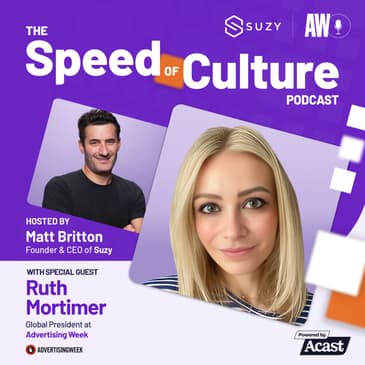
In this episode of The Speed of Culture Podcast, Matt Britton chats with Ruth Mortimer, Global President of Advertising Week. From blending entertainment and education to embracing creativity in a tech-driven world, Ruth delves into the evolving advertising landscape, the role of inclusivity, and the importance of staying curious in shaping a dynamic future.
Follow Suzy on Twitter: @AskSuzyBiz
Follow Ruth Mortimer on LinkedIn
Subscribe to The Speed of Culture on your favorite podcast platform.
And if you have a question or suggestions for the show, send us an email at suzy@suzy.com
Hosted on Acast. See acast.com/privacy for more information.
[00:00:01] As you enter a world where more and more is automated, slightly more generic, I think the actual human creativity also has a level of kind of quality, a level of connection with other people that will become more desirable.
[00:00:18] To thrive in a rapidly evolving landscape, brands must move at an ever increasing pace. I'm Matt Britton, founder and CEO of Suzy. Join me and key industry leaders as we dive deep into the shifting consumer trends within their industry.
[00:00:30] Why it matters now and how you can keep up. Welcome to the Speed of Culture.
[00:00:40] We are live from Advertising Week in New York, and we're really excited on this episode of the Speed of Culture Podcast to be joined by Ruth Mortimer, who's a global president of Advertising Week.
[00:00:49] Ruth, so great to see you.
[00:00:50] Great to see you too.
[00:00:51] Absolutely. I'm so excited to be here at Advertising Week. And I've been in the advertising industry for so long, and I don't recall ever coming to this venue where everything is.
[00:01:00] I've been to a lot of Advertising Week satellite events, but this is the heart of where it all happens.
[00:01:04] Why don't you describe for our listeners, if you will, what is going on today in New York at this awesome venue?
[00:01:10] Okay, so we're Advertising Week New York. You can tell from my accent I'm a native New Yorker.
[00:01:15] I mean, don't hold it against me that I'm British.
[00:01:18] We have effectively four stories of what's called the Penn District.
[00:01:23] It's an area just off 33rd being redeveloped, and this used to be a mall, which is kind of apt for us because this is the world of commerce in which we live as well.
[00:01:33] We at Advertising Week love to do events, places that are not traditional conference spaces, bit quirky, on brand, where we can build it ourselves and bring it to life.
[00:01:43] Yeah, it almost resembles like a shopping mall.
[00:01:44] Yeah, I mean, it was a shopping mall in its previous life, but just like great vintage clothing, we've given it a new life.
[00:01:51] Yeah.
[00:01:51] And now it's Advertising Week New York.
[00:01:53] So we've got upstairs, we've got the leadership zone, which is stages, activations, everything you need to know really in the leadership space.
[00:02:02] In the middle, we have the entertainment zone, which has everything, media, culture, all those good things, content.
[00:02:10] And then right down at the bottom, we have the zone, which is all about the trends.
[00:02:17] So technology, innovation, commerce, all the new stuff.
[00:02:20] And right in the middle, we have a big networking space where you can all meet.
[00:02:25] Very cool.
[00:02:26] So advertising as an industry bleeds into so many different categories.
[00:02:30] It bleeds into media, bleeds into technology, entertainment, et cetera.
[00:02:34] And it seems like every week there's a new conference or event popping up in this industry.
[00:02:38] But Advertising Week has had tremendous staying power.
[00:02:41] Why do you think that is?
[00:02:42] And what has Advertising Week done over time to remain relevant?
[00:02:46] Well, do you know what?
[00:02:47] Advertising Week is 20 years old this year.
[00:02:50] Wow.
[00:02:50] Yeah.
[00:02:51] And I think one of the things we always think about is when we're thinking to ourselves, what are we trying to do?
[00:02:57] We're always trying to look at what's next.
[00:02:59] Because when you're looking at what's next, you can really never go out of fashion.
[00:03:03] For sure.
[00:03:04] Because you're not looking at everything today.
[00:03:06] You're looking to the future.
[00:03:07] And what we're always trying to do, I guess what we think our special blend is,
[00:03:11] where we bring together entertainment and education.
[00:03:15] Because ultimately, you've got to leave this building feeling like I'm better at my job.
[00:03:19] Yeah.
[00:03:19] And inspired with a couple ideas to take back to the office.
[00:03:22] And in a way, that's kind of the foundation of it is you have something that you can take back and go,
[00:03:27] I'm better at my job today than I was yesterday.
[00:03:29] But nobody wants to be bored when they're working.
[00:03:33] And I think that's one of the things.
[00:03:34] Sometimes I feel like events, they can be very corporate.
[00:03:37] And we try really hard to bring that culture, that entertainment.
[00:03:41] People you wouldn't expect to see at a business conference talking about the topics that matter to you.
[00:03:47] Is there anybody here at Advertising Week this year that you've been particularly excited to see or hopefully to see?
[00:03:52] Oh, do you know what?
[00:03:53] I think there's such a huge range.
[00:03:55] So one thing I was really interested in was there was a session yesterday with Law Roach.
[00:04:00] He's one of Hollywood's top stylists.
[00:04:02] He was the stylist for Zendaya.
[00:04:04] But really, he thinks of himself as kind of growing people's brands, individual brands.
[00:04:09] And it's a different way of thinking about brands than you have as a classic marketer.
[00:04:14] But it's still just as applicable.
[00:04:16] And I think hearing from people like him who have a different lens on the same thing you do every day is what's really valuable.
[00:04:23] Yeah.
[00:04:23] So advertising, obviously, is a tremendous opportunity.
[00:04:25] And also, like any industry, is not without its challenges.
[00:04:28] AI, I know, is probably the two letters that are said probably the most at a conference like this here in 2024.
[00:04:36] What are some of the things that you think people in the advertising industry need to be paying particular attention to in terms of remaining relevant themselves in their career or having their company remain relevant with this looming shadow or light, depending on how you look at it, of AI heading into 2025?
[00:04:52] I think it's about having a clear mind and working out where AI is appropriate to help you.
[00:04:58] Because one of the things I think we've seen a lot of this year is people talking about the real implementation of AI.
[00:05:04] So less the kind of robot, big picture stuff maybe that we were seeing a year ago.
[00:05:10] It's much more about what I kind of think of as small AI.
[00:05:14] And really, it's not really AI.
[00:05:17] It's really automation.
[00:05:18] And effectively, it's just tiny tweaks that help you do your job better.
[00:05:23] How can you automate one particular thing?
[00:05:25] I remember about a decade ago, there was a company I met who was doing the automation of email subject lines.
[00:05:32] And they said, actually, if you can improve an email subject line, you improve the deliverability by 90%.
[00:05:39] And if you think to yourself how much that would improve most businesses, most emails that you ever received, that's probably a bigger kind of sea change in business than a million of the kind of bigger AI concepts we talk about.
[00:05:54] Yeah, it's interesting because if you look at just the evolution of advertising, if you go back to the Mad Men era, back then, the idea was the creative idea because you just needed a checkbook to be able to advertise in the very few select mass mediums that existed.
[00:06:08] And then over time, the medium became the idea with the advent of digital media and social media where using these platforms within themselves was an idea.
[00:06:17] And now it seems many ways we are reverting back to it's all about creativity.
[00:06:23] That's the differentiation, right?
[00:06:25] Like there's only so much so far science can take you.
[00:06:27] But at the bottom of every great activation needs to be somebody sitting in a room with a big idea that is truly different.
[00:06:33] And creativity, I would argue, is what makes us innately human in ways that machines can't.
[00:06:38] What does creativity mean right now in the advertising industry?
[00:06:42] And I guess, is there anybody from your perspective is doing it particularly well?
[00:06:46] Well, do you know what?
[00:06:46] One of the interesting things, I think, is that tech has democratized a lot of the industry.
[00:06:52] It sure has.
[00:06:52] I think lots of the people I see making amazing content, you would call them creators.
[00:06:59] And really, they're just people telling a story in the same way anyone has told a story.
[00:07:03] They just happen not to work for an ad agency.
[00:07:06] And there was a really interesting debate I saw online the other day about why there are no kind of great creative names in the same way there maybe were before,
[00:07:15] where you had people at agencies who are legend status.
[00:07:19] And someone said, is it that?
[00:07:21] Or is it just that we've got a more diverse group of people?
[00:07:24] So it's not so important.
[00:07:26] You don't need the agents.
[00:07:27] Like the Alex Bogusky of the 2000s.
[00:07:30] Yes, exactly.
[00:07:31] The Bogusky, the Porter, you know, these great people.
[00:07:34] And I love Chuck Porter.
[00:07:35] But actually, is it just that we've let in a greater diversity of creative minds these days?
[00:07:41] And it can come from anywhere, right?
[00:07:42] Creative ideas can come from anywhere.
[00:07:44] Exactly.
[00:07:45] And I think that's challenging.
[00:07:46] But it's more challenging for the agency business model than I think it's challenging for creativity itself.
[00:07:52] Yeah, I'm glad you brought that up.
[00:07:53] You brought up a bunch of, I think, interesting topics about the advertising industry, one of which is the agency business model.
[00:07:59] Because traditionally, big Madison Avenue agencies have billed by the hour.
[00:08:03] But what you were just saying earlier is also the case that they're all looking for efficiency.
[00:08:07] In some ways, the more efficient they get, the less billable hours they have.
[00:08:11] So how do you see the agency model evolving over time?
[00:08:14] And are there any unique sort of go-to-market strategies with agencies that you think maybe represent the future?
[00:08:20] Look, I think it's a tough time to be an agency.
[00:08:23] Clients are asking constantly for more, you know, more and do it with less, please.
[00:08:29] But you know what?
[00:08:29] I think we were talking about AI and I sort of think to myself, as you enter a world where more and more is automated, slightly more generic,
[00:08:37] I think the actual human creativity also has a level of kind of quality, a level of connection with other people that will become more desirable.
[00:08:48] Yeah.
[00:08:48] So I don't know.
[00:08:50] Maybe I'm slightly pessimistic.
[00:08:52] I think maybe the agency landscape will continue to consolidate and shrink.
[00:08:57] Which we've seen in recent years.
[00:08:58] Yeah.
[00:08:58] But I don't think creativity will.
[00:09:00] I think it will just come in different ways.
[00:09:03] Yeah.
[00:09:03] So I think for agencies, I think it's hard.
[00:09:06] The models you have maybe don't work for the future.
[00:09:09] I think you've seen it already, actually, in the world of media.
[00:09:12] I used to be a journalist.
[00:09:13] And one of the things I noticed was you just had so many people writing effectively the same story from very slightly different angles.
[00:09:21] And maybe you just don't need all that media.
[00:09:25] But does it mean that people don't still care about storytelling and story?
[00:09:30] Exactly.
[00:09:30] Absolutely not.
[00:09:31] It just means it's changing.
[00:09:33] I mean, I think what we're referring to is the barriers to entry sort of went away.
[00:09:36] So the barriers to entry to be a creator goes away where somebody like Mr. Beast can be a creator on YouTube.
[00:09:41] It's not just Alec Bogoski who works at a fancy ad agency.
[00:09:45] Right.
[00:09:45] And the barriers to entry for journalism went away because anyone can jump on Twitter or Medium or wherever and be a journalist.
[00:09:52] 100 percent.
[00:09:52] I think the thing that is important to keep is the craft.
[00:09:56] So the thing I think about journalism that's important to keep is when I was a magazine editor, if I published something wrong, I knew there was the threat that I would go to jail.
[00:10:04] It was so important to me.
[00:10:06] It was essential to be accurate.
[00:10:07] The truth mattered.
[00:10:08] The truth really mattered and it mattered personally for me.
[00:10:11] And I think in a world where there's so much information on the line, misinformation, hallucinations by AI, I think that becomes more essential than ever.
[00:10:21] And in the same way, I think great creativity often results from a process and trying again and time and effort.
[00:10:29] So this is not saying that the craft doesn't matter.
[00:10:32] It absolutely does.
[00:10:33] Yeah.
[00:10:34] Another big innovation we've seen in the last couple of years is that of retail media and walking in here to Advertising Week.
[00:10:40] I saw a huge banner for Target and Roundroll, which is their retail media platform.
[00:10:45] And of course, Walmart has really pushed it.
[00:10:46] So you have these big box retailers that are pushing merchants, the Pepsis and Cokes and P&Gs to advertise at the point of purchase.
[00:10:55] And they are now competing with traditional media, whether it be a TV network or a digital network, et cetera.
[00:11:00] What is your take on the future of media with this big push with retail media?
[00:11:05] Because obviously they have a ton of leverage in terms of the bottom line of a lot of these manufacturers.
[00:11:11] Yeah, I think commerce media and I call it commerce media because it's not just the retailer.
[00:11:15] You know, United Airlines is here with us today.
[00:11:18] Chase has it.
[00:11:18] PayPal.
[00:11:19] Exactly.
[00:11:20] Effectively, what's happened is if you're someone who has a large audience digitally, you think to yourself, I can take out.
[00:11:27] And first party data, which is.
[00:11:28] Exactly.
[00:11:29] So I think you have these whole new advertising kind of cohorts opened up.
[00:11:34] But the thing I think is going to be interesting, different is media has context.
[00:11:38] So I think there's a really interesting point that where it's right for audiences, where you need to understand their behavior and that behavior can be explained by a purchase decision.
[00:11:49] I think that will be a very successful business.
[00:11:52] But where you need context, which is maybe more attitudinal or more nuanced or more about kind of engaging people on a different level.
[00:12:02] I think that is where media will hold its own.
[00:12:05] Yeah.
[00:12:06] Right.
[00:12:06] Because people aren't necessarily passionate about buying deodorant at a big box retailer like they are about their favorite show on Bravo or something like that.
[00:12:14] Exactly.
[00:12:15] When I'm buying deodorant, you can think this woman is obsessed by not smelling.
[00:12:19] And that is a true behavioral insight.
[00:12:21] And if all you want to do is reach me on that criteria, that's very, very functionally.
[00:12:26] Very functional.
[00:12:27] But if you want to understand who I am or what I care about, you probably won't find it there.
[00:12:32] We'll be right back with the speed of culture after a few words from our sponsors.
[00:12:36] So shifting gears a little bit.
[00:12:37] One of the great things I've learned about advertising week this year is a spotlight on mental health.
[00:12:42] And particularly with real high profile discussions around leadership and women in business.
[00:12:46] I know that Shelley Zalas and Female Quotient here, which is a great organization that Susie is partnered with.
[00:12:52] Why is this important to advertising week?
[00:12:55] And how is the overall equality gender based in the advertising industry evolved over time?
[00:13:01] I think equality is important to us because effectively we see our role as we're partly reflecting the industry.
[00:13:08] But you've also got to make the industry you want.
[00:13:11] We want to be the people making the industry we want.
[00:13:14] And we know great ideas, great work come from a whole bunch of different people.
[00:13:19] In fact, our strapline for advertising week is great minds think unalike.
[00:13:23] And so we try to live there well.
[00:13:25] So we run something.
[00:13:27] I run something called the Future is Female Awards, which awards women every year.
[00:13:31] We have the female quotient here.
[00:13:33] These things are important because everyone needs to feel included.
[00:13:36] And in fact, when we started the Future is Female Awards about six years ago, I thought the women still need the acknowledgement.
[00:13:44] And last night when we had the ceremony, I spoke to two people's parents on the phone.
[00:13:49] Four people cried because it meant so much.
[00:13:52] And you go, yeah, it's sweet.
[00:13:54] But mostly you go, this still matters.
[00:13:56] Yeah.
[00:13:56] And we want to do the stuff that matters.
[00:13:58] Yeah, absolutely.
[00:14:00] And obviously, in order for you to matter, you also have to have a reach that expands past the U.S.
[00:14:05] And Advertising Week has now expanded beyond the U.S. into Europe, Asia, Latin America, et cetera.
[00:14:10] When do you go to Advertising Week events in different places around the world?
[00:14:14] What are the nuances that you personally notice about how industries are different in different areas of the world?
[00:14:20] Well, I think every place has its own.
[00:14:23] I think we have a kind of a central brand that runs through them all.
[00:14:26] But then we bring a lot of local flavor.
[00:14:28] So I'd say Mexico.
[00:14:30] Mexico is a market driven a lot by TV and e-commerce.
[00:14:34] So if you went to Mexico, you might think, oh, this is a different selection of businesses.
[00:14:39] We also work with a lot of consumer businesses there.
[00:14:42] And you might think this is a very different kind of industry we feel here.
[00:14:46] I think in Europe, the European and APAC audiences are quite similar.
[00:14:51] I sometimes feel in the U.S., people are a lot more supportive, whereas those audiences are more critical.
[00:14:57] So here we might have someone doing something and they say, we've launched this great new platform.
[00:15:01] And our U.S. audience might go, good on you.
[00:15:04] That's a great thing.
[00:15:06] In the U.K., they'll go, was that salesy?
[00:15:09] I think it was salesy.
[00:15:10] I hate you.
[00:15:11] So I think you have a different.
[00:15:13] Maybe they're just being honest in the U.K.
[00:15:14] Yeah.
[00:15:15] I think you just have a different flavor to how your culture translates onto stage.
[00:15:20] But in every market, it's always about entertainment, education.
[00:15:24] Yeah.
[00:15:25] So let's talk about you a little bit.
[00:15:26] So for those who haven't been in Advertising Week, it looks like it's just a tremendous production.
[00:15:31] Tell us about what goes into the planning of an event like this.
[00:15:34] And what does your day, the pie chart of your day look like year round within this organization?
[00:15:39] I think the best thing for me about Advertising Week is there is no typical day.
[00:15:43] Yeah.
[00:15:44] And I think one of the things I really enjoy is both a kind of backroom job where you're putting together the event on a business scale.
[00:15:51] And for me, I get to present a lot and be on stage.
[00:15:55] And I think there's very few gigs that actually kind of really have both those elements.
[00:16:00] But things will look like we'll be having calls with partners, planning the production, audience curation.
[00:16:06] But my favorite part is the creative ideas.
[00:16:09] So for me, the real goal is when I see an idea that was in my head a few months ago and someone's paid you and bought it to life.
[00:16:19] And you go, wow, I get to see ideas that were once just in my head be real living things.
[00:16:25] It's amazing to see that come to life.
[00:16:26] And not a lot of people have that privilege.
[00:16:29] They don't really understand how their work connects to any type of impact.
[00:16:32] And here you are at an event where you see thousands of people coming up and down the escalators, learning, getting inspired.
[00:16:38] And it's all because of the work that you actually put in.
[00:16:40] A hundred percent.
[00:16:41] And I think also the warmth, you know, sometimes I feel like advertising week is like getting married on a continuous basis.
[00:16:47] I had trouble getting here to the podcast studio because people are hugging you.
[00:16:52] And you feel like getting that kind of connection with people in a business environment feels really special.
[00:16:57] I think sometimes particularly on a business to business front, people feel that can be dry.
[00:17:02] Yeah.
[00:17:02] And my experience is anything but.
[00:17:04] It's all relationships and it's people who care.
[00:17:07] Yeah.
[00:17:07] It's so interesting because I see that in the real world where people sometimes feel like when they write an email at work, they have to be like the work version of Ruth.
[00:17:15] And then when they're at home, they're the home friend version of Ruth.
[00:17:18] But we should all be one person.
[00:17:20] We don't need to be somebody different just because we're in a work environment.
[00:17:22] In fact, I found throughout my career, it's the contrary.
[00:17:25] The more you can let your true self shine, the more authentic relationships you get, which only help you get to wherever you want to go in business.
[00:17:31] This is true.
[00:17:32] Although I have polled actually my own friends and family.
[00:17:35] They say I should not bring my true self.
[00:17:36] Oh, they don't want that.
[00:17:38] They say, look, the only reason you have a job is that you don't bring your true self to work.
[00:17:43] So I think there's that.
[00:17:44] OK, I'd love to see what would happen.
[00:17:46] Self-awareness is key.
[00:17:46] Yeah, exactly.
[00:17:47] I guess everybody needs some filters, right?
[00:17:50] So finally here, Ruth, if you look back on your career and you're in such a cool position today where people are stopping you and hugging you on the way to this interview,
[00:17:58] what were some of the decisions you think you made right along the way throughout the various points of your career that put you in a position that you are today?
[00:18:04] I think I've never been very intentional in my career.
[00:18:08] I've never had a job I wanted or anything like that.
[00:18:12] I think I've gone with what has challenged me.
[00:18:14] I'm such a curious, nosy person.
[00:18:18] I just love to know everything.
[00:18:20] And so I've always thought to myself, what interests me?
[00:18:23] And I think if you go with what is your one true kind of guiding star, mine is nosiness.
[00:18:29] Curiosity is the better word, but I think nosiness is more true.
[00:18:32] I just want to find out everything.
[00:18:34] Very cool.
[00:18:34] Every person, every idea, everything.
[00:18:38] And so I think where I've made decisions, I started life as an archaeologist.
[00:18:42] I went into journalism.
[00:18:44] And now here I am in kind of media and events.
[00:18:47] It's not a linear path, but that's what I love.
[00:18:50] An archaeologist.
[00:18:51] What was the most interesting thing that you've ever discovered as an archaeologist?
[00:18:54] Oh, well, the great thing about archaeology is you believe everything is a ritual burial.
[00:18:59] It's kind of a joke in archaeology because you uncover something and you go, oh, this is definitely a ritual burial.
[00:19:06] And then a little bit later you go, guys, I think it's a bin.
[00:19:10] This could be garbage.
[00:19:12] Well, it's about storytelling, right?
[00:19:13] Which is at the heart of advertising.
[00:19:15] Exactly.
[00:19:15] Right.
[00:19:15] And by the way, I didn't ask you, but what is your favorite brand of all time?
[00:19:19] I think my favorite brands in general are the ones that have great enduring stories that always link back to their original intention.
[00:19:28] And I've done a lot of work over my time with the lovely Mark Ritson, who you may know.
[00:19:33] And he does some great presentations, which were all about how when brands lose their brand health, it's because they went away from what really made them great.
[00:19:42] They forget who they are.
[00:19:43] Exactly.
[00:19:44] So today I'm wearing something, and this is very true to me.
[00:19:46] I'm wearing a vintage kind of Chanel top from 2008 that I stalked on the Internet for about three years because I was like, this actually speaks to something really creative about this brand that I love.
[00:20:00] And it didn't need to be new.
[00:20:02] I just wanted to find it because it was kind of a work of art.
[00:20:04] And so that's a brand where I love where it brings you back to that original intention of this was meant to be a work of art you felt proud to wear.
[00:20:13] Yeah.
[00:20:13] And they'll never veer away from who they are.
[00:20:15] You never see them running discounts or promotions or things that kind of are anti Chanel, so to speak.
[00:20:21] They stay true to their legacy and their story.
[00:20:23] A hundred percent.
[00:20:23] And it doesn't have to be a really expensive brand you love.
[00:20:26] You mentioned deodorant earlier.
[00:20:28] Actually, sure.
[00:20:29] Rexona.
[00:20:30] It's one of my favorites.
[00:20:31] I think it does exactly what it says.
[00:20:34] Right.
[00:20:34] And you know what?
[00:20:35] I'll always remember it.
[00:20:37] So, you know, you can have that low high thing all the time with the brands.
[00:20:41] Yeah.
[00:20:42] The rational side and the emotional side is how we make decisions and that comes out in brands.
[00:20:46] So is there a mantra or saying that comes to mind when you talk about guiding your professional career?
[00:20:50] We always wrap up our podcast with that question.
[00:20:53] I think I'd say be curious, have fun, work with good people, and then you cannot go wrong.
[00:21:00] Yeah.
[00:21:00] Be curious, have fun, work with good people.
[00:21:02] That sounds like a great roadmap to make.
[00:21:03] Thank you so much, Ruth, for taking your time during Advertising Week.
[00:21:06] It's such an amazing event.
[00:21:07] I know you're really busy and super appreciative for you to take the time to join the pod.
[00:21:11] Well, look, thank you so much for hunting me down, getting me in a podcast studio, and I had a great time.
[00:21:17] Likewise.
[00:21:17] On behalf of Susan Ayweteen, thanks again to the great Ruth Mortimer, the global president of Advertising Week, for joining us here today live at Advertising Week in New York City.
[00:21:25] Be sure to subscribe, rate, move you to Speed of Culture Podcast on your favorite podcast platform.
[00:21:29] Until next time, see you soon, everyone.
[00:21:30] Take care.
[00:21:35] The Speed of Culture is brought to you by Suzy as part of the Adweek Podcast Network and A-Guest Creator Network.
[00:21:41] You can listen and subscribe to all Adweek's podcasts by visiting adweek.com slash podcasts.
[00:21:47] To find out more about Suzy, head to suzy.com.
[00:21:50] And make sure to search for the Speed of Culture in Apple Podcasts, Spotify, or anywhere else podcasts are found.
[00:21:56] Click follow so you don't miss out on any future episodes.
[00:21:59] On behalf of the team here at Suzy, thanks for listening.