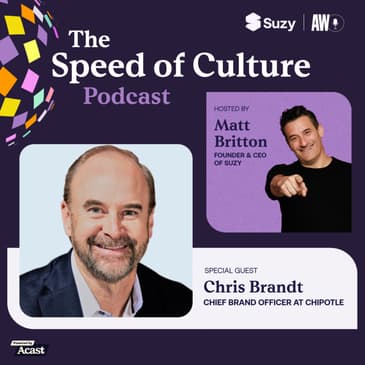
In this episode of The Speed of Culture, Matt Britton speaks with Chris Brandt, Chief Brand Officer at Chipotle, about leading with purpose, staying ahead in digital innovation, and building brand love through authenticity, storytelling, and culture.
Follow Suzy on Twitter: @AskSuzyBiz
Follow Chris Brandt on LinkedIn
Subscribe to The Speed of Culture on your favorite podcast platform.
And if you have a question or suggestions for the show, send us an email at suzy@suzy.com
Hosted on Acast. See acast.com/privacy for more information.
[00:00:00] The other big piece we've embraced is what I call big niches. So we got into gaming and we took it slow when we did it the right way. We've been on Roblox, we're in all of the social channels. We were one of the first brands on TikTok. And so we really have an innovative mindset here, an experimental mindset that let's try some of these new places, let's try some of the new technology, let's see what people embrace. And that's really worked well for us.
[00:00:26] To thrive in a rapidly evolving landscape, brands must move at an ever increasing pace. I'm Matt Britton, founder and CEO of Suzy. Join me and key industry leaders as we dive deep into the shifting consumer trends within their industry, why it matters now, and how you can keep up. Welcome to the Speed of Culture.
[00:00:48] Up today, we're thrilled to welcome Chris Brandt, the chief brand officer of Chipotle Mexican Grill, a company dedicated to providing fresh, responsibly sourced food. Chris has been a driving force behind Chipotle's innovative products, and we're going to be able to help you to help you. Innovative digital strategies, sustainability initiatives, and global expansion efforts. Chris, so great to see you today. Thanks for having me. Happy to be here. You know, people that are customers of Chipotle don't just like Chipotle, they love it. It's one of those brands that has a fanatical following, more so than most other companies in your category. Why do you think that's the case?
[00:01:18] So I think Chipotle is a magical blend of food that tastes great and that you feel good about eating. And think about how rare that is in your life. Most things that taste good, you don't feel that good about eating. Most things you feel good about eating don't taste that good. So at Chipotle, there's no compromises here. And that's because we're a little bit different than everybody else in our category because every one of our restaurants, and we call them restaurants, not stores, is a real restaurant.
[00:01:44] And there's real cooking going on there. And so I think the combination of those things really creates a great emotional connection with consumers that can transcend our brand a little bit more than maybe others can do. Yeah, and it's interesting. I mean, your role as chief brand officer and the word brand, some debate is taking on less meaning in this era. Some debate is taking on more than ever. What does it mean to manage a brand like Chipotle? And what are the areas that you focus on in stewarding it forward?
[00:02:10] So I think it starts with our brand purpose. We're lucky at Chipotle to have a founder-inspired brand purpose of cultivating a better world. Not every brand has that luxury. Sometimes you might have to make one up that fits with the values that you want to espouse. But we're lucky that we have that. And that acts as a lot of us as a North Star for us in good times and bad times. And so we went through COVID. We said, look, we have to do things that make sense for us, even if they're maybe a little bit counter to what everybody else is doing.
[00:02:38] I'll give you a great example. When we first started, when I started back in 2018, one of the first meetings we had, somebody came in from our supply chain group and came in and said, hey, only about 30% of the cilantro that Chipotle uses is organic. And we were like, well, why is it only 30%? And they said, well, there isn't enough cilantro in the world for us to go to 100%.
[00:02:59] So we can't really make any claims about 30%. So if we just went to non-organic cilantro, regular cilantro, we could save X number of dollars. And I think it was a great test for our leadership team because at the time Chipotle wasn't in the best shape. We were kind of hanging over some safety troubles that were back in 2015 and 2016.
[00:03:19] But we said, well, why don't you give us a plan to see how we get to 100% organic cilantro rather than try to save a few dollars because we can compromise our ingredients. And so even today, you've seen more companies backing away from antibiotic-free chicken and those kind of things. We are not. We are doubling down on what we believe to be true and what we believe is the right thing to do. So I think that's how we manage this brand and we make sure.
[00:03:47] And even if you extend to, we did a Super Bowl spot in 2019 and there's always a lot of anxiety as people watching this know around the Super Bowl spot and what it does for the company. And we made a Super Bowl spot for the company that we felt like our employees would really like. And as long as our employees really liked it, then it should be just fine for the consumer as well. And so we made an ad called, Can a Burrito Change the World? The answer is maybe not just one burrito, but the way we make it might.
[00:04:15] And so I think that it was really good for everybody. The consumers loved it. It scored really well. It ticked all the boxes, but we were really doing things that felt right for this brand and our employees. And turns out that was right for everybody. So when you make decisions on ingredients, obviously one of the things you have to think about is the cost implications. Because obviously your customer doesn't have unlimited price elasticity. You are in a category that you have to obviously play in.
[00:04:44] So how do you make those decisions based cost versus quality, convenience, all those things to make sure that you're delivering what the customer wants, holding up the brand ideals, but it's still smart business? Yeah, I think so. We don't look at those things in isolation. We look about how it all adds together. And one fun fact about Chipotle, we spend about half a billion dollars more in ingredients every year to make sure they're responsibly raised than just buying conventional ingredients.
[00:05:11] We offset that by having a fantastic operating model that can really move people through the operation really quickly. Many have tried to emulate what Chipotle does, but Chipotle is just really good at it. The other thing about Chipotle is we are culinary first. So that is our number one priority. We only have 53 ingredients in our restaurant, so we don't have any freezers. We don't have any microwaves. We don't have any can opener. So everything is fresh.
[00:05:36] But we think that investment in the food is key to our success and that there is a direct connection between how food is raised and prepared and how it tastes. And so we don't compromise on that. And the other part, I would say, is we have an outstanding supply chain team. And one of the challenges is we've grown so fast. We've doubled in size of revenues in about the last five years or so is getting enough supply of the responsibly raised ingredients that we have in order to keep us going.
[00:06:03] And so the cool thing is we've really formed a lot of alliances with partners and we're smaller companies at the start. And now they become bigger and bigger because they do things in what we think is the right way. And it's interesting when you talk about the throughput in the store and how that helps you on the margin side and then it affords you the ability to invest in better ingredients. It is all connected.
[00:06:22] Obviously, post-COVID, we've seen such an enhanced focus on the digital experience in your category, whether it's ordering ahead or whether it's knowing when your food is ready at checkout, etc. How much start are you putting into that on an ongoing basis? And obviously, with all the evolutions with AI and digital, is that an area you think is going to continue to evolve over time? The kind of digital space is a really interesting one from an order ahead standpoint, from a delivery standpoint.
[00:06:49] Because when we got here in 2018, I say we, there was a number of people in the management team that kind of started in 27 or 2018 to turn the brand around. And one of the things was when we first got here, we didn't have mobile pickup shelves. We had a good app. No one knew about it. We didn't have things like mobile pickup shelves and the like. We didn't have any Chipotle lanes. That was a creation that we did where it's like a drive-thru, but you can only order digitally. So the stress of a drive-thru is the order box. That's what slows everything down.
[00:07:18] That's what makes things difficult. So we just skipped that part and went right ahead to kind of a digital drive-thru, if you will, that's really worked out. But we put the mobile pickup shelves in. It's one of the first decisions we made. We put all those in. And we were kind of, as we got to the end of 2019, we had about 18 or 19% of our business already was digital. Now, at the time, digital was sort of being subsidized by the rest of the business. It was a lot cheaper. And then COVID hit. And then we went to, at some point, 70, 80% of our business was digital.
[00:07:48] And so we were kind of ready. Had COVID hit us a little bit sooner, we wouldn't have been as ready. It might have been a different story. But now we have an operation in our restaurants where we're about 35, 45% digital, and the rest is in restaurants. So we're really balancing those different places. I think digital isn't growing as fast. We were kind of an early in there. So it's not growing as fast as YouTube because the price is pretty high and because it's more costly to make that thing happen. So I think there's still a lot of room for it.
[00:08:16] There's still a lot of room for AI across a number of different marketing verticals. But our digital business is really important to us, both with partners like DoorDash and Uber Eats and our own white label business. And so, yeah, we'll continue to grow that and the in-restaurant piece to keep the ball rolling. Yeah, I mean, in terms of AI, I think one area, it certainly opens up for a company like yours that has so much first-party data on your customers is personalization. Right? Like, you know your customers, you know what they like to order, the frequency, et cetera.
[00:08:44] Is that a part of your strategy moving forward in terms of just continuing to enhance the customer experience? It is. And so we do some of that. I think there's a lot of AI versus machine learning. There's a lot of different jargon that's thrown around. But I think one thing, so there's certainly the personalization piece I think that can help. But it also, the AI also is helping us in the back of the house and do things.
[00:09:07] So we have cameras in our restaurants and we can look and see how are we staffed in these restaurants and are we fully staffed? What's going on in this restaurant? And we can use AI to sift through all this versus we have 3,700 restaurants now. Watching cameras in the back of the house is pretty boring work. But AI, you could put queries and things in and it'll sort out what's happening.
[00:09:30] So there's a lot of behind the scenes, I think, that can make our operations a little bit more efficient and tell us what's going on in the restaurant at the individual level. So I think there's a lot of breakthroughs there. We have a team here focused on robotics. So we have an autocado that'll, we're trying to take, and we call them co-botics because they kind of work alongside the employee.
[00:09:50] But we're trying to take some of the tasks that are a little bit more mundane, like coring a bunch of avocados every day or chopping vegetables and sort of get an automation in that that makes it just a little bit easier for our team member. Yeah, I mean, so much of the discussion around AI is on the more sexy, so to speak. This brand used to add to produce a TV spot or some cool video.
[00:10:10] And it is in the less sexy, more mundane things where you can really extract great insights, great data that can help your business act more efficiently, like seeing the flow inside the store or how your locations are appropriately staffed. That makes a lot of sense. And it's something I actually hadn't thought a lot about until you just brought it up to me in terms of all the applications there. Yeah. And I think we're just scratching the surface as every day it seems like we find a new thing that we could analyze to figure out, hey, what's going on in that restaurant?
[00:10:40] How do we make it more efficient and effective? It's underestimated how difficult it is for a headquarters to understand what's going on in every restaurant. You can't visit every restaurant, but we can kind of do it if we get all that data. But sorting through that data is a challenge, and AI can certainly help. So in terms of getting the brand story out to your customer and potential customers, you had just mentioned you had done the Super Bowl spot in the past.
[00:11:04] And that's obviously one way to capture big brand awareness in a big spot where the ability to capture mass scale is definitely fleeting in such a fragmented media landscape we have right now. What have been more recently some effective levers you've pulled to continue to tell the brand story over time? Yeah, I think, you know, going back to 2018, one of the things that was happening with the brand before is they were just doing a lot of discounting, but it wasn't driving more people into the restaurant.
[00:11:29] So we have a great story from Chipotle about responsibly raised ingredients, unprocessed ingredients. And when you come to Chipotle, one of the first things you do as an employee is go through store training so you can understand what's actually going on in a restaurant every day. And I remember my second week, I went to store training. So a lot of Chipotle is opening up at 6, 630 in the morning to really start bringing in all this fresh produce, start dicing and chopping just to get ready for lunch.
[00:11:54] And when I walked in there to that back of the house at Chipotle, it looked more like a farmer's market in there than any place I'd ever been. Because we're bringing in whole avocados. We're bringing in whole heads of lettuce. We're bringing in whole onions. And the team then goes to work. We don't have any freezers, so we're bringing in fresh chicken every day and they start grilling it. And so I think that I felt like, wow, look at what these people are doing. There's this real cooking going on here. And look at this back of the house.
[00:12:20] If we just show this to people, what we do every single day, they will love it. So basically when I first got here, we cut a whole bunch of our price promotions out and we started putting this story on TV. And we call them these ads are behind the foil. You'll see them across a wide spectrum of different places where our employees are telling you about what's special to them about Chipotle.
[00:12:42] And so every couple years, we kind of do a new round, but we're looking for employees to tell us, what do you wish everyone knew at Chipotle, but they don't? And so we've done a good job within a director called Errol Morris of really getting these real stories out. They're very authentic. They're very believable. And so it's been a huge advantage for us. And so we've really put those spots all across everything. The other big piece we've embraced is what I call big niches.
[00:13:11] So we got into gaming and we took it slow and we did it the right way. We've been on Roblox. We're in all of the social channels. We were one of the first brands on TikTok. And so we really have an innovative mindset here, an experimental mindset that let's try some of these new places. Let's try some of the new technology. Let's see what people embrace. And that's really worked well for us. And so I think we found some niches even in sports. Like certainly we advertise across NFL, NBA, all those.
[00:13:39] But we have a sponsorship with the National Hockey League. That is a big niche of people. And the hockey fans are super passionate. They were already using Chipotle anyway. And so it's a little bit less crowded than some of the big places with the NFL. And so we're able to make more of a splash. We're able to do things more authentically and organically. And so those things have really worked. But as we've gotten bigger, our media budgets have grown.
[00:14:05] And so now we have a little bit more weight to have a great TV plan, but also be across all social and digital. Also be in gaming. Basically, we want to be where our customers are. And so that's how we approach that. And how are you looking at creators and leveraging them? Obviously, to help tell your story, especially in the social channels. Yeah, great question. It's what you alluded to at the beginning. We have so many passionate fans. Well, I'll tell you that we did one promo early on where we just asked people in social to show us their fandom.
[00:14:34] Now, look, I love Chipotle. I bet I eat at Chipotle three times a week. I was embarrassed how little of a fan I was relative to these other people. You got to up your game, Chris. I know. And they're super talented. The super talents they have in art and everything was incredible for us. And so we really use influencers to unleash that passion. We try to find people who they've already talked about Chipotle. We already know their Chipotle fans. It's authentic.
[00:14:59] Yeah, because I have zero interest in trying to hire somebody to just be a spokesperson for our brand. We have so many athletes and so many influencers who are already. We have a platform we call Real Food for Real Athletes. Our goal is to be the training table for athletes of all ages and skill levels in America because there are so many athletes that demand Chipotle and their writers when they go on the road or on the PGA Tour. I mean, there's multiple, multiple players who are eating Chipotle three and four times a week when they're on the road.
[00:15:29] So how do we harness some of that testimony? Because they're certainly doing it authentically. And that's a key to our brand is that authenticity and just being real. It's what our food stands for. It's what our brand stands for. And so we take that very seriously. We'll be right back with The Speed of Culture after a few words from our sponsors.
[00:15:47] We're going to see you next time.
[00:16:23] So let's just zoom out a little bit in terms of you and your journey. And just kind of looking at your LinkedIn, you've been at a lot of great companies that are in the food and beverage space. Ever from General Mills, Coca-Cola, Taco Bell, Bloom Brands, and now, of course, your role at Chipotle. What has, I guess, stayed the same in terms of your role and ultimately the industry over the 20-plus year career you've had? And what's changed? What makes running a brand and building a brand different today than ever before?
[00:16:53] Yeah, I think it's harder. In the old days, you could put a spot on TV and you could have a lot of reach and it would work. But now the fragmentation of media is such a challenge. I think the other challenge is how to allocate your money. Cross-media measurement and cross-platform measurement is one of the hardest things that a CMO has to do. I kind of view my job a little bit more as an orchestra conductor because I have so many different pieces to the business that I'm trying to all make sure that they ladder up to the same thing.
[00:17:23] So I think that's what's really changed. I was fortunate to be in a lot of different environments. So General Mills, when I first got there out of business school, that really taught me about brand management and brand identity and brand reputation and those things. But I got a real marketing education at Taco Bell because we made so many different TV commercials. We had so many things going on. We had so much innovation that the combination of both of those, I think, has really helped me in my role at Chipotle. Yeah.
[00:17:51] I mean, Taco Bell, obviously, like Chipotle, is a brand that's in the zeitgeist and obviously has a lot of fans that are obsessive about it. And both of your brands have kind of colored outside the line, so to speak, in terms of how to build a brand in the space. And Taco Bell was a great example of a brand that didn't necessarily have a founder-inspired brand purpose. And so we had to create one. And that's where Liv Moss came from is we just wanted people to get, at the time, a little bit more out of life. But it really fit sort of the persona that Taco Bell had and what we wanted to have.
[00:18:21] But obviously, with Chipotle, we have a little bit more of a luxury of a little higher order brand purpose, which has been fantastic. Yeah. So sitting from your seat, as you look to build your team and bring on the next generation of great marketers who will hopefully have the same kind of prolific rise as you have in this industry, what do you think are the most important skill sets that younger people need to harness at the earlier stages of their career to set themselves up for success? I think, one, they need to have a lot of different experiences across a lot of different things.
[00:18:49] But at its core, I ask my team to be three things. I want you to be an innovator. We need people with a lot of ideas. When I'm interviewing people, I'm always going, what was your idea about this? What's your idea about this? Because ideas separate you from everybody else. They differentiate you and they enable you to win. The second one is I want you to be a storyteller. That's what a brand should be at the end of the day. A storyteller, think about your friends. Storyteller is always welcome.
[00:19:14] So when you can tell great stories and grounded in your brand that connect back to your brand, that's how you win. So I want you to be an innovator. I want you to be a storyteller. And then I want you to be a collaborator because one of us is smart, but all of us are a lot smarter. And I've interviewed every single person that works on our marketing team here. And it's because I'm really interviewing them, not necessarily for their skill set or their expertise in particular. I'm interviewing them for chemistry because I have what I call the conference room test. Do they pass the conference room test?
[00:19:43] And the conference room test is if we had to go in a conference room on a Friday night, are you going to be happy to see that person or are you going to be sad? And we're not hiring any of the people that we're going to be sad to see. I don't care what their expertise is because we need that team to be more than the product of the individual. And boy, one bad apple can ruin the whole bunch. And so if we can avoid hiring the bad apples, then we'll be in really good shape.
[00:20:08] And I think that all creates this culture, this culture of innovation, this culture of storytelling, this culture of trying different things. And boy, when everybody's pulling together, you can really make magic happen. Yeah. And I think on the storytelling front, I mean, data is everywhere. And it's not going to be the thing that pushes a decision or somebody who's wavering across the finish line. It's your ability to kind of take that data and put it in the context of a story that someone can understand.
[00:20:34] And ever since we were kids, right, we loved our parents to read us storybooks as we looked at pictures. And that really never changes. That's what kind of brings people imaginations, taps on their emotional side and gets them to make decisions. People want an emotional ride. That's why you read books. That's why you watch movies. And so if you can give them that and you can connect that something to them. And I think that certainly with the rise of all of the digital things, and I was a finance person before I got into marketing, before I went back to business school. And I think that that's really helped me from an analytics perspective.
[00:21:04] And so we are ruthless here about trying to measure everything. Some things are a lot easier to measure than others. Just because we can measure it doesn't mean that's what we should do. And just because we can't, it doesn't mean we shouldn't. So that's the art and the science that I think every CMO is tasked with trying to figure out. And we just do the best we can. Yeah. So obviously in order for you to be effective at such a fast-moving dynamic brand like Chipotle, you have to continually be learning and enriching yourself. Where do you go for inspiration?
[00:21:34] Where do you go to keep your finger on the pulse of the consumer so you can continue to drive the brand forward? A lot of it is social, to be quite honest. I mean, so it's an awful place in so many areas, but it really is a lot of the pulse of the consumer. And we really want to be relevant with these younger consumers. And we want to stay relevant with them. And so we have to know what they're doing and what they're saying. But I think you need to be a student of culture. And we're constantly looking. I think when we're at our best is when we find the intersection of Chipotle and culture.
[00:22:04] When we do things like napkin holders for your car. Or one of my favorite executions we did was for a freshman in college at a number of schools, we gave people a box. And it had our forks in it. It had our napkins in it. And it had a Tabasco. It's a full bottle of Tabasco sauce. And he said, we know you're going to borrow these from us anyway. So why don't we just go ahead and give them right out of the way? And so it's such a good insight. And it's got a little wink and a sense of humor. And so it really shows that you understand that consumer.
[00:22:32] I think the other thing is we've got to hire people who are in the culture and know it. We have some people on our social team that are super cool, super creative. And part of my job is to get obstacles out of their way and let them go. And some things make me, oh, is that really going to be fun? But sometimes you just got to trust them, right? But the number one thing that I tell my team is I'm willing to try a lot of different things and be across a lot of different platforms. But don't be lame.
[00:22:59] When we show up there, we can't show up like we don't know what we're doing. Or we can't show up like we don't understand this platform. And I'll use TikTok as a great example. Like back in 2019, we saw a bunch of people on TikTok. Most brands weren't there yet. But then I think that was the end of 2018. In 2019, we're like, man, we should do one of these challenges or something. But we didn't know what to do. So we didn't do much because we didn't have the right idea. And then one guy in our restaurant, he had a bowl and he had ability to take the bowl
[00:23:28] and we put it down, it lit up and put it right back on the bowl. And somebody sent it to us. He was just a young guy in a restaurant. We put it on Instagram. We got a million views like that fast, which was a lot back in the day. And we said, this is it. So we used an influencer. We created a challenge on TikTok. And man, it really took off. And so it really showed, hey, we're a brand on here, but we understand the content. We understand the community.
[00:23:53] And that's so important in things like gaming is to be contributing back to that community, not just being a brand there, putting up your placard and trying to be an appetizer. It's really, how do you understand this community and how do you tailor your communications to that specific group? You have to weave your brand to the fabric of the community, so to speak, for things to drop power shooting in. I think you need to start smaller. I mean, you don't want to make a giant splash right away. We did this in gaming.
[00:24:20] I was so worried about making a big mistake because we knew a number of gamers were eating at Chipotle. But how did we get into that fabric? And so we started small. We started with a group of guys that they were some of the top influences on Fortnite. They ate at Chipotle three times a week. A friend of mine I worked with called me and said, hey, we got this team. These guys eat at Chipotle three days a week. Are you interested? And we're like, yeah. And so we talked to them. They made a film to announce that they were coming out.
[00:24:46] And I remember I thought this film would be 30 seconds a minute. They came up with 12 minutes long. And I'm like, whew. I mean, I don't know that 12 minutes is going to work. I said, maybe you should cut it down. They're like, OK, we'll cut it down. And they came back and it was 10 and a half minutes, Matt. And I'm like, no, I don't think you knew what I was cutting down. They're like, trust us. Trust us. This is what our guys want. So sure enough, that video had completion rates of like 80, 90 percent. And it was 10 and a half minutes long. And so they were right. So we trusted them.
[00:25:15] But I think it was important for us to get in there authentically and then not just parade a prominent gamer around some kind of convention, but really start of understanding how this community works and how we can contribute to that community in a meaningful way and not just be an advertiser. Yeah, I think part of that is getting commitment to a strategy. In this case, you're committed to the strategy of being involved in the gaming community. And when you're committed to a strategy, you can take a measured approach where you're dipping your toe in the water.
[00:25:44] I think what I've seen and I read an ad agency for 15 years is so often a brand will come with a brief and like we have to dominate the gaming space when they've never even been in there before. And there's no way to do that authentically because your brand doesn't really have a right to play there yet. 100 percent correct. I couldn't agree with you more. Yeah. So wrapping up here, and this has been such a great discussion, Chris, and I always know the podcast episodes are great when I look at the clock. I'm like, wow, where did time go? So it flew by so fast. I'm really appreciative of you sharing so many insights today.
[00:26:12] We often ask our podcast guests when we wrap up episodes if there's a saying or a mantra that comes to mind that has driven their professional journey. I was wondering what might come to mind for you. So I think I talked about don't be lame, and I want to be the really good and really show that we understand the consumer of the platform at wherever we are. I think the other one is I would say is just say yes. I think when you're first starting out, if somebody asks for a volunteer, you should be the volunteer. I think that so many people have gotten their breaks.
[00:26:41] They're not going to give you more responsibility until you show you're good at some of the mundane things. And so be really good at the fundamentals, and you'll get more chances. And so don't be afraid to volunteer. Just say yes if people ask you to do things. Because if you want to be an innovator, which you really need to be, because that innovation drives business, you need to be able to connect the dots to a lot of different things. You need to try a lot of different things.
[00:27:11] When somebody asks for an opportunity. So that's what I tell my kids. They probably don't listen very much, but maybe some other people will listen maybe a little more closely. Awesome. Well, you've heard it from Chris directly. Everyone just say yes. I'm so happy Chris said yes to this podcast, because I know you're all going to love it. So Chris, thank you so much for taking the time. That has been fantastic. Thanks for having me, and I've enjoyed it. Absolutely. On behalf of Susie and I would team, thanks again to Chris Brandt, the Chief Brand Officer of Chipotle, for joining us today. Be sure to subscribe, rate, and view the Speed of Culture podcast on your favorite podcast platform. Until next time, see you soon, everyone. Take care.
[00:27:45] The Speed of Culture is brought to you by Susie as part of the Adweek Podcast Network and Agast Creator Network. You can listen and subscribe to all Adweek's podcasts by visiting adweek.com slash podcasts. To find out more about Susie, head to susie.com. And make sure to search for the Speed of Culture in Apple Podcasts, Spotify, or anywhere else podcasts are found. Click follow so you don't miss out on any future episodes. On behalf of the team here at Susie, thanks for listening.